
Mushrooms
White hedgehog mushroom
The white hedgehog mushroom, catalogued as Hydnum albidum, is a wild tooth fungus of tree roots and woodland. Its name and identity are unsettled, and its food status depends on which source is read.
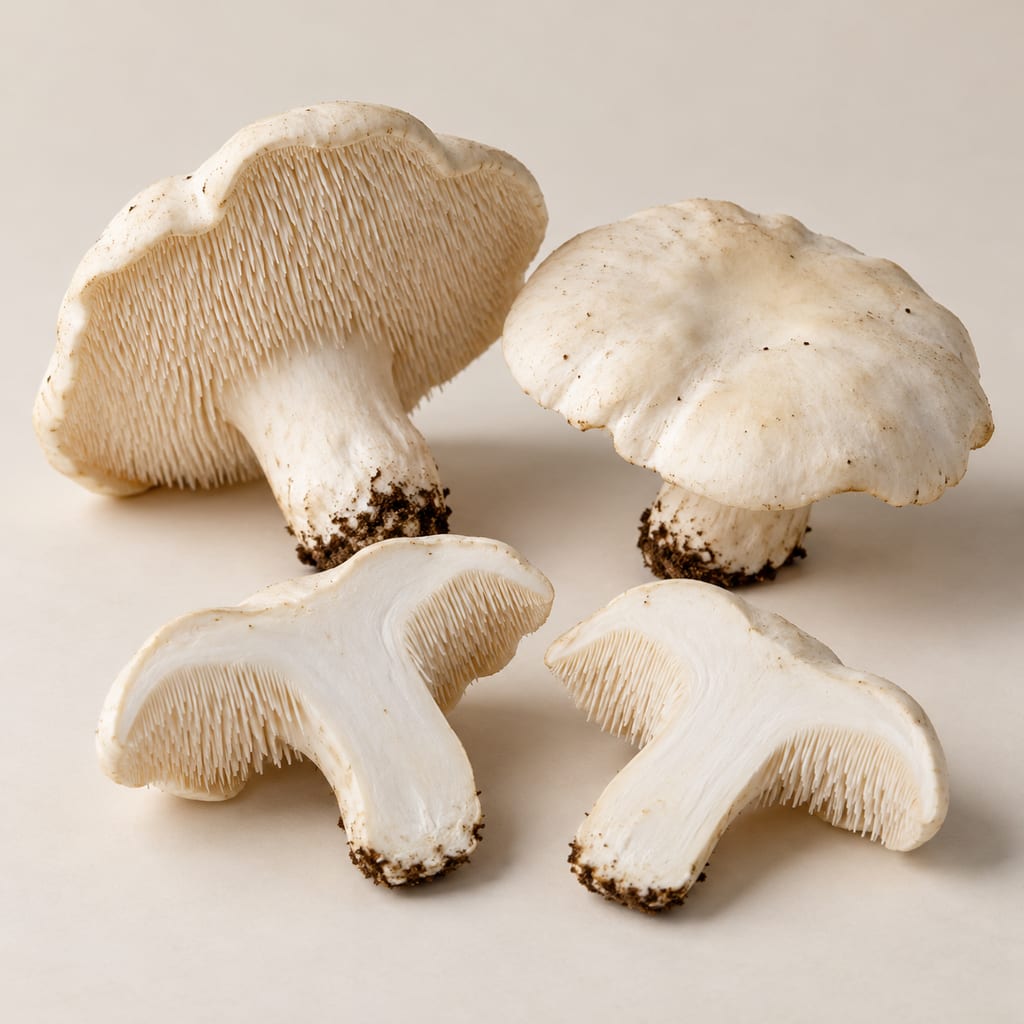
What it is
Hydnum albidum is a hydnoid fungus, meaning that its fertile surface is a layer of soft spines on the underside of the cap instead of gills. It belongs to the family Hydnaceae, the same family as the common edible hedgehog mushroom, Hydnum repandum. The fruiting body is white to pale grey and usually smaller than H. repandum, and it bruises yellow to orange when handled.
The name is not settled. A 2016 study notes that reports attributed to H. albidum from temperate and Mediterranean Europe have almost always been made under the name Hydnum reginae, so a European record under the name H. albidum may refer to a different species. The catalogue retains the name as supplied and does not reconcile it with a current accepted name.
Sources for this section
Food status in the sources
The catalogue records the species as a firm tooth fungus used cooked in Southern Europe, supplied as wild material. Wikipedia describes Hydnum albidum as an edible species.
Not every source agrees. The Fungi Kingdom page for the species says that this Hydnum has a bitter taste and is not usually collected for eating, yet the same page also calls it a choice edible. That contradiction is recorded here rather than resolved. The sources read do not describe a specific preparation used for this species in Southern Europe.
Sources for this section
Relation to the common hedgehog
Hydnum repandum, the wood hedgehog, is the common edible hedgehog mushroom and the name that Linnaeus published in 1753, which remains the accepted name. Its spines are cream to pale peach, densely set and running down the stem, and mature specimens can taste bitter, a bitterness that cooking reduces. Several hedgehog species are often confused in the field, so the wider genus is a useful reference point for anyone reading about H. albidum.
Because the species boundaries in Hydnum have changed, a regional record should be read with its place and its identification method. A cooking record for one name does not establish how a different species under a similar name behaves.
Sources for this section
Identification and safety
A wild hedgehog fungus should be identified from the whole specimen against a regional taxonomic key or by a mycologist before anyone eats it. This page does not establish that Hydnum albidum is safe to eat, and it gives no preparation that makes an unidentified mushroom safe. Look-alike spine fungi and changes in the genus are the main reasons for caution, as the sources themselves note.
Sources for this section
Open questions
The accepted identity of the name in Europe, the regions where it is eaten and the method of cooking are not settled by the sources read. A taxonomic revision and a regional ethnomycology survey that names the species directly would resolve most of the uncertainty on this page.
Sources for this section
Places
Southern Europe
Documented use · Region evidenceThe catalogue records cooked use in Southern Europe. The sources read for this page associate the name mainly with North America, and European records under it are mostly filed as Hydnum reginae.
Community
No community contributions have been published for this entry yet.
Share what you made
Sign in to contribute. Published comments and photos are free to read.
Sources
Boletin Oficial del EstadoCatalogue
Supplied catalogue source (BOE)Cooked food use in Southern Europe recorded for Hydnum albidum
Cited in: What it is; Food status in the sources; Open questions
WikipediaIdentity · Food
Hydnum albidumEdible species, smaller than H. repandum, white to pale grey, bruises yellow to orange
2016 study: European reports under this name mostly H. reginae
Cited in: What it is; Food status in the sources; Identification and safety
WikipediaGenus
HydnumHydnum repandum described by Linnaeus in 1753, accepted name; bitterness in mature specimens reduced by cooking
Cited in: Relation to the common hedgehog
Fungi KingdomFood · Caution
Hydnum albidum PeckBitter taste and not usually collected for eating (contradicted on the same page)
Cited in: Food status in the sources; Relation to the common hedgehog; Identification and safety