
Spices and aromatics
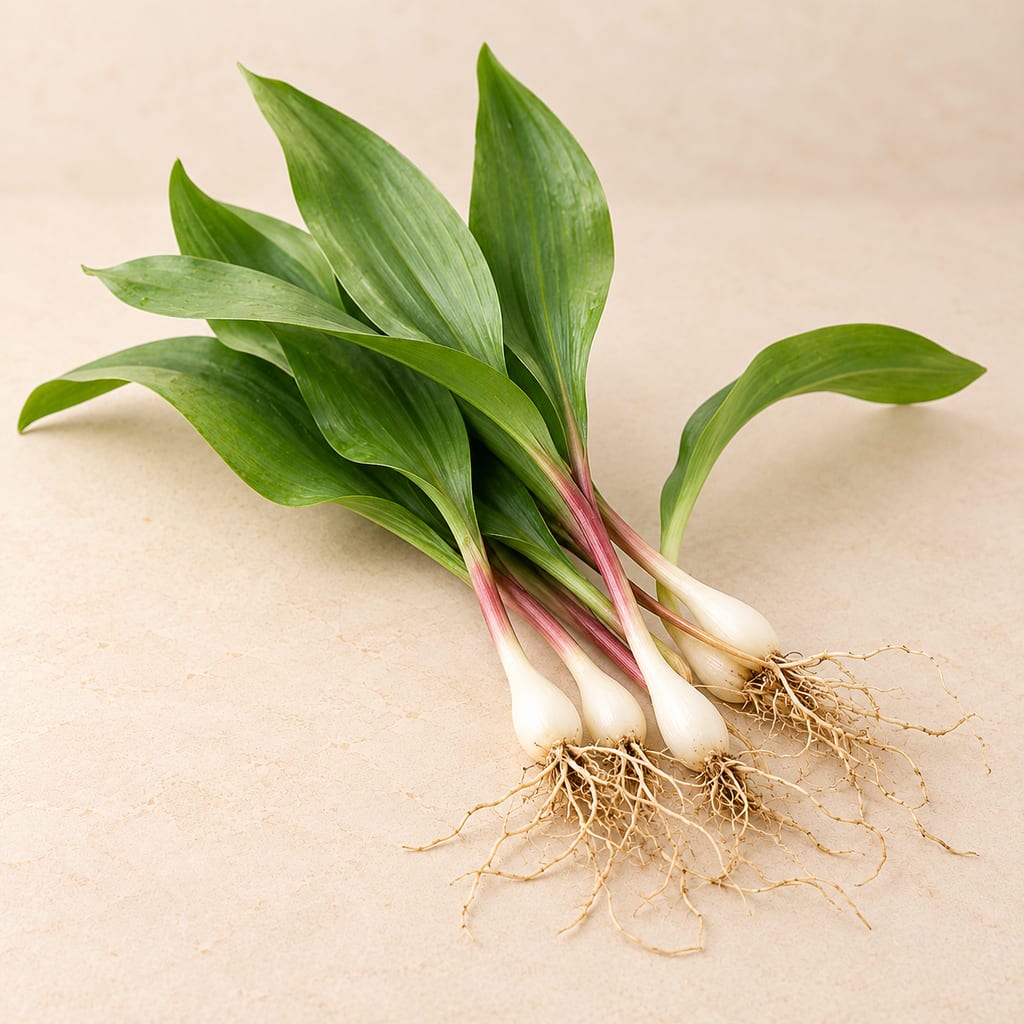
Allium tricoccum (ramp, wild leek, wild garlic)
Allium tricoccum is a North American spring ephemeral documented in Appalachian food and cultivation sources. Older ramp studies may combine it with Allium burdickii or use a broader variety concept.
Scope of this account
The common ingredient name can refer to more than one plant. The research below concerns the particular taxon and uses named in its sources; it does not identify every ingredient sold under this name.
Sources for this section
The plant named ramps
Kew accepts Allium tricoccum Aiton in the onion family Amaryllidaceae and records it as a temperate bulbous plant native to eastern Canada and the north-central and eastern United States. Kew also accepts A. burdickii as a separate species, while listing A. tricoccum var. burdickii as its synonym and recording a Flora of North America variety treatment. Older sources may therefore use a broader name for ramps than current Kew taxonomy. The common names ramps and wild leek do not identify a particular plant.
NC State Extension describes early spring leaves that disappear by summer before white flowers appear. USDA's forest-farming note places ramps in eastern North American deciduous forest and reports emergence after snowmelt as soil warms, often in late March or early April depending on location. Those are regional observations, not a calendar for every garden.
Food and community context
NC State Extension describes bulbs as tasting like sweet spring onions with a strong garlic-like aroma and records ramps as an Appalachian first-spring green. USDA's forest-farming note compares the bulb's spicy taste with scallion and garlic. These sources report food use; they do not establish that every plant called ramps or wild leek is A. tricoccum under the current narrower species treatment.
A 2023 article about wasdi (Allium tricoccum) describes collaborative research in western North Carolina and includes an Eastern Band of Cherokee Indians community researcher and an EBCI Natural Resources Department contributor among its authors. That article's place and authorship remain specific to the reported collaboration; they do not establish permission to publish private knowledge or gathering rights elsewhere.
Forest and shade growing
NC State's extension article covers A. tricoccum and A. burdickii or variety concepts. It describes rich, moist, well-drained soil, forest understory or artificial shade, and year-round soil moisture. The article says full sun can work when moisture is maintained. Its Appalachian advice is not a universal growing formula.
A North Carolina study published in 2002 compared forest, open-field and shade seed plots. Fall-sown seed emerged at 43 percent and spring-sown seed at 35 percent; forest and 30-percent shade plots had the strongest emergence, while the open field was lowest. The seed was collected in Madison County in 1998 but was not resolved to the currently accepted species. A separate preliminary forest plot comparison of pH 4.9, 5.5, 6.0 and 6.5 found the strongest first-year stand at pH 4.9, although the authors cited a habitat average near 5.5. These results describe those plots, not a universal pH target.
Slow establishment and harvest evidence
NC State reports that ramp seed can take 6 to 18 months to germinate and that plants grown from seed may take about four years to reach leaf harvest and five to seven years to reach bulb harvest. Those are regional extension estimates. The source describes warm, moist conditions followed by cold as part of the seed's dormancy sequence; it does not promise a particular home germination date.
A Great Smoky Mountains harvest study used three sites, including sites described as A. tricoccum var. tricoccum and var. burdickii, then combined the varieties in its analysis. Populations had not returned to baseline during the four post-treatment years. These findings do not set a current legal harvest limit or permission for a particular place. The reviewed sources do not supply a complete household recipe, food-storage period or preparation safety endpoint.
Research gaps
Older experimental seed and bulb material has not been independently matched to current taxonomic concepts.
The cited plot studies do not establish a universal pH, shade, emergence or harvest recommendation.
No complete source-specific recipe with quantities, yield, full steps, endpoint and storage was verified.
Current collection rules and landowner permissions vary by place and were not reviewed here.
No productive container or greenhouse trial was identified.
Sources for this section
- Allium tricoccum Aiton | Plants of the World Online →
- Allium burdickii (Hanes) A.G.Jones | Plants of the World Online →
- Forest Farming Ramps, Agroforestry Note 47 →
- Cultivation of Ramps (Allium tricoccum and A. burdickii) →
- Cultivating Ramps: Wild Leeks of Appalachia →
- Population recovery following differential harvesting of Allium tricoccum Ait. in the southern Appalachians →
- Doing research together: wasdi (Allium tricoccum) plants guide dynamic research collaborations in Cherokee landscapes →
Research status
The underlying plant account received a partial source review. Its review scope is described in the original plant article.
Sources for this section
Places
Unknown
Relationship not established · Place not establishedThe available research does not establish a single origin for this ingredient.
Community
No community contributions have been published for this entry yet.
Share what you made
Sign in to contribute. Published comments and photos are free to read.
Sources
Royal Botanic Gardens, KewIngredient research
Allium tricoccum Aiton | Plants of the World OnlineCited in: Scope of this account; The plant named ramps; Research gaps
Royal Botanic Gardens, KewIngredient research
Allium burdickii (Hanes) A.G.Jones | Plants of the World OnlineCited in: The plant named ramps; Research gaps
USDA Forest Service, National Agroforestry CenterIngredient research
Forest Farming Ramps, Agroforestry Note 47Cited in: The plant named ramps; Food and community context; Research gaps
NC State ExtensionIngredient research
Cultivation of Ramps (Allium tricoccum and A. burdickii)Cited in: The plant named ramps; Food and community context; Forest and shade growing; Slow establishment and harvest evidence; Research gaps
Davis and Greenfield; ASHS Press proceedings, reprinted in Trends in New Crops and New Uses (2002)Ingredient research
Cultivating Ramps: Wild Leeks of AppalachiaCited in: Forest and shade growing; Research gaps
Rock, Beckage and Gross; Biological Conservation 116 (2004)Ingredient research
Population recovery following differential harvesting of Allium tricoccum Ait. in the southern AppalachiansCited in: Slow establishment and harvest evidence; Research gaps
Chen, Baumflek, Sampson and Cabe; Ecology and Society 28(2):13 (2023)Ingredient research
Doing research together: wasdi (Allium tricoccum) plants guide dynamic research collaborations in Cherokee landscapesCited in: Food and community context; Research gaps
FermenteaResearch provenance
Ramps in Appalachian food and forest cultivation: original plant researchCited in: Research status