
Mushrooms
Wine cap
Wine cap is a large agaric mushroom of the genus Stropharia, grown on wood chips and straw and eaten cooked. Its cultivated form is the main supply.
What it is
Stropharia rugosoannulata is a basidiomycete mushroom in the family Strophariaceae. Its common names include wine cap, wine-red stropharia, garden giant, burgundy mushroom and king stropharia. The epithet refers to the wrinkled ring on the stem. The name is a research label in the catalogue and has not been checked against a current taxonomic authority for this record.
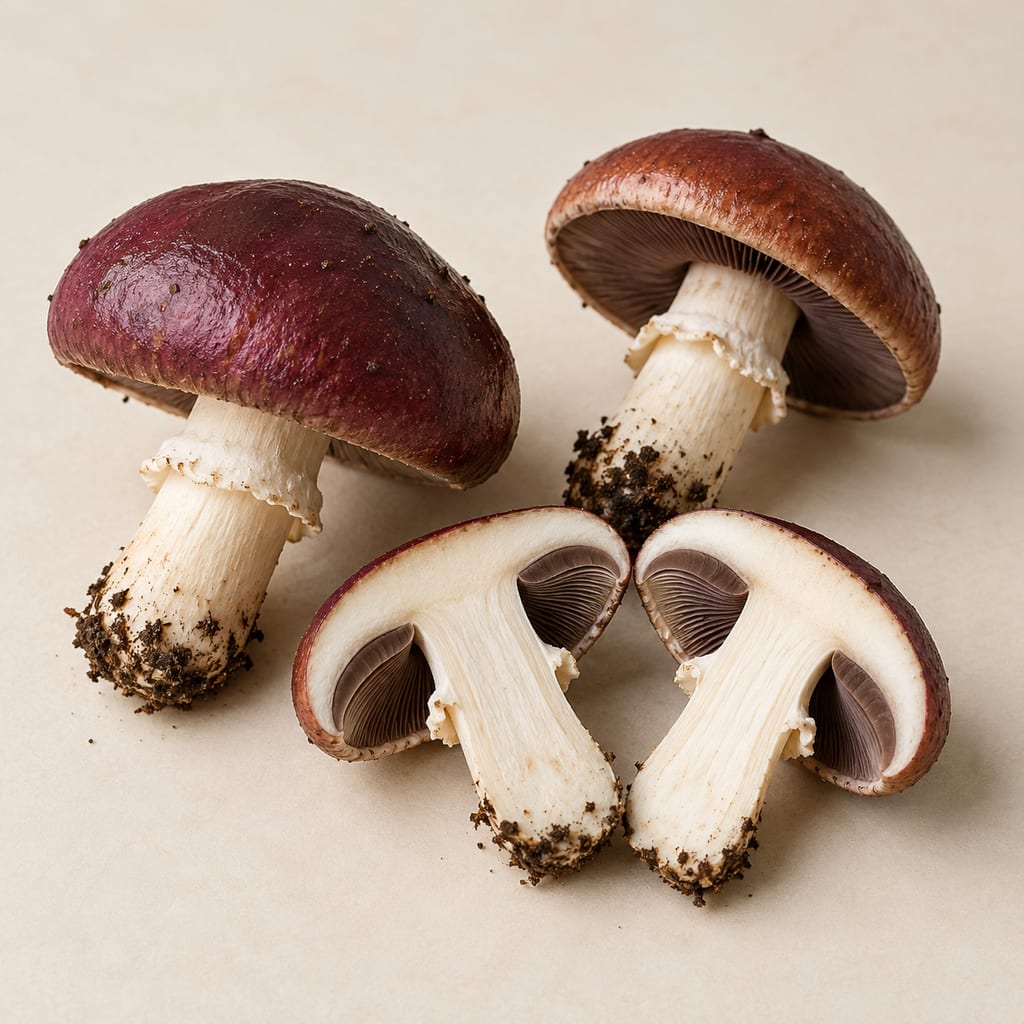
The cap is reddish-brown and convex to flattening, and can reach about 30 cm across. The stem can reach about 20 cm. The flesh and stem are white, the gills start pale and turn grey and then dark purple-brown, and the spore print is dark purple-brown to black.
Ecology and cultivation
In the wild it is a saprotrophic decomposer that grows on wood chips and straw. It fruits in summer and autumn in North America and is also recorded in Europe, and it has been introduced to Australia and New Zealand.
Because it grows on a medium similar to its natural substrate, it is easy to cultivate on wood chips, and it is grown in garden beds and on straw. Cultivation is the main supply reported for it in the catalogue. A 2006 study cited by an encyclopedia entry found that it can capture and digest nematodes. That finding concerns the fungus's ecology and does not bear on its food use.
Culinary use
Food sources describe it as a large, firm mushroom that is used cooked. Some authors call it very tasty. Antonio Carluccio recommended sautéing it in butter or grilling it.
A colloquial name, garden giant, reflects its size. Its firm texture makes it suited to cooking as a substantial mushroom rather than eating raw.
Identification and cautions
This page describes a cultivated food fungus. It is not an identification guide. The sources reviewed give no toxicity warning for this species. They do not establish that a wild specimen can be identified safely from a description, and they note resemblance to Stropharia hornemannii and to Agaricus. Agaricus gills are usually pinker.
The catalogue asks that the culture identity stay distinct from other Stropharia species. Anyone collecting wild mushrooms should confirm identification with an expert before eating them.
Places
Europe
Documented use · Region evidenceRecorded as a food mushroom and as wild in Europe; the catalogue gives Europe as a region, not a single locality.
North America
Traditional use · Region evidenceNative range given as North America, where it grows on wood chips in summer and autumn.
Unknown
Modern adaptation · Place not establishedThe catalogue records widespread cultivation without naming countries; the sources do not give a precise origin of cultivation.
Community
No community contributions have been published for this entry yet.
Share what you made
Sign in to contribute. Published comments and photos are free to read.
Sources
WikipediaTaxonomy · Description · Ecology · Culinary use
Stropharia rugosoannulataCommon names and taxonomy
Cap and stem size; gill colours; spore print
Wood-chip and straw habitat; introduction to Australia and New Zealand
Cultivation on a medium similar to its natural substrate
Sautéing or grilling as recommended by Antonio Carluccio
Resemblance to Stropharia hornemannii and Agaricus; no toxicity warning in the article
Boletin Oficial del EstadoCatalogue record
BOE-A-2009-1110Cited in the supplied catalogue record for this species