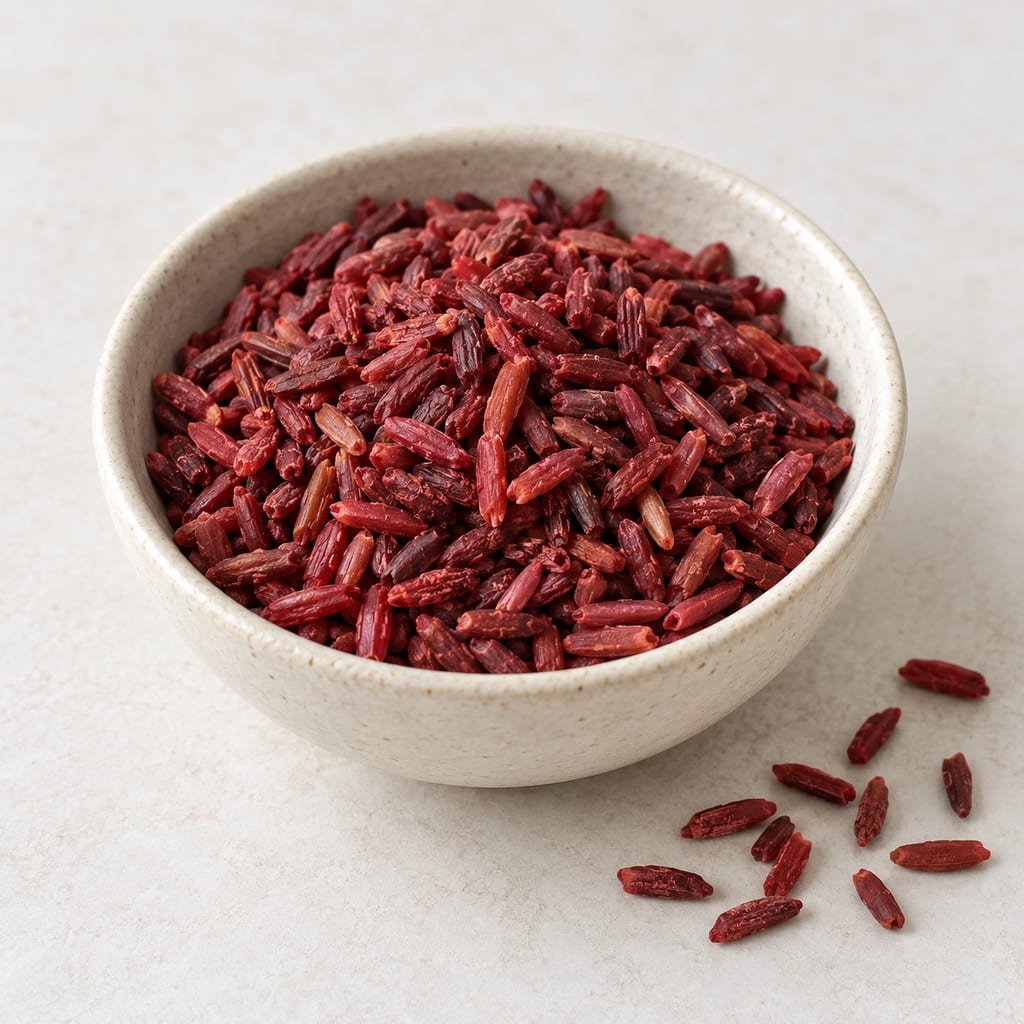
Gutian hongqu
A regional form of hongqu, the red rice starter of southeastern China, named for Gutian and distinguished in Fujian studies from Wuyi hongqu. Documented only through modern regional comparisons.
 FermenteaWhere food goes to change
Cultures
Wuyi hongqu is a regional red rice starter from the Wuyi area of Fujian, described as a mixed Monascus and Aspergillus culture used in rice wine and, in one report, cereal vinegar.
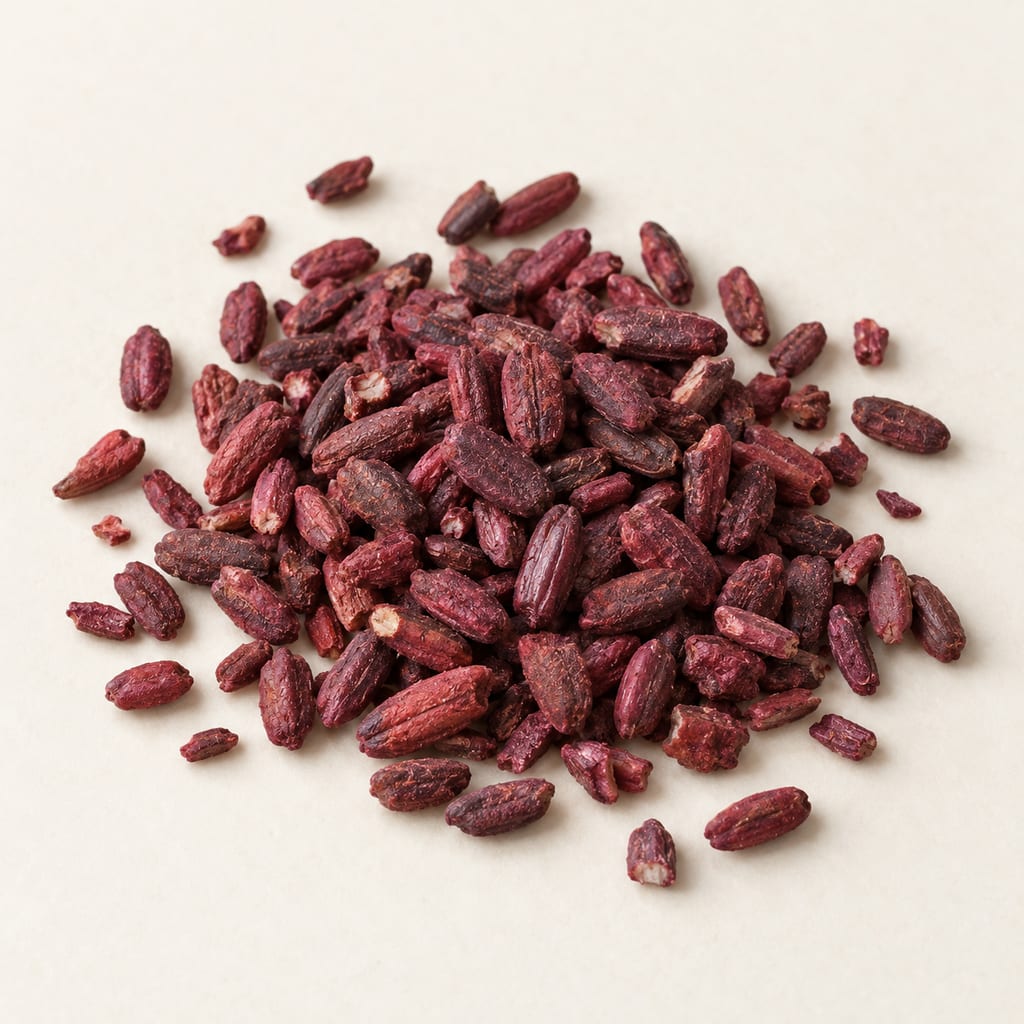
Wuyi hongqu, also written Wuyi Hong Qu and called black-skin-red-koji in some papers, is a regional form of the Chinese red rice starter hongqu. A 2021 study describes Hong Qu as one of four traditional Chinese qu categories and separates Wuyi Hong Qu from Gutian Hong Qu. The name marks a regional category, not a single strain, and it does not make all red fermented rice products the same thing.
Papers describe it as a mixed starter associated with fungi of the genera Monascus and Aspergillus. That mixed character is what sets it apart in the research: a recent line of laboratory work paired Monascus purpureus with Aspergillus niger, two organisms isolated from Wuyi hongqu, to see how they behave together.
Fujian province is the region the research ties it to. One regional study examined 20 Wuyi Hong Qu samples collected in six Fujian cities. A separate 2025 study reports nine Wuyi hongqu samples from Fujian and Zhejiang. The two sample sets were drawn differently, so together they are not a complete map of producers and they do not fix where the name stops applying.
Researchers isolated putative fungi from sampled starter material and tested selected fungal strains in laboratory co-cultures. A culture-collection strain or a single isolate is not interchangeable with the starter as a whole, which is a community of organisms.
The reported pigment and citrinin outcomes varied with the fungal pairing and the laboratory setup. One paper used a double-sided Petri dish, an indirect form of co-culture, and says itself that more study is needed. Citrinin is a mycotoxin that some Monascus strains can produce; the 2025 paper reports co-culture conditions that raised Monascus pigment production while lowering citrinin in the tested pairings. Those results do not give a standard Wuyi hongqu formula and they do not guarantee the composition or safety of a finished food.
The reviewed sources associate Hong Qu with rice wine, and the comparison of Wuyi and Gutian starters concerns wines brewed with them. One paper also describes black-skin-red-koji use in cereal vinegar. Wine made experimentally with a particular starter is a study result and not a validated home recipe.
Red yeast rice sold as a dietary supplement is a separate product context. The US National Center for Complementary and Integrative Health covers that context, and its material should not be read as describing the starter used to brew wine.
The papers call the practice old, and the review notes a statement that it goes back more than 1,000 years, but the earlier sources behind that statement were not inspected, so the age is attributed and not independently confirmed. The sources do not give a production season, a complete household method for making Wuyi hongqu, or a general storage period. Producer evidence from the region is needed to describe how far the name extends and how products differ.
Wuyi Hong Qu samples were collected in six Fujian cities; this region-level row does not pin the origin to a locality.
A 2025 study reports some of its nine Wuyi hongqu samples from Zhejiang; it does not say the starter originated there.
A regional form of hongqu, the red rice starter of southeastern China, named for Gutian and distinguished in Fujian studies from Wuyi hongqu. Documented only through modern regional comparisons.
No community contributions have been published for this entry yet.
Sign in to contribute. Published comments and photos are free to read.
International Journal of Food Science and Technology / Oxford AcademicIdentity · Use · Geography
Regional characteristics and discrimination of the fermentation starter Hong Qu in traditional rice wine brewingHong Qu is one of four traditional Chinese qu categories; Wuyi Hong Qu is distinguished from Gutian Hong Qu.
20 Wuyi Hong Qu samples were collected in six Fujian cities; the starters are linked to rice wine brewing.
Cited in: What Wuyi hongqu is; Where it comes from and what has been sampled; Uses; History and what is not established
Frontiers in MicrobiologyMicrobiology · Use
Cocultivation Study of Monascus spp. and Aspergillus niger Inspired From Black-Skin-Red-Koji by a Double-Sided Petri DishBlack-skin-red-koji is described as a mixed starter associated with Monascus and Aspergillus; the double-sided Petri dish is an indirect co-culture method; use for cereal vinegar is described.
Cited in: What Wuyi hongqu is; What laboratory studies have found; Uses
Journal of Fungi / MDPIMicrobiology · Geography
Co-Culture of Monascus purpureus and Aspergillus niger Isolated from Wuyi Hongqu to Enhance Monascus Pigments Production While Inhibiting Citrinin ProductionNine Wuyi hongqu samples from Fujian and Zhejiang; fungi isolated from them; pigment and citrinin results varied by pairing and setup.
Cited in: What Wuyi hongqu is; Where it comes from and what has been sampled; What laboratory studies have found; History and what is not established
U.S. National Center for Complementary and Integrative HealthContext
Red Yeast RiceRed yeast rice supplements are a separate product context from the brewing starter.
Cited in: Food starter and supplement are different products