
Substrates
Yellow false truffle
Rhizopogon luteolus, a pine-associated false truffle of Europe and introduced pine regions. Its food use is disputed, its immature stage is the one recorded as eaten, and it must not be confused with poisonous earthballs.
Overview
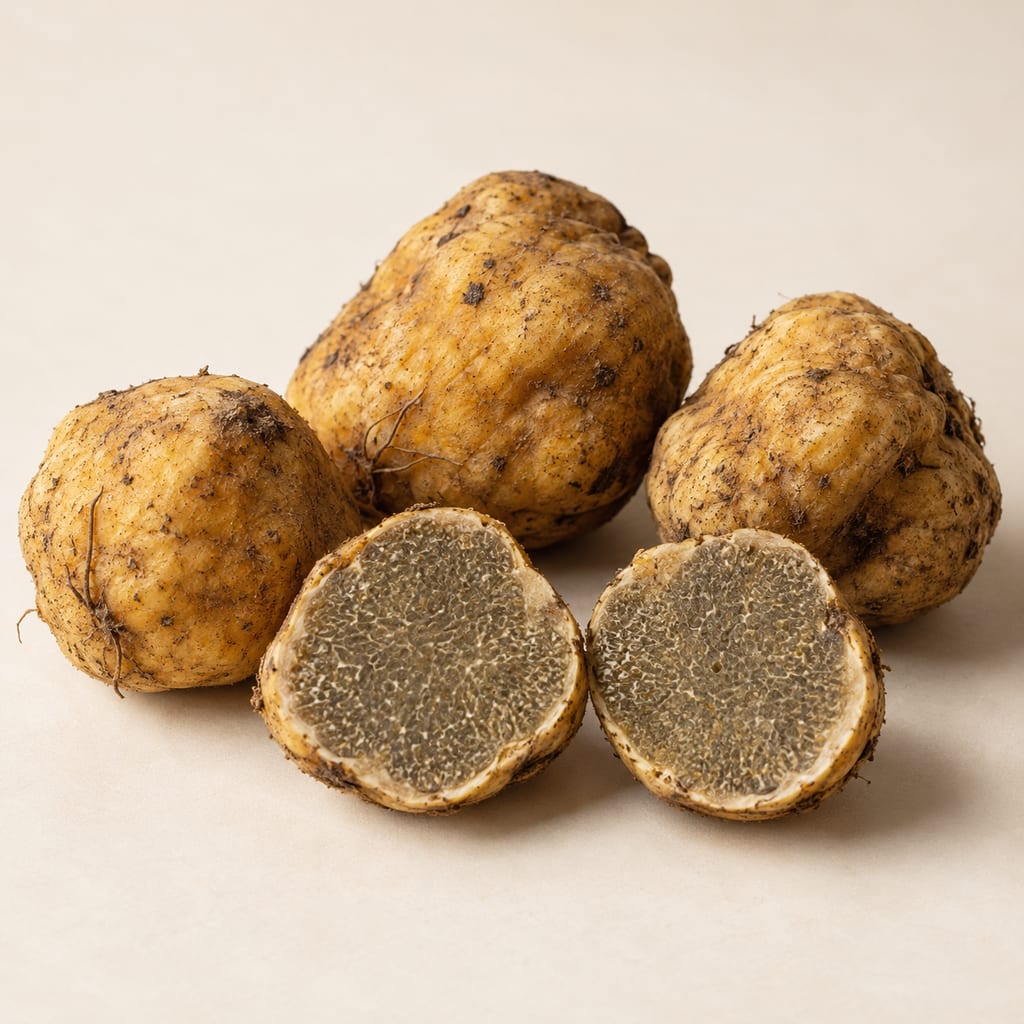
Rhizopogon luteolus is a false truffle, a fruiting body that grows underground or at the soil surface and releases spores without a mushroom cap. It is known in English as the yellow false truffle and in other sources as the yellow beard truffle.
The supplied catalogue records regional food use for immature false-truffle fruiting bodies in Europe and in introduced pine regions. Authorities disagree on whether the species is worth eating, so the record is kept as a conditional food use rather than a general recommendation.
Identity and look-alikes
The flesh of a young fruiting body is almost white and turns ochre, then olive brown or marbled olive grey as it matures. The colour change is the main visible sign of maturity in the sources.
Earthballs can look similar. They have a thick, tough skin and, when mature, a dark purple to black interior, and they are poisonous. The Spanish food-marketing decree Real Decreto 30/2009 lists the genus Scleroderma, the earthballs, among species that may not be sold in any form.
Habitat and ecology
The species is ectomycorrhizal with pine trees. It occurs across most of mainland Europe, and is common in the sandy pine forests of northern Europe. In Britain it is a fairly common sight in pine forest on sandy soil in Scotland and is rare in the rest of the UK.
The catalogue records the supply as wild. No cultivation is recorded.
Food use and status
Sources differ. First Nature describes the edibility as disputed: many authorities describe the species as edible, though not highly regarded, while others, including Roger Phillips and Leif Goodwin, list it as inedible. The WildFoodUK guide lists it as inedible. A Lithuanian source calls it edible but not tasty.
The Spanish decree Real Decreto 30/2009 lists Rhizopogon luteolus (as obtextus) among wild species that may be sold fresh. A regulatory listing permits sale in that country and does not establish that the species is safe in every preparation or stage.
Safety and identification
Because the sources disagree on edibility, the species should be treated as unproven as food. The record is not an edibility verdict.
Maturity and correct genus identification matter. The catalogue warns not to confuse the species with toxic earthballs. Anyone considering a false truffle should have the identification confirmed by a local expert before eating it Mature earthballs with a dark or purple interior are the look-alike to rule out.
Places
Europe
Documented use · Region evidenceSources give a European distribution in pine forests; the catalogue's introduced-pine regions are not named here, so the record does not give a locality.
Community
No community contributions have been published for this entry yet.
Share what you made
Sign in to contribute. Published comments and photos are free to read.
Sources
Boletín Oficial del EstadoFood use · Safety
Real Decreto 30/2009, de 16 de enero (Spanish mushroom marketing rules, consolidated text)Lists Rhizopogon luteolus (obtextus) among wild species that may be sold fresh.
Lists Scleroderma sp. among species that cannot be sold in any form.
First NatureIdentity · Food use · Ecology
Rhizopogon luteolus Fr. & Nordholm - Yellow False TruffleEdibility disputed; gleba almost white at first, turning ochre and then olive brown.
Ectomycorrhizal with pine; occurs across most of mainland Europe.
Wild Food UKFood use · Safety
Yellow false truffle (mushroom guide)Lists the species as inedible in this guide.
Earthballs look similar and are poisonous; mature earthballs have a dark purple to black interior.