
Mushrooms
Yellow morel
Yellow morel, Morchella esculenta, is a wild fungus gathered for cooking in Europe and recorded in historical reports elsewhere. Morels are cooked before they are eaten; raw morels have been linked to serious illness.
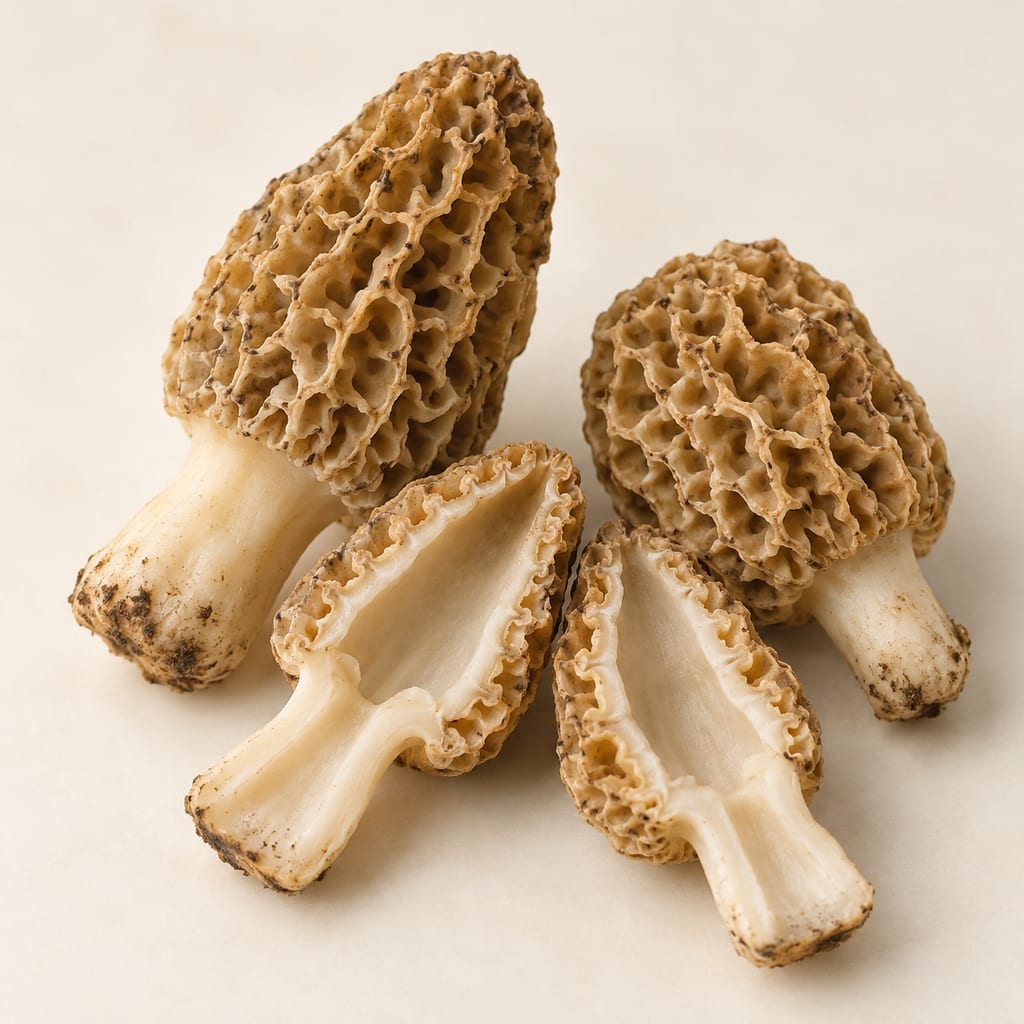
A wild fungus gathered for the pot
Morchella esculenta is the species the catalogue records under the common name yellow morel. It is a wild fungus, not a cultivated crop, and the catalogue lists its supply as wild. Its fresh or dried fruiting bodies are used for cooking.
The scientific name is kept in the catalogue as a research label. It is not treated as a checked, current accepted name, and the catalogue notes that the historical name Morchella esculenta covers a complex of forms. Where a record names this species, the name should be read as the complex it was written under, not as one precisely defined organism.
Sources for this section
Why cooking is the rule
The clearest safety evidence for morels comes from a 2023 outbreak in Bozeman, Montana. Between late March and mid-April 2023, 51 people reported gastrointestinal illness after eating at one restaurant, and two of them died. A matched case-control study identified morel mushrooms as the likely source. The investigators found a dose-response pattern, and eating raw morels was more strongly associated with illness than eating cooked or partially cooked ones.
At the restaurant, morels were served partly cooked on one date, with a hot boiled sauce poured over them and then a marinade of about 75 minutes, and on another date they were uncooked and cold-marinated. The outbreak report says that the toxins in morels that might cause illness are not fully understood, and that proper preparation, including thorough cooking, might help to limit adverse health effects. Its public health message is that morels should be cooked before they are eaten.
Sources for this section
Identification and false morels
The sources read for this page do not give a field guide to the features that separate this species from other morels or from false morels. Identification therefore rests on the person gathering the fungus and on expert confirmation, and no feature is recorded here as a sufficient test.
The catalogue states plainly that cooking does not rescue a misidentified false morel, and that cooking mitigates risk without being an absolute safety guarantee. Gathering and eating decisions for any morel should not be based on this page alone.
Use in food
The catalogue records yellow morel as a fresh or dried morel used for cooking. Its evidence is marked as food use with stated conditions: the stage of preparation, the processing and the identification each carry a condition that the individual record must meet.
The sources read here give no quantities, times or temperatures for preparing this species, so this page records no method. A cook who has a sound identification and wants to prepare morels should follow the cooking rule above rather than any raw or lightly cooked preparation.
Places
Europe
Documented use · Region evidenceRegional wild food use as the supplied catalogue records it, together with broader historical reports. No single origin is claimed.
Community
No community contributions have been published for this entry yet.
Share what you made
Sign in to contribute. Published comments and photos are free to read.
Sources
Centers for Disease Control and Prevention, Morbidity and Mortality Weekly ReportSafety · Method
Outbreak Linked to Morel Mushroom Exposure, Montana, 202351 gastrointestinal illness cases, two deaths, March to April 2023
Raw morels more strongly associated with illness than cooked or partially cooked morels
Toxins not fully understood; thorough cooking may limit adverse effects
Cited in: Why cooking is the rule; Identification and false morels; Use in food
Diva portal, Nordic sourceDistribution
Supplied Nordic fungi source for Morchella esculenta (catalogue record F-e07d22c10688)Listed in the supplied catalogue for the Europe food-use context; not reread for this page
Cited in: A wild fungus gathered for the pot; Identification and false morels; Use in food
Boletin Oficial del EstadoHistory
Supplied Spanish official source listed for Morchella esculenta (catalogue record F-e07d22c10688)Listed in the supplied catalogue; not reread for this page