
Garum intake
Ancient names and types of garum
Garum, liquamen, allec, muria and haimation were different Roman and Greek fish products, and the words never kept one meaning. What the texts, a price list and one buried jar tell us.
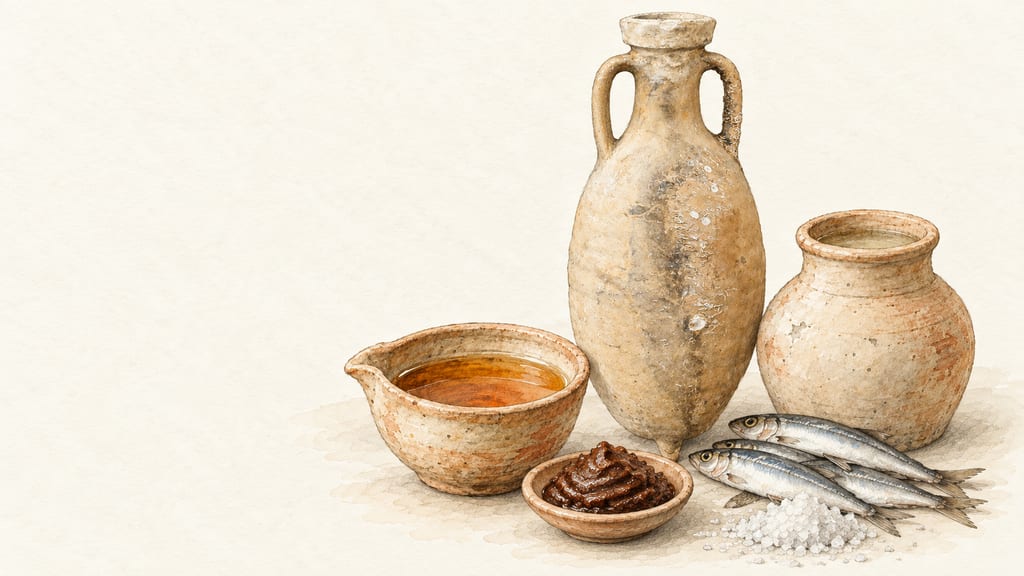
A historical interpretation of Roman fish products: garum, liquamen, allec and the amphorae that carried them.
One word, too many jobs
Ask what the Romans put on their fish and the answer comes quickly: garum. It is the word that survives in modern writing, and it is used for almost everything the ancient Mediterranean made from salted, fermented fish. The ancient sources are less tidy. They name several products, they do not always use the names the same way, and the evidence does not let us say with confidence which word meant what.
Pliny the Elder, writing in the first century CE, gives the textbook definition. In the thirty-first book of his Natural History he calls garum another kind of exquisite liquid, made by salting the intestines of fish and other parts that would otherwise be thrown away, until they dissolve into liquid. In the past, he adds, it was made from a fish the Greeks called garos. That sentence is the root of what the classicist Sally Grainger calls the single-sauce hypothesis: garum was the general name for every fish sauce, and the other words were synonyms.
Grainger argues the reverse. In her view, makers and traders used garum for a specific dark sauce made from blood and viscera, liquamen for the main everyday sauce made from whole small fish, and muria for a brine. Elite writers blurred the three. She concedes the evidence is thin and will often be impossible to apply to an excavated vessel. Her reading is a strong hypothesis built on the texts, not a settled result.
From garos to garum
The word is Greek before it is Latin. Fifth-century BCE comedy mentions garos from the Black Sea, and by the fourth century Cadiz was shipping it to Athens. Early sources treat it as a cheap, even rotten, condiment mixed with oil and vinegar or wine and served with vegetables and pulses. The Hellenistic cooking that reached Rome in the second century BCE leaned on this sauce, and Grainger thinks the Romans simply Latinised the name.
A second Greek product stands beside it. Archestratus, writing in Sicily in the late fourth century BCE, does not name garos but a dipping sauce built on a salted-fish brine called halme. Grainger reads that as the ancestor of the Latin muria, and as a sign that by the end of the Hellenistic period at least two different sauces were already in use.
The black sauce
What Rome prized, and wrote about, was the black sauce. Pliny says the most praised garum was made from mackerel in the salting works of Carthago Spartaria, in Spain, and that it was called garum sociorum, the allies' garum. For a thousand sesterces you could buy about two congii of it, around 6.5 litres, a price he compares with perfumes: scarcely any liquid except unguents, he says, was valued higher. He also names Clazomenae, Pompeii and Leptis as places whose garum was praised. Martial, in a line Grainger discusses, describes garum sociorum as made from the blood of a mackerel still breathing.
Satire leaves the impression of a sauce poured over everything. Oysters swim in it, mullet are drowned in garum sociorum made from mullet viscera, and a cook blends Falernian wine, aged garum and pepper for a roast boar. Grainger warns that satire looks closely at elite dining and so makes the black sauce look more important than it was. Amphora labels from Rome and Pompeii show garum on small jars found in modest houses and bars, so people lower down the social scale bought it as a table sauce as well.
It also had a second life as medicine. Pliny recommends garum poured on fresh burns, and Galen gives a remedy for the stench of wounds that calls for black garos, squill vinegar and Attic honey. Grainger takes this as evidence that the black sauce kept a medicinal role even as its role at table shrank. In her own experiments blood sauce had a strong smell of iron and was not fishy; the extra viscera mainly added digestive enzymes, and did not change the flavour of a whole-fish sauce.
Liquamen, the sauce in the kitchen
If garum was the luxury at the table, liquamen was the sauce in the pot. Grainger, who has edited the cookbook attributed to Apicius with Christopher Grocock, notes that the recipes use liquamen as the standard fish sauce. Garum appears almost only in compounds taken from Greek, above all oenogarum, a mixture of wine, oil and fish sauce used as a dressing, a dip or a cooking sauce. She argues that the book's recipes were written down by slave cooks in plain Latin, as a working collection, some of them perhaps as early as the first century. Her explanation for the black sauce's near-absence is that it was too strong to cook with, its flavour lost in the pot, and was kept for the table as a finishing condiment.
A price list from the end of the empire points the same way. Diocletian's Price Edict of AD 301 gives prices in Latin and Greek, and the Latin lists first- and second-quality liquamen where the Greek lists the same grades as garos. On Grainger's reading, the absence of a separate entry for black garum or muria means the black sauce was too small a share of the market to price separately. That is an argument from silence and should be weighed as one. Amphora labels give a compatible picture: the large amphorae, up to about 90 centimetres tall, usually carry liquamen labels, so far more liquamen was probably sold by volume.
She offers a modern parallel. In Japan, ishiri is a fermented blood-and-viscera sauce used as a finish for sushi, while ishiru is a whole-fish sauce used in cooking.
What was left over: allec and muria
Two other words name what surrounded the sauce. Allec, also written allex or hallec, is the thick residue left when the liquid has been drawn off. Pliny calls it the dregs of garum, its fault being that it is unstrained and imperfect, and in the following section he adds that it was later made on purpose from a tiny worthless fish, apua in Latin and aphye in Greek. The product then became a luxury with endless varieties. One kind, he says, was made for Jewish observance from fish without scales, and the taste for it spread to oysters, sea urchins, sea nettles and mullet livers. He also lists medical uses, from treating scab in livestock to easing dog bites.
The experiments Grainger reports add something the texts do not. When she re-brined the bone-free residue left from a liquamen for a few months, it produced a second sauce of relatively good quality, which she links to the second grade in the Price Edict. She notes that Pliny seems to treat allec as a separate paste, while the Geoponica makes clear that only the residue becomes allec. Sources disagree on whether allec was the sediment of garum or of liquamen, and Pliny's wording supports the first reading.
Muria is the brine in which salted fish were kept. Cato, Columella and Pliny all mention it. Pliny names the brines of Antipolis, Thurii and Dalmatia as praised, and says that a strong salt brine is useful for dysentery, sciatica and old stomach complaints. Grainger describes it as a brine of salt and water that was a valued product rather than a cheap one, and warns against treating it as another name for garum. Martial's epigram on muria, which describes a tuna-based sauce, has been read as a tuna garum; she thinks he may instead be contrasting two prized sauces, garum from mackerel and muria from tuna. A modern relative she mentions is colatura di alici from Salerno, made from ungutted anchovy aged for a year, which she says is closer to a muria than to a garum.
Haimation, the invisible garum
One name has a body to match it. Haimation appears in the Geoponica, the Greek farming compilation, as the best garum, made from the intestines of tuna with its gills, juice and blood, and salted. For centuries it was known from text alone, and fish sauce is hard to find in the ground. Garum, liquamen and muria were salty liquids, fairly clear once strained. Allec has the best chance of leaving bones, which is why the earlier finds are all of allec.
In 1998, excavators at Aila, ancient Aqaba on the Red Sea coast of Jordan, dug up the bottom of a ribbed-neck jar of local ware, set into the beaten-earth floor of a room in a mudbrick house of the late first century CE. It was full of earth and hundreds of fish bones. Nearly all were gills. They came from at least 33 medium-sized tuna of the genus Auxis, 40 to 50 centimetres long, plus a single lizardfish, Trachinocephalus myops. That fish matters: it does not live in the Mediterranean or the Black Sea, so the sauce was made from Red Sea fish, not imported.
The authors, Wim Van Neer and S. Thomas Parker, did the arithmetic. The gill apparatus and guts of one comparable fish weighed about 200 grams, so 33 of them make about 6.6 litres of tissue; add salt at the 8 to 1 ratio the Geoponica gives for fish sauce elsewhere and the total comes to about 7.4 litres, against a jar that held about 9.8 litres when complete. The sauce seems to have been made in the jar itself, never strained. It was found in what looks like an ordinary house on the edge of town. They propose that high-quality garum was one of the local industries of Aila. It shows a named product, of the same family as garum, made of blood, gills and viscera, and it shows that the Greek and Latin words covered more than one thing.
Garos after Rome
The word did not die with the empire. The Cyprus Food Museum describes garos, or garon, as a Byzantine sauce of the 11th to 12th century, made from fish entrails, gills and blood mixed with ground vegetables and salt. Mixed with water, wine, vinegar or oil it became hydrogaros, oinogaros, oxygaros or garéleon; the museum cites Koukoules (1952) for these names. Cyprus has also yielded self-heating ceramic vessels of the same centuries, which the museum links to serving such sauces hot. The Byzantine garos is a thousand years from Pliny, so it shows what a Byzantine reader meant by the word, not what a Roman producer meant by garum. The two share a pattern, not a proven line of descent.
What a name can and cannot tell you
Read together, the sources suggest that an ancient name tells you the raw material or the form, not a recipe. Garum points to a blood-and-viscera liquid, liquamen to a whole-fish sauce, allec to a residue or a deliberate paste, muria to a brine, haimation to a tuna preparation. Where two names overlap, no source gives a ratio, a time or a vessel that settles it. No ancient text ties a salt ratio or a fermentation time to a named product, and anyone who supplies one is adding evidence the sources lack.
The open question is whether residues in amphorae and vats can one day separate a viscera sauce from a whole-fish sauce by chemistry, and until then the sensible reading is that these names describe families of products. A reader who meets garum in a modern book should ask which of them the author means.
Community
No community contributions have been published for this entry yet.
Share what you made
Sign in to contribute. Published comments and photos are free to read.
Sources
Perseus Digital Library, Tufts University
Natural History, Book 31 (Perseus, Thayer text)Cited in: One word, too many jobs; From garos to garum; The black sauce; What was left over: allec and muria; What a name can and cannot tell you
OpenEdition Books
Garum, Liquamen and Muria: A new approach to the problem of definitionCited in: One word, too many jobs; From garos to garum; The black sauce; Liquamen, the sauce in the kitchen; What was left over: allec and muria; What a name can and cannot tell you
VLIZ / Journal of Archaeological Science
First archaeozoological evidence for haimation, the 'invisible' garum (Van Neer and Parker, Journal of Archaeological Science 35, 2008)Cited in: Haimation, the invisible garum; What a name can and cannot tell you
Gaps
- Whether allec was the sediment of garum or of liquamen is disputed.
- No ancient text gives a salt ratio or fermentation time that can be tied to a named product. The 8-to-1 salt ratio used in one calculation comes from the Geoponica's fish-sauce recipe, not from haimation itself.
- Grainger's distinction between garum, liquamen and muria is a hypothesis; the archaeological record may not allow it to be applied to individual vessels.
Updated 2026-10-29