
Alcoholic fermentation
Bappir and the beer of Sumer: brewing in the world's first written records
The first written records are full of beer, tracked to the litre. Yet bappir, the grain cake in almost every Sumerian brew, is still a puzzle. The evidence comes from tablets, a hymn, a tavern and pots.
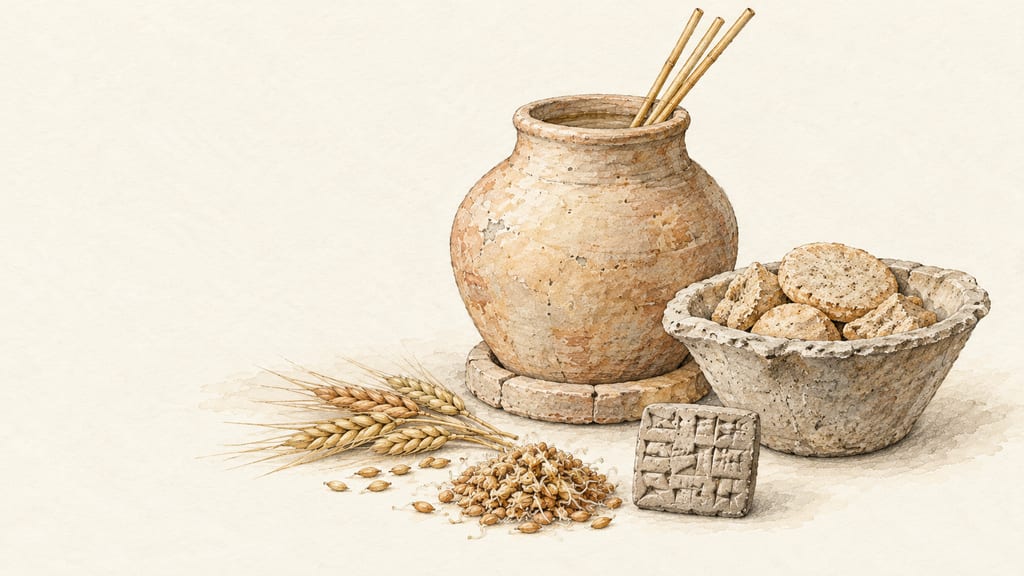
A beer jar with reed straws, a bevelled-rim bowl of dried grain cakes, barley and a clay tablet: an interpretation of the Sumerian brewer’s world.
A funeral in Garshana
In about 2029 BCE, in the southern Mesopotamian town of Garshana, a man named Shu-Kabta died. His household held a feast in his honour, and a scribe wrote down what it cost. Among the food and drink on the tablet are 320 litres of good beer and 640 litres of ordinary beer, twice as much of the cheap stuff as the good.
The scribe also listed what went into that beer. The list has malted barley, groats and something called bappir. There were two grades of each. Good bappir went into the good beer and ordinary bappir into the ordinary beer.
Four thousand years later, nobody can say for certain what bappir was.
Sumerian beer is one of the best-documented foods of the ancient world. Thousands of tablets name its ingredients, track its grain to the litre and grade its quality. Yet specialists still argue over the second ingredient in almost every recipe, the one written into the very word for brewer. This piece follows bappir from the first written records to the bureaucracies of the Third Dynasty of Ur around 2000 BCE, through a poem, a tavern and a pile of pots, and on to the modern brewers who have tried to bake it.
Two ingredients and a bowl
Writing in Mesopotamia did not begin with poems or laws. It began with accounts, and beer was in them from the start. A tablet in the British Museum, a pillow of baked clay a little under 10 cm tall made around 3100–3000 BCE, records an allocation of beer.
The proto-cuneiform tablets of Uruk, written between about 3200 and 3000 BCE, name nine kinds of beer, all of them hard to translate. They show beer as a product of large institutions, counted out in jugs and issued to workers alongside grain. One tablet tallies the jars of four beer types on its front and, on its back, the barley groats and malt needed to brew them.
Malt had its own system of number signs. It appears either on its own or as a beer ingredient, never in other grain products, which is the main reason scholars read it as barley sprouted on purpose. The other raw material was coarsely ground barley.
Scribes wrote grain rations with a sign called GAR. GAR is a drawing of a ration bowl, the coarse bevelled-rim type characteristic of Late Uruk sites, each holding roughly 0.8 litres. In the early tablets GAR marks barley products given to workers, probably ground and perhaps roasted or baked in the bowl itself. At this stage it has nothing to do with brewing.
A second sign, ŠIM, does. It probably shows a vessel with a spout at its base, the kind of pot that could let beer run out from under a floating layer of yeast. In the Uruk tablets it turns up in the names or titles of people and seems to mark their role in beer production. A few centuries later the two signs fuse, and the result is bappir.
How a bowl became a beer ingredient
Around 2900 BCE at Ur, and again around 2600 BCE at Fara, scribes wrote the ration-bowl sign GAR inside the brewing-vessel sign ŠIM. The compound stood for the brewer, lunga in Sumerian. In effect scribes wrote the brewer as the bappir man.
Then, in the archives of Girsu in the state of Lagash, in the middle of the third millennium BCE, the scribes swapped the outer sign. GAR now sat inside KAŠ, the beer-jug sign, and the compound no longer named the brewer. It named something the brewer used. This is the sign read bappir.
Because GAR is usually read ninda, "bread", and because some texts suggest bappir was cooked or baked, scholars usually translate the word as "beer bread". The historian of science Peter Damerow worked from the account tablets and called that translation at least misleading. If bappir had been a loaf, the scribes should have counted it, as they counted loaves. Instead, in these texts it was measured by volume, in the same capacity units once used for the coarsely ground barley it replaced.
The Girsu records are also where the vocabulary of brewing grows. Deliveries to brewers list munu, which everyone agrees is malt, and bappir, which appears in almost every beer. They also list imgaga, made from emmer wheat; GAR tam-ma, whose meaning is obscure; and titab, another grain product. The named beers are kaš sig, read by some as "golden" and by others as "strong"; dark beer; sweet dark beer; red beer; and strained beer. The golden, red and strained beers used emmer as well as malt and bappir.
The accounts carry one more clue. When the administration issued barley to make bappir, the scribes added an extra allowance of one third to cover what was lost in processing. Emmer issued to make imgaga got one sixth. For imgaga the smaller loss fits dehusking, the removal of the tight glume around each emmer grain. For bappir, what a one-third loss means depends on what you think bappir was. The numbers cannot settle that on their own.
Breweries run by accountants
By the Third Dynasty of Ur, from around 2100 to 2000 BCE, the state economy of southern Mesopotamia had produced tens of thousands of surviving administrative tablets. Brewing sat inside a standard system of measures. The sila was about 1 litre, the ban was 10 sila, the barig 6 ban and the gur 5 barig, about 300 litres. Brewers' balanced accounts tracked grain in and beer out, sometimes in hundreds of gur.
In these accounts the intermediate products mostly disappear. Breweries received raw barley from central granaries, and malt and bappir drop out of the deliveries. The likely reason is that the breweries now did the malting and the other preparation steps themselves, so these no longer needed their own entries. Bappir still turns up in other texts. Scribes qualified it as "good", "good crushed" or "flour of bappir", and converted good bappir back into barley with fixed factors. One unusual text counts bappir by the unit, each worth 7.5 sila of barley.
How scribes counted it depended on the city. Tate Paulette, an archaeologist at North Carolina State University who has spent years on the problem, notes that different cities recorded bappir by weight, by volume or by count, as if it came in loaves or some other unit. Bappir also went into stews and soups, so it was food as well as a brewing ingredient. Tablets mention kneading a dough, an oven of some kind, and bappir being spread, crushed, soaked or dried.
Scribes graded the beer too. In the Ur III texts the categories are ordinary, good and very good, or perhaps ordinary, strong and very strong. A related product, dida, often taken to be a sweet wort or beer concentrate, came in jugs of 2 ban. The records of a brewery of the period track it to the litre. They still do not say how the brewers made the beer.
Scholars disagree about how literally to read the figures. Marvin Powell, in a 1994 study of measures, treated the ratios of issued ingredients as real recipes for each beer type. Damerow found such conclusions speculative, because accounting conventions, loss allowances and value equivalents may stand between the numbers on a tablet and what went into the vat.
Dogs on the malt floor
For the process itself, everyone turns to a poem. The Hymn to Ninkasi survives on three tablets, now in Paris, Istanbul and Berlin, and it is traditionally paired with a drinking song. Miguel Civil of the Oriental Institute in Chicago published the first full edition in 1964. He noted that one Berlin copy carries the scribe's own variant readings, squeezed in as glosses, a rudimentary piece of textual criticism by someone trying to reconcile conflicting versions.
The hymn has twelve four-line verses, and each verse says its point twice, once with the goddess's name. Her father is Enki and her mother Ninti. She works dough with a big shovel in a pit, mixing the bappir with sweet aromatics. She bakes the bappir in the big oven, sets the piles of hulled grain in order and waters the earth-covered malt.
The next line reads least like a recipe. In Civil's translation, the noble dogs guard the malt even from the potentates.
Civil took it literally. Brewers spread sprouting barley on the ground under a thin layer of earth to keep it moist, and dogs kept people from trampling it. He found the same worry elsewhere in Sumerian writing. A dialogue describes a clumsy person with the phrase "the elephant tramples the sprouting greenmalt". Birds were a threat too. In one text, when a widow spread malt on her roof, "the birds of the sky did not eat that malt".
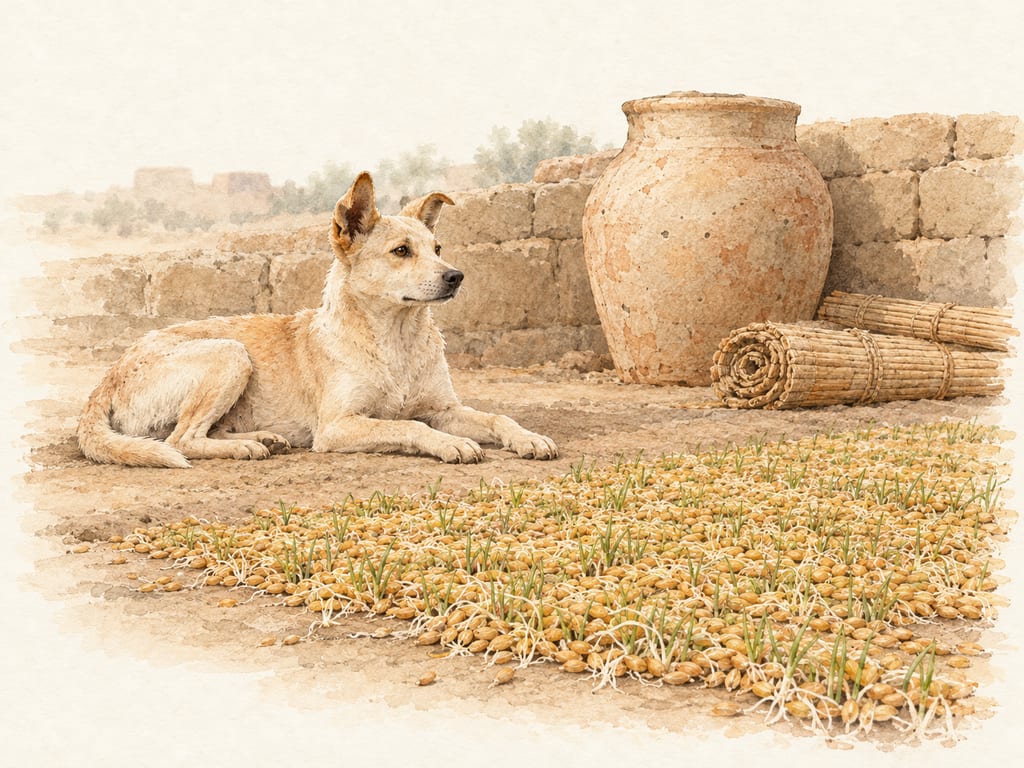
The next verses soak the malt in a jar, where "the waves rise, the waves fall", and spread the cooked mash on large reed mats to cool. Here too Civil found the reed mats in the accounts. An Ur III tablet lists the materials for mats used to cool titab, and he worked out that one mat covered about 54 square feet, roughly 5 square metres. A debate poem between the reed and the tree mourns the mat's end. People once rolled the mats up with care, and later used the old ones for fences. An Akkadian proverb gives the rule of the job, "for cooked greenmalt, spreading cannot be delayed". Assyrian kings later used the image in their battle reports, writing that they spread out enemy corpses "like parched malt".
Ninkasi then holds the great sweetwort with both hands and brews it with honey and wine. She sets the fermenting vat, "which makes a pleasant sound", on a large collector vat, and pours out the filtered beer. The hymn compares the beer to the onrush of the Tigris and the Euphrates.
Civil suggested, with caution, that the drinking song may celebrate the opening of a tavern kept by a woman, since women kept most taverns at the time.
What the hymn leaves out
Civil himself warned that a short lyric poem is not the best starting point for a study of technology. The hymn has no teaching purpose, and some operations are not mentioned at all. He thought the verses run roughly in order, because the first describes an early stage and the last pours the finished beer. He also thought bappir was a cooked mixture of dough and aromatic herbs, though it was uncertain to him whether malt went into it, sometimes shaped into cakes and counted but usually measured by volume. He noted that brewers hulled the grain for it, while titab kept its husks, which help filtering.
Damerow went further. Much of the standard reading, he argued, depends on modern brewing knowledge. The poem never says how the brewers stopped the sprouting. It mentions waves in a jar but not heat. It does not say when the brewers combined bappir and malt. One proposal reads dida, the "sweetwort", as the mixture of titab and bappir itself, with no sweetener involved. Damerow found it hard to believe that dida, kept as a liquid in jugs in the Ur III accounts, could be the same thing Ninkasi holds in both hands. Another literary text, the debate poem Lahar and Ashnan, has Ninkasi mix bappir and titab after preparing both in an oven. That supports part of the usual reading, though it is also a poem.
Paulette names two traps. The terminological trap is reaching for modern brewing words such as mash and wort, as Civil's translation did, which makes the ancient process look more familiar than the evidence allows. The minimalist trap is assuming that Mesopotamian brewing came down to a few basic steps and stayed the same for millennia.
The German Assyriologist Walther Sallaberger drew one alternative as a diagram. In his reading, brewers mixed a sourdough starter with barley, let it ferment, then baked or dried it to make bappir. They crushed and steeped malt and bappir, then mixed and fermented them together into an intermediate product they could dry and store. A final fermentation with water turns that into beer to drink. Paulette presents it as one hypothetical scenario.
A dried cake of yeast?
One ingredient missing from every list is yeast. No one knows how Mesopotamian brewers started fermentation. It may have been wild yeast from the air, dregs from the last batch, or something else. A long line of researchers has suggested the answer was bappir.
Other readings exist. Some have argued bappir was a roasted barley product. Others have pictured something like biscotti. Paulette favours a dried-out cake of sourdough starter, and compares it to nuruk, the cakes used to start fermentation in Korean brewing. In his 2024 book he tests the idea with arithmetic. Reviewing the book in Antiquity, Melania Zingarello described how he takes the weights and volumes recorded for bappir in the texts, works out a density, and compares it with modern bakery products to judge how dense or crumbly it was.
The practical problem is heat. Paulette has asked how you bake such a cake in an oven and still keep the yeast alive so that it will start a beer. A 2024 conference abstract by Curt Carbonell and colleagues takes up the same question in the lab. It says their earlier experiments showed a sourdough loaf baked with care can keep enough live yeast to start a beer, and a new series stored loaves for 26 weeks and sampled them each week for yeast survival. The abstract does not give the six-month results.
If bappir was a starter, its strangest feature in the accounts would make sense. A brewer could grade, store, crush and count dried cakes, and a one-third loss of barley could reflect the dough, the fermenting and the baking. No one has proved it. Paulette's own word for the evidence is hints.
Straws, taverns and a collapsed larder
People drank the beer as well as counting it, and archaeologists have found some of the places where they drank it. At Tell al-Hiba, ancient Lagash in southern Iraq, the Lagash Archaeological Project has excavated a public tavern that the Penn Museum dates to about 2700 BCE. It had a courtyard with benches, an oven big enough to serve a whole neighbourhood, and a cooler cut into the floor. The cooler is a sphere of broken pottery filled with sand around a smaller vessel, which the team calls a 5,000-year-old fridge.
The excavators found many bowls in what must have been the main larder, still full of fish and other animal bones. Most lay upside down and jumbled together in a heap, where they had fallen when the shelves collapsed almost 5,000 years ago. There is no indication that the building burned down. "For now we have no idea what calamity robbed these Sumerian tavern-goers of their dinner," wrote David Mulder, a member of the team. "We modern archaeologists can only be grateful that nobody ever came back to clean up the mess." He pictures the menu as fish and onions with beer, served in a goblet and a conical bowl. Elsewhere at Lagash, conical beakers and bowls make up most of the pottery, mass-produced vessels the excavators link to drinking, probably beer. No one has published a brewing identification for the tavern.
People often drank together. Hundreds of banquet scenes, most of them from the third millennium BCE, show people seated beside a large jar on a stand. They drink through long straws. Paulette counts from one straw to as many as nine. Elite tombs held straws of gold and silver. Most were reed, which rots, but finger-length metal filter tips with pierced holes survive from around 2000 BCE. They fitted on the end of a reed and sat down in the beer. Several burials just after 2000 BCE held a single tip at the base of a vessel, as if the mourners sent the dead off with a jar of beer and a straw in it.
Later law and literature add detail about taverns. The Code of Hammurapi shows beer sold in taverns, often run by women, places of amusement, prostitution and crime. The Instructions of Shuruppak, a father's advice to his son, include a warning not to pass judgment when drinking beer. In a myth, a drunk Enki hands the goddess Inanna his divine powers one after another, then asks his minister where they have gone.
What the pots say
Archaeology has found vessels but no recipe. The best-known residue test comes from Godin Tepe, a site in the Zagros mountains of western Iran with strong Late Uruk ties. A jar of the late fourth millennium BCE has criss-cross grooves cut into its inside below the shoulder. A pale yellow residue in the grooves tested positive for oxalate, a main component of beerstone, the scale that builds up in barley beer tanks.
The vessels people feel surest about have a hole in the base. Potters rarely pierce a pot's bottom, so these are easy to spot. In the texts such vessels come in named pairs, the pierced one sitting over a collecting vessel, and one text has them make a dripping "dooble-dobble" sound. At Tell Hadidi in Syria, one scholar has argued that a building full of them was a brewery, and residue work at Tell Bazi links such vessels to brewing.
Tell Bazi also produced the most detailed experiment linking excavated equipment to brewing. Houses of the 13th century BCE held large jars half-sunk in the floor. A team of brewing scientists and archaeologists used local barley and copies of the vessels. The reconstruction held a constant 24 °C, dried the malt at about 60 °C, mashed cold and fermented for 36 hours at 24 °C. Damerow reads the brewing there as most likely based exclusively on germinated grain. It is a careful reconstruction for one Syrian site, a thousand years after Garshana.
Modern brews
Everything in this section is modern practice.
Anchor Brewing of San Francisco, led by Fritz Maytag, worked with the anthropologist Solomon Katz of the University of Pennsylvania Museum to brew a beer from the Hymn to Ninkasi. They made bappir from honey and barley flour with unmalted, malted and roasted barley. The first bake did not dry out enough to store, so they baked it again, until it was like biscotti. They said ancient sources showed that people stored bappir, so they believed it was twice-baked, and added that they had no textual evidence for this. The beer was flash-pasteurised so that it would keep, because no ancient preservative could be identified. Tasters compared it to a hard apple cider that kept the fragrance of dates. Anchor's slides from the project are now at the Smithsonian's National Museum of American History.
Paulette, then a graduate student, joined a later project between the University of Chicago's Oriental Institute and Great Lakes Brewing Company in Cleveland. The team made ceramic replicas of vessels excavated in Iraq and called its beer Enkibru. Its bappir was a dried cake of sourdough and served as the only yeast. Batches varied from about 3% to 8% alcohol. The beer was fizzy, often milky and on the sour side, flavoured with a shifting mix of coriander, cardamom, fennel, dates and juniper. A twin beer used the same ingredients on modern equipment with a Great Lakes yeast and came out closer to a saison. About half the tasters preferred Enkibru. They drank it from a shared pot through straws, which were reed except once, when they were fluorescent plastic.
Paulette's book prints the recipe for the modern-equipment beer so readers can brew it. In Raleigh he later brewed another version with Trophy Brewing, focused on bappir, to serve on stage to the food writer Alton Brown. Each brew shows that an idea can work. None can show which idea the brewers of Garshana used.
Back to the funeral tablet
Little is certain. From the first written records on, brewers made beer from malted barley and a second grain product. Scribes wrote that product with a sign built from a ration bowl, and from the middle of the third millennium they called it bappir. They measured it by volume more often than they counted it, though cities differed. Brewers lost about a third of the barley issued for it. By 2000 BCE brewing sat inside large institutions that took in raw barley and turned out graded beer by the litre.
Past that, the readings divide. Bappir may have been a baked cake, a roasted grain product, a twice-baked rusk or a dried sourdough that carried yeast from one batch to the next. It may also have changed over the thousand years of tablets. Paulette points out that the bappir of 2400 BCE need not be the bappir of much later texts.
Shu-Kabta's household told the difference between good bappir and ordinary bappir well enough to put both on the record. The tablet keeps the grades and the litres. It does not say what was in the bappir.
Community
No community contributions have been published for this entry yet.
Share what you made
Sign in to contribute. Published comments and photos are free to read.
Sources
Cuneiform Digital Library Journal 2012:2
Sumerian Beer: The Origins of Brewing Technology in Ancient MesopotamiaCited in: Two ingredients and a bowl; How a bowl became a beer ingredient; Breweries run by accountants; What the hymn leaves out; Straws, taverns and a collapsed larder; Back to the funeral tablet
Oxford University Press, 2024
In the Land of Ninkasi: A History of Beer in Ancient MesopotamiaCited in: A dried cake of yeast?
Electronic Text Corpus of Sumerian Literature, University of Oxford
A hymn to Ninkasi: translation (ETCSL 4.23.1)Cited in: Dogs on the malt floor
Society for American Archaeology 89th Annual Meeting (tDAR 499189), 2024
Bappir: The Ancient Mesopotamian Brewer's Best FriendCited in: A dried cake of yeast?
Cuneiform Digital Library Journal 2012:2
Zarnkow et al. 2006, Tall Bazi brewing study (as summarised in Damerow 2012, §2.9 and §6.10–6.15)Cited in: What the pots say
Penn Museum, 2023
Penn Museum Researchers Uncover Ancient Tavern in Southern Iraq, Complete with 5,000-Year-Old FridgeCited in: Straws, taverns and a collapsed larder
Lagash Archaeological Project, University of Pennsylvania
2022 Fall SeasonCited in: Straws, taverns and a collapsed larder
Archaeology, July/August 1991
Brewing an Ancient Beer (Katz and Maytag; text as archived)Cited in: Modern brews
National Museum of American History, Anchor Brewing Company Records
Ninkasi Sumerian Beer Project/Ninkasi Bappir to BeerCited in: Modern brews
Wikimedia Commons
Early writing tablet recording the allocation of beer (British Museum ME 140855)Cited in: Two ingredients and a bowl
M. Civil, in Studies Presented to A. Leo Oppenheim, Oriental Institute, University of Chicago, 1964, pp. 67–89
A Hymn to the Beer Goddess and a Drinking SongCited in: Dogs on the malt floor; What the hymn leaves out
Tate Paulette, Fermentology (PubPub), 2020
Fermentation in Ancient Mesopotamia, Beer, Bread, and More BeerCited in: A funeral in Garshana; Two ingredients and a bowl; Breweries run by accountants; What the hymn leaves out; A dried cake of yeast?; Modern brews; Back to the funeral tablet
Drunk On History podcast, University of Oxford, 2025
Drunk On History, episode 2: Tate Paulette (transcript)Cited in: How a bowl became a beer ingredient; Breweries run by accountants; A dried cake of yeast?; Straws, taverns and a collapsed larder; What the pots say; Modern brews; Back to the funeral tablet
Melania Zingarello, Antiquity 99(406), 2025
Tate Paulette. 2024. In the land of Ninkasi: a history of beer in ancient Mesopotamia (review)Cited in: What the hymn leaves out; A dried cake of yeast?; What the pots say; Modern brews
David Mulder, Expedition Magazine, Penn Museum, 2023
It's Five O'Clock, SumerCited in: Straws, taverns and a collapsed larder
McMahon et al., Antiquity, 2023
Dense urbanism and economic multi-centrism at third-millennium BC LagashCited in: Straws, taverns and a collapsed larder
Gaps
- What bappir physically was remains unresolved. The texts give weights, volumes, grades and hints of dough and ovens, but no surviving text gives its recipe or form.
- No residue study from a southern Mesopotamian vessel of 3200–2000 BCE that identifies beer or bappir turned up. The Godin Tepe and Tell Bazi evidence comes from outside the region or period. No one has published a brewing identification for the Lagash tavern.
- Paulette 2024 was read only through its OUP chapter abstracts, a full Antiquity review and transcripts of two of Paulette's talks, and this article does not reproduce his density figures. Powell 1994 and Michalowski's 1994 chapter "The drinking gods" were not accessible and are known only through citations.
Updated 2026-10-30