
Garum intake
Garos: the Greek fish sauce with a famous name and no recipe
Athenian playwrights mentioned garos in the fifth century BCE and the surviving lines never say how it was made. The detailed Greek methods come from a Byzantine compilation more than a thousand years later, with a sauce of tuna blood among them.
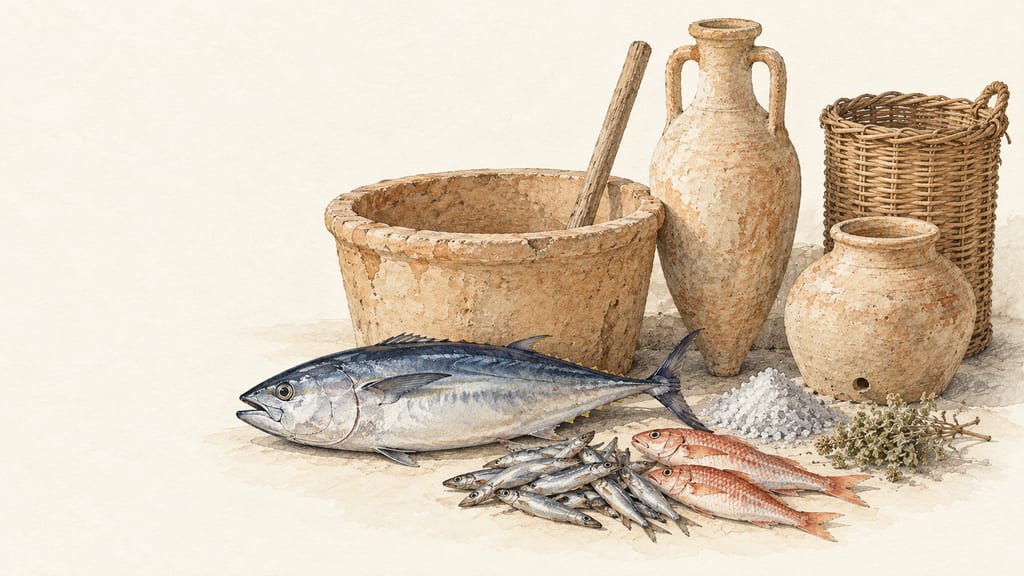
A historical interpretation of the ingredients and vessels behind a Byzantine fish sauce: a clay vessel in the sun, tuna, small fish, salt and oregano.
Lines of dialogue, never a recipe
The earliest Greek mentions of fish sauce are scraps of dialogue, and none of them is a recipe. The word is garos. It appears in the fifth century BCE in a fragment of Aeschylus's Proteus (fr. 211), in two fragments of Sophocles's Triptolemus (frr. 606 and 799a), and in comic fragments by Cratinus (fr. 312), Pherecrates (fr. 188) and Plato Comicus (fr. 215). The only classical prose example is a fragment of Clearchus (fr. 57 Wehrli), which survives because Athenaeus quoted it.
These lines show that garos was a known sauce by the fifth century BCE. None of them gives a manufacturing step. For the first Greek methods in this story, you have to jump forward more than a thousand years, and the jump comes with a warning: a recipe from a Byzantine book is not a record of what the playwrights' cooks did.
A condiment, a gender problem and a fish that may not exist
Later Greek writers add little. Pollux (6.65) lists garos among the condiments. Arrian's report of Epictetus (2.20.30) gives the compound oxygaron, garos with vinegar, a form that comes back in the Byzantine material below.
Greek writers also disagreed about the word's grammar. Philetaerus, Athenaeus and the Suda prescribe the masculine, ho garos. The neuter, to garon, is recorded by Eustathius as a metaplasm, a shift between declensions, and Strabo (3.4.6) is the first certain use of it.
Then there is Pliny. Writing in Latin in the Natural History (31.93), he gives the Greek word in a relative clause: "quem Graeci garon vocabant", which the Greeks used to call garon. In the fifth-century fragments, garos is the sauce. In 1947 Thompson observed that garos does not occur as a fish name in Classical Greek, and a later Latin translation of Rufus of Ephesus that does use it as a fish name is treated as doubtful. How Pliny's clause fits that evidence is not settled here.
What the Romans said, and what they built
Pliny's own account (31.93-97) is short and blunt. Garum is made from "intestinis piscium ceterisque, quae abicienda essent, sale maceratis": fish guts and other parts that would otherwise be thrown away, soaked in salt. A mackerel sauce from the fish-salting works of Carthago Spartaria had a name of its own, sociorum. Allec was "inperfecta nec colata faex", unfinished and unstrained dregs, and luxury versions added oysters, sea urchins, sea nettles and mullet livers. Brine, muria, appears in two of the sections. The word liquamen does not appear in them at all, though it heads the first Byzantine method below.
The industry left buildings. Andrew Wilson of the Oxford Roman Economy Project counted fish-salting capacity at 34 factories on 22 sites. Factories of 30 cubic metres or more cluster in Brittany, Baetica, Lusitania, the North African coast and the Black Sea. Smaller ones, of 3 to 20 cubic metres, lie in Italy, southern Gaul and Tripolitania. Plomarc'h 2 had ten cement-lined vats totalling over 466 cubic metres. Many of these capacities are minimum estimates. Wilson's curve shows considerable growth in the first and second centuries AD, a sharp fall in the third, and a trade nearly gone by the later fifth century. A vat proves that something was salted in it. It does not say what.
At Adro Vello, on O Carreiro beach at O Grove in Galicia, one vat does answer. A fish-salting plant worked there from the first to the third century AD. Haltern 70 amphora fragments in its walls place its construction in the early first century AD, and it was abandoned in the early third century AD. Vat 1, one of four large vats, held preserved fish residues. Campos, Espregueira Themudo and colleagues took DNA from 18 bone samples, vertebrae and opercula, and identified European sardine, Sardina pilchardus. The 12 samples sequenced in greatest depth form a clade with sardine reference mitogenomes.
The date rests on one bone. A radiocarbon measurement of 2280±30 BP calibrates to cal AD 84–394 at 95.4 per cent probability. Allowing for the uncertainty of the marine reservoir correction widens the range to 161 cal BC to cal AD 637, and the stratigraphy narrows it again. The same paper compares 12 historical sardine genomes with 108 modern ones and suggests continuity in the region's sardine populations, a conclusion its authors hedge.
Why the sauce changed in the later empire
Sally Grainger describes three types of sauce in the early empire, with very large differences in quality. The differences came from the species of fish, whether blood and viscera went in, the salinity and the length of fermentation.
In the late Roman period, she finds, sauces fermented by the fish's own enzymes were sometimes replaced by brines of eviscerated, aged salted fish. The change may in part be related to the Judaeo-Christian prohibition on blood, an interpretation she offers while calling the changes difficult to discern. In the Byzantine empire, enzyme-fermented sauce continued, though not as widely.
Four methods in one Byzantine chapter
The fullest Greek account is chapter 46 of Book XX of the Geoponika, a Byzantine compilation of farming lore. Its date is uncertain even within one translation: the heading of the Portuguese page consulted gives the ninth century and its introduction says the compilation was made in the tenth. Either way, the chapter fixes when the methods were written down, not when anyone invented them.
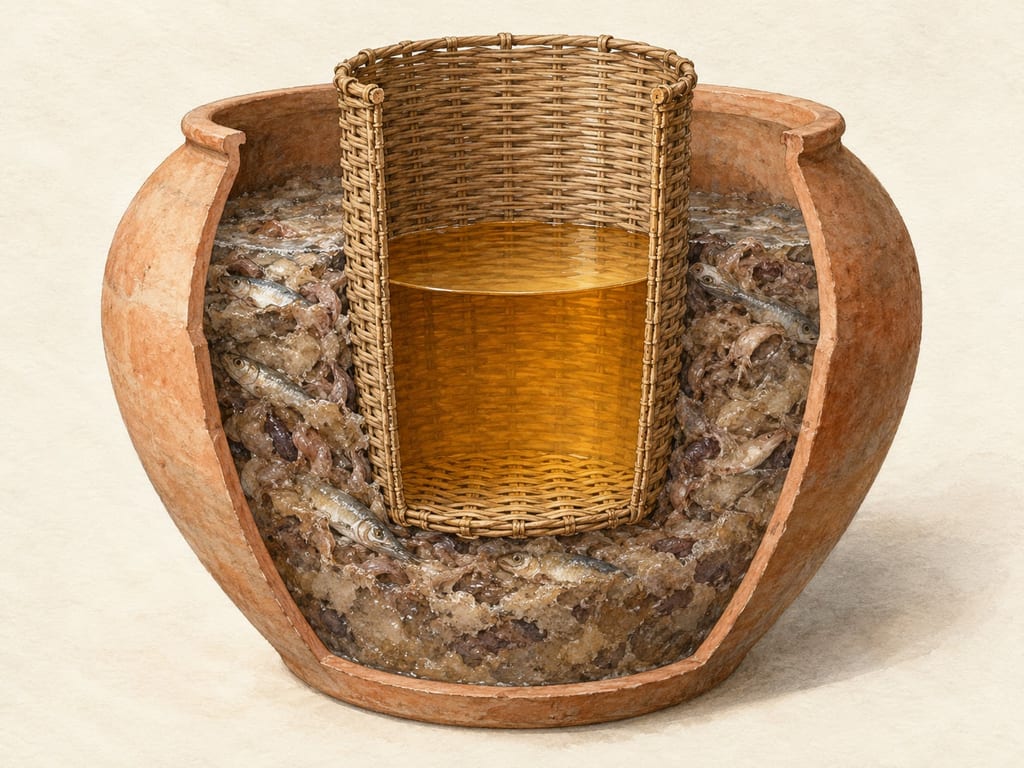
The first method is called liquamen. Fish viscera are salted in a vessel together with small fish such as red mullet and anchovies, and the mix is stirred in the sun. After a summer, a large, thick basket is set into the vessel. The sauce seeps into the basket and is collected, and what stays behind is hallec.
The Bithynian method starts with small fish and two sextarii of salt for each kind of fish, left overnight. The fish then go into a clay vessel in the sun for two or three months and are stirred with a rod. Some makers add two sextarii of old wine for each sextarius of fish. A sextarius is a Roman measure.
The third method is for cooks who cannot wait. The brine must be salty enough to float an egg. Fish and brine are boiled with oregano, sometimes with syrup added, and the liquid is strained two or three times until clear. A pot replaces the months of sun.
The first two methods are slow ferments of the kind Grainger calls enzyme-fermented: salt holds back spoilage while enzymes already in the fish break down the flesh and viscera over weeks or months. The boiled version does not depend on that slow work.
The sauce named for blood
The fourth method is haimation, from the Greek word for blood. Tuna viscera, gills, juice and blood are salted and held for at most two months. The vessel is then pierced so that the sauce drains out.
Archaeology may hold an earlier trace. At Aila, now Aqaba, Van Neer and Parker found gill remains from at least 33 medium-sized tunas (Auxis) and one lizardfish (Trachinocephalus myops) at the base of an Early Roman jar. The volume of gill remains roughly matches the volume of the jar, and the authors conclude that the sauce was made at Aila.
This sits awkwardly beside the blood prohibition that Grainger suggests may have pushed Roman makers toward eviscerated fish. A recipe whose name means blood shows that blood-based sauce was still being written down in the Byzantine period. It does not show how many people ate it.
Cyprus, eleventh and twelfth centuries
The Cyprus Food Museum describes a sauce called garos and dates it to the Byzantine period, the 11th and 12th centuries. It is made from the entrails, gills and blood of the fish with ground vegetables and salt, and it is eaten hot. Diluted forms carry names built on the old word: ydrógaros with water, enógaros with wine, oxygaros with vinegar and, by the order of the museum's list, garéleon with oil.
The museum also names two kinds of self-heating ceramic vessel from 11th- and 12th-century Cyprus, saltsária (or saltserá) and garária (or garerá). It cites Koukoules (1952), Papanikola-Bakirtzi (1999) and Bakirtzis (1989). Oxygaros is the same compound that Arrian reports as oxygaron, set down many centuries later in a different place.
What the thread shows
Across more than a thousand years the name holds steady, from garos in the fifth-century fragments to oxygaros in medieval Cyprus. The methods do not sit still. The Geoponika alone offers a sun-cured viscera sauce, a Bithynian fish-and-salt sauce, a boiled brine and a blood sauce that drains from a pierced vessel.
What nobody has found is the fifth-century method. The Athenian fragments cannot be read back from the Byzantine chapter, and the Byzantine chapter cannot be read forward into the Cypriot sauce without evidence that links them.
Community
No community contributions have been published for this entry yet.
Share what you made
Sign in to contribute. Published comments and photos are free to read.
Sources
Digital Encyclopedia of Atticism (Batisti; ed. O. Tribulato)
γάρος, γάρονCited in: Lines of dialogue, never a recipe; A condiment, a gender problem and a fish that may not exist; Cyprus, eleventh and twelfth centuries; What the thread shows
Latin Wikisource
Pliny the Elder, Natural History 31.93-97 (Latin text)Cited in: A condiment, a gender problem and a fish that may not exist; What the Romans said, and what they built
Oxford Roman Economy Project
Quantification of fish-salting infrastructure capacity in the Roman worldCited in: What the Romans said, and what they built
Antiquity 99(406)
Roman Atlantic garum: DNA confirms sardine use and population continuity in north-western IberiaCited in: What the Romans said, and what they built
Studia Ceranea 14
Garum, Fish Blood Taboos in the Judaeo-Christian World and the Evolving Nature of Ancient Fish SauceCited in: Why the sauce changed in the later empire; Four methods in one Byzantine chapter; The sauce named for blood
Selodemar
Geoponika, Book XX, chapter 46: Fabrico de garum (translation page)Cited in: Four methods in one Byzantine chapter; The sauce named for blood; What the thread shows
Journal of Archaeological Science (VLIZ repository)
Van Neer and Parker, Journal of Archaeological Science 35 (2008), pp. 1821-1827Cited in: The sauce named for blood
Gaps
- No Greek production method earlier than the Geoponika chapter has been found, and its own date varies between the ninth and tenth century. The Greek text and the published Spanish and English translations were not compared.
- Pliny's clause about the Greek name garon, and the Aila jar's exact date, are not resolved here. Van Neer and Parker were read as an abstract only.
- The Cyprus dating, the diluted sauces and the vessels rest on one museum page; the publications it cites were not read.
Updated 2026-10-29