
Garum intake
Comparisons that reveal the most about garum
Which comparisons with living fish sauces, grain sauces and fermented fish pastes explain how garum was made, and which ones only look alike.
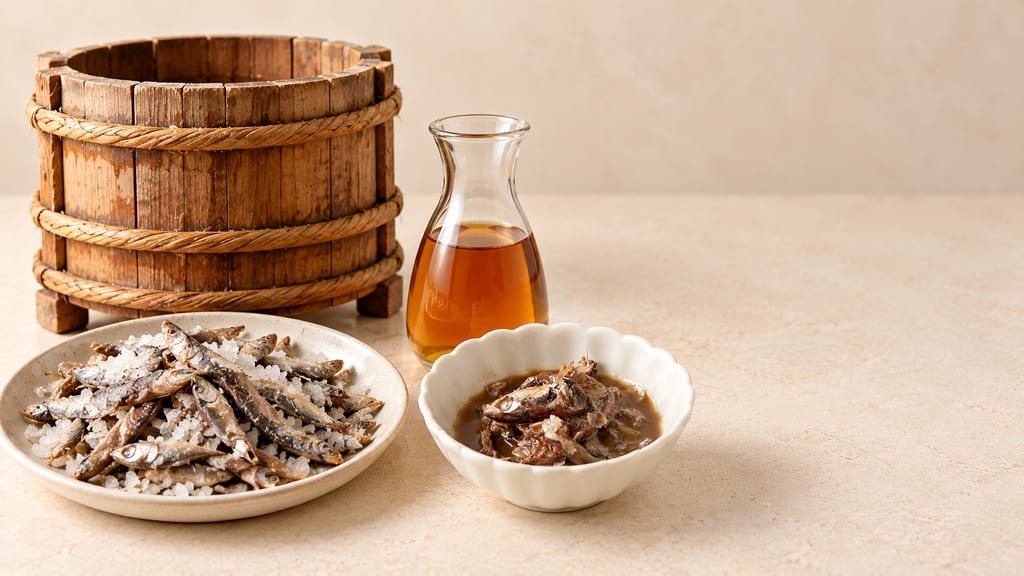
Salted anchovies, a wooden fish-sauce vat and a bowl of salted fermented anchovy: living relatives that help explain garum.
Resemblance is not descent
Garum sits beside many other salted, fermented and concentrated seasonings: nam pla, bagoong, ishiri, colatura, murri and the modern koji-assisted sauces that borrow the ancient name. Put side by side, they look related. The useful question is narrower: which features of production actually match, and which ones only resemble each other on the table.
A comparison helps when it sets out a specific process. Whole-fish liquamen and Thai or Vietnamese fish sauce share a long salted maturation followed by the extraction of a liquid. Haimation and other viscera-rich sauces point to the organs and digestive enzymes in the starting material. Allec and bagoong keep solids in the product. Murri relies on a mould-cultured grain substrate to supply enzymes. These are process comparisons. They do not draw a family tree, and they do not show that one tradition passed to another.
What to record before comparing
Most comparisons fail because the record is too thin. The word fermented covers very different operations. A sound comparison records the exact local name, the place and community, the dated evidence, and the starting material. It then records the source of the enzymes, the salt basis, whether grain is present, the temperature, the length of maturation and the finished form.
The finished form matters most. A product can end as a liquid, a paste, retained fish, a dried food or a fat. Two sauces that share a raw material can differ entirely in what the cook receives. Garum was a liquid seasoning in the sources that describe it in detail, but the same fish could also be kept as solids, pressed into pastes or dried, so a single name hides more than it tells.
Evidence also needs to stay sorted by kind. Archaeology can identify fish species and the installations that processed them. Written texts preserve names and recipes, and each text has its own date and its own author. Modern field studies record living manufacture. A dated claim from one kind should not be used to confirm a claim from another.
Whole fish and the liquid line
The closest living comparison to liquamen is the family of salted fish liquids of Southeast Asia. Vietnamese nước mắm and Thai nam pla are both fish sauces in which salted fish matures and a liquid is drawn off for seasoning. The JIRCAS database entry for nam-plaa and the ICH account of nước mắm describe that arc.
The same arc has a hazard. A Japanese study of fish sauce fermentation isolated the bacterium responsible for histamine accumulation and found that inoculating the mash with a lactic acid bacterium starter suppressed histamine. This is the reason a process comparison has to include the microbiology. Two sauces with the same salt and time can differ in histamine risk if the starter and the raw material differ.
Liquid extraction is therefore only one half of the comparison. The salt basis, the presence of starter cultures and the timing of extraction decide what the cook receives, and a reader should not assume that a modern fish sauce reproduces an ancient one step by step.
Viscera and enzymes
Starting material changes the enzymes. Fish viscera carry proteolytic enzymes that break down muscle protein during maturation. Fernandes's review of enzymes in fish and seafood processing is the general reference for that effect, and it explains why a sauce made from whole fish, from fish trimmings or from viscera behaves differently even at the same salt concentration.
Ishiri and other viscera-rich Japanese sauces show the practice in a regional form. The MAFF page on ishiri, part of its traditional foods series, is the Japanese government reference used here for the product itself. The comparison relies on it only for the description of ishiri as a traditional fish seasoning, not for any claim about shared descent.
The viscera comparison also clarifies the ancient evidence. Ancient recipes name sauces by their components, and the phrase whole-fish or viscera-rich marks a difference that a single word like garum does not carry.
Retained solids: allec, bagoong and prahok
Some fish products keep the solids in the final food. Allec is the clearest ancient case. Bagoong and prahok are the pastes named in this comparison, in which the fish stays in the product rather than being drawn off as a liquid.
The useful comparison here is about function. A paste can supply the same savoury depth as a liquid, but the cook uses it differently: as a base, not as a splash. Because the solids remain, the texture, the salt distribution and the risk profile change with it. The SEAFDEC compilation of Southeast Asian fish products is a useful starting point for the range of solid and paste forms in the region.
The comparison also shows why ancient allec and garum should not be treated as the same product. The Roman sources separate the liquid from the residue, and a modern paste is a different finished form even when the fish is the same.
Grain and koji: enzymes from a separate substrate
Murri, the medieval Arabic condiment, is the clearest grain comparison. The Arabic recipe collection translated by Charles Perry describes a dark, very salty paste that appears in thirteenth-century recipes and seems to have fallen out of Arab kitchens about two hundred years later. The barley-based recipes in that collection involve fermentation of several months, while a modern adapted version uses bread or starch, carob and spices and no fermentation step.
Murri is a grain-based comparison, and its enzymes come from a separate substrate rather than from the fish. Koji-assisted garums use the same principle with a mould grown on a grain or bean base. The comparison answers a practical question: where do the enzymes come from? In a fish sauce they come from the fish and from any starter. In murri and koji sauces they come from a separately moulded substrate.
The Gulf connection is not established in the material reviewed here. The sources found describe murri in medieval Arab and Byzantine cooking, not in a documented medieval Persian Gulf setting, so that link stays open.
Names that travelled
A seasoning name can outlast the raw material that gave it. Grainger's study of the words garum and liquamen shows how the two names were used in different ways by different writers, and why a translated name should not be read as a fixed recipe.
Late-antique and later sauces that take the name liquamen or garum for a different material show the same pattern. The name marks a use, a texture or a place in the meal. The process behind it may be quite different. A comparison is only as sound as the record of the material and the maturation, which is why the name alone is never enough.
Dried fish, fat and concentrate
Some seasonings stop short of a liquid. Eulachon grease, made by Indigenous communities on the Pacific coast of North America, is a fat rendered from a fermented fish. The Yukon News account of a Klukwan family's practice describes the fish fermented for about ten days in a sealed, wood-lined pit, then rendered in a vat of more than 550 litres, with the oil skimmed off and sealed in quart jars. The article also says the fish ferment faster in the iron-rich soil at Klukwan.
Rihaakuru, the cooked tuna paste of the Maldives, is a concentrate rather than a fat. A 2011 PhD thesis at Massey University describes it as a cooked fish paste made from a tuna soup, and it reports histamine above 500 ppm in the products tested. The same thesis found that most histamine was probably produced by bacteria in the raw fish, which are likely to die during manufacture, and that histamine fell by 30 to 70 per cent over ten months of storage at -80, 4 and 30 degrees Celsius. No fermentation step is described for it, so rihaakuru is not treated here as fermented.
Both cases are useful because they show a seasoning function reached by another route: rendering a fat, or reducing a broth to a paste. Their comparison with garum concerns the finished form and the use, not the fermentation.
What the comparisons cannot show
A comparison narrows the field but does not settle history. The surviving Roman recipes, the Greek and Latin names, the archaeological tanks at Baelo Claudia and the living Southeast Asian sauces are separate kinds of evidence. Joining them into one story would overstate the link.
The comparisons do not yet establish, for each sauce, the starting fish, the enzyme source, the salt, the presence of grain, the maturation length and the finished form. Where that information is missing, it is left unstated rather than filled in.
Home attempts carry the same warnings as any fish ferment. Histamine, spoilage and the control of salt and temperature are safety questions that a resemblance does not answer. The sources cited here are not a validated home process, and the page does not give one.
Community
No community contributions have been published for this entry yet.
Share what you made
Sign in to contribute. Published comments and photos are free to read.
Sources
Sally Grainger; Journal of Maritime Archaeology / Springer Nature
Garum and Liquamen, What's in a Name?Cited in: Resemblance is not descent; What to record before comparing; Names that travelled
Sally Grainger; Routledge
The Story of Garum: Fermented Fish Sauce and Salted Fish in the Ancient WorldCited in: What to record before comparing; Names that travelled
Conjunto Arqueológico de Baelo Claudia / Google Arts & Culture
The Roman City of Baelo Claudia and the Secrets of GarumCited in: What to record before comparing
Pedro Fernandes; Frontiers in Bioengineering and Biotechnology
Enzymes in Fish and Seafood ProcessingCited in: Viscera and enzymes; Grain and koji: enzymes from a separate substrate
Meiko Kimura et al.; Nippon Suisan Gakkaishi / Japanese Society of Fisheries Science
Isolation and identification of the causative bacterium of histamine accumulation during fish sauce fermentation and the suppression effect of inoculation with starter culture of lactic acid bacterium on the histamine accumulation in fish sauce processingCited in: Whole fish and the liquid line; What the comparisons cannot show
JIRCAS, Database of Fermented Foods of Thailand
Nam-plaaCited in: Resemblance is not descent; Whole fish and the liquid line
Le Hai Dang; ICH Courier / ICHCAP
Nước Mắm (Nuoc Mam): A Savory Depth of Flavor in Vietnamese Culinary LifeCited in: Resemblance is not descent; Whole fish and the liquid line
Ng Mui Chng and Hooi Kok Kuang, compilers; SEAFDEC Marine Fisheries Research Department
Southeast Asian Fish ProductsCited in: Whole fish and the liquid line; Retained solids: allec, bagoong and prahok
Ministry of Agriculture, Forestry and Fisheries, Japan; MAFF, Traditional Foods in Japan
Fishery fermented foodCited in: Viscera and enzymes
Ministry of Agriculture, Forestry and Fisheries, Japan; MAFF, Traditional Foods in Japan
Ishiri / IshiruCited in: Viscera and enzymes
U.S. Food and Drug Administration; FDA
Fish and Fishery Products Hazards and Controls GuidanceCited in: Whole fish and the liquid line; What the comparisons cannot show
Coquinaria; account of the medieval Arabic recipe collection, translated by Charles Perry (Prospect Books, 2001)
MurriCited in: Grain and koji: enzymes from a separate substrate
Yukon News, published 24 May 2017
Eulachon, oolichan, hooligan: A fish by any other name is just as oilyCited in: Dried fish, fat and concentrate
Aishath Naila, PhD thesis, Massey University
Control of histamine in Rihaakuru: emerging approachesCited in: Dried fish, fat and concentrate; What the comparisons cannot show
Gaps
- No primary source for a medieval Persian Gulf murri is established.
- Academic sources do not confirm the fermentation claim for rihaakuru, so it is not stated as fact.
- The eulachon account is one family's practice at Klukwan, not a general description of Indigenous grease making.
Updated 2026-10-29