
Preservation intake
Less oxygen, more time: how stores and packs change the air around food
Apples keep longer in air with less oxygen. Researchers tested that in Cambridge and Queensland, and packers now use it for salads and meat. What the gases do, what they cost and what they cannot make safe.
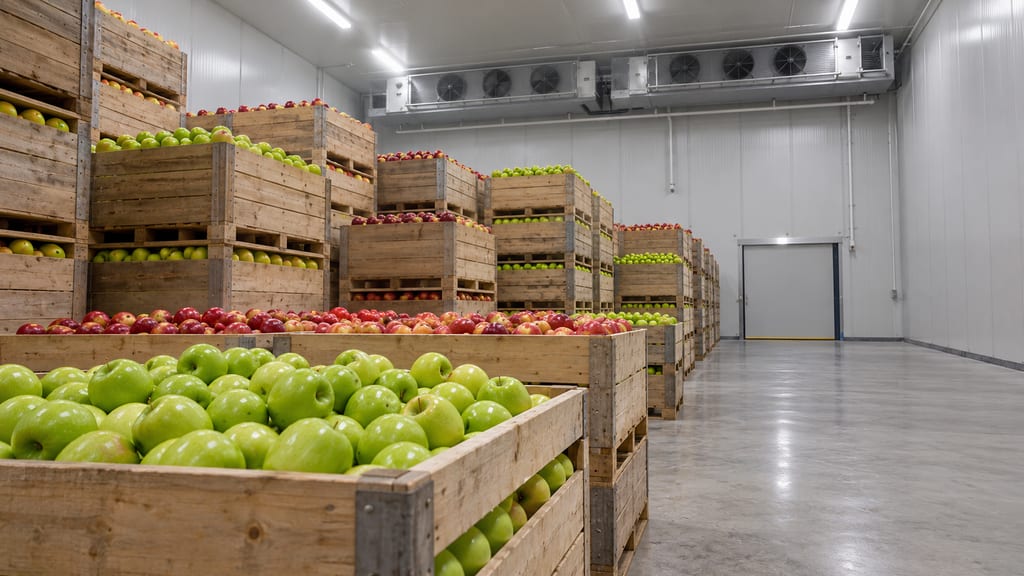
Apples in a sealed, insulated store, where the gas mix is held below the oxygen level of ordinary air.
Five atmospheres for one apple
In 1952, researchers at the Queensland Department of Agriculture stored Granny Smith apples in five different atmospheres. One was ordinary air. In the other four, oxygen was cut to 5% or 2.5%, and carbon dioxide was held at under 1%, 2.5% or 5%. Ordinary air, for comparison, is roughly 21% oxygen and 0.03% carbon dioxide.
Holding those numbers took work. Fruit changes the gas around it as it respires, so the team reset the mix with nitrogen and carbon dioxide from cylinders and checked it with an Orsat analyser, an instrument that measures the share of each gas in a sample.
The temperatures differed too. The control fruit stayed at 1 °C and the fruit in controlled atmospheres at 3 °C. What the trial found comes below. First, the idea behind it.
Air with the proportions changed
A controlled-atmosphere store is a room in which the gas mix is adjusted and held. Ordinary cold storage is different: there the oxygen and carbon dioxide levels are not controlled to specified values. A modified-atmosphere pack, or MAP, is a sealed package whose gas mix is set when the food goes in. UK guidance defines it as replacing air with a strictly controlled mixture of gases, usually chosen from carbon dioxide, oxygen and nitrogen.
The two methods share their gases and their aim, and they differ in how the atmosphere is kept. A store holds it by controlling the air in a large volume. A pack holds it with film, a seal and the food inside. Both depend on cold, which slows respiration and microbial growth, and a controlled atmosphere held at the wrong temperature may give little benefit.
Why a living fruit responds to gas
Fruit and vegetables stay alive after they are picked. They take up oxygen, give off carbon dioxide and heat, and age as their reserves are used. Lowering the oxygen and raising the carbon dioxide slows this respiration, and cold is the other half of the control.
The gases also change how produce responds to ethylene, the gas fruit gives off as it ripens. FAO lists a decreased sensitivity to ethylene at oxygen below 8% and carbon dioxide below 1%.
There is a floor as well as a ceiling. Bananas and tomatoes ripen irregularly when oxygen drops below 2% and carbon dioxide rises above 5%. A crop therefore has a window, with levels that do too little on one side and levels that damage the tissue on the other, and the window differs between crops. No single mix suits all produce.
Cambridge, and a slow spread
The best-known start is in Cambridge, with Franklin Kidd and Cyril West, who worked at the Low Temperature Research Station for the Food Investigation Board. Their Special Report No. 30, Gas Storage of Fruit, appeared in London in 1927. A Queensland paper of 1961 credits them with showing that certain English-grown apple varieties kept longer under refrigeration in an atmosphere with less oxygen and more carbon dioxide than normal air, and it dates that result to 1935.
Others confirmed it: Smock and Van Doren in 1939 and 1941, Huelin and Tindale in 1947, Mandeno and Padfield in 1953, and Martin and Cerny in 1956. Robert Smock of Cornell visited Cambridge in the late 1930s, and the first controlled-atmosphere rooms in the United States were built in New York in the 1950s.
Accounts of when it all began disagree. Popular accounts give 1917 or simply the 1910s, the report is dated 1927, and the first commercial facility is dated 1929. The range may reflect different milestones, from early trials to a working store, but the accounts do not settle it.
What the Queensland apples showed
The Queensland trial gave a clear winner and a practical problem. The most satisfactory atmosphere was 5% oxygen, but removing carbon dioxide from the store is expensive. A satisfactory alternative, if a scald inhibitor is used, was a mix of 16% oxygen and 5% carbon dioxide.
The carbon dioxide had its own price. Higher levels increased superficial scald, a skin disorder of stored apples, and the effect was strongest in fruit harvested before mid-April. So the two workable atmospheres traded one cost against another: the first needed expensive removal of carbon dioxide, the second needed a chemical treatment against scald.
These numbers describe one variety in one place. Modern fruit stores are described as taking oxygen down to 1.5–2%, with nitrogen and some carbon dioxide in its place, which is below the lowest level in the Queensland trial. Kidd and West’s own gas levels are not in the accounts available, so their figures cannot be compared with Queensland’s directly.
The same trick in a film
A pack applies the idea to a single serving. FAO gives a general target of 2–5% carbon dioxide, 2–5% oxygen and the rest nitrogen. For minimally processed produce, such as peeled or cut vegetables, it cites 2–8% oxygen and 5–15% carbon dioxide.
In a pack the gas works on microbes as well as on living tissue. Carbon dioxide has been used to control pathogens in both stores and packs. A high-oxygen mix inhibits aerobic and anaerobic bacterial growth and is particularly effective against enzymatic browning, the darkening of cut surfaces.
One worked example is prepeeled potatoes packed in 20% carbon dioxide and 80% nitrogen, kept in the dark at 4–5 °C. They are kept for 7–8 days, and sliced potatoes at 5 °C for 3–4 days.
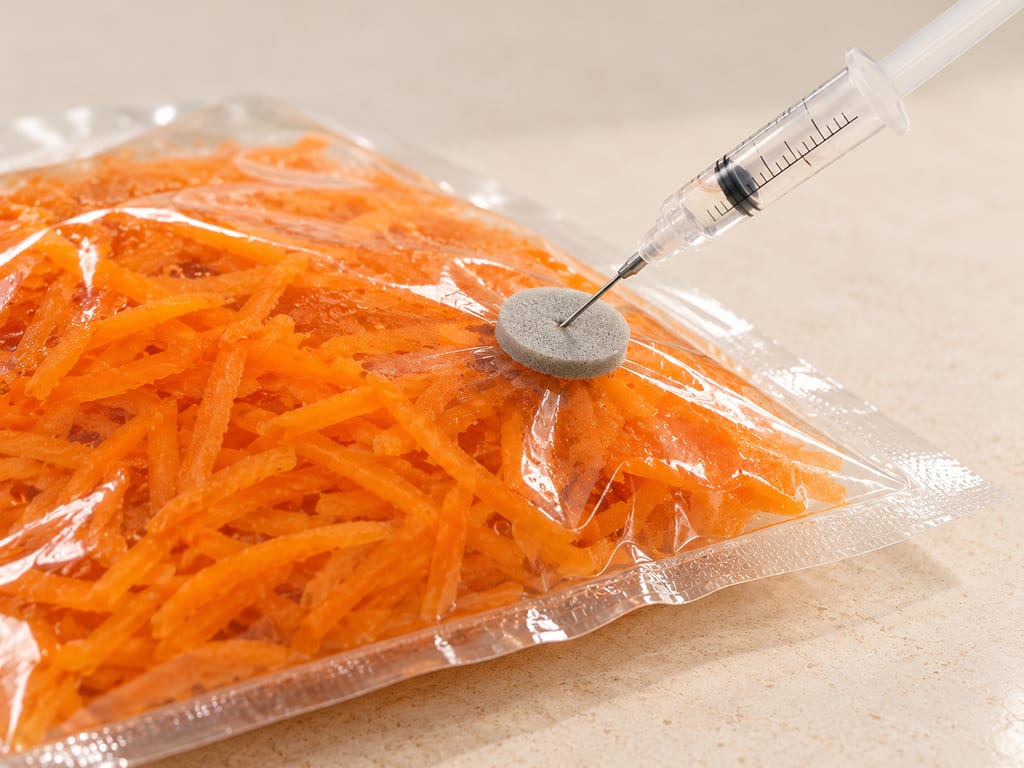
Packs are checked by drawing a gas sample through the film and measuring the oxygen and carbon dioxide inside.
Meat, fish and bread: ranges, not recipes
Published figures for fresh-meat packs run from 60% to 80% oxygen with 20–30% carbon dioxide, and the oxygen can reportedly fall to about 40–50% without major colour loss.
Fish, salad and bakery packs each use their own mixes, usually leaning on carbon dioxide, and the published numbers vary widely. Supplier pages, short abstracts and journal papers disagree, and several of these figures could be checked only in summary. Treat every number here as a range, not a specification.
What the gas cannot make safe
A low-oxygen atmosphere sounds protective, but it is not a safety guarantee. Refrigeration cannot be relied on alone to keep high-moisture food safe, because Listeria monocytogenes, which tolerates cold, can still multiply slowly in refrigerated food. Produce packs raise the same two questions: which spoilage organisms grow in them, and which foodborne pathogens may be on the produce.
UK guidance on vacuum and modified-atmosphere chilled foods is written around non-proteolytic Clostridium botulinum, a toxin-forming bacterium. It says that air, or any atmosphere containing oxygen, cannot be relied on as the sole control, because packs can contain oxygen-free areas. The outbreak foods it lists are baked potatoes in foil, organic hummus, black bean dip and carrot juice. Challenge studies found toxin forming as fast in air-packed food as in low-oxygen packs, and in some conditions faster.
Its limits are about temperature and time. Chilled storage must be kept at 3–8 °C, and a maximum shelf life of 10 days applies between 3 and 8 °C unless adequate controlling factors are in place. At least 3.5% salt in the water phase of the food is one of them. The guidance treats re-wrapping a pack and restarting the 10 days as a great concern.
This is UK guidance, not law, and it sets no general limit for pathogens. A 2020 consultation looked again at the 10-day rule for fresh beef, lamb and pork, and no final decision turned up.
What a label tells you
The gas is one control among several. A label that says a food is packed in a protective atmosphere tells you what the gas is for. It does not tell you that the food is safe or that it will keep past its date. Cold, a date set for that product and any extra controls such as salt do the rest of the work.
The apple trials show the same pattern in a store: a gas mix, a temperature, a harvest date and a chemical treatment had to be balanced together. What is still missing is the early record. Kidd and West’s own gas levels and a firm start date remain to be found.
Community
No community contributions have been published for this entry yet.
Share what you made
Sign in to contribute. Published comments and photos are free to read.
Sources
Food and Agriculture Organization of the United Nations
Chapter 5. Procedure for Vegetables Preserved by Combined MethodsCited in: Five atmospheres for one apple; Air with the proportions changed; Why a living fruit responds to gas; The same trick in a film; What the gas cannot make safe
Queensland Department of Agriculture
Controlled atmosphere storage of Queensland grown Granny Smith apples (Stevenson, Watkins and Blake, Queensland Journal of Agricultural Science 18(4), 1961)Cited in: Five atmospheres for one apple; Cambridge, and a slow spread; What the Queensland apples showed; What a label tells you
Wikipedia
Controlled atmosphere (cites Kidd and West, Gas Storage of Fruit, Food Investigation Board Special Report No. 30, 1927)Cited in: Cambridge, and a slow spread; What the Queensland apples showed
Food Standards Agency and Food Standards Scotland
Food Standards Agency guidance on the safety and shelf-life of vacuum and modified atmosphere packed chilled foods with respect to non-proteolytic Clostridium botulinumCited in: Air with the proportions changed; What the gas cannot make safe; What a label tells you
AGRIS, Food and Agriculture Organization of the United Nations
Modified atmosphere packaging and its effects on the microbiological quality and safety of produce (Phillips, 1996)Cited in: What the gas cannot make safe
Latvia University of Agriculture
FoodBalt 2014 proceedings, modified atmosphere packaging of fresh meatCited in: Meat, fish and bread: ranges, not recipes
Foods 13(6):902, 2024 (Carpenter and colleagues)
Comparison of Gas Treatments of High Oxygen, Carbon Monoxide, and Nitric Oxide on Ground Beef Color in Modified Atmosphere PackagingCited in: Meat, fish and bread: ranges, not recipes
Gaps
- The Kidd and West report and 1935 paper were not retrieved, so their gas levels are unknown and the start dates stay in conflict.
- Peer-reviewed gas mixes for meat, fish, salad and bread were not confirmed, and the published figures disagree.
- The UK guidance is not law and sets no general pathogen limit, and the outcome of the 2020 consultation on the 10-day rule was not found.
Updated 2026-10-29