
Preservation intake
Guard duty: the microbes hired to keep Listeria out of food
Food makers add protective bacteria, the antimicrobial peptides those bacteria make, and even bacteria-killing viruses to hold back Listeria. Each is chosen, dosed and aimed at a narrow target, which is what sets it apart from fermentation.
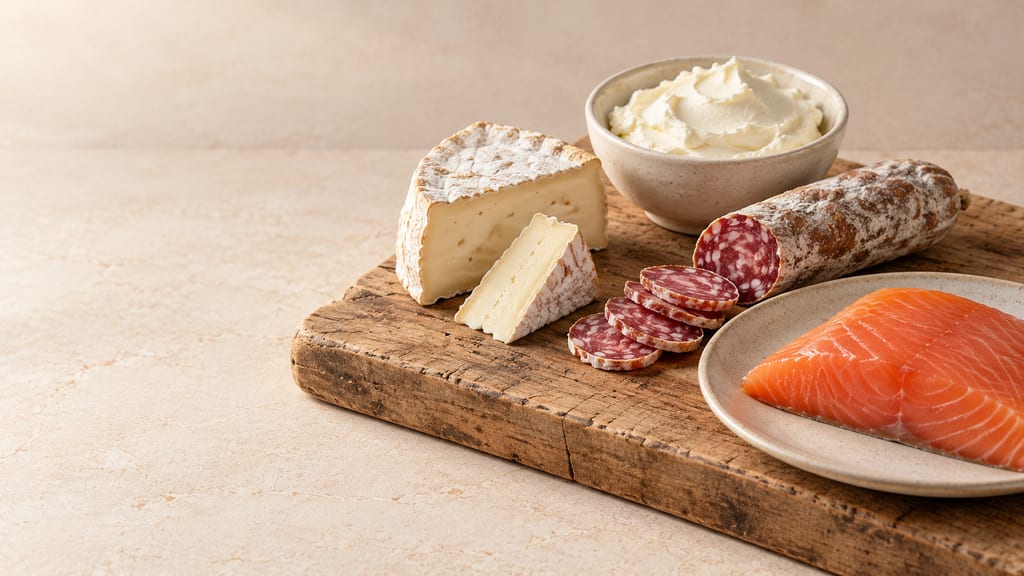
Foods where nisin is permitted or where protective agents have been tested: ripened cheese, mascarpone, dry sausage and smoked fish.
One bacteriocin, a short list of foods
In the European Union, exactly one bacteriocin may go into food, and only into a short list of foods: ripened and processed cheeses, dairy-based puddings, clotted cream and mascarpone. In cheese the highest permitted concentration is 12.5 mg/kg. That is how Food Standards Scotland describes the rules in its guidance on smoked fish. The bacteriocin is nisin, and the narrowness of the permission is the first thing to understand about deliberate biological preservation. It is a set of precise tools, each cleared for particular foods, not a general way of making food safe.
A bacteriocin is an antimicrobial peptide that a bacterium makes. Some kill a wide range of other bacteria and some only a few. Many come from the lactic acid bacteria that already live in food, and a bacteriocin can give a food a defence that keeps working after it leaves the factory. Nisin is made by Lactococcus lactis, and it was already the subject of a paper titled Nisin in food preservation in 1966.
Nisin has two companions. Protective cultures are living microbes added to a food to hold back specified unwanted organisms. Bacteriophages are viruses that infect and destroy particular bacteria. All three are used against the same kind of target, above all Listeria monocytogenes, and each has its own rules, limits and evidence.
Where this stops being fermentation
A fermented food is made by microbes: they sour it, transform it and give it its character. Biopreservation has a different purpose. The protective agent is picked for one job, which is holding back a named spoiler or pathogen. It goes in at a measured dose, and the food is checked for the result. A cook who leaves cabbage in brine relies on whatever microbes arrive with the cabbage. A producer who adds nisin or a protective culture supplies a known compound or organism aimed at a known target. That should make outcomes more predictable than a spontaneous ferment, though head-to-head measurements of the two are missing from the evidence.
The line is not drawn by the organism. The same lactic acid bacteria that sour a ferment can make bacteriocins, and bacteriocins from food-grade lactic acid bacteria also help shape the desirable flora of fermented foods. What separates the two is control and intent: whether the microbe is there to make the food or to guard it.
It is just as important to say what protective agents are not. They give no universal protection. A protective culture is an adjunct to a product, and a bacteriocin works within the permitted uses and the activity spectrum it has. A phage covers only the bacterial host it targets. Food Standards Scotland lists them among decontamination treatments for smoked fish, one part of a larger safe-smoked-fish toolkit. None of them lets a cook judge a food safe by its smell, its taste or its bubbles.
Nisin in the rulebooks
In 2017 the European Food Safety Authority reviewed nisin (E 234) in the light of new toxicology and a proposed extension of its use. The panel raised the acceptable daily intake from 0.13 mg/kg of body weight to 1 mg of nisin A per kg of body weight per day. The new figure rests on a no-observed-adverse-effect level of 225 mg nisin A per kg of body weight per day, the highest dose tested in a 2010 study by Hagiwara and colleagues, with an uncertainty factor of 200.
The proposed extension asked for a maximum of 12 mg/kg in unripened cheese and 25 mg/kg in heat-treated meat products. EFSA's own opinion states the cheese figure as 12 mg/kg in its conclusions and as 12.5 mg/kg in its background section, and it does not reconcile the two. The panel concluded that the extension would not be of safety concern. It also recommended that the risk of nisin inducing antimicrobial resistance in pathogenic bacteria be evaluated separately.
In the United States the FDA's partial list of microorganisms and microbial-derived ingredients, current as of 2018, shows nisin as affirmed as generally recognised as safe under 21 CFR 184.1538. The listed use is as an antimicrobial agent to inhibit the outgrowth of Clostridium botulinum spores and toxin formation in pasteurized cheese spreads. The list gives no numeric limits, and it is a partial list.
Delay, not prevention
Nisin slows bacteria down more reliably than it stops them. In the fish tests Food Standards Scotland describes, higher nisin levels delayed growth in vacuum packs stored at 5 °C but did not prevent it. Control on smoked fish needed 500–1000 units of nisin per cm² of fish. Listeria monocytogenes can also develop resistance to an individual bacteriocin, which is the same concern EFSA flagged when it asked for the risk of resistance to nisin to be assessed on its own.
That is why a bacteriocin appears as one barrier among several. It tilts the odds in food held cold in storage. It does not remove the need for the other controls around that food.
Pediocin and the sausage trials
Pediocin PA-1 is a bacteriocin tied to Pediococcus acidilactici, and a review also names Pediococcus pentosaceus OZF as a producer of pediocin AcH/PA-1. It attacks Listeria through the cell membrane. The peptide first binds electrostatically, and a hairpin at its C-terminal end then inserts into the membrane and forms pores. Through those pores ions leak out, ATP escapes from the cytoplasm, and the proton motive force that powers the cell collapses.
The trials in meat show what that costs Listeria and how much depends on conditions. A fall of 1 log is a tenfold drop in counts, so 2 log is a hundredfold drop. In dry-fermented sausage, a 2010 trial recorded a 2 log decrease in Listeria monocytogenes after 30 days. In frankfurters treated at 5,000 BU/ml, counts fell by 2 log after 60 days at 4 °C, but by only 0.6 log after 30 days at 15 °C. In irradiated chicken, a 2014 trial measured a reduction of 3.8 log cfu/g after 14 days at 4 °C, and the bacteria regrew after three to four weeks.
Portuguese traditional sausages gave the strongest result. At 1,280 AU/g, Listeria monocytogenes was undetectable after 14 days under refrigeration, and combined with a pressure treatment of 300 MPa for 5 min at 10 °C it was eliminated, in a 2017 trial. Across these results the effect of the bacteriocin depends on the food, the time and the temperature, and regrowth can overtake it, which is why combining it with a second hurdle, as the pressure trial did, is worth testing.
Protective cultures: crowding the pathogen out
A protective culture is a selected microbe added to suppress specified undesirable organisms. Reviews describe three routes: competitive exclusion, acidification, and the production of bacteriocins and other compounds. How well a culture works depends strongly on the strain and on the food it is in. The evidence here is thin, and what follows is reported at abstract level.
One study of cottage cheese reported that the main way a culture held back Listeria was by depleting manganese, a trace element, without any bacteriocin involved. A modelling study found that pH was the main limit on Listeria growth against a Lactococcus lactis strain that does not make nisin. A commercial meat culture based on Lactobacillus curvatus was reported to lower Listeria by 0.72 and 1.21 log10 cfu/g after 3 and 21 days, a modest effect by the measure used above.
Viruses with a single target
A bacteriophage is a virus that infects bacteria, and the phages used in food are lytic: they multiply inside the host and burst it. Each phage recognises particular hosts, so a phage preparation is precise by design, and its host specificity limits what it covers.
US federal regulation 21 CFR 172.785 describes a Listeria-specific bacteriophage preparation as a blend of six separately purified lytic bacteriophages in equal proportions. The mean titre is 1 × 10⁹ plaque-forming units per mL for each phage. Listeriolysin O must not exceed 5 hemolytic units per mL, and total organic carbon must be 36 mg/kg or less. The preparation is for direct application to ready-to-eat meat and poultry products, as defined in 9 CFR 430.1, as a spray of about 1 mL per 500 cm² of product surface.
Europe is more cautious. Food Standards Scotland states that Listex P100 and PhageGuard are not permitted for fish in the EU or UK, and that EFSA does not quite recognise their safety and efficacy. The same page reports a test in which a combined bacteriocin and phage treatment eliminated Listeria from hake and salmon fillets in under two days.
A phage against a drug-resistant strain in milk
A 2025 laboratory study shows both the promise and the limits. The phage vB_LmoP_M15 is a research isolate, not a commercial product. The researchers inoculated pasteurised full-fat milk (3% fat) with about 3.0 log10 CFU/ml of a pan-drug-resistant Listeria monocytogenes isolate called KCh5. They added 18.5 mM calcium chloride and phage at a multiplicity of infection of 100, which means 100 phage particles for each bacterial cell, and held the milk at 30 °C for 7 days.
By day 7 the untreated milk held 7.55 log10 CFU/ml and the treated milk 5.1, a reduction of 2.45 log10 CFU/ml. The phage blunted the growth of a strain that antibiotics could not touch, but it did not clear the milk. The isolate also proved fragile. Its activity fell by about 20% at 40 °C and about 50% at 50 °C, and none was detected at 60 °C or above, after 10 min. Acid at pH 2 and 3 and alkali at pH 9–13 inactivated it. For this isolate, heat or harsh pH would end the treatment.
The phage has no stated regulatory standing.
What to take from it
Deliberate biological preservation is a narrow tool applied to specific foods against specific bacteria. The permitted uses are listed food by food. Doses are set per kilogram, per square centimetre of surface or in plaque-forming units, and the effects measured so far are often a delay or a partial reduction. For someone fermenting at home, none of this describes what happens in the jar. A ferment is a different activity, even when the same bacteria are present.
Much remains open: whether the extended nisin uses EFSA assessed were adopted, how far Listeria resistance to bacteriocins will spread, and which traditional foods, if any, rely on protective cultures on purpose. Nothing found so far links protective cultures to a named traditional food. A food carrying nisin, a protective culture or a phage still cannot be judged safe by smell, taste or bubbles.
Community
No community contributions have been published for this entry yet.
Share what you made
Sign in to contribute. Published comments and photos are free to read.
Sources
Chemistry and Industry, 1966; PubMed record 5907030, US National Library of Medicine
Nisin in food preservationCited in: One bacteriocin, a short list of foods
Food Standards Scotland, Safe smoked fish tool
Potential fish decontamination treatmentsCited in: One bacteriocin, a short list of foods; Where this stops being fermentation; Delay, not prevention; Viruses with a single target; What to take from it
EFSA Panel on Food Additives and Nutrient Sources added to Food, EFSA Journal 2017;15(12):5063
Safety of nisin (E 234) as a food additive in the light of new toxicological data and the proposed extension of useCited in: Nisin in the rulebooks; Delay, not prevention; What to take from it
US Food and Drug Administration
Microorganisms & Microbial-Derived Ingredients Used in Food (Partial List)Cited in: One bacteriocin, a short list of foods; Nisin in the rulebooks
Frontiers in Microbiology 12, 2021
Antibacterial Activity of Pediocin and Pediocin-Producing Bacteria Against Listeria monocytogenes in Meat ProductsCited in: Pediocin and the sausage trials
Nature Reviews Microbiology 3(10):777-788, 2005; PubMed record 16205711
Bacteriocins: developing innate immunity for foodCited in: One bacteriocin, a short list of foods; Where this stops being fermentation; Protective cultures: crowding the pathogen out; What to take from it
Code of Federal Regulations, as published by the Legal Information Institute, Cornell Law School
21 CFR 172.785 - Listeria-specific bacteriophage preparationCited in: Viruses with a single target
Frontiers in Microbiology 16, 2025
Lytic bacteriophage disrupts biofilm and inhibits growth of pan-drug-resistant Listeria monocytogenes in dairy productsCited in: A phage against a drug-resistant strain in milk
Gaps
- Whether EU rules adopted the extension of nisin use that EFSA assessed in 2017 is not established, and the FDA list used is partial and dated 2018.
- Sources disagree on whether the FDA has approved pediocin, and no approved level for pediocin was found.
- No full paper on competitive exclusion was read, and no source links protective cultures to a named traditional food.
Updated 2026-10-29