
Garum intake
One fish, four decisions: why salted fish becomes sauce here and paste there
Cetara's amber colatura, Thai nam pla, Cambodian prahok and Korean jeotgal all start with fish and salt. A few choices separate them, and the published figures for those choices often disagree.
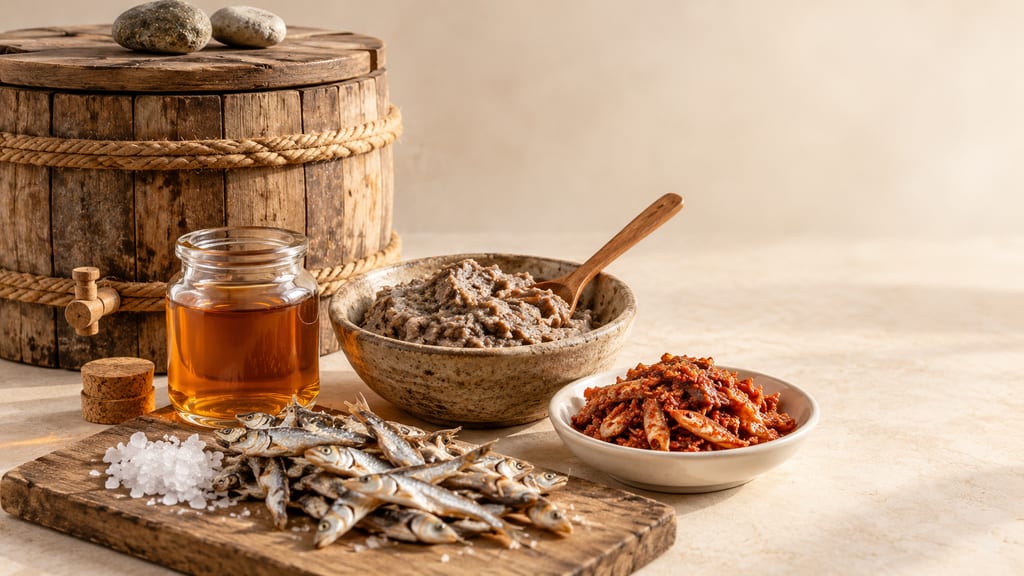
Wooden vats of maturing fish sauce, a bowl of paste and a jar of clear amber sauce: the same salted fish, kept as liquid or as solid.
A barrel of gutted anchovies
In the Gulf of Salerno the anchovies are caught by cianciolo lampara from late March to late July. At Cetara they are beheaded and gutted by hand and laid in an oak terzigno, a third of a barrel, layered with salt and set head against tail. A wooden disc goes on top, weighted with sea stones. Over the following months a liquid gathers. It is drawn off through a hole in the barrel with a tool called the vriale and concentrated in summer sunlight, and what comes out is clear and deep amber.
That barrel is one answer to a question that cooks from Cambodia to Korea have answered in their own ways: what do you do with a great many small, perishable fish and a great deal of salt? The chemistry underneath is shared. Enzymes break proteins into peptides and free amino acids, among them glutamate, which carries the savoury taste. A fish supplies some of those enzymes itself, from its muscle and its digestive organs. Microorganisms add more, along with flavour compounds of their own. How much each contributes differs from product to product.
Four decisions separate one product from another. Which part of the fish goes in. How much salt. How long it is left, and how warm. And whether the maker wants the liquid that drains off, the solid that stays behind, or both. A third route, fish packed with rice, changes the picture again. The sections below take the decisions in turn and give the published figures for each. Where sources disagree, both figures appear.
Liquid or paste: what you keep
A sauce is what you drain off. A paste is what stays. Thai nam pla shows the sauce route in full. Fish is packed with salt in wooden or cement tanks and held under the brine by a weight. The liquid is drawn off through a spigot or skimmed, filtered and exposed to the sun. The residue is extracted again, up to three or four times, with strong brine, and the extracts are blended into grades.
Other places draw the line differently. In the Philippines patis is the liquid, and bagoong keeps more of the fermented material; bagoong isda is made from fish and bagoong alamang from small shrimp. In Korea, jeotgal covers whole salt-ripened fish, shrimp, flesh, roe, gills and viscera, and aekjeot is its liquid branch. In Cambodia prahok is a paste that comes in a bone-containing form, prohok ch'oeung, and a fleshier one, prohok sach, and in some production a liquid is drawn off while prahok is made.
Thai kapi shows how much handling a paste can take. Small shrimp are tossed with 15–30% sea salt and rest for one to two days in a basket or vat. They are then dried in the sun until they have lost about 70% of their weight, pounded to a sticky mass and packed into earthenware or wooden vats. The liquid that drains away during this process can be used to make fish sauce. So liquid and paste are not always rival products. They can be two outputs of one process, and the maker decides which one carries the name.
Whole fish, or the insides
Cetara removes the head and guts before salting. Elsewhere the raw material is the whole catch, or the insides alone, and the choice shows in the names. On Japan's Noto Peninsula, ishiru is made from sardines. It matures for about six months to a year and is drained from the bottom of the vat, boiled, filtered and bottled. Its relative ishiri is made from squid, carries more visceral fat and takes less salt, though no exact ratio is given. It matures for about two years, and in Noto Town for one to two years more. In Akita, shottsuru is made from salted sandfish that liquefy over a year or longer.
Korean work on jeotgal tests the point directly. A 24-month study compared anchovy, cutlassfish viscera and small croaker. The pH of all three stayed at about 5.7–6.0, and the microbial community differed with the raw material.
Some products lean heavily on the fish itself. Researchers who studied momoni, a Ghanaian fermented fish condiment, suggest that the fish's own enzymes drive its fermentation. They reasoned from a pH above 6.0, lactic acid bacteria at only about 1,000 per gram and a high salt content.
How much salt, and measured how
Salt is reported in three ways, and the figures do not line up. Some sources give a weight ratio of fish to salt, where 3:1 means one part salt in every four by weight, or 25% of the total. Others give salt as a percentage added to the raw material, or as the concentration found in the brine or the finished product. Compare within one kind of measure, not across.
By ratio, Thai nam pla is made with anything from 5:1 to 1:1 fish to salt. Descriptions of nuoc mam from Phu Quoc commonly quote about 3:1. A separate Vietnamese record gives 4:1 for scad and 6:1 for cyprinids, the carp family. Pla ra and padaek, the Thai and Lao fish-and-rice products, take 3–5:1, with 4:1 for larger fish and 5:1 for smaller ones.
By percentage, the finished Thai shrimp paste measures 20.5% sodium chloride in a low-salt version and 30.5% in a high-salt one. The brine of Malaysian budu measured 21.5–25.7%. A survey of Cambodian prahok, kapi and toeuk trey found 170–270 g of sodium chloride per kilogram, and Indonesian terasi averaged 16.75 g per 100 g. A laboratory study of Korean anchovy sauce used 270 g of solar salt per kilogram of fresh anchovies plus 400 mL of 25% brine in each container, and the brine held at about 24.7%. That study writes its 25% as weight per weight in one place and weight per volume in another. The figure above is the one from its methods.
Salt also decides who does the work. In a study of ten pla ra and padaek products from central, northern and northeastern Thailand and from Vientiane, a salt concentration of about 10% divided the samples into two groups. In one, Tetragenococcus dominated; in the other, Lactobacillus. Both are lactic acid bacteria, and every product held between two and eight species of them.
How long, and how warm
Maturation runs from weeks to years. Thai nam pla takes 5 to 18 months, though the product table in the same database lists 18. Ishiru takes six months to a year, shottsuru a year or longer, and ishiri about two years. Thai kapi needs at least four months with low salt and at least six with high salt. The high-salt version is best at 14–16 months and loses its character after about 18. Pla ra needs at least six months. Narezushi, the salted fish fermented with rice, is ready in one to three months in its fresh form and takes at least a year, sometimes two or three, in its aged form.
Several of the best-known products carry figures that collide. A single paper on budu gives 6–12 months in its introduction and 6–18 months in its abstract. Phu Quoc nuoc mam is described as 12–15 months in wooden barrels, while other accounts give 6–12 months, and others 9 months or a year. The Cetara producer describes about four to five months, usually ending between late October and early November. The protected designation for Cetara colatura is cited at no less than nine months. These cannot all describe the same product, and none of the competing figures should be treated as the right one until the specifications themselves are checked.
The times are what producers and specifications set for flavour and character, such as the point at which a high-salt kapi starts to lose its best qualities. They are not safety deadlines.
Temperature moves the result too, though few of the sources record it. Budu is matured in earthen containers at room temperature. A Korean laboratory study held anchovy sauce at 15, 20, 25 and 30 °C for 473 days. The pH started at about 6.0. At 20–30 °C it rose to 7.2–7.4, while the 15 °C samples fell below 5.8 after about 200 days. Biogenic amines were not detected in the samples. That was a controlled experiment, not a household recipe.
Fish packed with rice
Adding a grain gives the fish a different environment, and these products keep their solids. For pla ra and padaek the fish is salted at 3–5 parts to 1 part salt, and then it is mixed with roasted rice at 10 parts fish to 1 of grain, or with rice bran at 5 to 1. Initial salting lasts anything from a day to three months. The jars then ferment for at least six months, with 6 to 10 listed. The fish keep their shape, and the flesh softens and dissolves when boiled. In the study of ten products, glutamic acid, the savoury compound, rose over four to six months.
Narezushi, from Japan, belongs to the same route. The fish is salted for about a month and then rinsed, and cooked rice ferments alongside it. Its origin is considered to have come with rice cultivation, and no date is attached to that.
Fermented does not always mean sour
The word fermented suggests the sourness of sauerkraut. Salted fish often do not follow that path. Terasi had a pH of 7.53, and 65.7% of its bacterial isolates were Bacillus. Momoni's pH was above 6.0, with Bacillus making up 37.7% of 67 strains from nine genera. The Korean anchovy sauce drifted toward alkaline at 20–30 °C. Prahok, kapi and toeuk trey ran the other way, with acetic acid (1.9–26.6 g/kg, highest in 10 of 13 samples) and lactic acid (0.4–12.9 g/kg). Their authors suggest the high salt holds back the Gram-negative bacteria that cause putrefaction.
Even one named product can vary. A study of budu sampled seven brands, 20 bottles and 60 samples. Tetragenococcus averaged 38.77% of the bacteria, reached 98.62% in one sample and was present in nearly all of them. But the microbial community varied between brands and between bottles of the same brand. Two jars sold under one name can be different ecosystems.
Garum, the same choices in a Roman workshop
Pliny the Elder wrote in the first century CE that garum was made from the guts of fish and the other parts that would otherwise be thrown away, soaked in salt. That is the opposite end of the first dial from Cetara's gutted anchovy. His celebrated garum sociorum used scomber, a mackerel, at Carthago Spartaria. He also names allec, the sediment of garum, the dregs, neither whole nor strained. The liquid and the solid were already two products from one vessel.
The Geoponica, a tenth-century Byzantine compilation, preserves four distinct methods. In the first, small fish and entrails are salted, stirred in the sun and filtered through a woven basket, and the solids left behind are alix. In the second, fish and salt stand in earthenware in the sun for two or three months. In the third, a shortcut, fish are cooked in strong brine with oregano and filtered. In the fourth, haimation, tuna entrails, gills and blood are salted and left for up to two months before the liquid is drained. These are separate preparations from a medieval text, not one Roman recipe. Neither Pliny nor the Byzantine compilation gives a salt ratio.
Reading a ratio
A fish-to-salt ratio on its own tells you little. It matters what the salt is measured against, how long the fish is left, how warm it is, and whether the liquid or the solid is the product. A seasoning's name carries the least information of all. Budu, nuoc mam and colatura are all anchovy and salt, and the figures above show how far such products diverge in ratio, time, acidity and microbes.
The figures here are what producers and researchers recorded. They are not tested instructions. Health guidance on Egyptian fesikh, a salted fermented fish, links outbreaks to fish that were not gutted and raises concern about biogenic amines. A fish product that smells savoury is not thereby safe.
Much remains unknown. No full-text ratio or time was found for prahok, bagoong, belacan or pekasam. The conflicts over Cetara and Phu Quoc await the designation texts. For Roman and Byzantine garum, the texts leave times and methods but no amounts of salt. Fish, salt and time are a short list of ingredients. The spread of results comes from how each maker sets them.
Community
No community contributions have been published for this entry yet.
Share what you made
Sign in to contribute. Published comments and photos are free to read.
Sources
Colatura di alici di Cetara (producer)
Colatura di Alici di Cetara: productionCited in: A barrel of gutted anchovies; Whole fish, or the insides; How long, and how warm
Mouritsen, Duelund, Calleja and Frost, International Journal of Gastronomy and Food Science (2017)
Flavour of fermented fish, insect, game, and pea sauces: Garum revisitedCited in: A barrel of gutted anchovies
JIRCAS and Kasetsart University, Thai traditional fermented foods database
Nam-plaaCited in: Liquid or paste: what you keep; How much salt, and measured how; How long, and how warm
JIRCAS and Kasetsart University, Thai traditional fermented foods database
Plaa-raaCited in: How much salt, and measured how; Fish packed with rice
Marui et al., Bioscience of Microbiota, Food and Health 34(2) (2015); JIRCAS research results
Importance of salt concentration and long-term fermentation in the quality of salty-fermented freshwater fish paste in Thailand and LaosCited in: How much salt, and measured how; How long, and how warm; Fish packed with rice
Applications of Biotechnology to Traditional Fermented Foods, National Academies (1992)
Fermented Fish Products in the PhilippinesCited in: Liquid or paste: what you keep
JIRCAS and Kasetsart University, Thai traditional fermented foods database
Ka-piCited in: Liquid or paste: what you keep; How much salt, and measured how; How long, and how warm
Ministry of Agriculture, Forestry and Fisheries, Japan
Ishiri and ishiru (fish sauces of the Noto Peninsula)Cited in: Whole fish, or the insides; How long, and how warm
Ministry of Agriculture, Forestry and Fisheries, Japan
Shottsuru (Akita fish sauce)Cited in: Whole fish, or the insides; How long, and how warm
ACS Omega (2024)
Microbial Dynamics and Metabolite Profiles in Different Types of Salted Seafood (Jeotgal) During FermentationCited in: Liquid or paste: what you keep; Whole fish, or the insides
Sanni, Asiedu and Ayernor, Journal of Food Composition and Analysis (2002), University of Ghana
Microflora and chemical composition of Momoni, a Ghanaian fermented fish condimentCited in: Whole fish, or the insides; Fermented does not always mean sour
European Commission, Official Journal
Published application for the Phu Quoc fish sauce designation (2012/C 1/05)Cited in: How much salt, and measured how; How long, and how warm
Zoqratt and Gan, PeerJ (2021)
The inconsistent microbiota of Budu, the Malaysian fermented anchovy sauce, revealed through 16S amplicon sequencingCited in: How much salt, and measured how; How long, and how warm; Fermented does not always mean sour
Chuon et al., Journal of the Science of Food and Agriculture 94(6) (2014)
Microbial and chemical properties of Cambodian traditional fermented fish productsCited in: Liquid or paste: what you keep; How much salt, and measured how; Fermented does not always mean sour
Surono and Hosono, Food Hygiene and Safety Science 35(3) (1994)
Chemical and Aerobic Bacterial Composition of 'Terasi', a Traditional Fermented Product from IndonesiaCited in: How much salt, and measured how; Fermented does not always mean sour
Jung, Lee, Chun and Jeon, PLoS ONE 11(3): e0151351 (2016)
Effects of Temperature on Bacterial Communities and Metabolites during Fermentation of Myeolchi-Aekjeot, a Traditional Korean Fermented Anchovy SauceCited in: How much salt, and measured how; How long, and how warm; Fermented does not always mean sour
ICH Courier, UNESCO-ICHCAP
Vietnamese nuoc mam: fish-to-salt ratios and processCited in: How much salt, and measured how
Regione Campania, Agricoltura
Colatura di Alici di Cetara DOP: production specificationCited in: How long, and how warm
Ministry of Agriculture, Forestry and Fisheries, Japan
NarezushiCited in: How long, and how warm; Fish packed with rice
Pliny the Elder, via Wikisource
Natural History, Book 31 (Rackham, Jones and Eichholz translation)Cited in: Garum, the same choices in a Roman workshop
PagePlace preview of the published book
Geoponica: fish sauce methods (Byzantine compilation, tenth century), previewCited in: Garum, the same choices in a Roman workshop
Gaps
- Full-text ratios and times for prahok, bagoong, belacan and pekasam, and a salt ratio for Roman garum, were not found.
- The Phu Quoc and Cetara designation documents were not available, so their own maturation figures are unconfirmed.
- The salt levels that reliably prevent histamine formation in each product are not established here.
Updated 2026-10-29