
Preservation intake
Two grams in a kilogram: how a pinch of chemistry holds spoilage back
Benzoate, sorbate, sulphite and saltpetre work at tiny doses, and they lean on the same thing a good ferment does: acid. How they work, where they stop working, and why the nitrite limits fell.
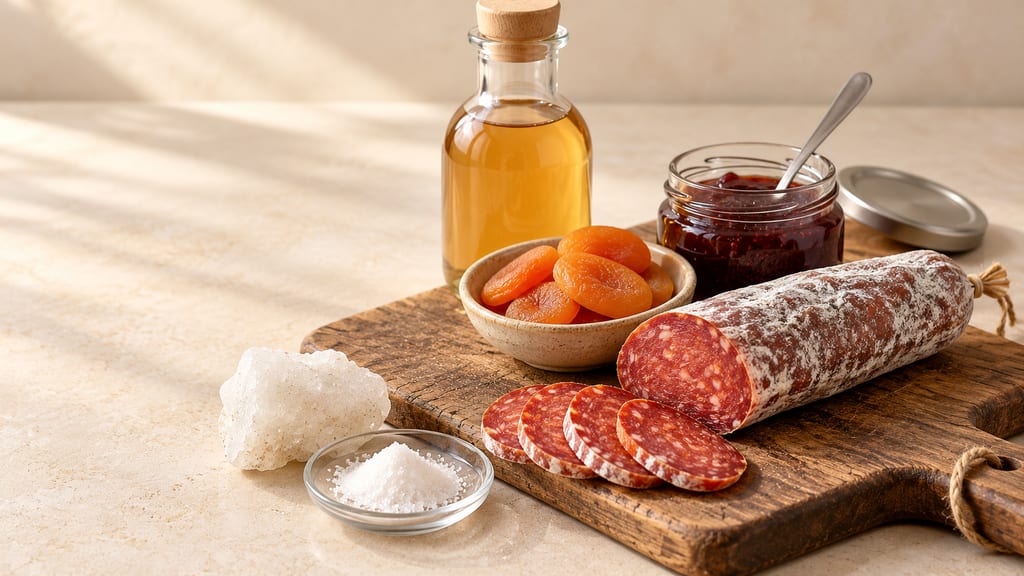
The foods these additives protect, from cured sausage and dried apricots to jam and fruit juice, beside a lump of natural saltpetre and a dish of its crystals.
A small dose aimed at yeasts and moulds
The FAO chapter on chemical preservation describes benzoates and sorbates as additives used in very low quantities, up to 0.2 percent of the food. That is 2 g in a kilogram. The target is spoilage in acid foods. Benzoic acid, in the form of its sodium salt, is one of the most common chemical food preservatives, and it goes into fruit juices, syrups, jams and jellies.
Neither compound kills microbes across the board. Benzoate inhibits yeasts to a greater extent than it inhibits moulds and bacteria. Potassium sorbate is a white, fluffy powder that dissolves in water at more than 50 percent, and once it is added to an acid food it turns into sorbic acid. Sorbic acid acts on moulds and on certain yeast species. At higher doses it also acts on bacteria, with the exception of lactic and acetic acid bacteria. The same FAO table lists sodium propionate, with fruits and vegetables as its uses, and says little more about it.
Why a preservative needs acid
The FAO chapter makes one general point about these chemicals: most of them work better at lower pH. The reason lies in what a weak acid does in water. Some of its molecules stay whole, which chemists call the undissociated form. The rest split into a negatively charged ion and a hydrogen ion. Only the whole molecule can cross the fatty membrane around a yeast or mould cell, and the FAO places benzoate and sorbate under the heading of lipophilic, or fat-loving, acid preservatives. Lower the pH and more of the acid stays whole. Raise it and the share that can get into the cell falls.
That makes a dose depend on the food. The same measured amount can hold a sharp fruit juice steady and do much less in a near-neutral sauce, because the sauce leaves less of the acid in the form that works. The FAO advises using a chemical preservative only at the dosage that normal preservation needs, and no more. How large the working share is for each acid at each pH is not given here, because the figures found were not from a source that could be checked.
Sulphite does two jobs
Sulphur dioxide and its sulphite salts follow the same curve. They dissolve in water and, at low pH, yield sulphurous acid, and their antimicrobial activity reaches its maximum below pH 4.0. The sulphite salts contain 50–68 percent active sulphur dioxide.
Sulphur dioxide also works as an antioxidant and a reducing agent, which is a job separate from holding back microbes. The FAO lists its uses as fruit juices, dried and dehydrated fruits and vegetables, and semi-processed products. In winemaking it goes onto crushed grapes or into the must as a gas, a solution or potassium disulphite, and it acts against unwanted microbial growth and against oxidation.
The FAO table, which reproduces 1991 figures from the US Food and Drug Administration, gives sulphur dioxide an acceptable daily intake of 0.7 mg per kg of body weight and a commonly used range of 0.005–0.2 percent. An acceptable daily intake is the amount regulators set per kilogram of body weight for a substance eaten every day.
The acid a ferment makes for free
A ferment reaches the same place by another route. In the FAO account, lactic acid produced by fermentation lowers the pH to levels unfavourable for the growth of spoilage organisms. Acetic acid is a general preservative that inhibits many species of bacteria, yeasts and, to a lesser extent, moulds. Citric acid is a less effective antimicrobial than the others. These are weak acids too, so the logic of the previous section applies to them: the lower the pH, the more of the acid is in the whole form that spoilage cells take up.
The two worlds meet in the FAO text. Yeasts and moulds that survive in an acid ferment can be handled by adding other preservatives, such as sorbate and benzoate. Even at the higher doses that reach other bacteria, sorbic acid leaves lactic and acetic acid bacteria alone, so it does not attack the organisms that made the acid.
The difference is who carries the safety. A traditional ferment carries it in the method: the acidity reached, the salt, the timing. An additive is a measured dose recorded on a label, and its presence does not show that a product was handled well.
From saltpetre to curing salt
A study of German and Austrian cookbooks located the emergence of deliberately prescribed saltpetre in meat curing within roughly 1600–1750, probably around 1700. That is a regional finding about written recipes. It does not date the first accidental nitrate in salt, and it does not date the invention of nitrate curing worldwide. The nitrum in an Apicius recipe was most likely an alkaline soda mineral rather than modern potassium nitrate, so the word cannot be read back into antiquity.
Saltpetre, or nitre, is potassium nitrate. Chile saltpetre is sodium nitrate. Nitrate does nothing by itself. Bacteria in the meat, or a nitrate-reducing starter culture, must first reduce it to nitrite, and the rate depends on the bacterial population, temperature, moisture, salt and pH, which makes it hard to control. Nitrite is the working compound, and in combination with salt it completely inhibits the growth of Clostridium botulinum.
The agencies name three recognised controls for C. botulinum in fermented, salt-cured and dried meat: 50 ppm sodium nitrite alone; a water activity of 0.92 or below alone; or at least 100 ppm nitrite or nitrate with at least 2.5 percent salt during fermentation and drying. Here ppm means parts per million, the same as mg per kg, and water activity is a measure of how much water is available to microbes. Each control is a combination the agencies name, not a validated process for any particular recipe.
Limits that do not line up
In the United States the nitrite ceilings are written as ingoing amounts on the green weight of the meat: 200 ppm for immersion-cured meat, 200 ppm for massaged or pumped meat, 156 ppm for comminuted products and 625 ppm for dry-cured ones. For nitrate the four figures are 700, 700, 1718 and 2187 ppm, and nitrate is not permitted in any bacon.
Canada allows 200 ppm nitrite per batch in preserved meat other than side bacon, 120 ppm in side bacon, and 200 ppm nitrate in dry or semi-dry sausage made by a slow cure. All are calculated before any smoking, cooking or fermentation. The nitrate figure for sausage is about 8.6 times lower than the US figure for comminuted products.
In the EU, Commission Regulation 2023/2108 changed the limits for nitrites (E 249–250) and nitrates (E 251–252). From 9 October 2025, in non-heat-treated meat products, a maker may add at most 80 mg/kg of nitrite, and the product may hold at most 45 mg/kg of residual nitrite throughout its shelf life, both expressed as nitrite ion. Added nitrate is capped at 90 mg/kg, with 110 mg/kg for large bacon primals and for dry sausages made without nitrites. Until that date the same category allowed 150 mg/kg expressed as sodium nitrite. A product that exceeds the residual level triggers an investigation into why, rather than an automatic ban from the market.
These numbers cannot be ranked against each other. The US figures count the weight of the nitrite or nitrate salt going in, the EU figures count the ion and add a residual cap, and the food categories are not the same.
Why the nitrite figures fell
Nitrosamines form when nitrite reacts with amines from meat proteins, and frying or burning increases them. US rules keep nitrate out of bacon because of nitrosamine formation in bacon. The European Food Safety Authority linked preformed N-nitrosodimethylamine to colorectal cancers and dietary nitrite to gastric cancers. It found some evidence for a link between nitrite and nitrate from processed meat and colorectal cancer, in line with the 2015 assessment by the International Agency for Research on Cancer. It also concluded that nitrosamines from added nitrite cannot be clearly told apart from those formed from natural or contaminant nitrite. The EU cut its maximum amounts in 2023 to keep nitrosamine levels as low as possible while still ensuring microbiological safety.
EFSA derived an acceptable daily intake of 0.07 mg of nitrite ion per kg of body weight per day, and kept 3.7 mg of nitrate ion per kg per day. If all dietary sources are counted together, the nitrite figure is exceeded in infants, toddlers and children at mean exposure and in every age group at the highest exposure, and food additives contribute about 17 percent of the total. The FAO table gives sodium nitrite a different acceptable daily intake of 0.2 mg per kg of body weight, from a 1991 US source. The two figures differ in source, date and basis, so the gap between them does not show a tightening.
Concentrated sodium nitrite is also acutely toxic. It causes methaemoglobinaemia, in which the blood carries oxygen poorly, and blue skin and shortness of breath can begin within minutes. Among 47 cases of intentional ingestion in US poison-centre data from 2017 to 2020, 30 percent died. That says how dangerous the pure substance is. It says nothing about the doses used in food.
What the label cannot tell you
Benzoate, sorbate, sulphite and nitrite all lean on the same ideas that a good ferment uses: lower the pH, keep the salt up, aim at the organisms that spoil that particular food. They differ in that a person measures them out and writes them down. Their reach is narrow, their dose is small, and the same dose does different work in a different food.
What this account cannot supply is the legal maximum for benzoate, sorbate, propionate and sulphite in each food and market, or the exact share of each acid that stays active at a given pH. The limits that were found are for nitrite and nitrate, and they have moved in the past few years. A chemical in the ingredient list is one barrier among several. It does not replace the method that makes a food keep.
Community
No community contributions have been published for this entry yet.
Share what you made
Sign in to contribute. Published comments and photos are free to read.
Sources
Food and Agriculture Organization of the United Nations
Food preservation chapter, FAO document v5030e0dCited in: A small dose aimed at yeasts and moulds; Why a preservative needs acid; Sulphite does two jobs; The acid a ferment makes for free; Why the nitrite figures fell; What the label cannot tell you
Official Journal of the European Union, OJ L 2023/2108, 9.10.2023
Commission Regulation (EU) 2023/2108 of 6 October 2023 amending Annex II to Regulation (EC) No 1333/2008 and the Annex to Commission Regulation (EU) No 231/2012 as regards food additives nitrites (E 249-250) and nitrates (E 251-252)Cited in: Limits that do not line up; Why the nitrite figures fell; What the label cannot tell you
Electronic Code of Federal Regulations, US National Archives and Records Administration / Government Publishing Office
9 CFR 424.21 — Use of food ingredients and sources of radiationCited in: Limits that do not line up
USDA Food Safety and Inspection Service
FSIS Directive 7620.3, Processing Inspectors' Calculations HandbookCited in: Limits that do not line up; Why the nitrite figures fell
USDA Food Safety and Inspection Service
FSIS Ready-to-Eat Fermented, Salt-Cured, and Dried Products Guideline (FSIS-GD-2023-0002)Cited in: From saltpetre to curing salt
Canadian Food Inspection Agency
Preventive control recommendations for manufacturing fermented and dried meat productsCited in: From saltpetre to curing salt
Health Canada, under the Food and Drug Regulations
List of Permitted Preservatives (Lists of Permitted Food Additives)Cited in: Limits that do not line up
Oregon State University Extension Service
PNW 784, Making cured bacon at homeCited in: From saltpetre to curing salt; Why the nitrite figures fell
New York City Department of Health and Mental Hygiene
2022 Health Advisory #22: Poisonings and Death Related to Intentional Sodium Nitrite IngestionsCited in: Why the nitrite figures fell
Gaps
- No E-numbers or legal maximum levels were found for sorbates, benzoates, propionates and sulphites, so none are given.
- The pH-dependent shares of undissociated benzoic and sorbic acid, and their pKa values, were not confirmed against a primary source.
- Sulphite sensitivity and labelling thresholds, and the early history of sulphur use in wine, are not covered.
Updated 2026-10-29