
Garum intake
Garum and its relatives: a global history of fermented seasonings
Garum sits in a much larger world of seasonings made by turning fish, shellfish, meat, grain or seed into concentrated savoury liquids and pastes. This article sorts that world by method, use and documented history.
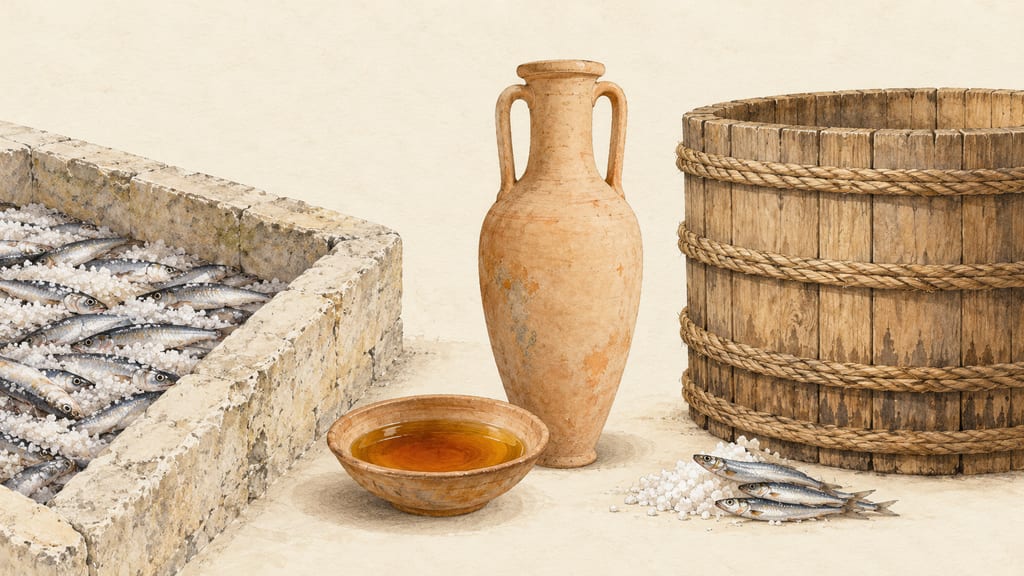
A historical interpretation: a Roman salting tank and amphora beside a wooden fish-sauce vat of the kind still used in Southeast Asia, two ends of the same salted-fish idea.
A word for a family of seasonings
Garum is the name that survives from the ancient Mediterranean, and it is used for almost everything that Roman writers made from salted fish. Modern cooks also use it for new sauces that have nothing to do with Rome. Both uses hide the same question: what do the seasonings have in common, and where do they differ?
The common thread is proteolysis. Enzymes break proteins into peptides and free amino acids, glutamate among them, and the result tastes deeply savoury. The enzymes can come from the fish's own tissues and digestive organs, from microorganisms, from a mould grown on grain, or from a commercial enzyme preparation. The method changes the flavour, the colour and what the product is: a clear liquid, a paste that keeps its solids, a dried material or, in some traditions, a fat.
Several families recur. Salted fish liquids such as garum, liquamen, nước mắm, nam pla and aekjeot are drained from a matured mass. Seafood pastes such as allec, bagoong, prahok, ngapi and shrimp pastes keep much of the flesh. Fish matured with rice or bran, such as pla ra, padaek and burong isda, adds a carbohydrate that changes the microbial community. Grain and bean seasonings, including murrī, soy sauce, miso and koji-assisted garums, depend on a mould that supplies enzymes. Seed condiments such as soumbala, iru and ugba are cooked, fermented warm and become alkaline. Cooked concentrates such as rihaakuru and some mushroom ketchups are reduced rather than fermented. These groups are working categories, not fixed boundaries. Even closely related regional products can behave differently, because salt concentration alone changes the microbes and the acidity.
Before Rome
At Norje Sunnansund in southern Sweden, an installation of about 9,200 years ago has been read as evidence for large-scale fish fermentation. The reading rests on the remains, on ethnographic comparison and on knowledge of microbial processes. It shows that fish fermentation is very old. It does not name a sauce, prove that a liquid was collected or connect the find to later Scandinavian foods.
The Akkadian word šiqqu appears in Old Babylonian and later texts from the early second millennium BCE. The Chicago Assyrian Dictionary glosses it as a brine or sauce made from fish or locusts, and uses garum as an English equivalent. The texts do not say whether every occurrence describes the same preparation, how long it matured or how thick it was. It is best read as an early related condiment whose technology is only partly understood.
Garos appears in fragments attributed to Greek authors of the fifth century BCE, among them Aeschylus, Sophocles and Cratinus, preserved through later quotation. These fragments establish a Greek literary history of the word. They do not give a full method. Recipes preserved centuries later have to be used with care when the earliest Greek product is reconstructed.
Roman factories and the names that do not sort neatly
Fish processing became a large industry around the Mediterranean and the Atlantic coasts. Punic salting installations near Cádiz date from the fifth century BCE, and Roman production later spread through Iberia, North Africa and other coasts. Batteries of large vats are common at Roman sites, but a vat does not prove that its contents were garum. Salted fish and smaller jars were part of the same economy, so the largest excavated plants show only part of it.
A 2025 ancient-DNA study at Adro Vello in Galicia identified European sardines in material from a Roman processing vat associated with the early third century CE. It is one of the more direct links between a production context and the fish that went into it.
The terminology is harder than the familiar account of four grades of Roman fish sauce. Garum could be a broad term or one associated with fish viscera. Liquamen was a common culinary term, and one influential reading separates a whole-fish liquamen from a viscera-focused garum while accepting later overlap. Garum sociorum was a prestigious mackerel sauce linked especially with Carthago Nova. Allec was the pasty material left after liquid separation, but Pliny also describes it as a luxury product made from shellfish, sea urchin and mullet liver. Muria was a brine associated with salted fish. Haimation was a blood-and-viscera preparation made from tuna, and a jar from late first-century CE Aila, in modern Aqaba, held a concentration of tuna gill remains that has been read as evidence for a local version. The names changed meaning over time, so a fixed quality ladder misreads the sources.
Recipes from a medieval compilation
The Geoponica, a tenth-century Byzantine agricultural compilation drawing on older material, preserves several methods. For small fish and entrails, the fish is salted and set in the sun, stirred, and liquid is drawn into a closely woven basket; the solids left behind are called alix. A Bithynian method mixes fish and salt in earthenware and leaves it in the sun for two or three months, with optional wine. A cooked shortcut boils fish in strong brine with oregano, sometimes with grape syrup, then filters it repeatedly. The haimation method salts tuna entrails, gills and blood and matures them for up to two months before draining.
These are several preparations, not one standard Roman recipe, and they should not be merged. The text also lists prepared combinations that use garum as an ingredient: oenogarum with wine, oxygarum with vinegar, hydrogarum with water and elaeogarum with oil. Those names describe what was added to the sauce, not necessarily a different fermentation.
A later analogue appears in Palladius, usually dated to the fourth or fifth century CE, who describes liquamen made from pears. Ripe pears are combined with salt, matured and drained, and wine can change the colour. A fish-sauce name was already being carried over to a plant with a very different chemistry.
Murrī and the grain route
Murrī appears in medieval Arabic cookery and medical writing, including a tenth-century Baghdad cookbook associated with Ibn Sayyār al-Warrāq. The main grain version used barley, or barley and wheat, shaped into dough cakes that developed a mould. The dried cakes were broken into a starter called būdhaj, combined with brine and sometimes aromatics, matured and strained. Some makers extracted the mass more than once. The name also covered fish- and meat-based versions, so murrī, like garum, names a family rather than one formula.
The grain versions are useful because the mould is an external source of enzymes. That makes them a close functional counterpart of the East Asian grain and bean sauces discussed below. The similarity shows a shared method, and it does not prove a common origin.
A medieval recipe translated under the name Byzantine murrī shows another route. Scorched honey, toasted bread, walnuts, quince, carob and spices are boiled and strained. Dark, concentrated flavour comes from cooking, not from a long grain fermentation. Medieval cooks therefore had both fermented seasonings and methods that copied their effect.
Europe: anchovies, herrings and bottled sauces
Colatura di alici from Cetara, in Campania, is made by layering headed and gutted anchovies with sea salt in wooden containers, weighting them and collecting the liquid that drains out. The current protected designation requires at least nine months of maturation. Its technique closely resembles the ancient fish sauces. An unbroken Roman lineage is harder to show than the resemblance itself.
Pissalat, from Nice and the nearby Mediterranean coast of France, is a paste of tiny sardines and anchovies. A traditional method recorded by Alain Ducasse specifies daily stirring for 45 days, with spices added during maturation. It is a regional condiment whose beginning is not documented here. Nice's own culinary account names it as the salted fish paste associated with pissaladière.
Northern Europe has related preservation traditions whose main product is the fish itself. Swedish surströmming is lightly salted Baltic herring matured in barrels, and modern production continues fermentation after canning. Sweden's heritage inventory records herring fermentation on the northern coasts from the fifteenth to the late eighteenth century, with canning developing in the nineteenth. Norwegian rakfisk is trout or char salted, packed under pressure and matured cold, commonly for about three months. Icelandic hákarl is Greenland shark fermented and then dried; a 2023 production study used seven or eight weeks of fermentation and five weeks of drying, as study conditions and not as a historical rule.
Britain offers a different branch. Mushroom ketchup appears in Richard Bradley's 1732 book in a recipe from Brussels that reduces mushroom-gill liquid with port, cloves and mace and contains no added salt, so it is not a long fermentation. Friedrich Accum's 1821 Culinary Chemistry describes walnut catsup and salted mushroom catsup, which follow different routes under one name. Worcestershire sauce, which Lea and Perrins dates to 1837, combines anchovies with vinegar, tamarind and spice and is matured for about eighteen months. Dark savoury liquids of this kind show that a sauce used like garum is not automatically fermented.
China and Japan: viscera, shiokara and regional sauces
Jia Sixie's Qimin Yaoshu, compiled in the sixth century CE, records several animal jiang: fish, meat from beef, lamb, deer or rabbit, and shrimp preparations, all using grain starters and salt. One recipe for fish internal organs, zhuyi, gives maturation of about 20 days in summer, 50 in spring or autumn and 100 in winter. The repertoire shows that early Chinese cooks already used different proteins and methods. An early jiang was not necessarily a clear liquid, and an ancient word does not match a modern bottle.
Yúlù, especially from the coast of Fujian, is a liquid fish sauce. A study of Fuzhou production describes salted fish, shrimp or processing material maturing under natural temperatures for about 10 to 12 months before the liquid is extracted. The broad connection with older preservation is clear. An unchanged recipe across the centuries is not.
Japan has three main regional fish sauces. Shottsuru from Akita is made from salted fish, most often hatahata, Japanese sandfish, which liquefies over a year or longer. Ishiru from the Noto Peninsula uses sardines matured six months to a year, or squid viscera for about two years. The ministry places the beginnings of ishiru in the late 1700s, while stating that the origin is unclear. Ikanago shōyu from Kagawa, made from sand lance, is a fish sauce in spite of its name. Shiokara covers many seafood products in which salted flesh or organs mature while solids remain, among them ika no shiokara, shutō made from bonito gut, konowata from sea-cucumber intestine and uruka from sweetfish gut. Kusaya soaks fish in a maintained fermented brine before drying, and narezushi, including funazushi, ferments salted fish with rice.
Korea: jeotgal and aekjeot
Jeotgal is the broad term for salted, fermented seafood, and aekjeot names the liquid forms. The Samguk Sagi, compiled in 1145, records fermented seafood among wedding gifts from 683 CE. That is a twelfth-century text recording a seventh-century event, so it dates the reference, not the practice itself.
Myeolchi-aekjeot, the anchovy sauce, is made by prolonged maturation of heavily salted anchovies; one original study describes fermentation of more than six months. Kkanari-aekjeot is sand-lance sauce. Saeu-jeot is salted, fermented tiny shrimp, kept whole rather than filtered. These seafood seasonings are also used in kimchi and other prepared foods.
Southeast Asia: the closest living comparison
Southeast Asia has the richest living set of liquid sauces, thick fish ferments and shrimp pastes. Dampier recorded a product called nuke-mum in Tonkin in 1688, and Marsden described blachang in Sumatra in 1783. These accounts date the products at particular moments and leave their beginnings open.
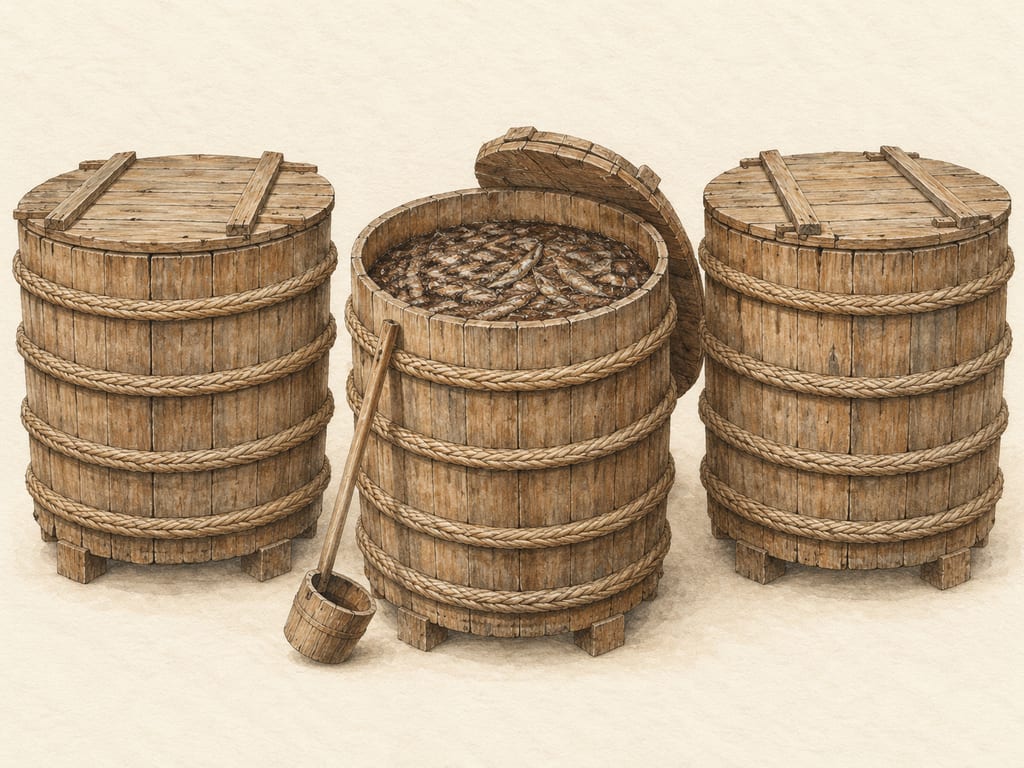
Nước mắm from Vietnam is made by maturing fish with salt in containers, drawing off the liquid and sometimes recirculating it through the mass. In Phú Quốc, the documented method uses anchovies in wooden barrels for roughly 12 to 15 months. It is among the closest modern process comparisons with whole-fish liquamen. Thailand's nam pla uses marine, brackish or freshwater fish matured in wooden or concrete tanks under weights for 5 to 18 months, with residues sometimes extracted again with brine. Pla ra and padaek from Thailand and Laos mix freshwater fish with salt and rice bran or roasted rice and mature them for six months or longer, leaving fish material in the product. Budu from Malaysia and southern Thailand, made from salted anchovies, was followed through 360 days in one production study. Ngan pya ye from Myanmar is a liquid sauce from fish, water and salt. Ngapi is a paste; one producer account describes at least five months for fish ngapi, and regional products differ widely.
The Philippines separates the liquid from the solids. Patis is liquid fish sauce, and bagoong keeps more fermented material, either fish or small shrimp. Burong isda and balao-balao, made with rice, belong to a carbohydrate-associated family. They should not be confused with the heavily salted, long maturation behind many patis and bagoong products. Bakasang from North Sulawesi is a viscera-rich condiment, often made from tuna or skipjack organs with salt, and it is a useful comparison with ancient blood-and-viscera sauces.
Shrimp pastes form a separate family. Thai kapi is pounded salted shrimp, matured for about four to six months. Malay belacan is dried, pounded and matured, producing a compact paste or block; drying and mechanical working distinguish it from a liquefied brine. Indonesian terasi varies with salt concentration, drying and maturation, and microbiological work shows that shrimp pastes can contain quite different communities depending on how they are made.
South Asia and the cooked concentrate
Northeast India produces fish ferments that do not depend on heavy salting. Shidal, from Assam and Tripura, is small dried fish moistened and packed into earthenware; studies describe salt-free products that stay solid or pasty. Ngari, from Manipur, is made from sun-dried small fish such as Puntius sophore, fermented by a salt-free method and used more as an ingredient than as a sauce. Hentak, also from Manipur, combines powdered dried fish with an aroid plant and ferments for about 15 to 20 days. The scientific descriptions do not establish dates of origin for these traditions.
Rihaakuru, from the Maldives and Maliku and Minicoy, is a thick brown concentrate made by boiling fish, removing the flesh and reducing the liquid. It resembles a fish seasoning and is culinarily close, but its central process is cooking and concentration, so it belongs in a separate class. Nineteenth-century observations, recorded in 1858 and published in 1859, document its trade. That is an anchor in the record, not a beginning.
Africa: fermented fish and alkaline seeds
In the Nile valley, terkin, also called tarkin or meluha, is a fermented freshwater-fish preparation that ranges from paste towards sauce, associated especially with Dongola. Mindeshi, another Sudanese fish paste, shows that the region contains several processing families rather than one generalised African garum. Modern documentation establishes the tradition, but claims of a pharaonic origin need stronger evidence.
West Africa has fermented fish used in small amounts for seasoning. Guedj, from Senegal and The Gambia, is salted and fermented fish that is partly or fully dried. Momone, from Ghana, is salted and fermented fish often dried afterwards. Yeet, from Senegal and neighbouring coasts, is fermented marine gastropod flesh, usually dried. Lanhouin, from Benin, is a fermented fish condiment. FAO's regional surveys describe combined salting, fermentation and drying, and separate fish eaten in quantity from strongly fermented products used sparingly. The surveys do not date the individual traditions.
Alkaline seed condiments take a different route. Seeds are cooked, dehulled and fermented warm, with Bacillus species playing a large part, and the environment becomes alkaline. One documented soumbala process ferments for roughly 48 to 72 hours, a timescale far from that of an aged salted fish liquid. Soumbala, dawadawa, iru, netetou and afitin, often based on African locust bean, Parkia biglobosa, are related but not identical. Ugba is made from African oil bean, Pentaclethra macrophylla. Ogiri covers oilseed condiments, okpei from Prosopis africana seeds, and bikalga from roselle seeds in Burkina Faso. These products are retained seed masses, pastes or dried condiments, and their chronologies are poorly resolved in the sources.
Soy and koji: the grain counterpart
Japan's Taihō Code of 701 CE includes provisions for hishio, an early seasoning. That is evidence of an early tradition, not proof that every later soy style already existed. Modern shōyu uses mould-grown material to supply enzymes, then presses the liquid from a salted mash. Miso uses cooked soybeans, salt and koji made on rice, barley or soybeans, and the paste is kept. Tamari was historically the liquid from soybean-paste production and is also made deliberately.
Korean production gives two products from one sequence. Cooked soybeans are shaped into meju blocks, fermented and dried, then placed in brine. The liquid becomes ganjang, and the retained solid becomes doenjang. Separating a fermented mass into liquid and solid gives two valued products, a pattern that also appears in fish sauce and fish paste.
The Americas and the Pacific
Among several First Nations of coastal British Columbia, eulachon grease is recovered from fish that have been allowed to ripen, then heated in water so the fat separates. Straining, reheating and storage vary by family. It accompanies dried salmon, berries, roots and vegetables. A food-composition study documents these methods and cites ethnographic accounts from 1915 and 1916; the practice is older than those accounts. The recovered product is mainly fat, not the water-based protein extract of a fish sauce.
Bitter cassava is the base of dark Amazonian seasonings such as tucupi negro and ají negro. A producer organisation working with Bora, Huitoto and Ocaina women in Peru's Ampiyacu region describes grating and pressing bitter cassava, then fermenting, cooking and concentrating the liquid into a dark sauce. The sauce has its own Indigenous history, and cassava processing history should not be used to date it.
In Tahiti and French Polynesia, miti hue and taioro are coconut-based fermented condiments. Miti hue combines coconut material and water with freshwater prawn or other crustacean material; taioro is a related preparation of grated coconut. Documentation from the 1970s describes them clearly, but it does not show when the traditions began.
Modern garums
Modern cooks use garum for any intensely savoury fermented or enzyme-matured seasoning. Noma describes adding koji to fish or meat, including beef, squid, mackerel and shellfish, so that its enzymes break down the protein. Its published method holds the mixture around 60 °C for 10 to 12 weeks. Those are conditions from one method, and they show that enzymes can keep working in a heated vat without active mould growth throughout. Noma presents the approach as a modern variation of historical fish-sauce methods.
Nordic Food Lab's insect work began with grasshoppers in 2013 and extended to crickets, wax-moth larvae, honeybee larvae and mealworms, combined with koji, salt and water. The experiments separated liquid, paste and sometimes fat from one maturation. A 2017 study compared fermented sauces made from fish, insects, game and peas, measuring composition and sensory properties. Noma's Smoked Mushroom Garum, released in 2022, uses mushrooms, rice koji and an oat-based garum component. The release date belongs to that product, not to the first mushroom-based sauce.
Reading the comparisons
The most useful comparisons are specific. Whole-fish liquamen matches nước mắm and nam pla in its long salted maturation and liquid extraction. Haimation and other viscera-rich sauces match bakasang and squid-viscera ishiru, which stress the organs and their enzymes. Allec matches bagoong, prahok and some shiokara, where the solids are kept. Grain murrī matches soy sauce and koji-assisted garums, where a moulded substrate supplies enzymes. Pear liquamen shows a seasoning name moving to another raw material. Guedj and other dried fermented fish show that the same seasoning function can be reached while the fish stays solid. Eulachon grease and rihaakuru show that a similar use can come from rendering fat or reducing broth.
These are process comparisons, not a family tree. Archaeology can identify fish species and installations, texts can keep names and recipes, and modern field studies can record living production. Joining these kinds of evidence gives a convincing history of one sauce. Without that care, a resemblance becomes an unsupported origin story. For a catalogue entry, the useful facts are the local name and community, the dated evidence, the starting material, the source of enzymes, the salt basis, the presence of grain, the temperature, the maturation time, and whether the finished product is a liquid, a paste, retained fish, a dried material or a fat.
Community
No community contributions have been published for this entry yet.
Share what you made
Sign in to contribute. Published comments and photos are free to read.
Sources
ScienceDirect
Fermented sauces from fish, insects, game and peas (2017 study)Cited in: A word for a family of seasonings; Modern garums; Reading the comparisons
JIRCAS
Research results on Thai and Lao fish fermentsCited in: A word for a family of seasonings; Southeast Asia: the closest living comparison
Lund University research portal
Something rotten in Scandinavia: the world's earliest evidence of fish fermentationCited in: Before Rome
Oriental Institute, University of Chicago
Chicago Assyrian Dictionary, entry šiqquCited in: Before Rome
Oxford Roman Economy Project
Quantification of fish-salting infrastructure capacity in the Roman worldCited in: Roman factories and the names that do not sort neatly
Cambridge Core, Antiquity
Ancient DNA of sardines from a Roman processing vat at Adro Vello, Galicia (2025)Cited in: Roman factories and the names that do not sort neatly
Springer Nature Link
Garum, liquamen and muria: Roman fish-sauce terminologyCited in: Roman factories and the names that do not sort neatly
Wikisource
Pliny the Elder, Natural History, Book 31 (Rackham translation)Cited in: Roman factories and the names that do not sort neatly
Flanders Marine Institute (VLIZ)
Haimation: the tuna blood-and-viscera sauce from AilaCited in: Roman factories and the names that do not sort neatly
Routledge preview
Geoponica, preview of the Byzantine compilation chapters on fish saucesCited in: Recipes from a medieval compilation
Istraživanja, University of Novi Sad
Murrī and medieval Arabic fermented seasoningsCited in: Murrī and the grain route
Cariadoc recipe collection
Byzantine murrī, medieval recipe translationCited in: Murrī and the grain route
Regione Campania
Colatura di alici di Cetara DOP specificationCited in: Europe: anchovies, herrings and bottled sauces
Levande kulturarv
Surströmming, Swedish heritage inventoryCited in: Europe: anchovies, herrings and bottled sauces
PubMed Central
Hákarl production study (2023)Cited in: Europe: anchovies, herrings and bottled sauces
Project Gutenberg
Richard Bradley, 1732 cookery bookCited in: Europe: anchovies, herrings and bottled sauces
Project Gutenberg
Friedrich Accum, Culinary Chemistry (1821)Cited in: Europe: anchovies, herrings and bottled sauces
Kraft Heinz
Lea & Perrins Original Worcestershire SauceCited in: Europe: anchovies, herrings and bottled sauces
Gushiwen
Qimin Yaoshu, text of the sixth-century Chinese agricultural and culinary treatiseCited in: China and Japan: viscera, shiokara and regional sauces
Journal of Zhejiang University SCIENCE
Fuzhou fish-sauce production studyCited in: China and Japan: viscera, shiokara and regional sauces
Ministry of Agriculture, Forestry and Fisheries (MAFF)
Shottsuru, Japanese regional foodCited in: China and Japan: viscera, shiokara and regional sauces
MAFF
Fermented seafood products of JapanCited in: China and Japan: viscera, shiokara and regional sauces
Journal of Food Culture
Fermented seafood in the Samguk Sagi recordCited in: Korea: jeotgal and aekjeot
BiblioAsia, National Library Board Singapore
Shrimp paste and belacanCited in: Southeast Asia: the closest living comparison
EUR-Lex
Nước mắm Phú Quốc protected geographical indicationCited in: Southeast Asia: the closest living comparison
JIRCAS
Nam pla, Thai fermented foods databaseCited in: Southeast Asia: the closest living comparison
PubMed Central
Budu production study, 360-day maturationCited in: Southeast Asia: the closest living comparison
International Labour Organization
Fish processing in MyanmarCited in: Southeast Asia: the closest living comparison
Global New Light of Myanmar
Ngapi made from Myanmar fishCited in: Southeast Asia: the closest living comparison
PubMed Central
Microbial communities in Indonesian shrimp pasteCited in: Southeast Asia: the closest living comparison
PubMed Central
Shidal, salt-free fish fermentation of northeast IndiaCited in: South Asia and the cooked concentrate
FAO
FAO regional survey of fish fermentation in AfricaCited in: Africa: fermented fish and alkaline seeds
African Journal of Biotechnology
Soumbala fermentation processCited in: Africa: fermented fish and alkaline seeds
The Guardian
Without time there is no flavour: Korean soy sauce grand masterCited in: Soy and koji: the grain counterpart
Journal of Food Composition and Analysis
Eulachon grease, food composition studyCited in: The Americas and the Pacific

Gaps
- Whether allec was the sediment of garum or of liquamen is disputed, and the surviving evidence does not settle it.
- The earliest attestation of most regional fish sauces is undated. A first written mention is not an invention date.
- No ancient recipe for garum gives a maturation time that can be read as a standard. The Byzantine times quoted here come from a medieval compilation.
- The link between Roman garum and later Mediterranean, Asian or African sauces is a comparison of method, not a documented line of descent.
- Modern enzyme and insect garums are recent experiments and products. Their conditions are the conditions of one method, not a validated safety process.
Updated 2026-10-29