
Preservation intake
Alive until needed: how people have kept fish and eels in water
From Gunditjmara eel traps to Chinese carp ponds, Dutch eel bins and British well-smacks, people have stored fish by keeping them alive. The method works until the water fails.
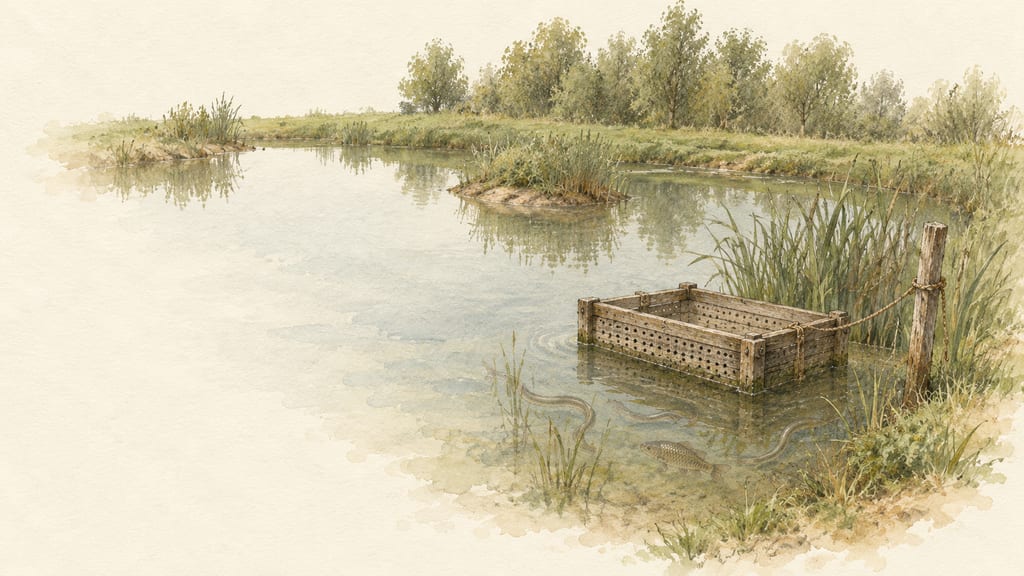
A historical interpretation of two live stores: an earth-banked pond and a floating slatted eel box moored among reeds.
Eels in the pond, eels in the tree
An eel caught at Budj Bim, in Gunditjmara Country, could end up in two very different stores. One kept it alive in the water. The other hung it in smoke inside the hollow of a living tree. Keeping fish alive is usually set against drying, salting and smoking as a different kind of storage. At Budj Bim the two ran side by side.
The water system diverted flow from Darlot Creek into low-lying ground, using weirs, dams and channels to trap short-finned eels, the kooyang of the Gunditjmara. One of five eel-trap systems at Lake Condah has been carbon-dated to 6,600 years old. That date belongs to the trap, not to the whole network, and the landscape was added to the World Heritage List on 6 July 2019. How much of the channel work was dug by people is disputed: critics cite a late-1990s survey by Dr Anne Clark to argue that the channels were not cut from basalt.
The same eels were also smoked. Eel taken in the wider aquaculture landscape was smoked in the hollows of large trees for later preservation, for storage or trade. In the Traditional Owners' account, a hollow at the base of a Manna Gum or Red Gum was enlarged and burnt out so that it worked as a chimney. Eels and fish hung inside, a small fire at the base sent smoke up the cavity, and stones sometimes held the heat. The tree did not die.
So live holding at Budj Bim was one stage in a longer sequence. The pond system kept eels living and available. The smoking tree turned some of them into food that would last or could be carried away. A reader who takes the system for a pure live store has missed half of it.
Caution is needed with the trees. At Kurtonitj, Gunditj Mirring representatives identified a large eucalypt as an eel-smoking tree, but the heritage assessment did not establish that it belonged to the ancient aquaculture system, and the chemical evidence for smoking or a hearth there is unresolved. Nothing on record gives the cleaning, salting, fuel, duration or moisture of the smoking, and this is a cultural practice whose interpretation belongs to the Traditional Owners. It is not a method to copy.
Carp in ponds, carp in barrels
China has some of the oldest written records of keeping fish in ponds. A treatise credited to Fan Li and dated to about 460 BC is described by the FAO as the earliest monograph on freshwater fish culture in the world. It summed up how to raise common carp. The text itself is lost, and modern reviews do not agree on its date, so it is best read as an attributed account rather than a firm anchor.
The practice it describes is concrete. Ponds for parent fish ran to 3 to 4 mu, a traditional Chinese land measure, and were 1.5 m deep. Fish were best collected in autumn and winter, when the water was cold, about 10 °C. To move a parent fish alive in a barrel, the rule was about one fish of 10 kg to every 100 litres of water. Advice attributed to Fan Li for King Wei of Qi was to keep 2,000 carp two chih long as broodstock and sell the rest.
Earlier traces are less certain. Oracle-bone script from the Shang period (1,600–1,046 BC) is the earliest record of pond fish culture. A claim that carp were farmed by about 6,000 BC is contested. Mixed-species ponds, with several kinds of fish sharing a pond, are recorded from the Tang dynasty (618–904).
None of these accounts calls a pond a larder. They describe growing, breeding and harvest. But a pond that is harvested in the cold months, and fish that travel alive in barrels, show the central idea: the fish stays alive and fresh until someone wants it. Reading the ponds as a living reserve is an inference, not something the texts say.
Stew ponds beside the abbey
In England the same idea appears as the medieval fishpond. The ponds at Fountains Abbey held eel, tench, pickerel, bream, perch and roach, and large monastic ponds were probably for storage while smaller, shallow ones were for breeding. The practice seems to have peaked in the 12th century, and about 2,000 examples are recorded across the country.
Whether a given pond worked as a live larder, how often it was netted and how long a fish waited are not known. What survives is mostly earthwork, a bank and a hollow in a field, and the way the fish were managed has to be inferred from it.
Eel bins on a Frisian ditch, eels in a Thames hold
The Wijde Sloot at Gaastmeer, in Friesland, was once a store for live eels waiting to be shipped to London. The eels went into bins, floating boxes with holes. The holes were large enough to let fresh water in and too small for an eel to leave. The water there always flowed, which was part of why the system worked, and the eels could be kept for months before the eel boats took them across. The record gives no date for the bins.
The trade began with dead eels. John Wyatt Greenlee describes salted, dried eels shipped in barrels to London from the 1360s. Live eels came later, carried in the holds of ships in the 1440s to 1470s. The hulls were pierced with holes covered by screens, much like the Frisian bins, and the ships parked in mid-Thames near Queenhithe. Dutch ships were absent from the Thames between 1666 and 1681.
The order matters. Salting and drying were the first answer to carrying eels over distance. Keeping them alive, with moving water through the hull, was a later one.
Empty stomachs before sale in Japan
In modern Japanese eel culture, holding comes at the end of the farm. Anguilla japonica is fed until shortly before harvest. Feeding stops at least 1 to 2 days before the eels are taken, and they then go into holding tanks for several days without feed so that their stomachs empty. They are chilled and packed with just enough water to keep the skin moist, and the packs are filled with oxygen. Eels meant for processing travel live to the processing plant.
The aim here is not a reserve against a poor season. It is a clean, fresh eel at the point of sale or cooking. No temperature, density or water figure is on record for this step, so the practice is described but not measured.
A boat with holes in the hull
British fishermen built the same idea into a boat, the well-smack, which was in use from the late 18th century to about 1920. The first were 50-foot gaff cutters, built from about 1775 to 1875 for longlining cod, ling and turbot, and later boats were lengthened into 80-foot gaff ketches. The hull held a well, and external seawater circulated through it, entering through auger holes in the planking, so the catch stayed alive until it was landed. Turbot were hung on thin rope so that they did not block the holes.
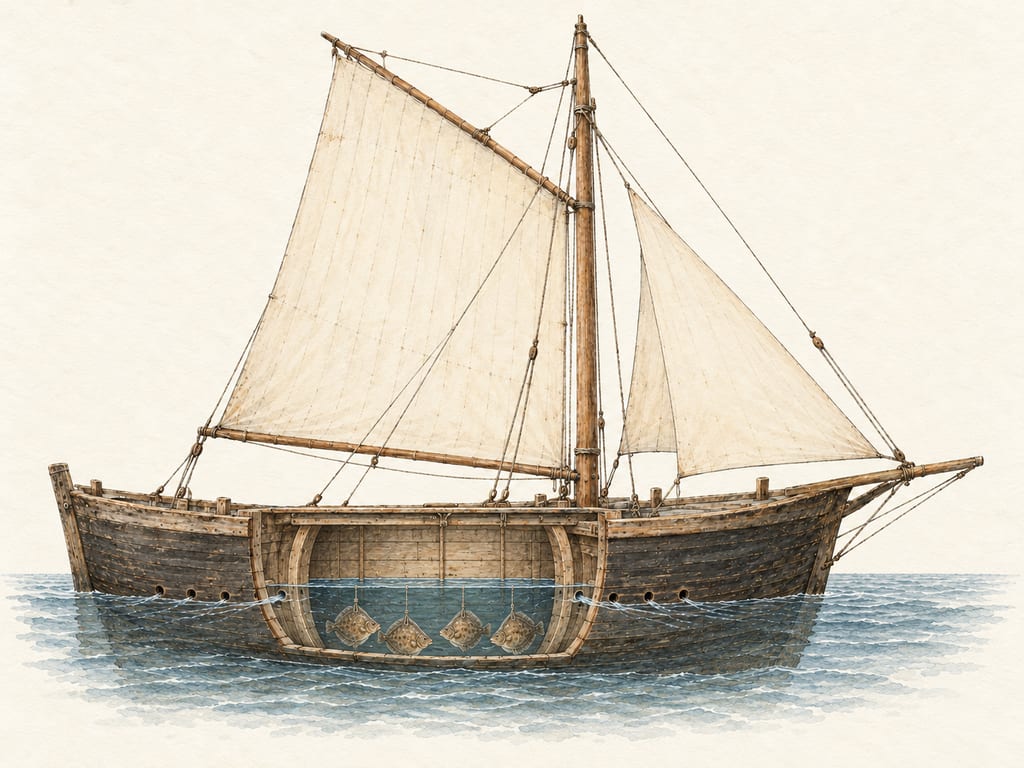
The method depended on clean outside water. By about 1854 the Thames had become too polluted for it, and the boats moved to Barking. A well-smack used in the fresh halibut fishery on George's Bank in the 1830s and 1840s survives in a sectional drawing by Capt. J.W. Collins, with a barrel-shaped well amidships.
Modern livewells follow the same logic with machinery: they pump water in and aerate it. The water has changed from a gift of the sea to a system someone has to run.
Where a living store fails
A live store exchanges one problem for another. A dead fish spoils. A live fish does not, but it fouls its own water. Fish release ammonia as they live, and bacteria that convert it need the right conditions. Total ammonia in retail holding systems has been measured at anywhere from 0 to 65 mg/L, and low pH, which slows that conversion, is linked to the high values.
Welfare and handling follow from the same facts. The practices above all manage the animal: starve it before moving it, keep its skin moist, give it oxygen, hang it so the water can move. No source reviewed here gives density, temperature or welfare figures for holding adult eels.
Pathogens are the other limit. In one laboratory experiment in seawater, Vibrio parahaemolyticus was still present at about 3.0 log CFU/mL, roughly 1,000 cells in each millilitre, at 10 °C, and one virulence-gene strain grew faster than another at 30 °C. That work did not use live-fish tanks, and it shows only that cold water does not remove the organism.
Nothing here sets a food-safety endpoint for live holding, and nothing supports keeping fish alive at home as a way to store food. What the history shows is narrower. A living reserve lasts exactly as long as someone keeps the water moving, clean and the right temperature. Where that stops, so does the store.
Community
No community contributions have been published for this entry yet.
Share what you made
Sign in to contribute. Published comments and photos are free to read.
Sources
National Museum of Australia, Defining Moments
Budj Bim Cultural LandscapeCited in: Eels in the pond, eels in the tree
Gunditj Mirring Traditional Owners Aboriginal Corporation
Cultural Features of the Budj Bim Landscape: Smoking TreesCited in: Eels in the pond, eels in the tree
Australian Government, Department of Agriculture, Fisheries and Forestry
Kurtonitj: Australian Heritage Database assessmentCited in: Eels in the pond, eels in the tree
Flat White, The Spectator Australia
The oldest culture, engineeringCited in: Eels in the pond, eels in the tree
FAO
Training Manual: Integrated Fish Farming in China (NACA/TR/85/11), Chapter IICited in: Carp in ponds, carp in barrels
Frontiers in Aquaculture 3:1437833 (Edwards, 2025)
Co-evolution of fish and rice farming by Austroasiatic communities in the Neolithic Era and early documentation of aquaculture in ChinaCited in: Carp in ponds, carp in barrels
Historic England
Medieval monastic fishponds immediately east of Park House (list entry 1018691)Cited in: Stew ponds beside the abbey
London Guided Walks
Episode 83: Dutch Eels in Medieval London (John Wyatt Greenlee)Cited in: Eel bins on a Frisian ditch, eels in a Thames hold
FAO (text by J. Xie, edited by Valerio Crespi and Michael New, 2009)
Anguilla japonica, Cultured Aquatic Species Fact SheetsCited in: Empty stomachs before sale in Japan; Where a living store fails
NOAA, via Wikimedia Commons
Well smack sectional plan (drawing by Capt. J.W. Collins)Cited in: A boat with holes in the hull
Global Seafood Alliance
A review of hauling systems and holding system protocolsCited in: Where a living store fails
Microbiology Spectrum (Liu et al., 2023)
Fitness and transcriptomic analysis of pathogenic Vibrio parahaemolyticus in seawater at different shellfish harvesting temperaturesCited in: Where a living store fails
Gaps
- No study has been found of how medieval stew ponds were actually used as live stores.
- Nothing found records Japanese live-holding tanks (ikesu) or gives density and welfare figures for adult eels.
- How the Budj Bim smoking trees were used, and for how long, is not recorded in the sources found.
Updated 2026-10-29