
Preservation intake
Food in the gamma canal: how irradiation became a regulated way to keep food
A measured dose of radiation can cut back insects, moulds and bacteria in food without cooking it. US ceilings run from 1 to 30 kGy, and the rules grew out of a mid-century Army programme.
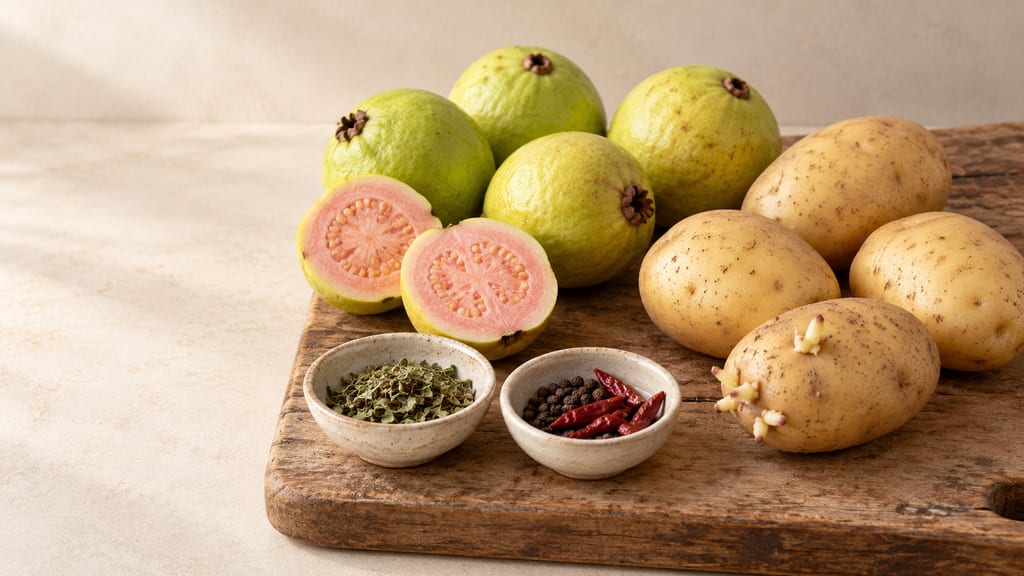
Foods that irradiation rules name: potatoes held back from sprouting, tropical fruit, and dried herbs and spices.
Potatoes and tins in a pool
In an archival photograph from a mid-century American research facility, a man in a white coat steadies a steel container hanging from a chain and hook. Inside are potatoes. He is guiding it into a column in a gamma canal, a channel of water built for the job. In a second picture, two men in white coats lower a cluster of tins towards the bottom of a canal for a gamma irradiation experiment.
Neither scene looks dramatic, and that is much of the point. Food irradiation gives a food a measured dose of ionising radiation. Insects, moulds and bacteria are the main targets. Depending on the dose, the aim runs from stopping a potato sprouting, through reducing pathogens, to sterilising meat so that it keeps without refrigeration. The US Food and Drug Administration is blunt about the worry most people have first: irradiation does not make food radioactive.
This article follows that range: how the energy is delivered, what a dose of a given size is allowed to do, how a military research programme turned into a set of regulations, and where the method sits beside fermentation, salting and drying. One point first. Irradiation is not fermentation. It belongs in the story of preservation because it works on the same problem from the opposite side.
Gamma rays, electrons and X-rays
Three kinds of radiation are used. Gamma rays come from sealed sources of cobalt-60 or caesium-137. Electron beams come from machines, at energies up to 10 MeV. X-rays are permitted up to 5 MeV. In each case the energy disrupts molecules in the food and produces reactive fragments that react with its components.
What the food absorbs is the dose, measured in grays. One kilogray (kGy) is 1,000 grays, and food rules are written in kilograys. The dose decides what the treatment does.
What a dose is allowed to do
The FDA's overview sorts uses into rough bands. Under 2 kGy is the territory of sprout inhibition and delayed ripening. From 1 to 10 kGy lies pathogen reduction, which the overview likens to pasteurisation. Above 10 kGy is sterilisation. The bands overlap, and they summarise the rules rather than set them.
The rules are the ceilings in the US food additive regulation, 21 CFR 179.26. They are maximum permitted doses, not recommended ones. Growth and maturation inhibition in fresh foods, and insect disinfestation, may not exceed 1 kGy. Pork treated against Trichinella spiralis must receive at least 0.3 kGy and no more than 1 kGy. Fresh iceberg lettuce and spinach, treated against pathogens and for shelf life, may not exceed 4.0 kGy. Molluscan shellfish, treated against Vibrio and other microorganisms, may not exceed 5.5 kGy, and seeds for sprouting, treated against microbial pathogens, 8.0 kGy. Dry or dehydrated enzyme preparations are held to 10 kGy. Dry or dehydrated aromatic vegetable substances used in small amounts as flavour or aroma ingredients are held to 30 kGy.
One row sets a floor instead of a ceiling: meat for space flight must receive at least 44 kGy, well above the overview's 10 kGy sterilisation line. The FDA's consumer page makes the same distinction in words, saying that sterilised foods receive far higher treatment levels than those approved for general use. The regulation has no row titled sprout inhibition, because the fresh-foods row covers it. Where the overview's under-2 kGy band and the regulation's 1 kGy cap for fresh foods differ, the regulation's figure is the permitted one in the United States.
An Army programme and a first clearance
The idea is older than the programmes. The FDA dates the first use of ionising radiation for food preservation to the early 1920s. The large American effort came about three decades later. Accounts of the US Army programme place its start in 1953, at the Quartermaster Food and Container Institute in Chicago, under the Atoms for Peace banner. In 1958 the Food Additives Amendment gave the FDA authority over irradiation, and the Soviet Union is reported to have cleared irradiated potatoes for sprout inhibition in March of that year.
The Army decided in 1960 to build a dedicated laboratory at Natick. It was finished in 1962, with a cobalt-60 source of 1.3 million curies and an 18 kW electron linear accelerator.
The first US clearance came in 1963: wheat and wheat products, for insect control. The Army filed its petition for white potatoes the same year, and potatoes were approved in stages. The dates disagree. A Natick report gives 30 June 1964 for cobalt-60 at 50–100 Gy and 1 November 1965 for cobalt-60 and caesium-137 at 50–150 Gy, while an Alaska legislative document gives 8 August 1964. In kilograys those doses are 0.05 to 0.15, a small fraction of the 1 kGy ceiling the regulation sets today. Treat the early dates as approximate: they come from secondary accounts that do not always agree.
Sterile meat and the expert verdicts
After 1960 the Army concentrated on sterile meat. Accounts of the programme list ham, bacon, pork, sausage, beef, corned beef and chicken kept for years without refrigeration, and they credit Dr Eugen Wierbicki with the work. The programme passed to the US Department of Agriculture in 1980.
Safety questions went to international committees. A joint FAO, IAEA and WHO expert committee met in Geneva from 27 October to 3 November 1980. It is reported to have concluded that food irradiated to an overall average dose of up to 10 kGy poses no toxicological hazard and needs no further toxicological testing. The report appeared in 1981 as WHO Technical Report Series 659, a number some catalogue records give differently.
A study group on high-dose irradiation met in Geneva from 15 to 20 September 1997 to look at doses above 10 kGy. Its report, High-dose irradiation: wholesomeness of food irradiated with doses above 10 kGy, is WHO Technical Report Series 890. Summaries give its conclusion as no need for an upper dose limit, with foods judged wholesome across the whole technologically useful range, from below 10 kGy to doses above it. The FDA's overview places its approval of irradiation for pathogen control in unprocessed red meat and meat products in the same year.
The label and the Radura
In the United States, a whole food that has been irradiated carries the Radura symbol and a statement that it was treated with radiation or by irradiation. Bulk fruits and vegetables are labelled individually or by a label beside the container. An ingredient does not need one: the spices in a blend, for example, carry no statement.
Rules differ by market. Codex's general standard for irradiated foods, CODEX STAN 106-1983, revised in 2003, recognises the Radura. In Australia the symbol is optional, while US rules require it.
Where the Radura came from is told more than one way. One account dates it to the 1960s and to a pilot plant for food irradiation at Wageningen in the Netherlands. The FDA and Codex versions are drawn differently, and no date has been confirmed.
Spices and the European list
The European Union started from a much narrower position. Directive 1999/3/EC, dated 22 February 1999, set up a Community initial positive list of foods and food ingredients. Its annex has one entry: dried aromatic herbs, spices and vegetable seasonings, with a maximum overall average absorbed dose of 10 kGy.
Set that beside the US rule above. The US ceiling for dry or dehydrated aromatic vegetable substances is 30 kGy, three times the European figure. Both are caps, so a treatment dose sits at or below them. Neither says how much spice is actually treated or at what dose.
Beside fermenting, salting and drying
Fermentation keeps food by putting living microbes to work. Irradiation does the opposite. It uses energy to reduce the microbes and insects already on the food, and it puts nothing living in their place. A fermented food depends on its cultures, so the two methods answer the same question in different ways: how to keep food from being spoiled or eaten by something else before people can use it.
What irradiation shares with canning and pasteurisation is that it treats a food without conventional high-temperature cooking. That is its practical advantage over heat methods, and the FDA overview likens pathogen-reducing doses to pasteurisation. It differs from salting, drying and fermenting in who can do it. Gamma rays need a sealed source and electron beams need a machine, so the method belongs in plants, not kitchens. At the Bhabha Atomic Research Centre, gamma irradiation has extended the life of a packaged industrial mint and coriander dip to six months at ambient temperature. That is an industrial process, not a household one.
For a reader who ferments at home, irradiation turns up in two places: on a label and in a spice jar. A Radura on a whole food says it was treated. In the United States, a spice in a blend does not have to say so.
Community
No community contributions have been published for this entry yet.
Share what you made
Sign in to contribute. Published comments and photos are free to read.
Sources
US Food and Drug Administration
Overview of Irradiation of Food and Food PackagingCited in: Potatoes and tins in a pool; What a dose is allowed to do; An Army programme and a first clearance; Sterile meat and the expert verdicts; Beside fermenting, salting and drying
US Food and Drug Administration
Food Irradiation: What You Need to KnowCited in: Potatoes and tins in a pool; Gamma rays, electrons and X-rays; What a dose is allowed to do; The label and the Radura; Beside fermenting, salting and drying
Legal Information Institute, Cornell Law School
21 CFR 179.26: Ionizing radiation for the treatment of foodCited in: Gamma rays, electrons and X-rays; What a dose is allowed to do; An Army programme and a first clearance; Spices and the European list
European Union, EUR-Lex
Directive 1999/3/EC establishing a Community list of foods and food ingredients treated with ionising radiationCited in: Spices and the European list
World Health Organization
High-dose irradiation: wholesomeness of food irradiated with doses above 10 kGy (WHO Technical Report Series 890)Cited in: Sterile meat and the expert verdicts
Gaps
- The early history rests on secondary accounts, and the potato approval dates disagree.
- How deep each radiation source reaches in food is unverified, as is the current consolidated status of the European list.
- No figure was found for how much spice is irradiated or how much food is treated worldwide.
Updated 2026-10-29