
Preservation intake
A pantry that keeps growing: why farmers leave roots in the ground
A dug cassava root starts to spoil within a day, so farmers leave it in the earth. Parsnips under straw, yams in pits and carrots in a cellar follow the same idea: keep the food alive and slow it down.
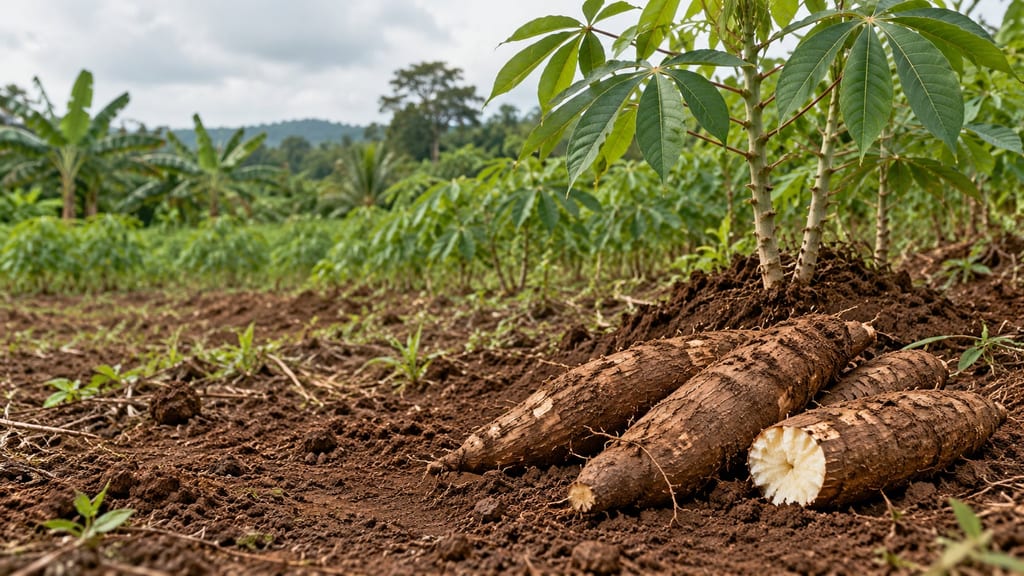
Freshly dug cassava roots: once lifted, they begin to deteriorate within about a day.
A root with about a day
A cassava root starts to go bad within about 24 hours of being dug. The first change is physiological: discolouration spreads through the root’s vascular tissue within a few days. Decay caused by microbes follows, usually five to seven days after harvest. For a household that cannot sell, dry or process a whole field at once, digging is a deadline.
In many cassava-growing regions the answer is not to dig. Subsistence farmers leave the roots in the ground until they are needed, and the roots can stay there for several months after reaching maturity. Nothing is dried, salted or sealed. The root stays attached to a living plant and comes out when someone is hungry, so the field itself is the pantry.
What the waiting costs
The pantry charges rent. Cassava roots left too long become more fibrous and woody, their starch content falls and their susceptibility to pathogens rises. The risk is highest where marketing is delayed. The sources give no tighter figure than “several months”.
Temperate roots work the same way. A parsnip left in the soil loses flavour and turns fibrous if it is not harvested before new tops and seed stalks begin to grow. In both crops the plant sets the deadline, not the farmer: the stored food is only available while the plant is behaving like a store.
Buying a few weeks after the dig
Farmers and researchers have found ways to stretch the clock on either side of harvest. Stems are cut back about three weeks before harvesting. A 1986 study of twelve cultivars at 15 months of age, published in a Japanese agricultural journal, found that pruning the stem to 30 cm two to three weeks before harvest delayed physiological deterioration, and that burying the roots underground for three weeks also helped. The abstract does not say whether the buried roots were still attached to the plant. Across the cultivars, the severity of deterioration fell as the moisture in the root at harvest rose, and rose with its starch content.
After lifting, traditional methods are simple. Roots are buried in pits or trenches, or heaped and watered daily for a short period, or coated in earth or mud paste, which is said to preserve them for four to six days. Clamps and boxes are the improvements. Field clamps achieved storage for up to eight weeks. Roots packed in boxes with moist sawdust on the day of harvest had 75% still acceptable after four weeks, and a one-day delay in packing cut that to 50%. Treated airtight plastic bags keep roots for two to three weeks. These methods favour a humid, warm environment, and roots meant to be kept for more than a week need careful harvesting and selection.
Yams, sweet potatoes and cocoyams
Yams show how far a living crop can be managed. For the short-term yam Dioscorea rotundata, the grower can cut below the head of the tuber and leave the top to grow again and produce a further tuber. The same plant can be harvested twice, the first time 5 to 6 months after planting and the second 3 to 4 months later. It is an exceptional case. Maturity and dormancy arrive about 8 to 11 months after planting.
Once yams are lifted, West Africans store them in barns, the commonest type of yam store in the region. The maximum storage life of yams in a barn is six months, with losses of 10% to 15% in the first three months. In Ghana and Côte d’Ivoire they are stored in pits. One ventilated pit measured 2.9 m long, 1.3 m wide and 1.5 m deep, held about 200 tubers, and stayed between 21 and 24 °C. Curing helps: tubers piled on the ground under a layer of grass at least 15 cm thick are cured in a heap, and tubers treated for two weeks in a pit showed 40% rotted after four months. Curing at 32 to 40 °C and 85% to 95% relative humidity for 4 to 7 days is also described.
Other tropical roots are handled to suit. Sweet potato is left in the ground and harvested only as needed, then cured at 30 to 32 °C and 85% to 90% humidity for four to seven days and stored best at 13 °C. Cocoyam corms are heaped under shade or kept in pits covered with leaves and soil; the best storage temperature is 7 °C, and at 25 to 30 °C they last only 4 to 6 weeks. The target moves with the crop.
Winter in the garden
The same logic works in a cold climate. After the first fall frosts, University of Illinois Extension advises throwing a few inches of soil or straw mulch over parsnip crowns, and notes that a low tunnel can keep snow off the plants for winter and early spring harvesting. Frost helps rather than harms: parsnip flavour develops when the roots are exposed to near-freezing temperatures for two to four weeks in the fall and early winter.
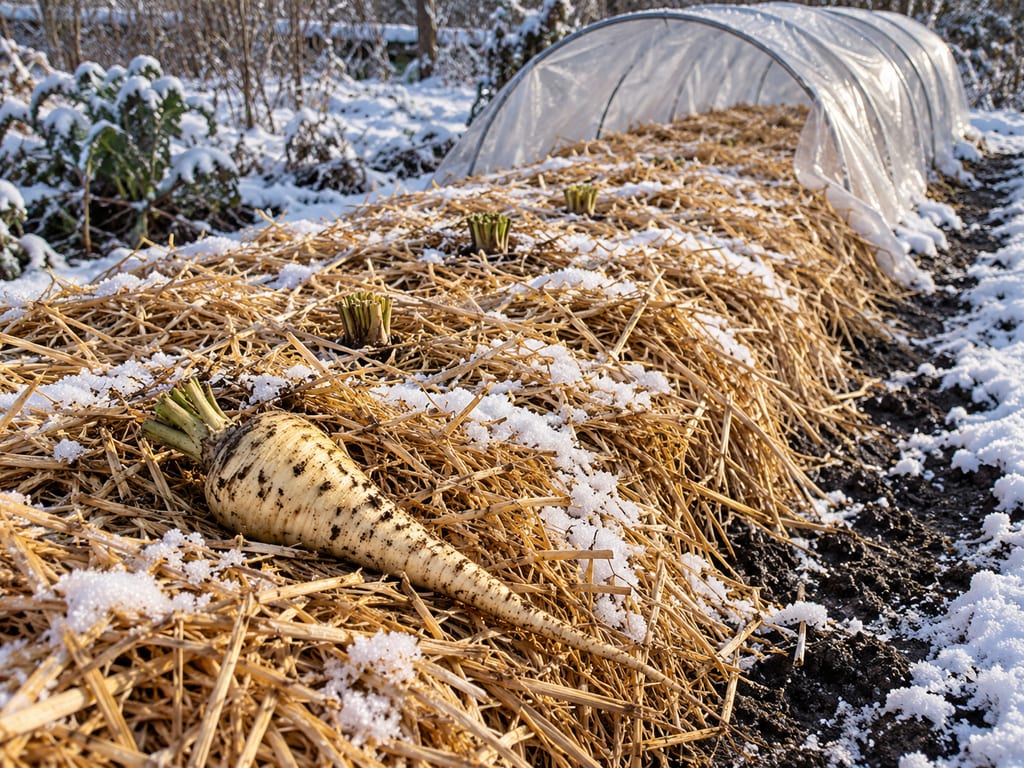
Iowa State University Extension gives the same advice for several roots, without any temperature or time figures. Rutabagas stay heavily mulched and are harvested until the ground freezes. Parsnips are covered with straw and harvested in spring before growth resumes. Horseradish is left in the ground and dug in spring, and salsify overwinters under a thick mulch and is dug in spring before new growth.
Leeks appear to follow the pattern, with less certainty. Gardening advice on leeks commonly describes hilling soil or heaping mulch around hardy cultivars so they can be dug into late fall, with overwintering types harvested in the spring or the summer after planting, and warns that leeks flower and go to seed if they are left past the start of consistent spring warmth.
The cellar: the same bet, indoors
Roots that cannot stay in the ground can go into a cold, damp store. Iowa State’s table for winter vegetables gives each crop its own conditions, and the pattern is plain: near freezing and humid. Carrots keep 4 to 6 months at 0 to 2 °C and 98% to 100% relative humidity. Beets keep 1 to 3 months at 0 to 2 °C and 95%. Rutabagas keep 2 to 4 months and turnips 4 to 5 months, both at 0 to 2 °C and 90% to 95%. Fall-harvested parsnips keep 2 to 6 months at 0 to 2 °C and 90% to 95%, celeriac 3 to 4 months at 95%, and salsify 2 to 4 months at 0 °C and 95% to 98%. Horseradish keeps 10 to 12 months at −1 to 0 °C and 90% to 95%. Potatoes keep 5 to 8 months at 4 °C and 90% to 95%, and sweet potatoes, the exception, 4 to 6 months at 13 to 16 °C and 85% to 90%.
Extension services do not always agree. A separate Iowa State page on parsnips, updated in December 2024, advises harvesting in mid- to late November and storing at 0 °C and 95% to 98% humidity, with no duration, against the table’s 90% to 95% and 2 to 6 months. Oregon State University Extension passes on University of Missouri figures for rutabagas and turnips, a cold, very moist cellar at 0 to 4 °C and 90% to 95% humidity for up to six months; those numbers are secondhand. The same advice says to trim the tops to about an inch, pack the roots in barely moist sawdust, and remember that a rutabaga can take a frost but must not freeze. A garage that stays above freezing will also work, though a root cellar is ideal.
Clamps, the covered heaps of lifted roots that do the cellar’s job outdoors, come without tested numbers in this material. The only measured clamp is the cassava one, at up to eight weeks.
Alive, slowed or changed
Drying, salting, fermenting and cold storage act on food that has already been separated from the plant. They remove water, add salt or acid, or hold the food cold, and the food that comes out is no longer quite the food that went in. Leaving a crop in the field acts before the separation and does nothing to the food itself. The cellar sits between the two: the roots are lifted, but nothing is done to them except to slow them down.
For a gardener the lessons are practical. Mulch the crowns after the first frosts, expect the flavour to improve, and dig before the plant restarts. For a cellar, aim for near-freezing and damp, and treat the months in each table as keeping-quality ranges, never as safety deadlines: a root that looks or smells fine has not been shown to be safe. For a cassava farmer the field is a flexible pantry, but not an endless one, and the longer roots wait, the woodier they get.
The numbers that would make this a precise craft are the ones still missing: how long cassava can safely wait, what temperature and humidity a clamp holds, and how yams are kept alive in the field beyond regrowth.
Community
No community contributions have been published for this entry yet.
Share what you made
Sign in to contribute. Published comments and photos are free to read.
Sources
Hosted by the Food and Agriculture Organization of the United Nations; the page names no author
Traditional post-harvest technology of perishable tropical staples, Chapter 5 – CassavaCited in: A root with about a day; What the waiting costs; Buying a few weeks after the dig; Alive, slowed or changed
Hosted by the Food and Agriculture Organization of the United Nations; the page names no author
Chapter 4 – Handling and storage methods for Fresh Roots and TubersCited in: A root with about a day; Buying a few weeks after the dig; Yams, sweet potatoes and cocoyams; Alive, slowed or changed
JARQ: Japan Agricultural Research Quarterly 19(4): 241–252, 1986 (Shohei Hirose); abstract
Physiological Studies on Postharvest Deterioration of Cassava RootsCited in: Buying a few weeks after the dig
Iowa State University Extension and Outreach, Yard and Garden (Aaron Steil), reviewed January 2025
Storing Winter Storage VegetablesCited in: Winter in the garden; The cellar: the same bet, indoors; Alive, slowed or changed
Iowa State University Extension and Outreach, Yard and Garden (Richard Jauron), updated 6 December 2024
How do I store parsnips?Cited in: The cellar: the same bet, indoors
University of Illinois Extension, Home Vegetable Gardening
ParsnipCited in: What the waiting costs; Winter in the garden
Oregon State University Extension, revised January 2026 (quotes University of Missouri Extension)
Rutabagas harvest and storage suggestions?Cited in: The cellar: the same bet, indoors
Gaps
- No source gives a safe time for cassava in the ground, and raw cassava needs processing whatever its storage history because its cyanide content varies.
- Tested temperature and humidity figures for vegetable clamps, for yams kept alive in the field beyond regrowth and for overwintered leeks were not found.
- The University of Missouri cellar figures are secondhand, and the 1986 cassava study was read as an abstract only.
Updated 2026-10-29