
Garum intake
A Barley Sauce Rotted in the Sun, and the Fish Sauce of the Gulf
A medieval Arabic recipe turns barley bread into a black seasoning with 40 days of sun. Around the Gulf, salted small fish still become sauce, and laboratories and health ministries now measure it.
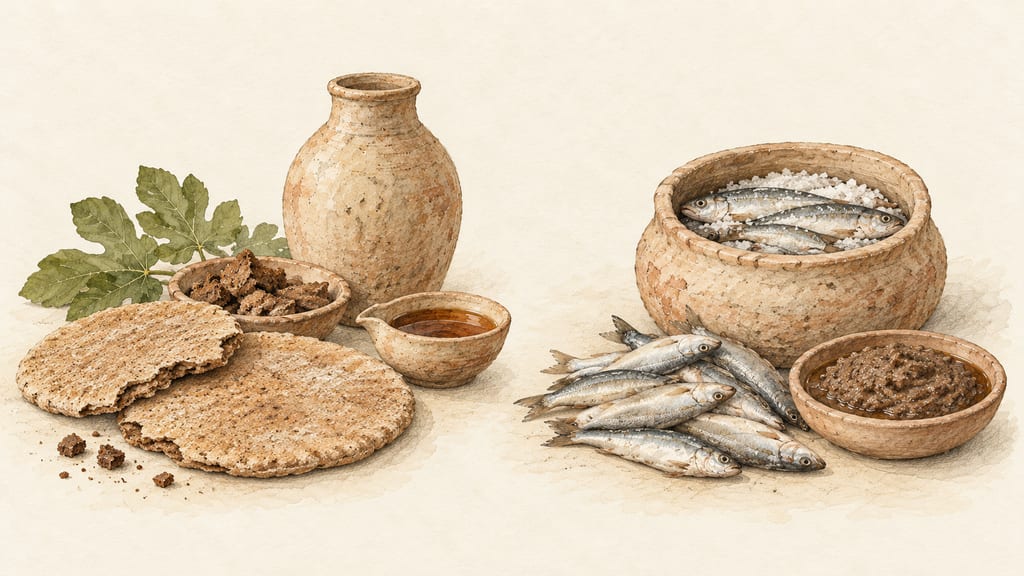
An imagined still life of the two kinds of seasoning: dried barley loaves and an earthenware jar for murri, whole small fish and a jar of brine for the Gulf's fish sauce.
Bread baked to be ruined
The recipe starts with baking bread and ends, forty days later, with something black. In al-Baghdadi's version you take five ratls of flour and five ratls of rotted barley and make a dough with no leaven and no salt. You bake it and let it dry. Then you grind the loaf and knead it with salt equal to a third of its quantity, and you set it in the summer sun for 40 days, kneading it at dawn and again in the evening and sprinkling it with water. When it has turned black, you pack it into jars with an equal amount of water, stir it morning and evening and strain it. Cinnamon, saffron and herbs finish the liquid. This is murri, a seasoning of the medieval Arabic-speaking kitchen.
The English translation of that recipe lists penny-royal where this account says rotted barley. Charles Perry, who translated the book, concluded that penny-royal was a mistake for budhaj, the Arabic word for rotted barley. Budhaj was a product of its own. Loaves were left to rot, generally in closed containers for 40 days, then dried and ground so they could rot a second time. Murri therefore came in two stages: first a spoiled bread, then a seasoning made from it.
A second recipe in the same book shows the first stage alone. Flour and budhaj are mixed with hot water and baked into a loaf with a hole in the middle. The loaf is wrapped in fig leaves, put in a jar in the shade until it is fetid, and dried. The recipe gives no number of days.
You will often read that murri meant 40 days in fig leaves. That schedule comes from a modern description, which cites Davidson, Saberi and McGee, and not from the medieval text. In the modern account the dough sits in fig leaves for 40 days, is dried and ground, is mixed with water, salt and more flour, and then rests in a warm place for another 40 days. The medieval recipe that names 40 days puts them in the sun.
One name, several recipes
Murri was a family of preparations, and the recipe changed with the cook. An Iraqi style, tied to Ibn Sayyar al-Warraq's Kitab al-Tabikh and to the thirteenth-century Kitab Wasf al-Atima al-Mutada, ferments ground flatbread, barley flour and salt. A Maghrebi style uses barley flour alone and flavours it with carob, fennel stems, citron and other ingredients. The sources differ on where that recipe is written down. One summary places it in the Kitab Wasf. Anagnostakis finds the Moroccan barley murr in a later Egyptian compilation, the Anonymous Kanz, in recipes 150 and 151.
In Andalusia the condiment was called almorí, and the Anonymous Andalusian Cookbook describes it as a liquid. Murri mixed with milk is said to have been called kamakh, but that claim rests on a single secondary citation and has not been checked against a medieval text.
Cooks short of time had a quick version: two parts barley flour to one part salt, baked hard, crumbled, soaked for a day and a night and strained.
A murri that never fermented
The Kitab Wasf also gives a Byzantine murri, in Perry's translation, and it shows how far the name could stretch. The cook scorches honey, then adds ten loaves of scorched oven bread, starch, roasted anise, fennel and nigella, Byzantine saffron, celery seed, Syrian carob, peeled walnuts, split quinces and salt dissolved in honey. All of it is boiled in 30 ratls of water until a third of the water is absorbed, and the liquid is strained through a hair nosebag into a greased glass or pottery vessel with a narrow top.
Nothing in that pot ferments, and no fish goes in. Anagnostakis calls it a muzawwart, a simulated dish, made as a counterfeit of murr for Christian Lent and other restricted diets. The label murri in a medieval text therefore does not tell you whether anything fermented.
Murri and fish
Murri belongs in a story about fish sauce only by association, because its best-known form contains no fish. Fish did enter the picture. Anagnostakis describes an Egyptian murr qadim made from small anchovy-like fish, called r or tjir, and a variety made near Antioch. Grain murr, he adds, was not often made from the blood or entrails of salted fish.
Where the word comes from is open. Latin murria, Greek halmuria and Akkadian marru have all been proposed, and the origin is generally believed to be unknown. A summary of the evidence notes that the Arabic translation of Artemidorus' dream book uses garos, the Greek word for fish sauce, for murri. Medieval Arabic had other words in the same territory: ṣīr and mulūḥa can each mean salt-cured fish, fish sauce or brine. Not every medieval murrī was a fish product, and the names do not map neatly onto one.
Mahyawa, a sauce still made in the south
Mahyawa, also written mahyaveh and mehyawa, is a fish sauce of southern Iran and the Gulf, and unlike murri it is in the kitchen today. Bahrain's national food-based dietary guidelines, published in 2024, name it in a box of tips for cutting salt. Mahyawa and dried seafood appear there as foods to limit, in a list with olives, pickles, processed meats and salted nuts.
Neighbouring coasts have relatives. In Hormozgan, a 2018 study compares a fish sauce called suragh made with and without red earth. In Jazan, in south-western Saudi Arabia, a salted-fermented fish called hout-kasef is eaten at Eid al-Fitr and Eid al-Adha with special foods. A survey of 24 market samples from Jazan and Abu Arish, collected at different times of year, found an average of 15.19 per cent salt, with a range of 12.72 to 19.74 per cent, and a mean pH of 6.39. Salt-tolerant bacteria ran from 3.26 to 5.14 log10 CFU/g, mostly Bacillus and Staphylococcus. Listeria, Vibrio, Campylobacter and Yersinia were not detected in those samples, which says nothing about the next jar.
In 2012 Zarei and colleagues published a survey of the chemistry and microbiology of southern Iranian mahyawa. The Iranian and Saudi work describes a living production, not an invention date.
Tareeh: sardines, salt and the sun in Bahrain
A 2017 paper from the University of Bahrain, written by Freije to compare fatty acids, records how two linked products are made at home. Tareeh starts with whole sardines, locally called oom (Sardinella albella). They are cleaned, air-dried, mixed with salt and packed into large earthen containers, where they ferment for a month to several months. There are no spices and little straining. The result is a thick brown paste.
Mehiawh, the paper's spelling of mahyawa, is the sauce made from it. Spices and water are added to the mashed paste, and the mixture ferments at room temperature for anywhere from two weeks to a year. It is used as a flavouring and a salt substitute, and it is spread on thin local bread. In the paper's own batch, 50 kg of fish went into the containers with 10 kg of salt, which is 20 per cent, and stood in the sun for one month. The sauce then took two more weeks. The paper's producers came from East Riffa market, in October 2012 and October 2016; eight home producers took part in all.
The measurements concern fat, not microbes. The fermented products held more polyunsaturated fatty acids than the raw fish, and one of them, C18:4 n-3, rose from 8.08–8.25% in the raw fish to 9.54–10.76%. The paper calls tareeh the more nutritious of the two products.
What the laboratory measured
Mahyawa has been studied more closely than murri ever was. In 2013 Moayedi and Moosavi-Nasab, writing in Persian, followed a laboratory batch in saturated brine in pottery containers, prepared in an incubator at 37 °C. They sampled it at six stages across 54 days. Total bacterial count and trimethylamine, the compound associated with the smell of stale fish, correlated at r = 0.8. The abstract gives no salt percentage.
A 2022 study asked which recipe gives the lowest microbial load. Kavian and Nateghi froze tuna, anchovy and sardine at −18 °C, then fermented them at 37 °C in an incubator at 15, 25 and 35 per cent salt for 30, 75 and 120 days, in 15 treatments. Sardine at 29.38 per cent salt for 103.63 days came out best, with a desirability of 99.49 per cent. That is the optimum of one laboratory design, not a household method.
A 2024 study followed dried anchovy, 50 g per batch, in a brine of 12.65 per cent salt in sealed glass jars for 40 days at 39 °C, blending the jars daily and sampling on days 5, 10, 20, 30 and 40. Histamine climbed from 6.25 to 43.49 mg/kg and cadaverine from 15.55 to 42.76 mg/kg. These are the biogenic amines that fish ferments are checked for. Histamine-producing bacteria rose from 3.00 to 4.58 log CFU/mL, while lactic acid bacteria in the low-salt count fell from 7.24 to 4.14 log CFU/mL. Tasters gave the sauce, after the 40 days plus 15 days of sun, 5.10 ± 0.87 on a scale of 1 to 7. One detail is easy to misread: the 10 per cent salt in that paper was in the agar plates used to count bacteria, not in the sauce, so the study does not show what a given salt level does to the sauce itself.
Taste, smell and a good score do not show that a fish ferment is safe. Each of these batches ran under laboratory control.
Two seasonings, one idea
Murri and mahyawa both lean on salt and time. The murri recipe calls for salt equal to a third of the ground loaf and 40 days of sun. The mahyawa figures run from 12.65 per cent salt in one laboratory brine to 15.19 per cent in Saudi market samples, 20 per cent in the Bahraini paste and 29.38 per cent in the optimum of the 2022 design. That salt is part of why Bahrain's guidelines list mahyawa as a food to eat less of.
They are not relatives. Murri is a grain seasoning known from medieval Arabic recipes, and some of it was never fermented at all. Mahyawa is a fish sauce known from modern household practice and modern laboratories. No source ties one to the other, and none dates mahyawa to the Middle Ages.
Community
No community contributions have been published for this entry yet.
Share what you made
Sign in to contribute. Published comments and photos are free to read.
Sources
Cariadoc (Lindahl), pbm.com
Medieval recipes introduction: murri, Byzantine murri and Charles Perry translationsCited in: Bread baked to be ruined; One name, several recipes; A murri that never fermented; Two seasonings, one idea
Wikipedia
Murri (condiment)Cited in: Bread baked to be ruined; One name, several recipes; Murri and fish
I. Anagnostakis, Studia Ceranea 14 (2024)
Sweet and Salty Recipes: Some Examples from the Muslim and Byzantine Culinary and Medicinal Common TraditionCited in: One name, several recipes; A murri that never fermented; Murri and fish
Iranian Scientific Fisheries Journal 22(3) (Moayedi and Moosavi-Nasab, 2013)
Evaluation of nitrogenous compounds, microbial changes and electrophoresis pattern during fermentation of Mahyaveh, the Iranian traditional fish sauceCited in: What the laboratory measured
Kavian and Nateghi, Iranian Journal of Microbiology 14(2) (2022)
Optimization of production conditions of Mahyaveh, a traditional Iranian fish sauce, with low microbial loadCited in: What the laboratory measured; Two seasonings, one idea
Ghayoomi and colleagues, Food Science & Nutrition 12(4) (2024)
The principal component analysis of key and significant features of the safety and nutritional value of Mahyaveh sauceCited in: What the laboratory measured
M. A. Gassem, Saudi Journal of Biological Sciences 26(1) (2019)
Microbiological and chemical quality of a traditional salted-fermented fish (Hout-Kasef) product of Jazan Region, Saudi ArabiaCited in: Mahyawa, a sauce still made in the south; Two seasonings, one idea
Bahrain Ministry of Health (2024)
National food-based dietary guidelinesCited in: Mahyawa, a sauce still made in the south
A. Freije, Bahrain Medical Bulletin 39(4) (2017)
Fatty Acid Compositions of Raw Fish White Sardinella (Oom), Fish Paste (Tareeh), and Fish Sauce (Mehiawh): Fermented Fish Products Rich in Polyunsaturated Fatty AcidsCited in: Tareeh: sardines, salt and the sun in Bahrain; Two seasonings, one idea
Zarei and colleagues, Food Control 23(2) (2012)
Chemical and microbial properties of mahyaveh, a traditional Iranian fish sauceCited in: Mahyawa, a sauce still made in the south
Owjifard and colleagues, Aquatic Ecology, University of Hormozgan (2018)
Comparison of physicochemical, microbial and sensory properties of traditional Suragh fish sauce with sauce without red earthCited in: Mahyawa, a sauce still made in the south
Gaps
- No source here gives the salt level of the 2013 mahyawa batch, a date for mahyawa before the modern studies, or a link between it and a medieval fish condiment.
- Kamakh rests on one secondary citation, and the book that carries the Maghrebi barley murri is disputed.
- No source on tareeh was found for Kuwait or Oman.
Updated 2026-10-29