
Preservation intake
A sieve for bacteria: what membrane filters do for milk, beer and wine
Ceramic and polymer membranes hold microbes back instead of killing them, which gives milk extra weeks and makes beer and wine stable. The pores are far too wide to stop a virus, and filtration alone does little against a dissolved toxin.
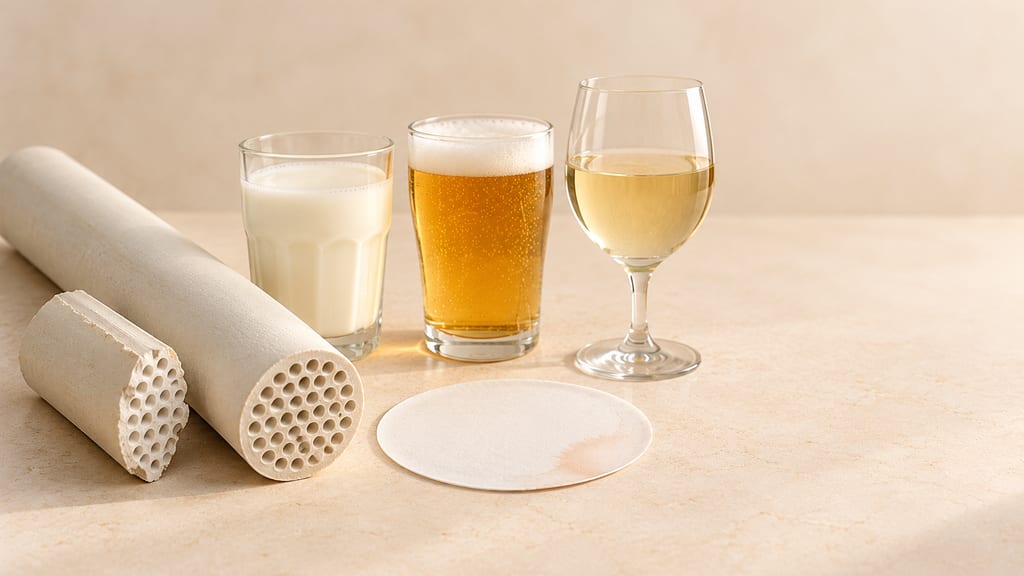
A ceramic membrane element of the kind used for crossflow filtration, beside a glass of milk, a glass of beer and a glass of white wine.
Milk that outlasts its pasteurisation
A carton of extended-shelf-life milk can last three to six weeks in the refrigerator. Part of the reason is a step that happens before the heat. The skim milk is pushed through a ceramic membrane with pores 1.4 µm wide, and the bacteria stopped on the wrong side of it never reach the pasteuriser.
That is a different idea from most preservation. Heat, salt and acid act on microbes where they sit. A membrane takes the microbes out of the liquid. The milk that passes through keeps its dissolved components, because nothing has heated it, and the cells that were removed are no longer something the later steps have to deal with. The method is industrial, with pumps, pressure control and sanitary equipment, and it runs in dairies and other liquid-food plants, not in kitchens.
Counting what the filter catches
Filter performance is counted in log units. One log unit means nine of every ten cells are removed, two means 99 of every 100, and four means all but one in 10,000.
The best-studied milk line is called Bactocatch. Across the whole process, which also separates the cream and pasteurises the milk, the bacterial load falls by 4.6–5.6 log units. In 2017 a team at the Technical University of Munich, in Freising, measured the hardest part of the job, which is spores: dormant cells that survive conditions that kill growing bacteria. In spiking experiments, reductions of added spores ranged from 2.0 to 4.5 log units. In six large-scale runs at two dairies, the process cut spores by close to four log units, 3.7 on average.
The filter did most of that work. In the large-scale runs the membrane step removed 2.2 log units on average, the largest removal of any single stage, and up to 3.1 in the best run. In processes that were not running properly it managed 0.6 or 1.5. Final pasteurisation added a further 1.2.
The bacteria that arrive after the filter
The Munich team also asked what actually spoils this milk, and the answer was awkward for the technology. Microfiltered, pasteurised extended-shelf-life milk spoiled mainly through cold-tolerant, spore-forming bacteria, and these often came from recontamination, picked up somewhere after the filter and the heat.
Tetra Pak's Todd Hutson makes the same point from the plant floor. Heat-tolerant bacteria such as coryneforms can survive pasteurisation, he says, and filling equipment is particularly sensitive. Spores the membrane removed do no good if the filler puts new ones back. Each stage guards against a different route to spoilage, and a weak link in one undoes the others.
Shelf life follows the whole chain. In Germany the shelf life of this milk is generally regulated to a maximum of 24 days, at a recommended storage temperature of 8 °C. Other studies of the Bactocatch process give 22–29 days at 8 °C and 26–33 days at 6 °C. Hutson puts it at 30 to 45 days at 7 °C when microfiltration is combined with pasteurisation, and calls a cold chain below 7 °C critical. His figure is a vendor's.
All of these are quality limits. They say when spoilage organisms are expected to win, not when milk becomes safe or unsafe, and smell or taste cannot settle that either way.
Pushing toward three months
Between 2003 and 2005 a Cornell University project led by D. M. Barbano, funded by the Dairy Research Institute, asked whether fluid milk could last 60 to 90 days. Its route was microfiltration of the skim milk to remove somatic cells (the cow's own cells), vegetative bacterial cells and spores, then recombination with cream and a minimum HTST treatment, the standard short-time heat step. The reported result was a total bacterial count below 20,000 colony-forming units per millilitre out to 60 to 90 days, at 2 and 4 °C. The record gives no heating temperatures or hold times, and a count is not a verdict on flavour.
Pore size is the main lever. Ceramic membranes in dairies have pores between 0.8 and 1.4 µm. Hutson says 1.4 µm membranes typically deliver about four log units of spore reduction and 0.8 µm membranes can reach six. The six is a vendor's statement, and no measurement backs it in the material gathered for this article. A second supplier, SPX Flow, says only that the result depends on milk quality and membrane configuration.
Beer and wine: a pore rating that has to pass a test
In a brewery the question is narrower. Does a membrane stop the particular organisms that spoil beer? In 1993 three researchers at Millipore, K. L. Roche, P. M. Meier and R. V. Levy, tested membrane discs rated 1.0, 0.65, 0.45 and 0.22 µm, challenging them at 50 psi (3.45 bar) with a spoilage yeast, Saccharomyces diastaticus, and two lactic acid bacteria, Pediococcus damnosus and Lactobacillus brevis. All four ratings held back the yeast completely. Only the 0.45 and 0.22 µm discs held back both bacteria. Their advice was to use membranes of 0.45 µm or tighter, with retention verified by microbial testing and validated by an integrity test.
Manufacturers' datasheets set similar thresholds, though they are vendor claims and not independent data. Eaton, for example, challenges its beer membranes with 10 million organisms per square centimetre of membrane.
The lesson from the Millipore tests carries over to wine filtration: a pore size that stops the yeast can still let the bacteria through, so the rating has to match the organism that matters.
Draught beer without the heat
Cold filtration takes microbes out of beer without heating it. A 1999 Austrian patent from Steirerbrau AG, the one source found for it, states that cold-filtered beers are sold as draught beers in the United States, Japan and Korea. It also says the method's weak point is that the filter blocks quickly, because deposits of beer substances build up on its upstream side, and that technical enzymes are used to counter it.
These are the patent's claims, written by a company with something to protect. The text gives no pore size and no filtration temperature.
What a pore cannot hold back
A membrane sorts by size, so the smallest particles pass through. The hepatitis A virion, a non-enveloped virus, is about 30 nm across. Pore ratings of 0.2 to 1.4 µm are roughly 7 to 47 times wider. That comparison is arithmetic, not a measurement, and no milk-specific data on virus removal by microfiltration turned up.
Dissolved toxins are a separate limit. A 2018 study from Zagreb on removing aflatoxin M1 from milk, a toxin with a regulatory limit of 0.05 micrograms per kilogram, found that filtration alone gave poor results. Heat treatment combined with filtration and centrifugation removed as much as 96 percent. The abstract does not say that the filtration was done with a membrane.
What the word filtered tells you
A filter lowers the number of cells by a measurable amount, and how much depends on pore size, on whether the membrane has been tested, and on what happens downstream. In milk that is heat and a clean filler. In beer and wine it is a rated membrane with an integrity test. A label that says filtered does not say the product was never heated, and a heated product may never have met a membrane.
Many numbers are still missing: industrial milk-line pressures and temperatures, measured retention of pathogenic spores, and any measure of virus removal in milk.
Community
No community contributions have been published for this entry yet.
Share what you made
Sign in to contribute. Published comments and photos are free to read.
Sources
Doll, Scherer and Wenning, Frontiers in Microbiology 8, article 135 (2017)
Spoilage of Microfiltered and Pasteurized Extended Shelf Life Milk Is Mainly Induced by Psychrotolerant Spore-Forming Bacteria that often Originate from RecontaminationCited in: Counting what the filter catches; The bacteria that arrive after the filter; What the word filtered tells you
Dairy Foods, 23 March 2026
Membrane Technology: Improving Dairy Product Shelf LifeCited in: Milk that outlasts its pasteurisation; The bacteria that arrive after the filter; Pushing toward three months; What the word filtered tells you
USDA National Agricultural Library, food safety research projects (D. M. Barbano, Cornell University)
HTST strategy: 60-90 day fluid milkCited in: Pushing toward three months
Journal of the American Society of Brewing Chemists 51(1):4–9 (Roche, Meier and Levy, 1993)
Retention of Beer Spoilage Microorganisms by Polyvinylidene Fluoride Microporous Membranes with Various Retention RatingsCited in: Beer and wine: a pore rating that has to pass a test; What the word filtered tells you
Google Patents
Method for producing cold-filtered beer, Austrian patent AT405291B (Steirerbrau AG, 1999)Cited in: Draught beer without the heat
Kuharić and others, Archives of Industrial Hygiene and Toxicology 69(4): 334-339 (2018)
Removing aflatoxin M1 from milk with native lactic acid bacteria, centrifugation, and filtrationCited in: What a pore cannot hold back
Eaton (manufacturer data)
BECO MEMBRAN PS Beer technical data sheetCited in: Beer and wine: a pore rating that has to pass a test
Gaps
- Pressures and temperatures for industrial milk lines, and measured spore retention for pathogens, are not established.
- The cold-filtered draught beer claims rest on one patent that gives no pore size or temperature.
- No milk-specific data on virus removal by membranes were found.
Updated 2026-10-29