
Preservation catalogue
Mould starts it, salt picks the survivors: the soybean pastes and sauces of Asia
Miso, soy sauce and doenjang share one idea: let a first stage break down beans and grain, then add enough salt that only a few microbes can follow. In Korean doenjang, bacteria do most of the work.
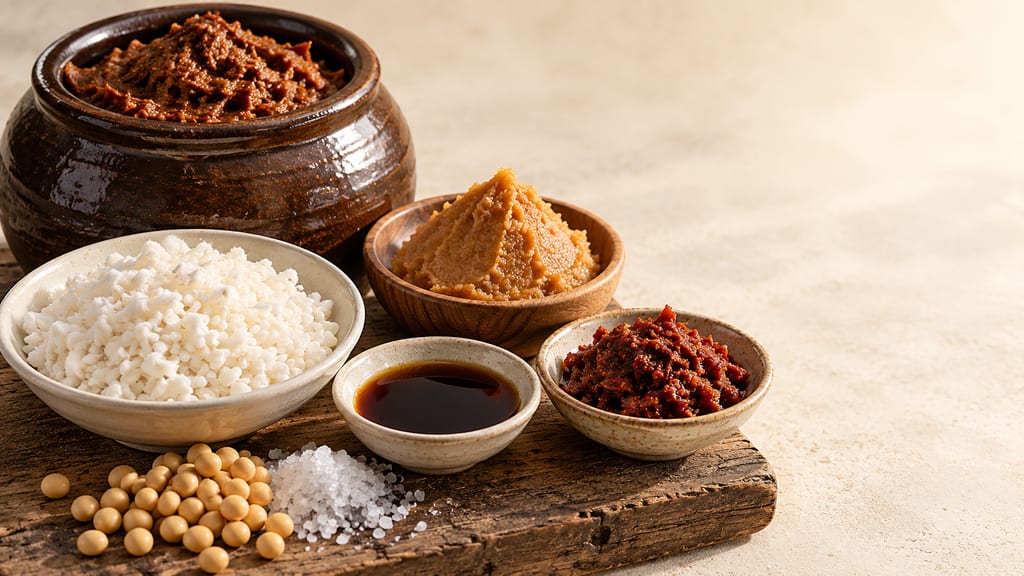
The family on one table: koji grown on rice, soybean paste, soy sauce and a chilli bean paste, with soybeans and coarse salt.
Ninety bricks, 332 days
Researchers at Chung-Ang University in Seoul followed a batch of doenjang, the Korean soybean paste, for most of a year. They put 90 meju bricks, the fermented soybean blocks that start the process, into 180 litres of brine made with about 20% (w/v) solar salt. The bricks soaked for 42 days. The mash then fermented for 332 days in pots with no temperature control.
Throughout, the salt in the water phase held at about 17.5% (w/w), give or take half a point. At that level the paste was far from sterile. Bacteria fell from roughly 270 million to 41 million colony-forming units per gram of fresh weight, a count of living cells that grow into a visible colony on a plate. Fungi fell from 320,000 to 79,000. Bacteria outnumbered fungi by about a thousand to one for the whole year.
That count complicates the label on this family. ‘Mould-assisted’ describes the koji route well: a mould grown on grain or beans makes enzymes before any salt goes in, as in Japanese miso and soy sauce. It describes Korean doenjang less well, because bacteria dominate the maturing paste. Several relatives, such as natto, kinema and cheonggukjang, are led by Bacillus bacteria and not by a mould at all. What the members share is a sequence: a first stage that breaks down beans and grain, then enough salt to narrow the list of microbes that carry on.
The first stage works, then the salt chooses
Japanese miso starts with koji: rice, barley or soybeans grown with a mould. The koji is mixed with salt into steamed soybeans. Enzymes from the mould turn starch into sugar and soybean protein into amino acids, and the amino acids give miso its savoury depth. Lactic acid bacteria and yeast then act on the mash.
Soy sauce follows the same order. Kikkoman, the soy sauce maker, names Tetragenococcus halophilus as its lactic acid bacterium and Zygosaccharomyces rouxii as its yeast. The two accounts also name different koji moulds. Japan's agriculture ministry gives Aspergillus oryzae as the koji mould for miso and soy sauce, and Kikkoman gives Aspergillus sojae for its soy sauce. This overview keeps each attribution and does not settle the difference.
Salt does not clear a mash of life. It changes who can live in it. In the Korean doenjang, Bacillus made up about 40% of the bacteria throughout. Tetragenococcus, the genus soy sauce makers name, became dominant from day 108, and Lactobacillus also figured at day 179. The authors suggest that Tetragenococcus is the main producer of organic acids and biogenic amines in the paste. That is an inference, not a measured result.
Salt levels differ by style. Among Japanese miso, sweet rice miso sits at 5 to 7, salty rice miso at 11 to 13 and soybean miso at 10 to 12. The published table prints no unit, and percent is the likely reading. Work on Korean doenjang adds that the amount of meju strongly influences amino acid production, while the salinity changes which microbes take over in turn.
Salt is one of three measures that get confused. Salt content, water activity and acidity answer different questions, and a number for one does not stand in for the others. Smell, taste and bubbling never show that a paste or sauce is safe.
Records, theories and a priest's story
The documented history is Japanese. By about the seventh century, people were harvesting large quantities of salt from broad sandy salt fields, and that supply is linked to the growth of miso, soy sauce and other salted fermented foods. The Taiho Code of 701 records hishio made from soybeans. Hishio, the earliest form of soy sauce, came from China. Japanese written records of hishio-type foods reach into the early eighth century. They are not an invention date for the whole family.
Miso appears in the Shoso-in documents as misho and miso, and in the Wamyoruijisho as misho. One theory has miso arriving from Goguryeo in 666. It is presented as a theory, not a settled date.
In medieval Japan, rising soybean output moved miso making out of the temples and into village kitchens, where it became a homemade food. In the Kamakura period the Zen priest Kakushin is said to have brought kinzanji miso from China, and the story is told as the origin of tamari. Tamari reached its modern form by the end of the Muromachi period. The word shoyu first appears in 1597, in the Ekirinbon-setsuyoshu.
On 2 December 2024 UNESCO inscribed jang making in the Republic of Korea on its heritage list. The inscription recognises a living practice. It is not an origin date.
One koji stage, two kinds of kitchen
In Japan the two lines part after the same first step. Miso keeps the solids as a paste. Soy sauce is pressed from moromi, a salted koji mash, and keeps the liquid.
Korea splits one batch instead. Meju blocks are brined, and then the liquid becomes ganjang, the soy sauce, and the solids become doenjang. Sauce and paste are two outputs of one process. Gochujang is a separate category.
Tamari shows the link running the other way: a sauce that came out of miso. The Kamakura story ties kinzanji miso to its origin, and modern tamari is made from balls of miso koji with a little salt water.
Japanese soy sauce comes in styles of its own. Koikuchi, made with roughly equal parts soybeans and wheat, is at least 80% of output. Usukuchi, from Kansai, is lighter in colour and aroma, but not in salt. Tamari, from the Tokai region, is made mostly from soybeans. Saishikomi uses soy sauce in place of brine. Shiro, the white style, is made mainly in Aichi. Miso matures for anything from several days to two years.
Whole beans, chilli paste and fungal cakes across Asia
In China, Pixian doubanjiang from Sichuan combines broad beans, chilli, wheat and salt. Its broad-bean koji, a mould grown on the beans, becomes a paste that matures for months. Researchers at Jiangnan University and the Tianjin Institute of Industrial Biotechnology have compared broad-bean koji made with an Aspergillus oryzae strain in a laboratory and in a factory. Douchi keeps the beans whole: fermented black soybeans, with microbial communities that differ by style. Taiwan's black-bean sauces use black soybeans, not black turtle beans.
In Indonesia, tauco is a salted soybean paste, and a 2025 study followed how its microbes replaced one another over 105 days. Oncom is a different food, a fungal ferment of food residues linked to Neurospora intermedia. In Vietnam, tương combines soybeans with a stage in which a grain is cultured, and official material discusses rice-associated Aspergillus oryzae.
Across Thailand, Myanmar, the Himalaya and northeast India, the work passes to bacteria. Thua nao, pe poke, kinema, akhuni, tungrymbai and bekang are soybean ferments led by Bacillus. Japan's natto and Korea's cheonggukjang belong with them.
Relatives that break the rules
Nesashi miso ferments spontaneously with the mould Mucor plumbeus and uses no added koji. It is a mould ferment with no koji in it, and a 2026 study describes its microbial ecology.
In 2017, Mouritsen and colleagues documented a sauce of peas and barley koji, in a paper on the flavour of fermented fish, insect, game and pea sauces that revisits garum, the old fish sauce. It was a feasibility demonstration, not a validated process. A 2025 study made miso from chickpea and lupin and followed the fermentation.
Soumbala, a West African ferment of locust beans, is driven by Bacillus bacteria that break down protein, and it sits outside this family. Bacillus cereus toxins, cereulide and enterotoxins, have been found in fermented African locust beans, and biogenic amines have been studied in douchi. Both findings are reasons to treat a fermented bean as a food that needs controls.
What holds across the family
Along the koji branch the logic holds. A mould or another first stage breaks beans and grain into sugars and amino acids. Salt then narrows the list of microbes that carry on. The cook decides whether to keep the paste or press the sauce. Doenjang shows that the second half can do more of the work than the first, and that ‘mould-assisted’ describes one route, not a rule.
What no one has pinned down is how much of the koji's work survives once the salt is in. Which enzymes stay active at miso or soy sauce salt levels, and how much of what they make reaches the salt phase, is an open question. A reader who wants to make any of these foods should take the method from a tested recipe for that one food, not from this outline.
Community
No community contributions have been published for this entry yet.
Share what you made
Sign in to contribute. Published comments and photos are free to read.
Sources
Ministry of Agriculture, Forestry and Fisheries, Japan
Miso and soy sauceCited in: The first stage works, then the salt chooses; Records, theories and a priest's story; One koji stage, two kinds of kitchen; What holds across the family
Frontiers in Microbiology 14:1139406 (2023)
The differences between broad bean koji fermented in laboratory and factory conditions by an efficient Aspergillus oryzaeCited in: Whole beans, chilli paste and fungal cakes across Asia
Frontiers in Microbiology 7:827 (2016)
Functional Characterization of Bacterial Communities Responsible for Fermentation of DoenjangCited in: Ninety bricks, 332 days; The first stage works, then the salt chooses; What holds across the family
Kikkoman Institute for International Food Culture
Brewing technologyCited in: The first stage works, then the salt chooses; One koji stage, two kinds of kitchen
UNESCO, Intangible Cultural Heritage
Knowledge, beliefs and practices related to jang making in the Republic of KoreaCited in: Records, theories and a priest's story
Foods 14(23):4131 (2025)
Fermentation Process Evaluation of a Sustainable and Innovative Miso Made from Alternative LegumesCited in: Relatives that break the rules
International Journal of Gastronomy and Food Science 9:16-28 (2017)
Flavour of fermented fish, insect, game, and pea sauces: garum revisitedCited in: Relatives that break the rules
Frontiers in Microbiology 17:1759987 (2026)
Miso without koji: nesashi miso ecology driven by spontaneous fermentation with Mucor plumbeusCited in: Relatives that break the rules
Gaps
- Nothing gathered here measures which koji enzymes stay active at miso or soy sauce salt levels, or gives a maturation temperature for miso, soy sauce or doubanjiang.
- The miso salt table prints no unit, and tauco, douchi and tương rest on abstracts and national descriptions, not full papers.
- The 666 Goguryeo date is only a theory, and no origin date is established for Korean or Chinese soybean ferments.
Updated 2026-10-29