
Garum intake
Nine thousand years under clay: the fish pit that may be the oldest fermentation on record
In southern Sweden, a Mesolithic pit packed with fish bones has been read as the earliest known fermentation, made with no salt and no pots. What the evidence shows, how firm the case is, and how it compares with rakfisk.
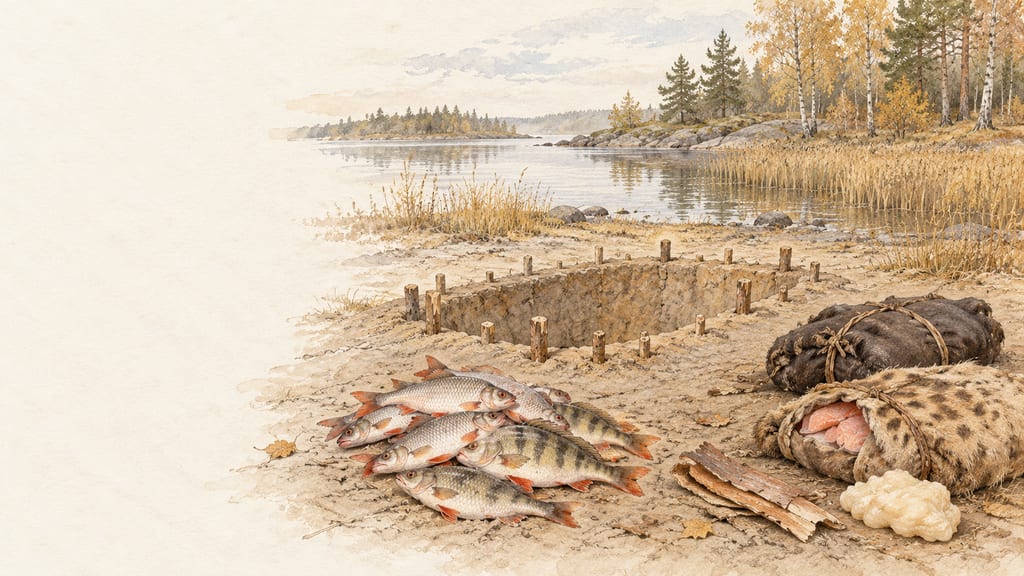
An imagined Early Mesolithic lakeshore of southern Sweden, with a fish pit cut into clay: a historical interpretation, not a record of the excavation.
A bone bed beside a lake
Fish bones rarely last 9,000 years in the ground. At Norje Sunnansund, on the former shore of a lake near the Baltic coast of south-eastern Sweden, they came out of the soil in huge numbers. Lund University's press office put the density at roughly 30,000 bones per square metre of excavation grid. Fine-mesh sieving made the find possible.
The site lies in Sölvesborg, in the county of Blekinge, beside what was Lake Vesan, close to the point where the lake drained into the Baltic. It was an Early Mesolithic camp: a settlement of foragers who lived by hunting, fishing and gathering, with no farming and no pottery. The bones belong overwhelmingly to freshwater fish.
The age depends on which publication you read. Lund's 2016 press release calls the settlement about 9,200 years old. A 2021 follow-up gives a range instead, around 9600–8600 calibrated years before present (radiocarbon dates converted to calendar years), and draws the occupation at about 9000 calibrated years before present. The two do not contradict each other, since 9,200 years falls inside the range. One is a round figure, the other a span.
The find was written up by Boethius, who works in historical osteology at Lund University. The 2016 paper in the Journal of Archaeological Science, titled "Something rotten in Scandinavia: The world's earliest evidence of fermentation", argues two things. The first is that fish were fermented here without salt. The second is that the people who did it were semi-sedentary, which questions current demographic models for the period. Lund's own headline for the story set the find beside the "cradle of civilisation", presenting settled communities in the Nordic region as appearing about as early.
A pit cut into clay
The reconstruction starts with a feature in the ground: an elongated pit cut into clay, ringed by stake holes and smaller pin holes. In Boethius's reading, fish were wrapped in the skins of seals and wild boar and laid in the pit. Pine bark and seal fat went in with them, named as agents in the ferment or in its acidification. The pit was then covered with muddy or clayey soil.
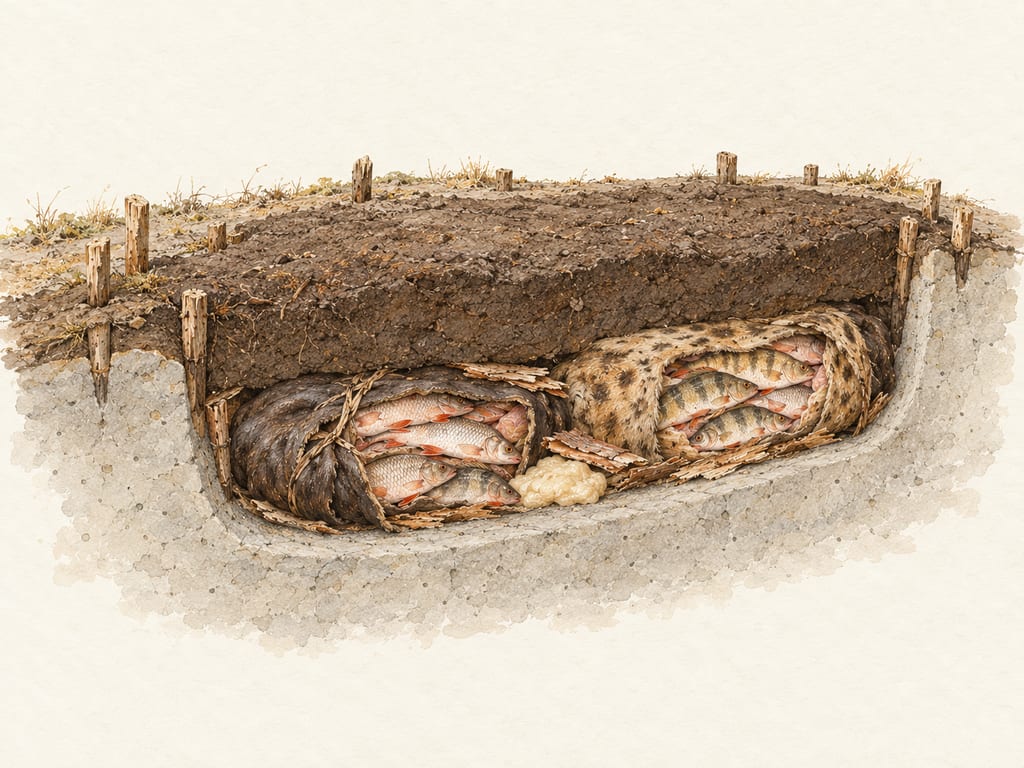
Nothing in that list is a salt or a pot. Salt was not available to these people, and there was no pottery to hold a brine or a sealed ferment. The skins stood in for a vessel, and the clay and soil closed it.
No one watched this being done. The reading comes from three things combined: what was in the pit, ethnographic parallels with circumpolar peoples such as the Inuit, and knowledge of how microbes behave in fish. The press release also calls the method an early precursor of modern surströmming, the Swedish fermented Baltic herring. That is a comparison of technique, not a claimed line of descent.
Why cold matters
Boethius states that this kind of fermentation requires a cold climate. The 2021 follow-up applies the point to the calendar. The fish in the pit were mostly roach, a freshwater fish that gathers in numbers in autumn before it migrates, and the authors judge that these were caught then. Because a salt-free ferment needs cold, they favour autumn or winter as the time the fish were processed.
On that reading the pit belongs to a seasonal rhythm: a catch taken when the fish were abundant and processed in the cold part of the year. How long the fish stayed in the ground, and how they were taken out and eaten, is unknown.
It also marks how far this is from anything a modern cook should copy. Nothing in the evidence amounts to a safe method, a tested time or a temperature range for a salt-free fish ferment. Smell and taste are no guide to whether such a food is safe.
How much fish, depending on who counts
The size of the catch is where the published figures drift apart. Lund's 2016 release says the bones imply at least 60 tonnes of freshwater fish caught at the site. That number is a calculation from the bones, not a count of fish. The 2021 follow-up says that hundreds of tons of fish were probably caught there, a larger scale again.
The bone counts differ too, though they measure different things. The 30,000 bones per square metre is a density across the excavation grid. The 2021 paper's figure, 16,180 fragments identified to species or family, is a count of what was identified from the material analysed, and less than 10 per cent of the site has been excavated. The two cannot be set side by side as if they were one measurement.
The mix of species is steadier. Roach make up 79 per cent of the assemblage in the fermentation pit, against 22–56 per cent in other parts of the site. Fish that migrate between sea and river amount to less than one bone in a thousand. This was a lake fishery, and the pit holds a more concentrated roach catch than the ground around it.
Fish from elsewhere, caught in autumn
The 2021 study went at the fish themselves. Boethius and colleagues at Lund, the National Historical Museums and the Swedish Museum of Natural History measured strontium in the enamel of 24 fish teeth: eight from pike and sixteen from cyprinids, mostly roach. Strontium isotopes in enamel carry a signature of the water a fish lived in, so a tooth can be compared with the local lake. The authors set that local baseline with the teeth of water voles.
Two of the cyprinids matched Lake Vesan. The rest did not; their strontium signatures were non-local. The authors read the fish in the pit as autumn catches, which fits the roach's autumn gathering.
They are open about what this cannot do. Only enamel data were used. The aquatic baseline is an estimate. The salt-free fermentation and the timing of tooth formation are inferences that were not tested directly, and one pike was treated as an outlier. The paper itself still calls the pit the earliest known evidence of fermentation, and treats that as a reading of the evidence rather than a measurement.
The living relatives
Fermented fish was once an ordinary northern food. Historically it was widespread among the peasantry of northern Scandinavia, the Faroes and Iceland. Today it is largely a festive food across Scandinavia. The Faroes are the only Nordic place where fermented, air-dried fish is still an everyday food.
Rakfisk is the best-studied relative. Norwegians make it from trout, char or whitefish, and a 2019 study sampled the brines of six producers over two seasons. The study's own text gives the salt in three ways: between 3.8 and 7.2 per cent NaCl, between 3.5 and 7.4 per cent weight per volume, and approximately 4–7 per cent by weight. The units and ranges differ, so each is given as written. The fish ripened at 3.5–7.5 °C, and sampling covered a 91-day ripening period; ripening times for rakfisk in general run from three to twelve months.
The brines were dominated by Gammaproteobacteria and Bacilli, and the largest differences between samples came from Psychrobacter and Lactobacillus. Of 155 lactic acid bacteria colonies sequenced, 120, or 77 per cent, matched Latilactobacillus sakei, either subspecies sakei or subspecies carnosus. So a cold, salted fish ferment does have lactic acid bacteria in it, alongside cold-tolerant Psychrobacter.
That is the context, not proof. Rakfisk uses salt at 4–7 per cent or so, which the people at Norje did not have. It shows what cold fish fermentation looks like today, and that it has been studied microbe by microbe. It cannot say what happened in a clay pit nine millennia ago.
What the pit does not show
Norje Sunnansund shows that a very large number of freshwater fish were caught and processed at one place by people with no farming and no pots. It shows a pit built to hold something. The fermentation reading is the authors' interpretation of that pit and its contents, supported by ethnographic parallels, and the fermentation itself has not been shown by a direct test of the pit's contents.
It also does not show a sauce. No liquid seasoning, no drained brine and no traded product is attested at the site. Garum and its relatives are liquids or pastes made for flavour; this pit is evidence of storage and preservation. Linking the two across thousands of years would be a guess.
Several questions are still open. The tonnage figures rest on a calculation that has shifted between publications. Less than a tenth of the site has been dug. What the fish tasted like, how long they stayed in the clay and how they were eaten are things the bones cannot say.
Community
No community contributions have been published for this entry yet.
Share what you made
Sign in to contribute. Published comments and photos are free to read.
Sources
Journal of Archaeological Science 66 (Lund University repository)
Something rotten in Scandinavia: The world's earliest evidence of fermentationCited in: A bone bed beside a lake; A pit cut into clay; Why cold matters; What the pit does not show
Lund University
Rutten fisk tecken på bofasta samhällen i Norden lika tidigt som i civilisationens vagga (press release, Swedish)Cited in: A bone bed beside a lake; A pit cut into clay; How much fish, depending on who counts
Lund University
Signs of early settlement in the Nordic region date back to the cradle of civilisation (press release, English)Cited in: A bone bed beside a lake; A pit cut into clay; How much fish, depending on who counts; What the pit does not show
PLoS ONE 16(1): e0245222
Early Holocene Scandinavian foragers on a journey to affluenceCited in: A bone bed beside a lake; Why cold matters; How much fish, depending on who counts; Fish from elsewhere, caught in autumn; What the pit does not show
Foods 8(2): 72
Exploring the Brine Microbiota of a Traditional Norwegian Fermented Fish Product (Rakfisk) from Six Different Producers during Two Consecutive SeasonsCited in: The living relatives
Journal of Ethnobiology and Ethnomedicine 11:76
Ræstur fiskur: air-dried fermented fish the Faroese wayCited in: The living relatives
Gaps
- The full text of the 2016 paper was not available, so the pit's dimensions, the radiocarbon table and the species list are unconfirmed.
- The sources describe no chemical or microbial test of the salt-free fermentation reading, which rests on the contents and ethnographic parallels.
- Figures for age, bone counts and tonnage differ between the 2016 and 2021 publications.
Updated 2026-10-29