
Preservation catalogue
Summer in a crock: keeping fruit under strong spirit
Rumtopf in Germany, cherries in Lisbon, green ume in Japan: steeping fruit in strong spirit makes a preserve and a liqueur at once. How it works, what is known of its past, and where the evidence stops.
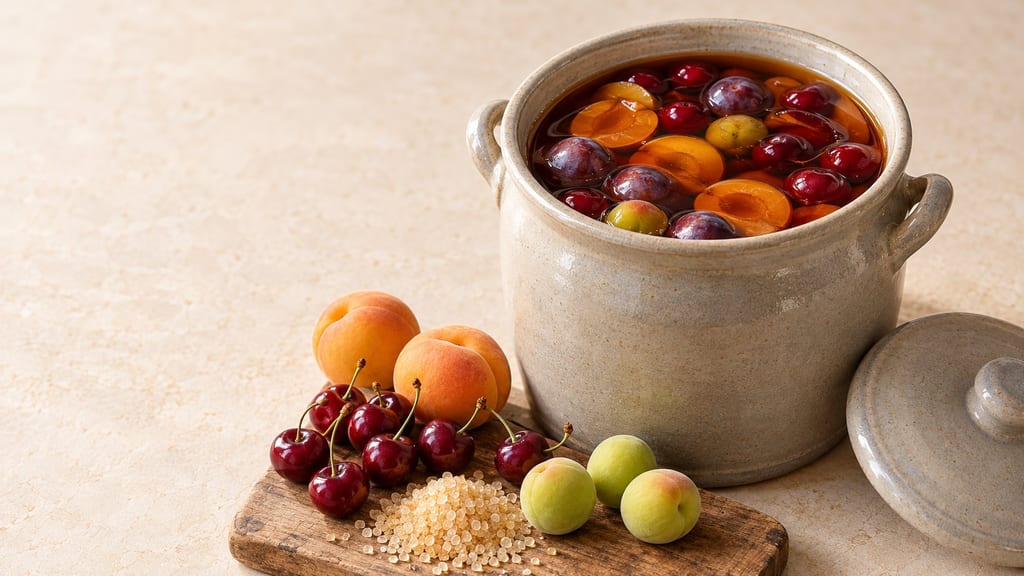
A stoneware crock of cherries, plums and apricots under high-strength spirit, the way a Rumtopf is set up and left to mature.
A pot that fills as the summer goes
A Rumtopf starts as an empty stoneware pot and a bottle of rum. In spring the pot goes into a cool, dark place. Fruit goes in as each kind comes into season, berries, cherries, plums, apricots, together with sugar and high-strength rum. Then the pot waits for several months, until the fruit is very soft and completely saturated with rum. Traditionally it is eaten around Christmas.
The rum is the part that cannot be casual. The usual instruction is rum of 50–55% alcohol by volume, bought at that strength or made up by blending a 151 or 160 proof rum with an ordinary 80 proof bottle. Rumtopf is an Austrian, German and Danish dish, and it is also made in the valleys of Trentino in northern Italy. It was once immensely popular as a home project and had somewhat gone out of fashion by the 21st century, because of the time and commitment it needs. The German television cook Clemens Wilmenrod is one of those who helped popularise it.
Where it came from is less clear. No dated source for the origin of Rumtopf turned up. A story that links it to the rum trade of the 18th century is widely repeated, and nothing found backs it.
Two foods in one jar
What comes out of a Rumtopf is two things. The fruit is soft, sweet and heavy with rum. The liquid has become a fruit-flavoured spirit, sweetened and coloured by what steeped in it. Both are the product: a stored fruit and a flavoured drink, made in one jar.
That double identity is also the main practical problem. Fruit carries its own water, and over the months that water dilutes the spirit. The strength on the bottle is therefore not the strength of the finished jar, and the finished strength is the figure that decides whether the contents keep. Sugar lowers the water activity of the fruit, which is the share of its water that microbes can use, and strong alcohol works against them as well. Dilute the spirit too far, leave sugar in the liquid, and the same jar can start to ferment or spoil.
How strong is strong enough? Makers give figures: Rumtopf recipes start at 50–55% alcohol, and the Tanabe umeshu recipe below uses a spirit of 35–40%. A tested minimum for home fruit in spirit, for final alcohol or for sugar, from a food-safety agency or an extension service, was not found. Blog posts offer ranges, and they are not evidence. Smell is no guide either: a jar that smells of rum says nothing about whether the liquid in it is strong enough.
Cherries in Vignola, ginja in Lisbon
Cherries are the fruit that turns up in spirit most often. In Vignola, home of the famous cherries, a firm called Toschi dates its start to 1945. Two founders, Giancarlo and Lanfranco, began in a small workshop packing the local cherries under spirit so that people could eat them all year. That is the company's own account, not an independent history.
In Lisbon the same fruit became a drink. Ginjinha is made from ginja, the Morello cherry (Prunus cerasus var. austera), steeped in aguardente with sugar, water and cinnamon. A popular account credits a Galician friar of the Church of Santo António, Francisco Espinheira, with the recipe. The story carries no date and no reference, although a bar list in the same entry gives the Espinheira bar a start of 1840. As with Rumtopf, the fruit and the liquid are two halves of one preparation.
Green ume, rock sugar and a three-month wait
In Japan the fruit is ume, Prunus mume, usually picked unripe and green, and the drink is umeshu. The Kishu Tanabe Ume Promotion Committee describes the household method as an infusion of fruit and sugar in an existing alcoholic base, extraction and maturation rather than a fruit-juice fermentation. Its recipe uses 1 kg of sound unripe ume, 800 g to 1 kg of rock sugar and 1.8 litres of white spirit of 35–40% alcohol. It is kept for at least three months, and six to twelve months is better.
The waiting time is a maturing time for flavour, not a safety deadline. The dilution problem applies here as it does in Rumtopf: fruit water and sugar syrup both pull the strength of the finished liqueur below that of the spirit that went in.
The question of the stones
The Tanabe recipe has one instruction that stops a careful reader: leave the stones intact. The kernels inside stone fruit contain cyanogenic glycosides, compounds such as amygdalin that can release cyanide. The European Food Safety Authority put a number on the hazard in 2016 for apricot kernels: an acute reference dose of 20 micrograms per kilogram of body weight. For an adult, less than half of one large kernel could already exceed it. The opinion covers acute toxicity from eating apricot kernels and nothing else.
The question for a maker is whether anything moves from a whole stone into the spirit over months. No measurement of that was found, in umeshu or in any other fruit in spirit. Advice for umeshu makers is that whole small stones are generally harmless and that crushing or chewing them is what releases cyanide, but that advice is second-hand. The cautious reading is to keep stones whole, never to crush them and never to eat them, and to treat any claim about exactly how much leaves them as unproven.
Steeping is not distilling
Kirsch looks like a relative of all this and is not. It is a cherry spirit: the cherries are fermented and the result is distilled. A jar of cherries in spirit leaves out both steps. The fruit never ferments, and nothing is distilled; it simply sits in a spirit someone else has already made.
That step matters for one hazard in particular. Plum brandy makers have to manage methanol, which forms as the enzyme pectin methylesterase breaks down the pectin in the fruit, and a demethanolization column added to the still can reduce it. That finding concerns plum brandy and the distiller's job of removing methanol after distilling. A cook who buys a finished spirit and steeps fruit in it is not distilling anything. No study turned up that measured methanol in fruit steeped in bought spirit, and plum brandy says nothing about apricots or other fruit.
How old is the habit?
Isabella Beeton's Book of Household Management, published in 1861, names preservation in spirits in a single clause, listed among ways of keeping vegetable matter beside pickling, drying, sugar, vinegar and salt. It gives no fruit, no sugar quantity, no spirit strength and no storage time. It shows that the method was familiar enough to be named in passing in a household manual by then, and little more.
Beyond that, the dates in this story are thin. Toschi's 1945 is a company's own claim, the Lisbon friar's story has no date, and Rumtopf has no documented origin. A dish of prunes in Armagnac has no dated history either. What the evidence does show is a household habit that appears in different forms in different places: fruit and strong drink, kept together until they taste of each other.
For anyone making it now, the unanswered questions are the practical ones. No tested minimum strength for the finished jar turned up, nothing measures what leaves a whole stone, and the origin of the habit is still a story rather than a record.
Community
No community contributions have been published for this entry yet.
Share what you made
Sign in to contribute. Published comments and photos are free to read.
Sources
Victorian London
Mrs Beeton's Book of Household Management, Chapter XXX (section 1495)Cited in: How old is the habit?
Wikipedia
RumtopfCited in: A pot that fills as the summer goes; Two foods in one jar; How old is the habit?
Il Resto del Carlino
La frutta spiritosa da 78 anni: Toschi, business con il sorrisoCited in: Cherries in Vignola, ginja in Lisbon; How old is the habit?
Kishu Tanabe Ume Promotion Committee
Umeshu (ume liqueur) recipeCited in: Two foods in one jar; Green ume, rock sugar and a three-month wait; The question of the stones
Journal of Agricultural Sciences, Belgrade
Possibilities for methanol content reduction in plum brandy (Nikićević and Tešević, 2005)Cited in: Steeping is not distilling
EFSA Journal
Scientific opinion on the acute health risks related to the presence of cyanogenic glycosides in apricot kernels (EFSA, 2016)Cited in: The question of the stones
Gaps
- No tested minimum alcohol or sugar level for home fruit in spirit was found, and Rumtopf, Armagnac prunes and kirsch have no dated origin.
- No measurement of methanol in steeped fruit, or of what moves from whole stones into the spirit, was found.
Updated 2026-10-29