
Programme
Cheese in a box in a fridge: what a lidded ripening box can and cannot do
A lidded box keeps moisture around a ripening cheese but cannot change the refrigerator’s temperature. Cornell’s Camembert lesson, the food-safety limits, and the humidity nobody has measured.
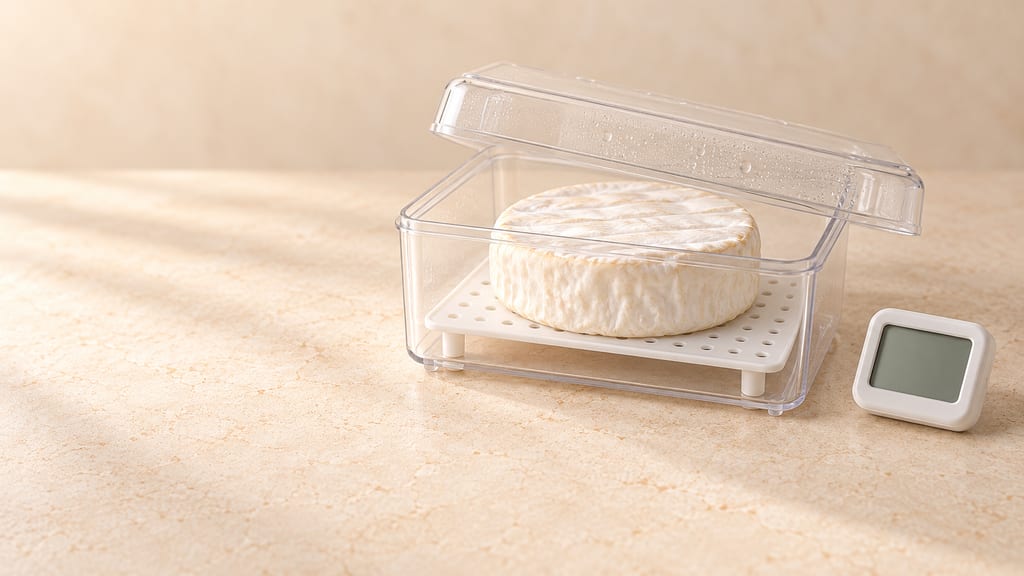
A clear lidded box holding a small Camembert on a raised mat: a local climate for one cheese.
A small climate inside a cold one
A refrigerator is built to keep food cold, and it dries food out while it does so. A bloomy-rind cheese such as Camembert wants the opposite: a damp surface where white mould can spread. A lidded box is the cheapest way to give one cheese a climate of its own. The lid holds in the moisture the cheese gives off, a raised mat or platform keeps the cheese out of its own whey, and the walls keep it apart from everything else on the shelf.
What the box cannot do is change the temperature. Inside it, the cheese is as warm or as cold as the refrigerator around it. Home cheesemakers judge the damp by eye. Ian Treuer, writing for a cheesemaking supplier, says a light fog on the container means the air sits between 85% and 95% humidity, and suggests a damp paper towel in the corner opposite the cheese when it does not. A retailer’s box page suggests small vessels of water or a damp sponge. These are hobbyist rules of thumb, not measurements.
What Cornell’s Camembert asks of the box
Cornell’s goat-cheese lesson makes a Camembert in a storage box with ripening mats at the bottom. While the curd drains, the lid stays fully closed. After salting, the lid is left slightly open for air circulation, three to five days depending on the weather, until no more moisture forms; then it is closed fully. Any moisture that collects on the box is removed, because it encourages the black mould the lesson calls “cat hair”. White mould should show within five to seven days, and the cheese is ready in about six to eight weeks in a fridge, or sooner in a warmer room.
The lesson ripens Camembert at 10–12 °C and says a fridge running at 4–7 °C slows it down. It is one educational recipe for one goat’s-milk cheese, not a setting that carries over to other cheeses.
The fridge wants one temperature, the cheese another
The FDA tells households to keep a refrigerator at 4 °C or below. Cornell’s Camembert wants several degrees more and says the colder fridge makes it slower rather than impossible. The American Cheese Society’s guide gives general ranges by cheese type: 8–18 °C for hard cheeses, depending on variety, and 12–14 °C for bacterial surface-ripened cheeses, with the warning that these are only general recommendations. It gives no range for bloomy rinds.
The guide also names a trade-off. Mites that attack cheese rinds are best deterred at around 2 °C and no higher than 5 °C, but in that range it is hard to hold the high humidity that natural-rind cheeses need, and ripening slows. A box softens the humidity half of that problem. It does nothing about the temperature half, and warming a shared refrigerator to suit one cheese would move all the other food out of the range the FDA advises.
What the mould is doing
A young Camembert is acid and firm. As Penicillium and Geotrichum moulds cover the surface, the acid is used up and the paste softens from the outside in. In Okayama measurements on the centre of a Camembert, the pH rose from 4.5 to 7.8 and lactic acid fell from 1.0% to 0.1%, with softening moving from the surface to the centre after three to four weeks. A French study of controlled production found the rind close to pH 7 when Penicillium growth began, Geotrichum growing exponentially between days 4 and 10 with a generation time of about 4.6 days, and ammonia in the rind staying low until day 6 and then rising with fungal growth through day 45.
The American Cheese Society’s guide describes the cheeses this way: high in moisture, around 50%, and ending near pH 7.0, with rind development shaped by temperature, humidity and airflow together. That is why the lid matters. It is one of the three controls, and the only one a box gives you.
Lid, air and condensation
Cornell’s lid sequence, closed while draining and ajar after salting, is a way of managing condensation. Treuer wipes the lid every day so that water does not drip onto the cheese, and leaves the lid open “just a crack” for airflow; some boxes have vents for the same purpose. The FDA’s refrigerator advice points the other way: cold air must circulate around food to keep it chilled, and food belongs in covered containers. A closed box may limit the air around the cheese, and none of the sources settles how much.
The American Cheese Society’s guide also says to keep air circulating in coolers and to drain or evaporate condensate. A box in a home fridge has no drain, so the cheesemaker’s cloth is the drain.
Choosing and cleaning a box
Cornell recommends containers of stainless steel, glass or food-grade plastic and advises against aluminium and wood. One retailer’s ageing box is 6.5 × 12.5 in (16.5 × 31.75 cm) inside and 4 in (10.1 cm) high, built for two cheeses up to 5 in across, with a polycarbonate platform that lifts the cheese off the floor and a mat that lets the underside breathe. The platform can go in the dishwasher; the mat cannot, and boiling water may warp it. Those are the details of one product, not a standard.
The American Cheese Society’s guide says boxes suspected of infection should be thoroughly scrubbed, scalded and dried. It offers no cleaning routine for a plastic box in a home fridge.
What nobody has measured
The humidity numbers do not agree. Treuer’s fog test implies 85–95%. The American Cheese Society’s only figure, 90–95%, belongs to Alpine-style cheeses with a bacterial rind, not to Camembert. No study of a loaded box in a household refrigerator turned up, so there is no measured map of temperature and humidity inside one, no data on how much ammonia a closed box holds, and no tested cleaning routine. A thermometer and a hygrometer in an empty box describe the empty box.
The guide is blunt about the risk. As cheese matures, conditions may become favourable for pathogens, and as surface moulds raise the pH toward neutral, pathogens can grow more readily. It summarises US rules as allowing raw-milk cheese to be sold only after at least 60 days at no less than 2 °C, and adds that 60 days is not a fool-proof procedure. A box is a way to look after one cheese. It is not a food-safety control.
Community
No community contributions have been published for this entry yet.
Share what you made
Sign in to contribute. Published comments and photos are free to read.
Sources
Cornell University, College of Agriculture and Life Sciences / NYS 4-H
Cooking with Goat ProductsCited in: A small climate inside a cold one; What Cornell’s Camembert asks of the box; The fridge wants one temperature, the cheese another; Lid, air and condensation; Choosing and cleaning a box
U.S. Food and Drug Administration
Refrigerator Thermometers - Cold Facts about Food SafetyCited in: The fridge wants one temperature, the cheese another; Lid, air and condensation; What nobody has measured
The Cheesemaker
Small Cheese Aging Containers—Includes Draining Platform & MatCited in: A small climate inside a cold one; Choosing and cleaning a box
American Cheese Society
Best Practices Guide for Cheesemakers, Second EditionCited in: The fridge wants one temperature, the cheese another; What the mould is doing; Lid, air and condensation; Choosing and cleaning a box; What nobody has measured
New England Cheesemaking Supply Company
How to Use Ripening Boxes with Ian TreuerCited in: A small climate inside a cold one; Lid, air and condensation; What nobody has measured
Scientific Reports of the Faculty of Agriculture, Okayama University
Softening and Salts Movement in the Ripening Process of Camembert CheeseCited in: What the mould is doing
Journal of Dairy Research, 2004
Controlled production of Camembert-type cheeses. Part I: Microbiological and physicochemical evolutionsCited in: What the mould is doing
Gaps
- No study of ripening boxes, condensation in a closed box or humidity in a household refrigerator was found; humidity figures come from hobbyist advice.
- The Cornell and FDA pages were read through summaries, and two journal papers as abstracts only.
- One box model, one cheese and one recipe are described; none has been tested here.
Updated 2026-10-30