
Programme
A thermostat on a mini-fridge: what the documents say, and what they leave out
A plug-in thermostat can switch a mini-fridge on and off, but no document read here shows it is safe for the compressor or that the fridge would hold a cheese-ripening temperature.
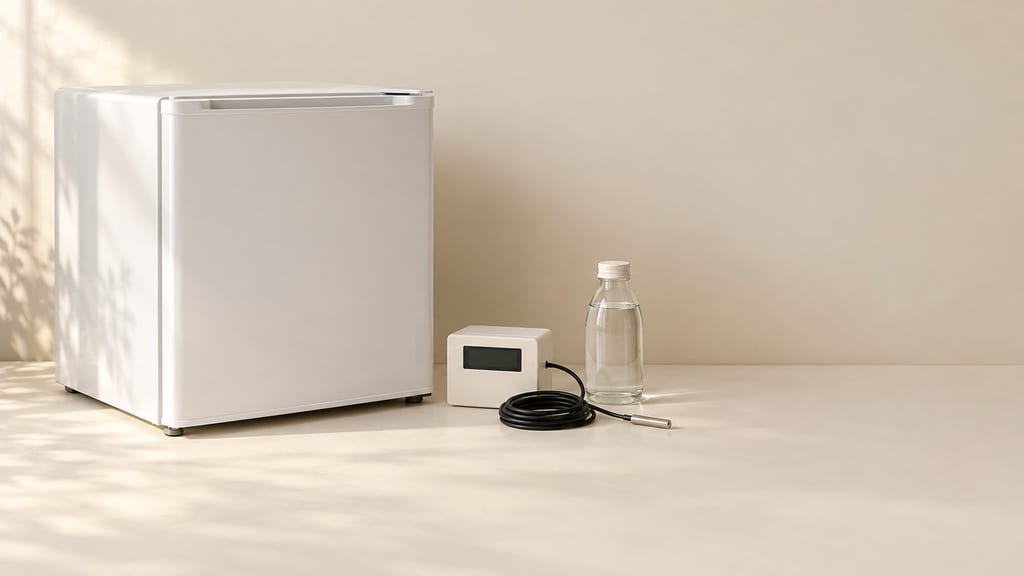
A small white refrigerator beside a plug-in thermostat with a probe cable: an unselected pairing.
The idea
Take an ordinary compact refrigerator, plug it into a thermostat with its own probe, and let the thermostat decide when the fridge runs. A fridge that would hold food at refrigerator temperature could then be steered warmer and steadier, closer to what a cheese-ripening room provides. The INKBIRD ITC-308 is the example people reach for: a plug-in controller with two receptacles and a temperature probe on a cable. In the manual, the controller starts cooling when the probe reads a set number of degrees above the target and stops at the target. The factory difference is 2.0 degrees.
That describes how the controller behaves. It says nothing about whether a particular refrigerator will cope with being switched this way.
What the ratings say, and where they disagree
The product page lists the standard ITC-308 at 120 VAC, 60 Hz, 10 A and 1,200 W maximum across its two receptacles, while a feature bullet claims 1,100 W of load capacity. The WiFi model is listed at 100–230 VAC, with 1,200 W at 110 V and 2,200 W at 220 V. A 2016 copy of the manual gives a 10 A relay at 100–240 VAC.
Both quote an accuracy of ±1 °C, but they differ on the top of the control range: 120 °C on the product page, 99 °C in the manual. They may describe different hardware revisions. Nothing here settles which one applies to a unit on a shelf, and the current manual page could not be opened.
Why compressors need a wait
A refrigeration compressor should not be restarted the moment it stops. Whynter’s manual for a wine cooler says to wait three to five minutes before restarting and warns that the appliance may not start if restarted sooner. A Johnson Controls bulletin for a commercial refrigeration controller explains the reason for its anti-short-cycle delay: it gives the system pressure time to equalise before the compressor restarts.
The ITC-308 has its own compressor delay. In the manual copy the default is three minutes, adjustable from zero to ten, counted from the moment cooling stops. That delay protects the equipment from the controller’s side. It does not say what any particular fridge needs. The documents read here give no starting-current figure for a household mini-fridge, and the controller’s pages do not rate it for the surge a compressor draws as it starts.
The probe reads one place
The ITC-308 uses an NTC probe on a lead. The product page says the probe is waterproof to IP68 while the controller body and its sockets are not. A probe reports the temperature where it hangs. Air near the door swings faster than a loaded cabinet, and neither is the temperature inside a cheese. The manual offers a calibration offset of up to 15 degrees either way, which corrects a reading but does not say where to put the probe.
Fridge thermometers show the same problem in miniature. NDSU Extension says to read the thermometer just as the compressor turns on, when the fridge is at its warmest, and notes that door openings, hot food and defrost cycles cause temporary readings above 4 °C. The FDA notes that few refrigerator controls show actual temperatures.
What cheese asks for
The FDA advises keeping food in a refrigerator at 4 °C or below. The American Cheese Society’s guide gives general ranges for ageing: 8–18 °C for hard cheeses and 12–14 °C for bacterial surface-ripened cheeses, depending on the variety. It also lists poor temperature control, cycling from high to low, among the faults of an ageing room, and wants a near-constant temperature and humidity. A thermostat that swings by a few degrees every cycle is part of the question.
A wine cooler’s range is the nearest thing to a match. Whynter’s manual gives 5–18 °C and recommends a room of 23–26 °C. The same manual says not to store perishable food, medicine or other medical products in it, and notes that perishable food may need a different storage environment. A range that fits the cheese does not make the appliance a cheese cave.
Where this leaves a buyer
No document read here approves any controller and fridge as a pair. A buyer would start with the appliance’s rating label and manual, find out whether the maker allows an external controller and what restart delay it wants, and ask a qualified electrician about the compressor’s starting load before plugging one into the other. Wiring changes, cabinet drilling and internal repairs are outside this account.
After that comes measurement: the empty fridge, then the loaded one, with the probe and an independent thermometer in more than one place. No setpoint, probe position or ripening schedule is established here.
Community
No community contributions have been published for this entry yet.
Share what you made
Sign in to contribute. Published comments and photos are free to read.
Sources
U.S. Food and Drug Administration
Refrigerator Thermometers - Cold Facts about Food SafetyCited in: What cheese asks for
American Cheese Society
Best Practices Guide for Cheesemakers, Second EditionCited in: The probe reads one place; What cheese asks for; Where this leaves a buyer
INKBIRD
Temperature Controller ITC-308 SeriesCited in: The idea; What the ratings say, and where they disagree; The probe reads one place; Where this leaves a buyer
INKBIRD
ITC-308 ManualCited in: The idea; What the ratings say, and where they disagree; Why compressors need a wait; The probe reads one place; Where this leaves a buyer
Whynter
BWR-1662SD Instruction ManualCited in: Why compressors need a wait; What cheese asks for; Where this leaves a buyer
NDSU Extension, North Dakota State University
BAC DOWN! Keep Cold Foods Cold (FN612)Cited in: The probe reads one place
Johnson Controls, PENN Controls
Anti short cycle delay, A421 Series product bulletin (LIT-12011972)Cited in: Why compressors need a wait
Gaps
- The current INKBIRD manual page could not be read; its figures come from a 2016 copy, and the product page and manual disagree on several ratings.
- No compressor starting-current data for household mini-fridges, and no manufacturer guidance on external controllers for them, was found.
- The Whynter manual covers a wine cooler, not a mini-fridge; no mini-fridge manual has been matched to the controller.
Updated 2026-10-30