
Programme
Oyster sauce: a famous origin story, and a sauce that is not fermented
Lee Kum Kee dates oyster sauce to 1888 and a forgotten stove; no independent record confirms it. The sauce is cooked and thickened, not fermented, and the vegetarian bottle has a label conflict of its own.
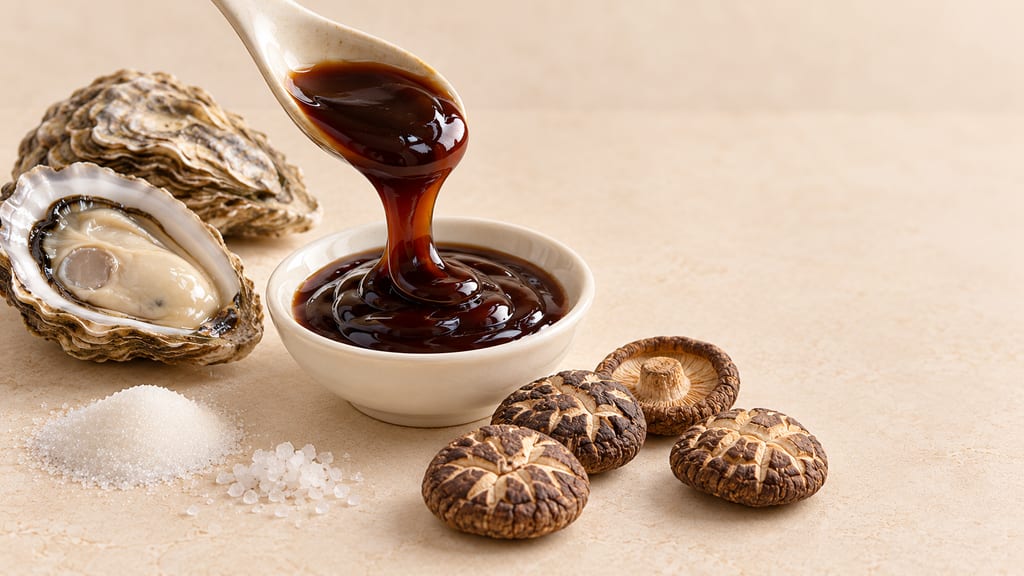
Dark oyster sauce poured from a bottle onto a spoon.
A tea house in Nanshui
In Nanshui, a village in Zhuhai, Guangdong, a man named Lee Kum Sheung (李锦裳) runs a small tea house that sells boiled oysters. One day he forgets the stove. When he comes back, the broth has cooked down into a thick, dark layer. He tastes it, and the sauce is born. That is the story Lee Kum Kee tells, and it puts the moment in 1888.
The company's own chronology is plainer. It says Lee invented oyster sauce in Nanshui and set up Lee Kum Kee to make and sell two products, oyster sauce and shrimp paste. It gives the year and the village and mentions no tea house and no stove. The tea house and the forgotten pot come from a retelling the company supplied to the trade press, which adds that Lee had farmed before he settled in Nanshui.
Other tellings drift. A Xinhui district government notice says he opened a small tea house that also cooked and sold oysters. Some English-language accounts call the place a food stall and the dish an oyster soup left on the stove. Accounts of his later move to Macao, and of his life dates, disagree with one another. What they share is the year, the village and the stove.
One date, no second witness
No independent source for the 1888 story turned up. Beyond the company, retailers and writers repeat its account; no independent record of the invention has turned up. A Hong Kong industrial-history article says Lee "is often credited" with inventing oyster sauce by accident in 1888, with the word "accidentally" in quotation marks, and does not call the claim disputed. It also names a rival maker, Hop Sing Lung, founded in Macao in 1928 by Chan Cheung-chi (陳象池), forty years after the Lee Kum Kee date.
A later official record points the same way without settling the question. In December 2020 Xinhui district listed Lee Kum Kee's oyster-sauce craft among its intangible cultural heritage items, in the traditional-skills category. The applicant was the company's Xinhui factory, and the notice records that in 1995 Li Man-tat (李文达) returned to Xinhui to set up that factory and bring the craft back. A heritage listing recognises a craft and the people who carry it on. It does not rule on who made the sauce first.
From oyster juice to sauce
The company's description of its process is short. Mature oysters from clean waters are steamed with water and salt, which draws out oyster juice. The juice is mixed with white sugar, salt and starch or modified starch, then cooked at high temperature, filled into bottles hot, sealed, cooled and packed. The company gives no temperature. It says its 旧庄 line follows the original 1888 recipe.
Nothing in that sequence is a fermentation. The juice is cooked and thickened, and the process as described has no culturing step. The maker also says the product does not use biological enzymatic hydrolysis, which is the other common way to break shellfish protein down into flavour. What reaches the bottle is oyster juice that has been reduced, sweetened, salted and bound with starch.
Where fermentation does and does not come in
Standard Cantonese-style oyster sauce is a cooked seasoning, not a microbial ferment. The oyster is not fermented at any stage of the process described above.
Fermentation reaches some bottles another way. A sauce that lists soy sauce among its ingredients carries a fermented product, but the ferment belongs to the soy sauce. The Xiamen group standard's definition may also admit enzymatically hydrolysed oyster meat as a raw material; the clause is not clear. An enzyme step breaks protein down without microorganisms growing, so it is not microbial fermentation either.
Genuinely fermented oyster sauce exists, but it is a different food. In Vietnam, researchers at Nha Trang University developed a process for mắm hàu chua, a sour fermented oyster sauce made from farmed Pacific oysters (Crassostrea gigas) in Khánh Hòa province. The parameters they settled on were 12 per cent salt, added once, 15 per cent sugar, 2 per cent roasted rice powder and a pressing weight set at a ratio of 25 per cent. It ferments for about 25 days and ends at pH 4.6–4.8, which is the measurable sign of its sourness. The abstract gives no temperature, and the full text was not available. It is a process developed in a study, not a home recipe.
Standards: one national, one local, none from Codex
China's national standard for the product is GB/T 21999-2008, "Oyster sauce". It is a recommended standard, meaning voluntary, issued in 2008 and in force from 2009. China has no mandatory national standard for oyster sauce that could be found, and most products follow GB/T 21999.
The Xiamen group standard T/XMSSAL 0109-2024 sits beside it. It was issued by a food-safety association, is dated 16 May 2024 and is not a national rule. It lists GB/T 21999-2008 and GB 10133, the national standard for aquatic seasonings, among its normative references, and cites clauses of GB/T 21999 for indicators measured in grams and milligrams per 100 grams. The indicator names themselves did not extract from the document.
Codex Alimentarius, the international food-standards body, lists no standard for oyster sauce. Its nearest text is CXS 302-2011, for fish sauce, and that product is a true ferment: fish mixed with salt, fermented for not less than six months, with salt at not less than 200 g/l as sodium chloride. The scope excludes acid hydrolysis. Oyster sauce, which is not made that way, has no equivalent text there.
The mushroom bottle
Lee Kum Kee Singapore sells an oyster-flavoured sauce with no oyster in it, listed as 素食蠔油 and also as 香菇素食蚝油, shiitake vegetarian oyster sauce. It comes in 510 g and 770 g packs and is marked fully vegetarian and halal certified. The ingredient list reads: water, sugar, soy sauce (water, soybean, salt, wheat flour), modified corn starch, caramel colour, salt, shiitake powder, yeast extract, spice, lactic acid as an acidity regulator, sodium benzoate as a preservative, and disodium 5'-inosinate and 5'-guanylate as flavour enhancers. It contains soy and wheat. The sugar, salt and starch frame is the same as in oyster sauce, and the oyster juice is replaced by soy sauce, shiitake powder and yeast extract.
The page contradicts itself in two places. Its description says the product has no added preservatives, yet the ingredient list names sodium benzoate as a preservative. It says the product has no MSG, yet a "Natural MSG" tag sits next to the flavour enhancers. The allergen section on the page is blank, although the ingredients include soy and wheat. Until the pack and the maker settle it, the ingredient list is the better evidence, and the "no preservatives" claim should not be repeated.
What the label can and cannot tell you
An oyster sauce made with oyster ingredients contains a mollusc. Health Canada counts both crustaceans and molluscs as priority food allergens, names oysters as molluscs, and requires the specific species to be declared in the ingredients list. Rules differ elsewhere, and a shellfish allergy is a reason to read the ingredient list of the exact bottle in hand and to ask the maker when it is unclear. A mushroom-based sauce is not automatically safe for the same reader, since it can still carry soy and wheat.
For the cook, the evidence supports a modest conclusion. Oyster sauce is a cooked, thickened seasoning, and the vegetarian version is a different recipe built on soy sauce and shiitake. The sources give no validated home method and no storage period once a bottle is opened, so the instructions on the pack are the guide. The question that remains open is the oldest one: whether the sauce first came off a forgotten stove in Nanshui in 1888 or has an earlier or different history that nobody wrote down.
Community
No community contributions have been published for this entry yet.
Share what you made
Sign in to contribute. Published comments and photos are free to read.
Sources
Xiamen Food Safety Work Federation (厦门市食品安全工作联合会)
T/XMSSAL 0109-2024 Oyster sauceCited in: Where fermentation does and does not come in; Standards: one national, one local, none from Codex
China Food Safety News
李锦记牌旧庄蚝油、财神蚝油Cited in: A tea house in Nanshui; From oyster juice to sauce; Where fermentation does and does not come in
Lee Kum Kee Singapore
素食蠔油 / Vegetarian Oyster Flavoured SauceCited in: The mushroom bottle; What the label can and cannot tell you
Lee Kum Kee corporate history
Lee Kum Kee history, 1888–1987Cited in: A tea house in Nanshui; One date, no second witness
Xinhui District People’s Government
Xinhui district government intangible-heritage notice (第六批新会区级非物质文化遗产代表性项目名录)Cited in: A tea house in Nanshui; One date, no second witness
Health Canada
Crustaceans and Molluscs - Priority food allergensCited in: What the label can and cannot tell you
Tạp chí Khoa học – Công nghệ Thủy sản, Nha Trang University
Phát triển quy trình chế biến mắm hàu chua từ hàu Thái Bình Dương (Crassostrea gigas) nuôi ở địa bàn tỉnh Khánh HoàCited in: Where fermentation does and does not come in
Codex Alimentarius, FAO/WHO
Standard for Fish Sauce (CXS 302-2011)Cited in: Standards: one national, one local, none from Codex
Gaps
- No independent record confirms the 1888 origin, the village or the forgotten-stove story, and the accounts of the founder's life disagree.
- The group standard's definition and indicator names could not be read in full, and the status of GB/T 21999-2008 rests on a standards-sales listing, not the official record.
- No validated home method or opened-storage period exists for either sauce, and the Vietnamese oyster-ferment paper was read as an abstract only.
Updated 2026-10-29