
Programme
Pour, fry, spoon: three ways to put chili in oil
Sichuan hongyou, Chiu Chow chili sauce and Japanese rayu all put chili in oil, by different methods. Fermented beans sit behind some jars, and botulism rules for garlic in oil decide how long any of them keeps.
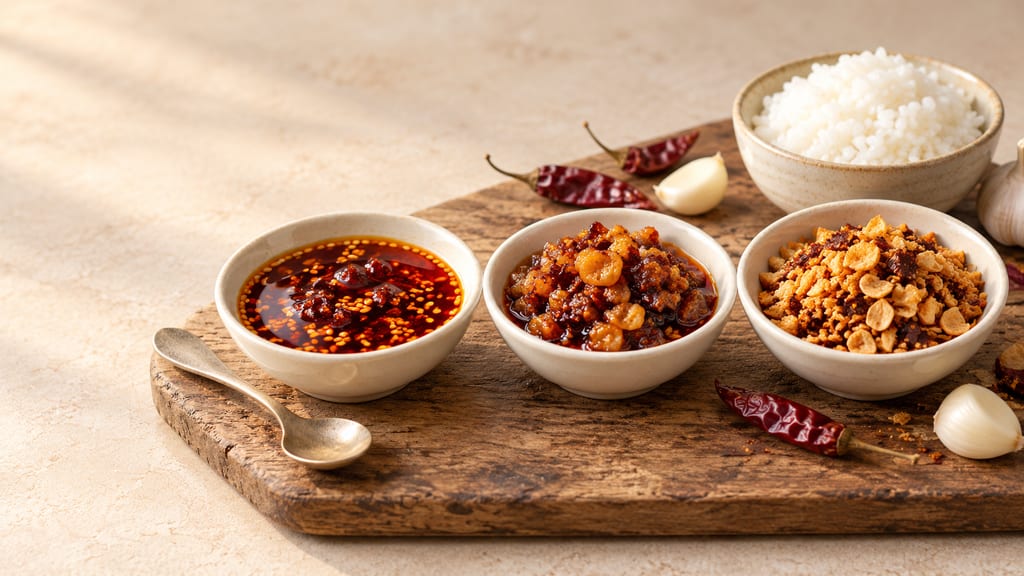
Three ways to put chili in oil: a clear red oil, a chunky garlic sauce and a crisp topping for rice.
The jar Japan ran out of
In August 2009 a Japanese company, Momoya, released a jar of rayu. By 23 March 2010 it was apologising for shortages. The official price was 400 yen a jar. On auction sites the same jar was listed at about 1,000 yen, two and a half times as much.
A competing rayu went on sale the same day, 23 March, at an official 346 yen. Its maker, SBS Foods, was apologising for shortages itself six days later.
Rayu (ラー油, rāyu) is the Japanese variety of Chinese chili oil, and the name comes from 辣油 (làyóu). The jars people were chasing belonged to a newer kind called taberu rayu, "rayu for eating". The style dates to 2009 and is based on Chinese chili crisp: edible chunks of food and chilies in oil, closer to a topping than a dressing.
On the Chinese side the paper trail is thin. The company Lao Gan Ma was founded in 1997, and its founder, Tao Huabi, is said to have created its sauce in 1984. The entry that gives that date asks for an independent source, and none was found.
The shortage is a useful starting point because it shows how little the words "chili oil" settle. A clear red oil poured over noodles, a sauce of fried garlic and salted chili and a crunchy topping all sit under the name. Their makers heat the oil differently, put different things in the jar, and face different questions about how long it keeps.
Three pours in Chengdu
Chengdu's intangible-heritage office lists the making of 熟油海椒 (shúyóu hǎijiāo) as a traditional chili craft. The chilies are Erjingtiao, a Sichuan variety, puffed at low temperature and pounded. They are mixed with sesame, Sichuan peppercorn, salt, MSG, scallion, ginger, garlic and spices. Refined rapeseed oil, heated, is poured over the mixture in three rounds. What comes out is the red, fragrant oil this article calls hongyou.
No temperature or time is recorded for the puffing or for the oil, and no account from a Sichuan producer was available to fill the gap.
A local account ties the craft to the migrations of the early Qing dynasty, known as 湖广填四川, and to a Fujian family surnamed 陈 (Chen). No historical record is cited for it. It stays a story the craft tells about itself, not a documented date.
What the temperature of the oil changes
Why three pours, and not one? Chengdu's description does not say, but a 2025 laboratory study in Foods tested the question. The team used 7 g portions of dried Erjingtiao chili and heated rapeseed oil to 215 °C, then cooled it. In one set of trials, 30 mL of oil at 210, 180 or 150 °C went over the chili in a single splash. In another, 10 mL went on three times, at 210, then 180, then 150 °C, so the chili received the same 30 mL in total. The researchers analysed the volatile compounds and the lipids that resulted. Both the oil temperature and the number of splashes changed the aroma significantly (p < 0.05).
Those figures are the conditions of that experiment. The design echoes the three rounds of the Chengdu craft, but it is a laboratory protocol, and the craft itself has no recorded temperatures to compare it with.
Home recipes set the heat by the state of the chili. One recipe from The Woks of Life pours oil at 163–177 °C over fresh, moist flakes, at 120–135 °C over dry flakes and at 110–120 °C over flakes that have been pre-roasted. The same recipe infuses aromatics in oil at 110–120 °C. The Chiu Chow, rayu and Tiger recipes below give either a different target or only "low" heat. Nothing here suggests a single correct temperature for chili oil. The figure belongs to the recipe, the chili and the effect the cook wants.
Chiu Chow: a sauce built on garlic
A household recipe for Chiu Chow chili sauce starts from fresh chilies. Fifteen are sliced, salted with 2 teaspoons of salt and crushed. In a pan, two heads of garlic fry slowly in 1¼ cups of neutral oil, added in two lots of ½ cup and ¾ cup, for about 30 minutes, give or take 10, until golden yellow. The recipe aims to keep the oil at 107–121 °C. The salted chilies then fry for 5 to 10 minutes. A cup of Sichuan chili flakes, ½ teaspoon of sugar and 2 tablespoons of soy sauce finish it. The batch makes about 2½ cups of something thick and chunky.
The author is frank about the salt. She calls the salting of fresh chilies her shortcut for salt-preserved chilies and says she is not sure it approximates them. The sauce is a modern kitchen approximation of a preserved-chili sauce, not the preserved original.
A commercial jar shows the other direction the style can take. Lee Kum Kee's Chiu Chow chilli crisp lists garlic, mushrooms and pickled mustard tubers. It lists no peanut, Sichuan pepper or seafood. A name such as "crisp" or "Chiu Chow" does not promise any of those, and the ingredient list is the only reliable guide.
Rayu: flavour the oil first, or keep the crunch
Home rayu from Just One Cookbook reverses the Sichuan order. A mix of ½ cup of neutral oil and ¼ cup of toasted sesame oil are heated with garlic, ginger, green onion and ½ teaspoon of Sichuan peppercorns, on low heat for about 15 minutes. The cook is told to avoid smoking the oil. The aromatics are strained out, and ⅓ cup of coarse gochugaru goes in off the heat. The result is about ¾ cup (180 mL) of oil with chili flakes and no fried pieces.
Tiger Corporation's taberu rayu keeps the pieces. A batch of about 340 g combines 40 g of fried garlic, 40 g of fried onion, 20 g of dried shrimp, 120 mL of salad oil and 80 mL of sesame oil. The oil is heated on low for 10 to 15 minutes. The recipe gives no temperature and no storage advice.
The fermented beans behind some jars
The recipes above are mostly built from fresh and fried ingredients. Fermented and pickled foods enter at the edges. The Chiu Chow recipe finishes with soy sauce, and Lee Kum Kee's Chiu Chow crisp includes pickled mustard tubers. The same maker sells bean products that sit close to this family. Its chilli bean sauce lists salted chillies with soybean paste and broad bean paste, and its black bean garlic sauce lists fermented black beans and garlic. The Chengdu list of seasonings and the home rayu name none of these.
The closest to a raw material for this family is douchi (豆豉, dòuchǐ), black soybeans fermented with mould and salt. A 2016 PLOS ONE study by Yang and colleagues documents one route and tracked its microbial community by DNA sequencing. The beans are steamed at 115 °C for 30 minutes to soften them. They are inoculated with 5% koji and held for 7 days, until a white mould covers them. Salt goes in at 5% by weight, and the beans mature for 15 days at about 55 °C in sealed tanks. A final drying step in an oven has no temperature recorded.
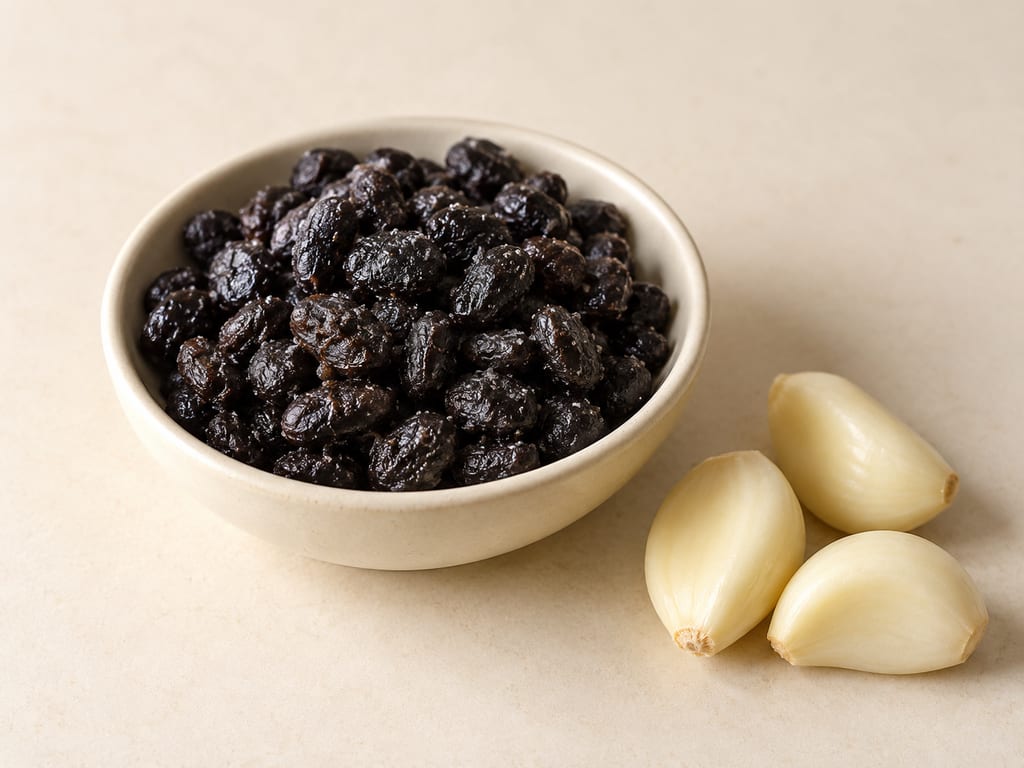
Douchi is not one process. A mould-led route has a first stage, in which the mould grows on the beans and makes enzymes, followed by salted maturation. Aspergillus, Mucor and Bacillus each lead a different version. The word "douchi" alone does not say which one was used, and the care each needs differs. Traditional douchi can also be contaminated by Aspergillus flavus or A. parasiticus, moulds that can make aflatoxins. A controlled study of commercial douchi measured biogenic amines at several stages and found they changed with the starter. A home batch has no such assay.
No source read here puts douchi into a chili oil or a chili crisp, so how common that is remains unrecorded. What the evidence supports is narrower. Several jars in this family share a shelf with fermented beans and pastes, and the ingredient list is where to find out which are in a given jar.
Garlic in oil: where the guidance splits
Several of these recipes put garlic in oil, and garlic in oil has a record. Clostridium botulinum, the bacterium behind botulism, makes its toxin only when four things coincide: spores are present, oxygen is absent, the pH is above 4.6 and the water activity is above 0.85. Most foods stored in oil are low in acid, and oil shuts out air.
Cold slows the organism and does not stop it. Group I strains are inhibited below 10 °C. Group II strains grow at refrigerator temperatures and are held off only at 3.3 °C or below, and toxin has been recorded in 10 days or less at 8 °C for these non-proteolytic strains. A survey of 939 home refrigerators in the United States, cited in a 2011 review by Nummer and colleagues, found that 27.4% ran above 5 °C and 1.4% above 10.5 °C.
The review also lists the cases. In 1985 a garlic-in-oil preparation at a restaurant sickened 37 people. In 1989 the US Food and Drug Administration ordered commercial garlic-in-oil without an acidifying agent off the market. Home-bottled garlic in oil has been linked to botulism in California in 1991, in Florida in 1999 and in Denmark in 2003, where the product was garlic in chili oil.
On one point the guidance disagrees. Penn State Extension describes acidifying the garlic: one part of garlic to three parts of a 3% citric acid solution. A weaker solution or a shorter soak, it says, can leave an unsafe product, and it considers room-temperature storage safe for oils acidified that way. Nummer and colleagues do not recommend room-temperature storage of acidified garlic oil. Health Canada says never to keep vegetables and herbs stored in oil at room temperature, and the National Center for Home Food Preservation at the University of Georgia says garlic in oil at room temperature is at risk of botulism. Penn State's Q&A also advises making garlic, vegetable and herb oils fresh. For dried herbs in oil, Penn State gives up to three months refrigerated. Whether dried chili flakes fall under that rule is not addressed.
How long a jar lasts
The extension and government pages give short times. Penn State advises using leftover garlic, vegetable and herb oils within 3 days, and fresh herbs in oil that has not been acidified within 2 to 4 days. The National Center for Home Food Preservation gives 4 days at 4 °C or lower for garlic in oil, or freezing for up to several months. Nummer and colleagues also give 4 days refrigerated and call freezing the safest option. Health Canada says to use oil within one week and to keep it at 4 °C or lower. The review's table of studies on garlic in oil lists 3 days and 10 days.
Recipe authors give longer times. Just One Cookbook says rayu with the aromatics removed keeps 1 to 2 months refrigerated. The Chiu Chow recipe says 2 to 3 months, and the same page predicts the batch will not last 2 weeks. The Woks of Life chili oil, which allows optional garlic and shallots, says up to 6 months refrigerated. Tiger gives no time. These are the authors' own estimates, and no source tests them.
The published guidance covers garlic, vegetables and herbs in oil, not a chili crisp, and it says days, not months. Whether it applies to garlic that has been fried is not established by anything read here. A cook who makes a jar with fresh garlic, shallot or fresh chilies has the cautious figures to hand: refrigerate it and use it within a week, or freeze it. The longer times in the recipes remain unvalidated claims until someone tests them.
Community
No community contributions have been published for this entry yet.
Share what you made
Sign in to contribute. Published comments and photos are free to read.
Sources
Chengdu Intangible Cultural Heritage Protection Centre
辣椒传统加工技艺(熟油海椒制作技艺)Cited in: Three pours in Chengdu
Just One Cookbook
Homemade La-yu (Rayu Japanese Chili Oil)Cited in: Rayu: flavour the oil first, or keep the crunch; How long a jar lasts
The Woks of Life
How to Make Homemade Chiu Chow Chili SauceCited in: Chiu Chow: a sauce built on garlic; The fermented beans behind some jars; How long a jar lasts
The Woks of Life
How to make chili oilCited in: What the temperature of the oil changes; How long a jar lasts
Penn State Extension
How to Safely Make Infused OilsCited in: Garlic in oil: where the guidance splits; How long a jar lasts
Penn State Extension
Canning and Freezing Questions and AnswersCited in: Garlic in oil: where the guidance splits; How long a jar lasts
Tiger Corporation
食べるラー油Cited in: Rayu: flavour the oil first, or keep the crunch; How long a jar lasts
Food Protection Trends 31(6), International Association for Food Protection (Nummer, Schaffner, Fraser and Andress, 2011)
Current Food Safety Issues of Home-prepared Vegetables and Herbs Stored in OilCited in: Garlic in oil: where the guidance splits; How long a jar lasts
Foods 14(6): 1006 (Li et al., 2025)
Impact of Oil Temperature and Splashing Frequency on Chili Oil Flavor: Volatilomics and LipidomicsCited in: What the temperature of the oil changes
PLOS ONE 11(12): e0168166 (Yang et al., 2016)
High-Throughput Sequencing of Microbial Community Diversity and Dynamics during Douchi FermentationCited in: The fermented beans behind some jars
Health Canada
Food safety tips for vegetables and herbs in oilCited in: Garlic in oil: where the guidance splits; How long a jar lasts
National Center for Home Food Preservation, University of Georgia
Freezing garlic in oilCited in: Garlic in oil: where the guidance splits; How long a jar lasts
Food Science and Human Wellness
Comparative evaluation of commercial Douchi by different molds: biogenic amines, non-volatile and volatile compoundsCited in: The fermented beans behind some jars
Asia Market (retailer product page)
Lee Kum Kee Chiu Chow Chilli Crispy 198gCited in: Chiu Chow: a sauce built on garlic; The fermented beans behind some jars
Gaps
- No producer account was available for Sichuan hongyou or Chiu Chow sauce, so their temperatures and timings come from a heritage description, a laboratory study and household recipes.
- No source tests the storage life of a chili oil or crisp that contains fresh or fried garlic, and the origin accounts for Chengdu's craft and for Lao Gan Ma's sauce rest on statements without independent records.
- Douchi and bean pastes are linked to chili oils here only through product ingredient lists; how often cooks add them to a chili crisp is not recorded.
Updated 2026-10-29