
Programme
The mortar comes first: inside a Thai curry paste, and the two ferments in it
Thai curries are sorted by colour, but the work happens in a stone mortar, and two of the saltiest ingredients had already fermented for months. How pastes are built, how the pot is run, and why Massaman has no agreed past.
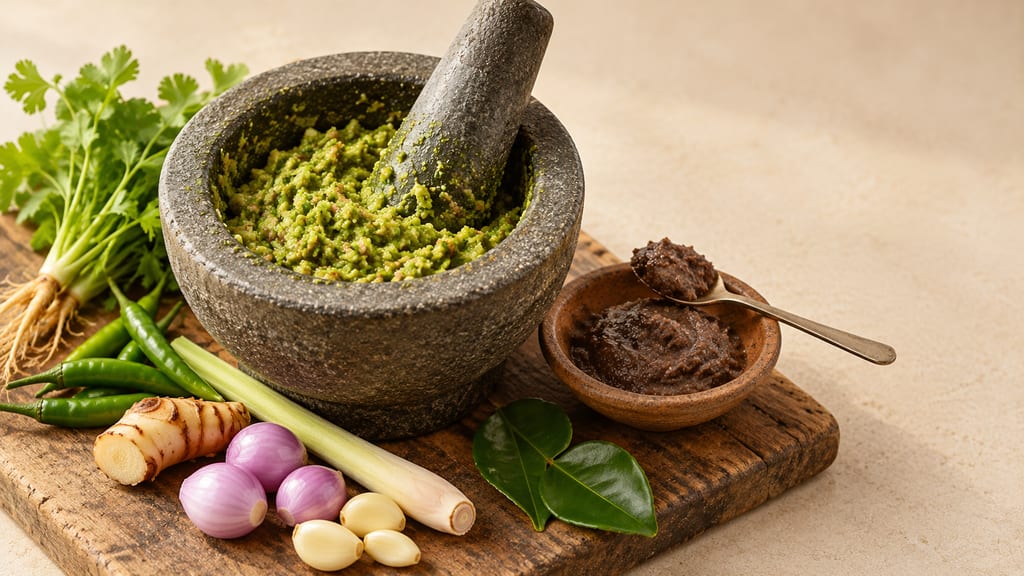
A stone mortar and pestle, a dish of shrimp paste, fresh green chillies and aromatics: the ingredients of a green curry paste.
Twenty minutes at the mortar
A Thai curry is often decided before the pan is hot. In the traditional method, the cook sits with a stone mortar and a pestle and pounds the paste by hand. A study of Thai curry pastes puts the work at twenty minutes to half an hour for each meal.
The order is fixed enough to write down. First salt, chilli and pepper are pounded into a thick paste. Then the fresh aromatics go in, lemongrass, galangal, the skin of the kaffir lime, coriander root, garlic and shallot, and are worked until smooth. Dry spice powders follow. Shrimp paste goes in last, and is pounded softly. The study gives no quantities.
Bongkoch Satongun, the chef at Paste, a One MICHELIN Star restaurant in Bangkok, keeps the same division in her home version of green curry. The fresh paste is pounded in the mortar; the dry spices are roasted in a pan and ground apart. The two meet in the hot pan.
The last ingredient in the mortar is a ferment
That last, softly pounded ingredient is kapi, Thai shrimp paste, and it is a fermented food. The curry-paste study describes kapi in the curry-paste study as tiny shrimps salted, dried in the sun, pulverised and fermented for several months, and calls it the main ingredient used for flavouring dishes in Thailand. By the time it reaches the mortar, its fermentation is finished. The pounding that follows does not ferment anything.
The Thai fermented food database kept by JIRCAS, a Japanese agricultural research institute, gives the detail. The shrimps are small Acetes and Mesopodopsis species. They are mixed with 15–30% sea salt and left for one to two days, then dried in the sun on bamboo mats until they have lost about 70% of their weight. The dried shrimp is pounded to a sticky dough and left to mature, at least four months when the salt is low and six months when it is high.
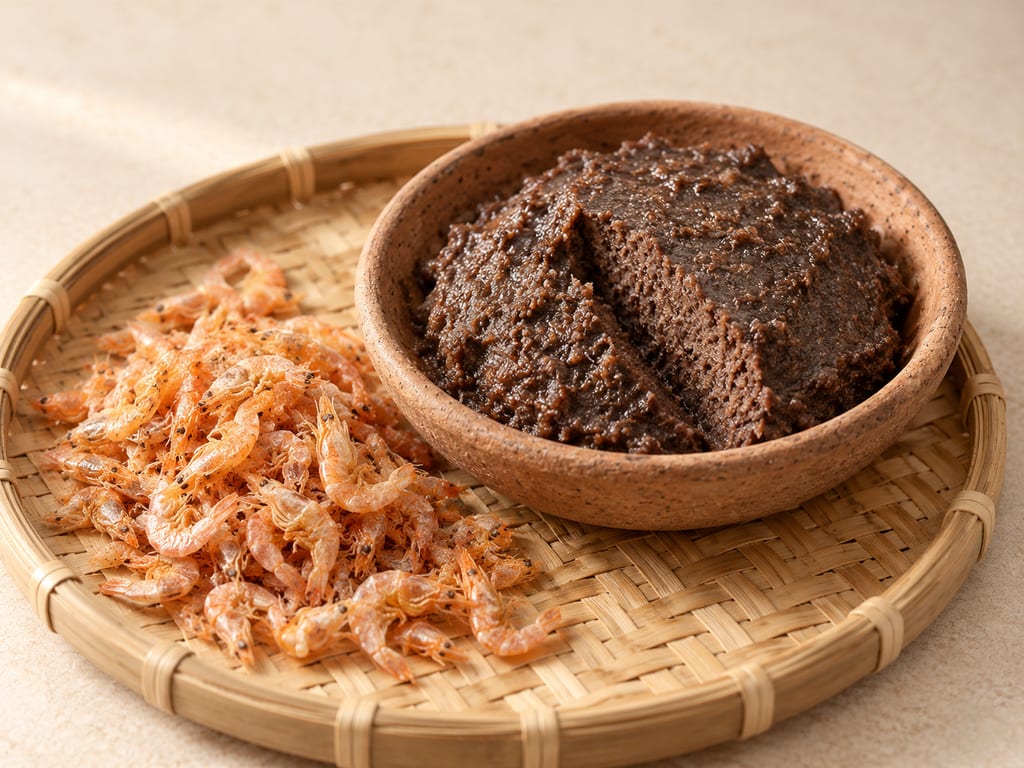
In Satongun's green paste, 4 g of kapi sits among about 215 g of other ingredients, roughly 2% by weight. The JIRCAS entry also says a made kapi keeps for 12 to 18 months depending on salt and not more than two years, and that a low-salt paste should be eaten within one year of being made. Those limits belong to the dried shrimp paste. They say nothing about a curry paste pounded with fresh herbs.
The microbiology of related pastes has been measured in Cambodia. A survey of Cambodian fermented fish products, prahok, kapi and toeuk trey, measured salt at 170–270 g/kg. Acetic acid was the highest acid in 10 of 13 samples, at 1.9–26.6 g/kg, and lactic acid ran from 0.4 to 12.9 g/kg. The genera found included Bacillus, Clostridium, Staphylococcus and Tetragenococcus. The results are not split by product and the work does not settle safety, so they show how mixed these pastes are rather than how any one jar behaves. Related pastes are not interchangeable either: belacan, terasi, kapi and bagoong alamang differ in raw material, fermentation and treatment.
Colours are names for pastes
Thai curries are usually sorted by colour, and the colour is shorthand for what is in the paste. Green paste uses fresh green chillies with garlic, shallot, galangal, lemongrass, coriander root and shrimp paste. Satongun's version lists 50 g of green goat peppers, 15 g of bird's-eye chillies, 55 g of lemongrass, 25 g of galangal, 30 g of shallot, 20 g of garlic, 10 g of coriander root, 4 g of shrimp paste and 6 g of red turmeric. The Department of Agricultural Extension names the same fresh base for its green curry with chicken.
Red paste is built on dried red chillies, peppercorns and lime zest, sometimes with roasted coriander, cumin and cloves. Yellow curry is kaeng kari, a soup curry, whose link to Indian curries shows in turmeric and cumin. Thai yellow curry does not usually contain potato, except in some southern versions. A KRUA yellow chicken curry for four servings does include potatoes. Its paste is dried chilli, galangal, ginger, lemongrass, shallot, garlic, roasted shrimp paste, coriander, cumin and curry powder, and turmeric is not listed.
The same study lists the original Massaman paste as dried red chillies, coriander, cumin, cloves, white pepper and peanuts, plus roasted cinnamon, cardamom and nutmeg. The finished curry has coconut milk, peanuts, potato, bay, cardamom, cinnamon, palm sugar, tamarind and fish sauce.
Khao soi, the noodle dish served with crisp noodles and pickled mustard greens, shows how loose the colour system is. One KRUA recipe for eight servings pounds dried chilli, coriander, black cardamom, ginger, turmeric and shallot. Another, for two, takes 40 g of red curry paste and a tablespoon of curry powder. The Bangkok Thai Cooking Academy lists green, red, Panang, Massaman and khao soi as separate classes and says its recipes vary from one class to the next. Every set of figures here is one cook's answer, not a standard ratio.
Splitting the coconut cream
There are two ways to cook a paste, and the curry-paste study gives both without ranking them. One fries the meat in the paste before the coconut milk goes in. The other simmers the paste in coconut milk first.
Satongun starts with the fat. She pours 150 ml of coconut cream into a hot pan a little at a time until it separates, with no time given, then fries 80 g of paste in it for about five minutes over medium heat. The spice powder follows. She seasons with 20 g of palm sugar and 25 g of fish sauce, adds 350 g of coconut milk with Thai and pea eggplants, and simmers for about ten minutes before folding in basil and bergamot leaves. Prawns are grilled apart for four to five minutes. Her rule for the dish is short: green curry must be green, as its name says. The cream can be replaced with vegetable oil or pork lard. In this recipe the cream works as the frying fat.
A Royal Thai Embassy cookbook gives a Massaman chicken that follows the same logic. It cooks 100 ml of the coconut milk until the oil separates and fries 60 g of paste in it. The rest of the 400 g of coconut milk and 250 ml of stock go in, then 300 g of chicken and 150 g of potato, then 50 g of peanuts and 100 g of onion. Seasoning is 100 g of palm sugar and 40 g of tamarind juice. Neither recipe gives a doneness test for the meat.
Fish sauce, the second ferment
Fish sauce, nam pla, is the other fermented seasoning at the stove. Satongun adds 25 g to her green curry; the curry-paste study lists it among the ingredients of Massaman. JIRCAS records nam pla as made from fresh, brackish or sea fish, salted at a fish-to-salt ratio between 5:1 and 1:1 and matured for 5 to 18 months.
The ranges are wide, and fish sauces differ in strength, so a dipping or seasoning ratio should follow the bottle in hand and not a number from another kitchen. Between them, kapi and nam pla bring months of fermentation into a pot that cooks in about ten minutes.
How old are the pastes?
The curry-paste study draws on interviews and workshops: 6 key informants, 15 casual informants and 170 general informants, plus observation and focus groups. It places the start of curry development in the Lanna and Sukhothai periods, in the 13th century. Shrimp paste became common in the Ayutthaya period. Its informants list influences from China, Japan, Persia, France, the Mon Kingdom, Portugal, India and the Netherlands. Nobody has systematically documented the history of the pastes, the study itself concedes, so this is an informed outline, not a chronology.
Massaman, a curry with too many ancestors
Massaman comes with several competing origin stories. Its name is probably a corruption of Mosulman. The curry-paste study says the dish dates back to the 13th century, cites the 14th-century Lanna Kingdom as the first Thai record, and calls it Muslim in origin with Portuguese spicing. It offers two stories. In one, a Persian merchant, Sheik Ahmad Qomi, adapted Thai Muslim food by replacing coconut cream with milk or yoghurt. In the other, an Indian chef at the royal court made it.
National Geographic collects more. Saiphin Moore points to Indian spice traders who stopped at southern Thai ports. David Thompson's book on Thai food links the curry to the first Persian envoy. The theories name Persia, India or both, and none has been settled.
The written trail is short. National Geographic names the earliest known Thai recipe as one from 1889 by Lady Plean Passakornrawong, made with bitter oranges rather than tamarind. Her cookbook, Maae Khruaa Huaa Bpaa, is dated 1908 in that article and 1958 in a Thai cultural encyclopedia, and the sources do not reconcile the two; they may be different editions. The encyclopedia gives a twelve-spice formula from the book, with meat, peanuts and onion, sweetened with palm sugar and soured with tamarind and sour orange, so the souring agent also differs between the two accounts. It links the name to the Persian stew mosamma and concludes that Massaman more likely came from India through Muslims.
The same entry quotes a poem it attributes to Rama II, with lines about dishes fragrant with cumin, pungent and strong in heat. A poem is not a recipe, and the attribution rests on that one entry. Of the dish itself, National Geographic says only that it is ideally eaten the day after cooking, a point about taste, not about keeping.
What nobody has measured: keeping a paste
No readable source gives a storage period, a cooling time or a doneness endpoint for a curry paste or a finished curry. The Embassy, Michelin, Department of Agricultural Extension and KRUA recipes give none. The nearest hard numbers are the kapi limits above, and they do not transfer to a paste pounded with fresh herbs.
For a cooked coconut sauce, UK Food Standards Agency guidance is to refrigerate promptly in small, clean containers, at 0–5 °C, with a practical aim of 4 °C or colder. A 48-hour working window is borrowed from general advice and is not a measured shelf life for any particular formula, and coconut sauces taste better when used earlier. The only cues the recipes give are smell, taste and texture, and none of them establishes that a curry is safe.
Where the knowledge runs out
A curry paste is fresh herbs, dry spices and, usually, a shrimp paste that took months to make. The fish sauce in the pot spent 5 to 18 months maturing. Seen that way, the colour of a curry names only the part the cook pounds on the day.
What is still unknown is how long a pounded paste lasts, how Panang and khao soi came to be, and which of Massaman's ancestors is the right one. The pounding, the cream and the shrimp paste are documented. The rest is argued about.
Community
No community contributions have been published for this entry yet.
Share what you made
Sign in to contribute. Published comments and photos are free to read.
Sources
Dusit Thani College Journal
The Evolution of Thai Curry PastesCited in: Twenty minutes at the mortar; The last ingredient in the mortar is a ferment; Colours are names for pastes; Splitting the coconut cream; How old are the pastes?; Massaman, a curry with too many ancestors; Where the knowledge runs out
Department of Agricultural Extension, Thailand
Gaeng Keow Wan Gai (Green Curry with Chicken)Cited in: Colours are names for pastes
Bangkok Thai Cooking Academy
Thai Food Recipes – Bangkok Thai Cooking AcademyCited in: Colours are names for pastes
National Geographic
Deconstructing massaman curry, Thailand’s mellow classicCited in: Massaman, a curry with too many ancestors
Royal Thai Embassy to the State of Qatar
Discovering Thai Cuisine in QatarCited in: Splitting the coconut cream
Michelin Guide
How to Make Thai Green Curry Like a MICHELIN Starred RestaurantCited in: Twenty minutes at the mortar; Colours are names for pastes; Splitting the coconut cream; Fish sauce, the second ferment
Thailand Cultural Encyclopedia, SAC Digital Collections
อาหารแขกในตำรับอาหารไทยCited in: Massaman, a curry with too many ancestors
JIRCAS, Thai fermented food database
Ka-piCited in: The last ingredient in the mortar is a ferment; What nobody has measured: keeping a paste; Where the knowledge runs out
JIRCAS, Thai fermented food database
Nam-plaaCited in: Fish sauce, the second ferment; Where the knowledge runs out
Journal of the Science of Food and Agriculture
Microbial and chemical properties of Cambodian traditional fermented fish products (Chuon et al., 2014)Cited in: The last ingredient in the mortar is a ferment
Gaps
- No readable source gives a storage, cooling or doneness rule for a curry paste or finished curry; the kapi limits belong to dried shrimp paste only.
- The origins of Massaman and khao soi are unsettled, and Lady Plean Passakornrawong's cookbook is dated 1908 in one source and 1958 in another. The 1889 recipe and the Rama II poem each rest on one source.
- No measured formula for red or yellow paste, and no home paste ratio, was found. Panang is not covered because its recipe source could not be read.
Updated 2026-10-29