
Programme
The paste that starts the pot
Before a Malay, Indonesian or Peranakan dish gets its liquid, a cook pounds and fries a wet spice paste. Four home recipes, a dictionary and a food writer show what goes in, why the oil must return, and where fermentation enters.
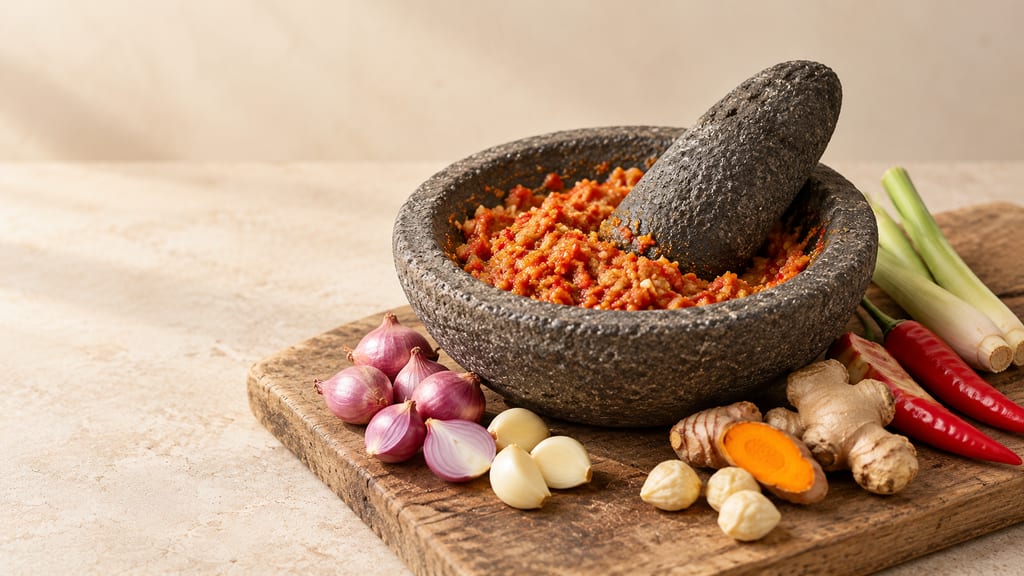
Shallots, garlic, ginger, lemongrass, chilli and turmeric beside a stone mortar, the raw material of a rempah.
A big mortar, then a smaller one
Nyonya Pranee Sak's mother gave her a big mortar, and she links it to firmness, love and care. Writing in The Peranakan, the magazine of the Peranakan Association Singapore, she says she recently bought a new, smaller one. Her advice for her nam-prik, a Thai condiment, is practical: grinding is easier if you first grind the ingredients separately in another mortar and mix them afterwards.
Her mortar is a fair way into rempah, the wet spice paste that starts a great many dishes in Malay, Indonesian and Peranakan cooking. A cook pounds or blends shallot, garlic, chilli and whatever else the dish needs, fries the paste in oil, and only then lets the other ingredients in. The paste decides much of what the dish tastes like. This article follows it from the word to the pan: what rempah means, what goes in, why it is fried until the oil comes back, how a mortar differs from a blender, and where fermentation enters.
One word, two meanings
In Malay, rempah first means spice. The Kamus Dewan, Malaysia's standard dictionary, defines it as a flavouring made of cinnamon bark, clove, cardamom and similar spices. Its next sense is wider: anything put into a dish such as a gulai, a synonym of bumbu. A student dictionary adds that spices such as black pepper and clove are mixed into food to give a fairly hot taste.
Malay food writing also separates out rempah basah, wet rempah. A Malay-language article on Malay food culture, published by Dewan Bahasa dan Pustaka in 2023, gives its base as shallot, garlic, ginger and chilli, usually ground or pounded. Indonesian uses bumbu for both a blend of spices and for pastes, and Indonesia's KBBI dictionary describes it as plants with a pleasant aroma and flavour that enhance food. A food writer for the MICHELIN Guide Singapore defines rempah as a paste of spices that gives a dish an intense flavour. The paste sense is the one cooks reach for at the stove, and it is the one this article follows.
Three cooks, four dishes
Peranakan cooking in Singapore is a hybrid. Singapore's National Heritage Board says it arose from Chinese ingredients and cooking techniques, mainly Hokkien and also Hainanese, blended with Malay, Indian, Thai and Western colonial influences. Peranakan itself means people of mixed Chinese, Malay and Indonesian heritage. The 2012 issue of The Peranakan prints the pastes of several home cooks, and together they are a good corrective to the idea of one standard formula.
Baba Joseph "Aji" Chen of Kudus gives a nasi pindang paste of 5 to 8 garlic and 5 to 8 shallots, 7 or 8 buah keluak, 7 or 8 candlenuts and 10 to 15 young melinjo leaves, stir-fried until fragrant. His ayam galanga is a different paste: 10 cloves of garlic, 6 or 7 shallots, 15 candlenuts, 3 or 4 red chillies or 1 or 2 cabai rawit, fresh turmeric and kenchur at 1 to 1.5 cm each, 1 teaspoon of white pepper and 1 teaspoon of coriander seed toasted in a wok without oil. He renamed the dish because its aroma comes from kenchur, not from lengkuas.
Chetti Nyonya Daisy Jacobs fries the rempah for her chili padi lemak until a reddish layer of oil rises to the top, and notes that the Malay dish of the same name has a runnier texture. Nyonya Debbie Teoh's kapitan chicken starts with 15 shallots, 1 clove of garlic, 10 g each of young ginger, galangal and turmeric, 2 candlenuts, 2 stalks of lemongrass, 5 soaked dried chillies and 10 g of toasted belachan. She blends them in an electric blender, then fries the paste in the oil left over from crisping onions.
The three pastes with written ingredient lists share a core. Each has shallot, garlic and candlenut, though the garlic runs from one clove to ten and the shallots from five to fifteen. The recipes serve different dishes, so the counts do not compare directly. Two of the three add fresh roots, and two include chilli.
Fry it until the oil comes back
The magazine recipes that describe the frying agree: the paste goes into hot oil and cooks until it is fragrant. Jacobs watches for the reddish oil. The MICHELIN Guide writer gives the reason: the paste has to be fried over a gentle fire until it turns fragrant, and oil that separates out shows that no water is left in it. A paste fried short of that point, she writes, tastes raw and unbalanced.
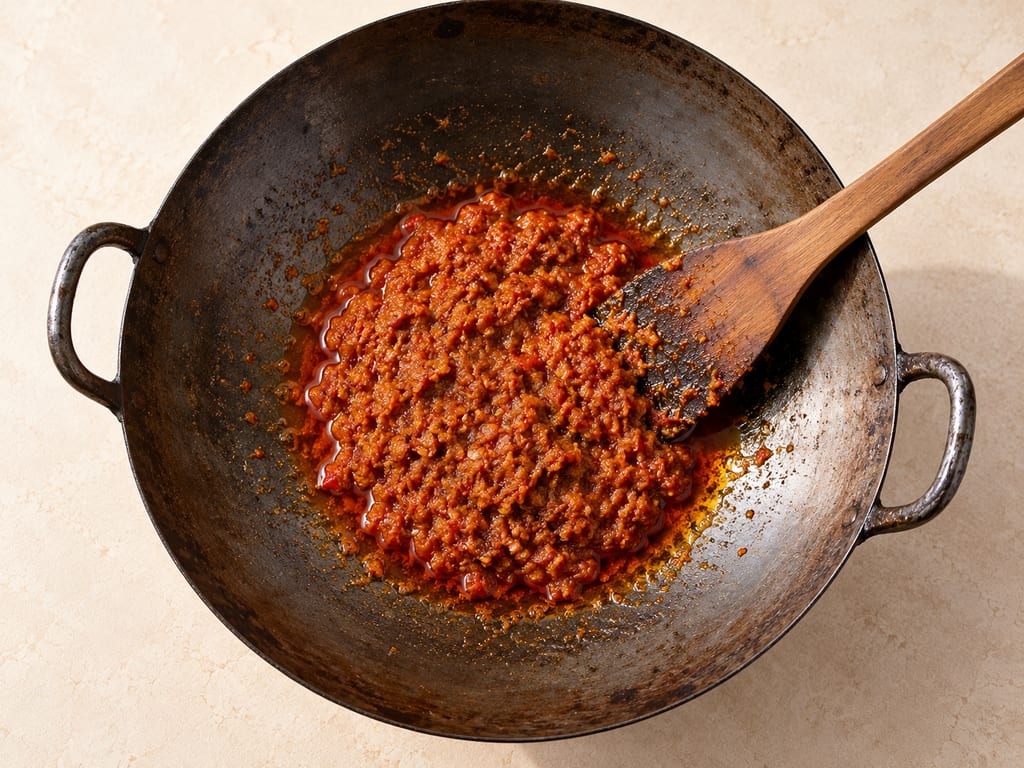
The Malay article describes the same rule in its own words. Earlier generations used a generous amount of oil so that the rempah was cooked through, pecah minyak, before the other ingredients went in. Dry spices such as coriander seed, cumin, cardamom and cinnamon were first fried without oil, a step called sangai, much as Chen toasts his coriander seed in a dry wok. Teoh adds a cook's detail of her own: she stirs continuously so that the paste does not burn or stick.
The paste is the first stage of the dish, not a flavouring added at the end. It starts out wet and raw, and the cook's job is to bring it to the point where the water has gone and the oil takes over.
Stone, pestle and blade
Pounding by hand was backbreaking work, the MICHELIN Guide writer says, and it once served as a gauge of culinary skill. She argues that the blunt pressure of a pestle destroys plant cell walls more thoroughly than blades do, giving a silky, unctuous paste instead of a pulpy one, and that alliums, ginger rhizomes and lemongrass stalks gain most. Singapore's National Heritage Board notes that the spices were traditionally pounded by hand with a mortar and pestle and that blenders are now common.
The Malay article reports the same belief from the cooks' side. The taste and aroma of rempah ground by machine differ, and cooks who use a stone mortar and a grinding stone are believed to get a more distinctive flavour. That is testimony rather than a trial, and the cooks in the Peranakan magazine do not all agree. Teoh uses an electric blender. Pranee Sak advises grinding in stages.
The Malay article also describes village wedding feasts, kenduri kahwin, where neighbours cooked together with trays, hearths, foot-operated pestles and wooden ladles. It says that custom is fading as caterers take over.
Colours, regions and families
Indonesian cooks sort their basic bumbu by colour. White has shallot, garlic, galangal, candlenut and coriander. Red has red chilli, shallot, garlic, tomato, roasted shrimp paste, coconut sugar and salt. Yellow has shallot, garlic, sauteed candlenut, roasted turmeric, coriander, ginger, galangal and black pepper. Orange has red chilli, shallot, garlic, caraway and anise, plus the yellow list. Bali has its own base, basa genep, and the Minangkabau have pemasak.
The MICHELIN Guide writer sorts rempah by what it carries instead: rempah kuning, built on turmeric and commonly paired with fish; rempah asam pedas, which carries tamarind; and rempah titek, built on candlenut and called the typical Peranakan rempah. She lists dishes from beef rendang to the Peranakan pork stew babi pongteh as users of such pastes.
Baba Ong Jin Teong, writing in the same magazine, says candlenut is used extensively to thicken gravies in Singapore Peranakan cooking, most probably an Indonesian influence, and more selectively in Penang, as in curry kapitan. He also warns that dishes of the same name cooked by different families can be mistaken for regional differences. That caution fits any account of rempah: a recipe first belongs to the cook who wrote it.
Where the ingredients came from
Many of the usual ingredients came from elsewhere. Candlenut, keluak, lemongrass and galangal are described as native to Indonesia. Pepper, turmeric, shallot, cinnamon, coriander, ginger and tamarind likely arrived from India or mainland Southeast Asia, and garlic from China. Chilli came last, from the 16th century, brought by Portuguese and Spanish traders. That account is a general one rather than a botanical study.
Where fermentation comes in
The paste itself is cooked, not fermented. Neither the magazine recipes nor the MICHELIN Guide article describes leaving it to ferment. Two ingredients bring fermentation in.
The first is shrimp paste. Belacan, called terasi in Indonesian, is a fermented shrimp paste, and Singapore's National Heritage Board calls belacan dried and fermented. Teoh's paste includes 10 g of it, toasted, and the Indonesian red bumbu includes roasted shrimp paste. The microbiology is thinly documented here. A 2022 laboratory study of low-salt terasi, made with 5 percent salt, found that the bacterial genus Tetragenococcus dominated early, that histamine and cadaverine accumulated as fermentation went on, and that a fermentation of 7 to 21 days was recommended. That is one study of one style of terasi, so it cannot speak for every belacan or terasi.
The second is buah keluak, the seed in Chen's nasi pindang paste. Peranakan cookery writing calls the seeds poisonous before fermentation and says they are buried in ash for at least three months at their point of origin; cooks then soak them before use. A study of burying keluak in soil gives a different account: seeds buried at 15, 30 and 45 cm for 20, 40 and 60 days lost cyanide, but a large reduction is not the same as a universally safe level. The two methods differ in medium and duration, and neither is a method for treating raw seeds at home.
How long a paste keeps
Basic bumbu can be used fresh or stored in the refrigerator for later use, and Teoh says her kapitan chicken tastes better the next day. Those are statements about convenience and flavour. No source gives a time after which a wet rempah or a fried paste should be thrown away, and neither a better taste nor a pleasant smell shows that food is safe.
The nearest tested guidance concerns a different food, so treat it as an analogy and not a rule for rempah. University of Georgia Extension warns that garlic and herbs in oil carry a Clostridium botulinum concern. A mixture that is not acidified must be kept in the refrigerator and discarded 4 days after it is made, or frozen, and vinegar or lemon juice must not replace the tested citric acid solution, because they have not been tested. A fried rempah is not raw garlic in oil, and whether it carries the same risk is unknown. Until someone tests it, the cautious course is the one that guidance gives for its own product: refrigerate it and use it within days, or freeze it.
What nobody has measured
The story of rempah has plenty of cooks and almost no measurements. Whether a mortar gives a better paste than a blender rests on testimony and on one writer's explanation of cell walls. The age of the Peranakan paste is unknown, and so is how long a family kept it before it went into a pot. A cook who wants an answer has the experiment to hand: pound half a batch, blend the other half, fry both until the oil returns, and taste.
Community
No community contributions have been published for this entry yet.
Share what you made
Sign in to contribute. Published comments and photos are free to read.
Sources
The Peranakan Association Singapore (2012)
The Peranakan, Issue 2Cited in: A big mortar, then a smaller one; Three cooks, four dishes; Fry it until the oil comes back; Stone, pestle and blade; Colours, regions and families; Where fermentation comes in; How long a paste keeps
Dewan Bahasa dan Pustaka, Rampak Serantau 2023
Apresiasi Makanan dan Pemakanan dalam Masyarakat MelayuCited in: One word, two meanings; Fry it until the oil comes back; Stone, pestle and blade; What nobody has measured
MICHELIN Guide Singapore (Stephanie Lim), 15 October 2016
What is rempah?Cited in: One word, two meanings; Fry it until the oil comes back; Stone, pestle and blade; Colours, regions and families; What nobody has measured
Wikipedia
Bumbu (seasoning)Cited in: One word, two meanings; Colours, regions and families; Where the ingredients came from; Where fermentation comes in; How long a paste keeps
Roots.gov.sg, National Heritage Board (ICH-048)
Peranakan Cuisine in SingaporeCited in: Three cooks, four dishes; Stone, pestle and blade; Where fermentation comes in
University of Georgia Extension, Circular 1334 (17 December 2024)
How to Safely Make Infused Oils: Best Practices for Food SafetyCited in: How long a paste keeps
Metabolites (2022), PMC8874951
Dynamic Changes in the Bacterial Community and Metabolic Profile during Fermentation of Low-Salt Shrimp Paste (Terasi)Cited in: Where fermentation comes in
Gaps
- No source gives a keeping time for a wet or fried rempah; the 4-day figure comes from guidance on garlic and herbs in oil, a different food.
- The fermentation of belacan and terasi rests on one laboratory study of low-salt terasi known from its abstract, and the ash and soil accounts of keluak burial are not reconciled.
- Malaysian state-level heritage sources for wet rempah variants, the age of the Peranakan paste and any household storage practice are not documented here.
Updated 2026-10-29