
Programme
Makhni, white, brown and green: the gravies Indian curries start from
Butter chicken has two inventors, both named Kundan Lal. Behind its sauce sits a small system of cooked bases, which two Indian cookery textbooks count differently, and a plain question: how long does a batch keep?
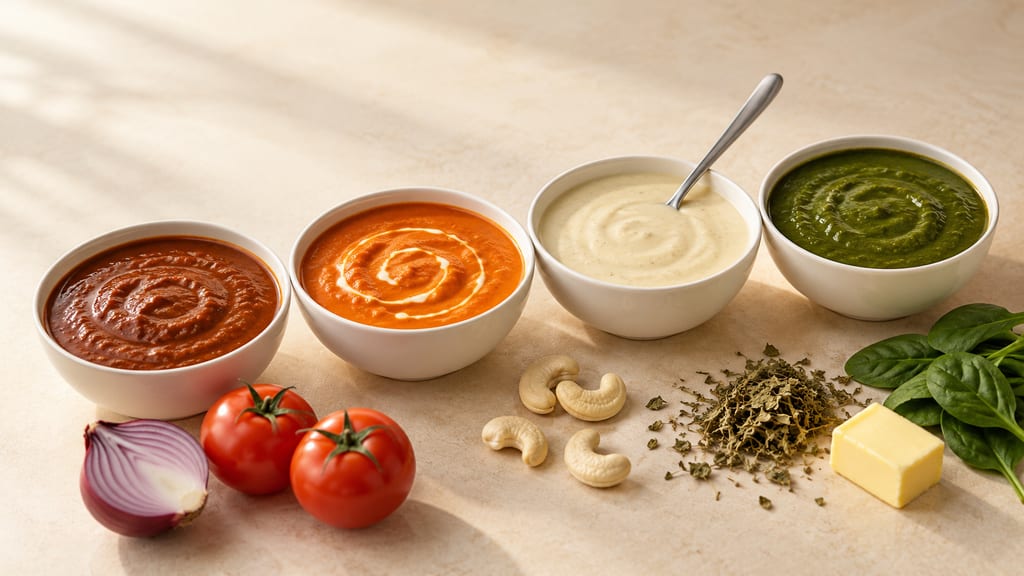
Four Indian gravy bases in small bowls: brown onion-tomato, orange-red makhni, pale white and spinach green.
Two men named Kundan Lal
Two men named Kundan Lal, two restaurants named Moti Mahal, and one sauce that two families both claim. Butter chicken, built on the buttery tomato gravy called makhni, has no agreed inventor. Both the Gujral and the Jaggi families say that Kundan Lal Gujral and Kundan Lal Jaggi were colleagues who moved from Peshawar to New Delhi after 1947 and opened Moti Mahal there. Both agree the dish was first served at the Delhi restaurant. They disagree about who made it, where and why.
The Gujral family says Kundan Lal Gujral invented it in 1920 at an older Moti Mahal in Peshawar, to revive leftover tandoori chicken in a rich gravy. The same family credits him with dal makhani. The Jaggi family says Kundan Lal Jaggi made it in New Delhi during a late-night rush, when little food was left, by combining tandoori chicken with a tomato gravy. Some people in Peshawar remember a Kundan Lal making butter chicken there but give no surname.
Early accounts are poorly documented, and no record from before 1947 turned up outside the two family stories, so the 1920 date is a family claim. The Gujral family has sued over the rival claim, and the case was still open in March 2024. What both stories share is the sauce: a tomato gravy rich enough to turn leftover meat into a dish. Makhni is one of several cooked gravies that Indian kitchens treat as bases, and the rest of this piece is about them.
A gravy is the liquid the food cooks in
Two Indian cookery textbooks written for different courses reach for the same words. A hospitality course from Uttarakhand Open University calls gravy the soul of Indian cuisine. The Class 12 food science text of Maharashtra's state board calls it the heart and soul, and adds that gravy and curry are used interchangeably.
The university course also separates gravy from the French sauce. A sauce is generally poured over finished food. A gravy is the simmering liquid in which the food or meat is cooked, so the dish and its gravy come together in one pot. That is why Indian kitchens think in bases: the Maharashtra text calls onion-tomato masala the base for most curries in India, and the other gravies are variations in how the body, colour and richness are built.
Four gravies, or more, depending on the book
Ask the two textbooks how many basic gravies there are and they give different lists. The Maharashtra text names four: onion-tomato masala, which it also calls brown onion gravy; makhni; white; and hariyali, meaning green. The university course names white, yellow, brown and makhni, then lists the dishes that grow from them: korma, yakhani, lababdar, kadhai, achari, malai kofta and spinach gravy.
The two lists overlap without matching. They are teaching frameworks for a kitchen course, not a survey of how India cooks, and the headings below follow the Maharashtra four because they are the easier to compare.
Brown: onion, tomato and the oil that rises
The sequence for onion-tomato masala is fixed. Oil is heated in a kadhai. Khada masala (whole spices) and slit green chillies are tempered in it, and chopped onions cook until slightly darker than golden brown. Ginger-garlic paste goes in, then a paste of red chilli in water, then chopped tomatoes. Small amounts of hot water are added while the cook mashes everything into a thick gravy, and the pan is covered and cooked until the oil separates and the colour darkens. The university course's brown gravy uses the same family of ingredients: browned onion with ginger-garlic, turmeric, coriander, cumin and chilli, finished with tomato puree.
The onion is where the cook wins or loses. The Maharashtra text warns against burning it, because burnt onion gives a bitter taste. Short of that, browning works in the cook's favour. Heat starts the Maillard reaction, in which sugars and amino acids combine into brown, savoury compounds. Laboratory measurements on yellow and purple onion, tomato and other vegetables found that steaming, frying and baking all raised the level of Amadori compounds, the first stable products of that reaction, whatever the vegetable or the method. That shows browning begins in ordinary cooking. It does not give the temperature or time that makes a good gravy base, and a study of onion browning in a sauté pan is still missing.
Oil separation is the cook's signal that the gravy is done, and the Maharashtra text uses it again for makhni and hariyali. It gives no explanation. The likely reading is that the water in the onions and tomatoes has cooked off and the oil is left on top, but that is an inference, not something the textbooks state. The text adds that this gravy is usually made fresh for each dish in every Indian home.
Makhni: butter, cashew and a late cream
The Maharashtra method for makhni starts with the tomatoes. They are slit, cooked soft with ginger and garlic, pureed and strained. Butter is heated, red chilli powder, salt, garam masala and green chillies go in, and the pan is covered and cooked until oil separates on the surface. Cashew paste, roasted and powdered kasuri methi and sugar follow, then more butter if needed and cream to finish.
The cream goes in last for a reason. The gravy should not be boiled after it is added, because it might curdle. The university course gives a larger version built on twelve large tomatoes, with cashew, cream and kasuri methi as well, but sweetened with honey instead of sugar. Kasuri methi is dried fenugreek leaf. It is dried, not fermented, and India's spices research institute ICAR-IISR describes it as used in paneer and curry dishes.
The university course treats makhni as a parent. Add fried onion paste and mawa, reduced milk, and the result is lababdar. Add kadhai masala with chunks of onion and capsicum and it becomes kadhai gravy.
White: boiled onion, kept pale, thickened with nuts
White gravy is built to stay pale. In the Maharashtra method, ghee is heated, whole spices and slit chillies are tempered in it, and ginger-garlic is sautéed for about a minute. Boiled onion paste is cooked until the ghee comes out, with care that the onions take no colour. Cashew paste and magaz (melon-seed) paste follow, with a little hot water if needed, and whipped curd goes in last and is cooked until it boils. The university course's list is richer: cream, mawa, milk, cashew, white pepper, sugar, clarified butter and whole spices.
White gravy is rarely used alone. Cooks combine it with makhni or hariyali for dishes the text calls royal, such as malai kofta, methi matar malai and navratan korma. It is also the base of kormas, where more curd and brown onion paste are added. It is the one gravy in the Maharashtra text with a warning instead of a storage time: make it when required, because the nut pastes can make it sour and spoil rapidly.
Curd is the one place where fermentation reaches these gravies. It is milk soured by a starter culture, which the same textbook describes in an earlier chapter as converting lactose to lactic acid over 6–12 hours. Yakhani, the stock-and-yoghurt gravy of Kashmir and Awadh in the university course, leans on the same ingredient. The link is thin. The gravy itself is cooked, and the souring happened before the curd reached the pot. The warning about nut pastes souring reads as a spoilage warning, not a description of a fermentation anyone wants.
Green: two books, two foundations
Hariyali means green. The Maharashtra text makes it by cooking spinach puree into the onion-tomato masala, uncovered, until oil floats on top. The university course instead adds blanched spinach puree to white gravy and lists the result as spinach gravy.
Both are leaf-green gravies, built on different foundations: one on a tomato base, the other on a pale nut-and-onion base. The disagreement is a fair reminder that these are kitchen families and not fixed recipes.
Where the body comes from
The university course lists the main sources of body in a gravy: onion pastes, nut pastes of cashew, almond, coconut and pistachio, and seed pastes of poppy seed, char magaz and sesame. Nut and seed pastes mark Mughlai curries, and the course links them, with a hedge, to Mughal influence. Cream is common too, though the course says it is more prevalent in commercial establishments.
Read this way, the four bases are four answers to one question. Brown takes its body from onion and tomato cooked down. Makhni takes it from tomato, butter and cashew, with cream at the end. White takes it from boiled onion and nut and seed pastes. Green takes its colour and body from a leaf puree laid over one of the other two.
How long a batch keeps
The Maharashtra text gives a week for three gravies: makhni kept in a closed container in the refrigerator, onion-tomato masala stored for up to one week in a refrigerator, and hariyali stored for a week in a closed container under refrigeration. These are the textbook's figures. Neither book gives cooling curves, acidity measurements or a shelf-life test, so a week is a classroom statement and not a tested safe limit. Smell, taste and bubbles do not show that a gravy is safe.
Food-safety agencies work with time and temperature instead. Hong Kong's Centre for Food Safety names gravy, along with stewed beef and curry, among precooked foods that should go into hot or cold holding within 2 hours if they are not served at once. Hot food is held above 60 °C and cold food at 4 °C or below. Food on display should be eaten within 4 hours of cooking.
The Minnesota Department of Health covers the cooling in between. Cooked food should fall from 57 °C to 21 °C within 2 hours, and from 57 °C to 5 °C or below within 6 hours in total. Its advice is to cool food in shallow pans or smaller portions, in an ice-water bath with frequent stirring, and to use an ice wand for thick foods such as chili.
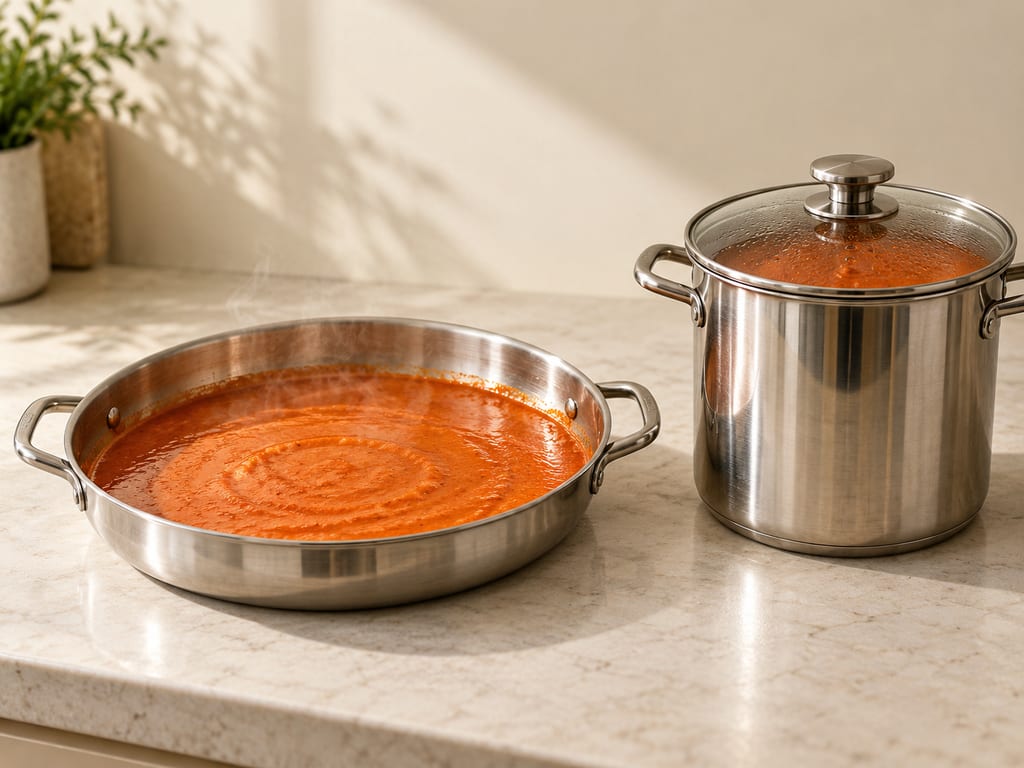
A thick gravy is the kind of food those instructions are written for. Read together, they suggest cooling a batch uncovered in shallow metal pans and covering and refrigerating it only once the cooling window is met, so that the lid does not trap the heat. That is an inference from the two sheets, not a tested method for makhni or any other gravy.
What the bases are for
For a cook, the useful part of the textbooks is the order of decisions: how far to brown the onion, butter or ghee, which paste gives the body, when the cream goes in, and how fast the batch cools. The bases are not a closed list. They are a way to make one pot of gravy serve many dishes.
What nobody can yet supply is the history. Apart from two family claims about makhni, no dated record turned up for makhni, korma, yakhani or the other bases, and household versions are barely written down.
Community
No community contributions have been published for this entry yet.
Share what you made
Sign in to contribute. Published comments and photos are free to read.
Sources
Uttarakhand Open University
Introduction to Indian Cookery (BHM-401T)Cited in: A gravy is the liquid the food cooks in; Four gravies, or more, depending on the book; Brown: onion, tomato and the oil that rises; Makhni: butter, cashew and a late cream; White: boiled onion, kept pale, thickened with nuts; Green: two books, two foundations; Where the body comes from; What the bases are for
Balbharati, Maharashtra State Bureau of Textbook Production and Curriculum Research
Food Science and Technology, Standard TwelveCited in: A gravy is the liquid the food cooks in; Four gravies, or more, depending on the book; Brown: onion, tomato and the oil that rises; Makhni: butter, cashew and a late cream; White: boiled onion, kept pale, thickened with nuts; Green: two books, two foundations; Where the body comes from; How long a batch keeps; What the bases are for
Food Republic
The Competing Origin Stories Of Butter ChickenCited in: Two men named Kundan Lal; What the bases are for
Minnesota Department of Health
Cooling Time/Temperature Control for Safety Food (TCS)Cited in: How long a batch keeps
Journal of the Science of Food and Agriculture
Evaluation of the extent of initial Maillard reaction during cooking some vegetables by direct measurement of the Amadori compoundsCited in: Brown: onion, tomato and the oil that rises
Gaps
- The earliest record of makhni is two family accounts, and the court case was not followed after March 2024.
- The textbooks give incomplete yields and no storage tests, and no Indian food-safety text was read.
- No study measures onion browning in a sauté or the holding of a makhni.
Updated 2026-10-29