
Garum intake
Roman fish-salting production: vats, sites and products
Roman fish processing ran as a large industry along Mediterranean and Atlantic coasts. A vat shows that salting happened, but not that its contents were garum.
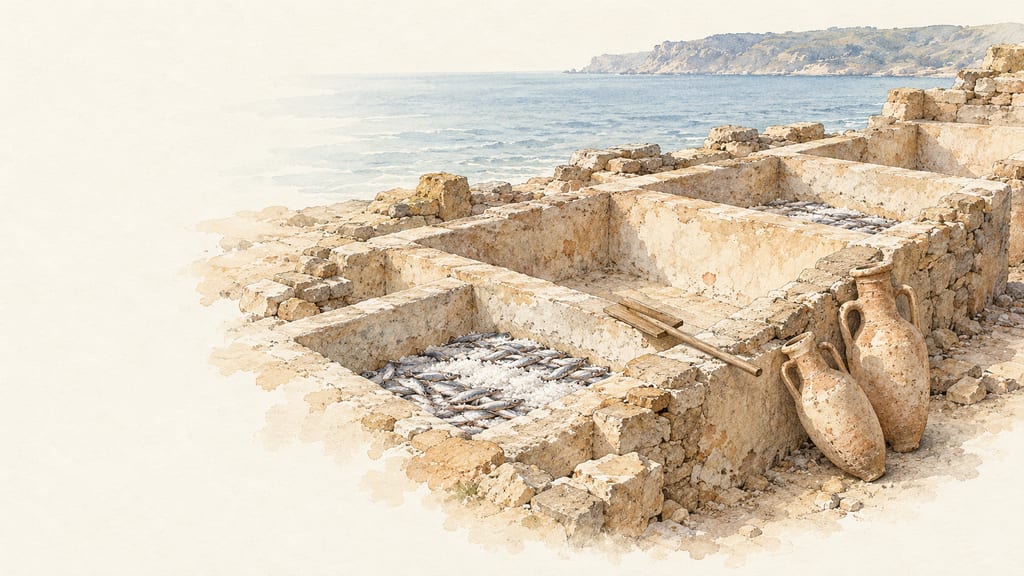
A historical interpretation of a Roman fish-salting works: rectangular tanks cut into the rock beside the sea.
A sardine at the bottom of a vat
On O Carreiro beach in O Grove, Galicia, lie the remains of a Roman fish-salting plant called Adro Vello. It worked from the first to the third century AD, and four large vats survive. At the bottom of one of them, vat 1, archaeologists found spines, vertebrae and scales: the crushed leftovers of whatever was once packed in salt there. Most of the identifiable bones looked like sardine. In 2025 a team published what a DNA laboratory made of them, and the answer was more than anyone expected of bones that had lain for about 1,800 years in the acid residue of a fermented fish product.
Of 18 bone samples, 17 were sequenced and 12 were sequenced in depth. Between 4 and 21 per cent of the DNA in them belonged to the fish, a lower share than in cod, which the authors attribute to the acidity of fermentation. It was enough to assemble complete mitochondrial genomes, and they sit firmly with the European sardine, Sardina pilchardus. The result is a rare thing in the study of Roman food: a direct answer to the question of what, in one vat, was being made.
An industry, not a sauce
The vat at Adro Vello belongs to something much larger. Andrew Wilson, in a 2007 working paper for the Oxford Roman Economy Project that builds on his article “Fishy business” (Journal of Roman Archaeology, 2006), argues that factories built around batteries of concrete vats are a distinctly Roman phenomenon, “a veritable fish-processing industry” on a scale well beyond earlier Greek and Punic production. The technology itself is older: small Punic vats were built in the bay of Cádiz in the fifth century BCE.
Wilson’s argument turns the usual picture round. Garum and liquamen, the fish sauces that fill the literature, were by-products of this wider salting industry rather than its main concern. The factories made salted fish, and fish pastes, and sauces, in the same buildings, and Pliny (Natural History 31.94) knows of a Dalmatian muria, the brine in which salted fish had lain. Salted fish was largely an export product. Fish reaches inland communities only if it has been salted, so the trade in salted fish tracked the supply of an important protein as well as a taste. Near Rome, fishponds probably supplied the market for fresh fish; the salted product went to the wider Mediterranean.
Why the coasts
The big factories stand where fish came in numbers. Wilson links them to the migratory routes: the Straits of Gibraltar, the North African coast, the Kimmerian Bosphorus and the Bay of Douarnenez. Factories of 30 cubic metres or more cluster in Brittany, Baetica, Lusitania, along the North African coast and on the Black Sea. Smaller establishments, of about 3 to 20 cubic metres, line the coasts of Italy, southern Gaul and Tripolitania.
The largest sites are on a scale of their own. Tróia I/II and Plomarc’h 2 far exceed other single establishments. Plomarc’h 2 in Brittany had ten cement-lined salting vats totalling more than 466 cubic metres, along with five unlined vats whose purpose is uncertain. At the other end are small, pot-based operations such as the “garum shop” at Pompeii and the Maison des Fresques at Tipasa.
The map has holes that are not all Roman. Few large vat factories show up along the Eastern Mediterranean and the Adriatic, and Wilson suggests that production there may have used pithoi or dolia, which would make it smaller in scale rather than absent. Part of the pattern is an accident of fieldwork: the Tunisian concentration ends abruptly at the Libyan and Algerian frontiers. A map of big vats is a map of big vats, not of all salted-fish production.
A rise and a fall in concrete
Because the vats can be measured, they can be counted, and Wilson counts them. His data cover 34 factories at 22 sites, grouped in half-century phases, and the total of vat capacity becomes a rough indicator of the industry’s fortunes, even, he suggests, an empire-wide one. Capacity grows strongly in the first and second centuries AD, falls sharply in the third, declines through the fourth and early fifth, and is almost nothing by the later fifth century. Construction investment peaks in the later first century BCE and again in the later first and early second centuries AD; the lower peaks of the third and fourth centuries mostly reflect rebuilding.
Regions run on their own clocks. The Gibraltar region grows earlier, falls more sharply at the end of the second century and then holds a fairly stable lower level from the third to the early fifth. Armorica starts later, with investment from the late first century AD that peaks in the second largely because of Plomarc’h, and then stops. It declines more sharply after the third century.
What a vat does not prove
Capacity is not output. The sources do not say whether the vats were full, what fish-to-salt ratio was used or how many batches were made in a year. The figures are also minimums, because some sites are unexcavated or eroded and many publications lack basic vat data. Wilson’s thresholds of 30 and of 3 to 20 cubic metres are his own classifications, not external standards.
Vats could also hold more than fish. Meat was salted in them at some sites: beef at Kerobestin, mutton at Telgruc, beef and mutton at Douarnenez. At Iulia Traducta, when the factory was abandoned in the early sixth century AD, its vats were used for horse, beef and mutton. That complicates residue studies, since meat and fish could be salted in brine or oil using the same infrastructure, and it is a reminder that a Roman salting site is not automatically a sauce factory.
One vat, one fish, 2,000 years
Adro Vello shows what the other kind of evidence can add. Its radiocarbon date is 2280 ± 30 BP, or cal AD 84–394 at 95.4 per cent probability; the marine reservoir effect widens the range considerably, and the stratigraphy points to abandonment in the early third century AD, which the authors consider most likely. Baetican Haltern 70 amphorae built into the plant’s walls date its construction to the start of the first century AD.
The European sardine was the main fish resource for making Roman fish sauce at O Grove. Sardine dominates at other Atlantic sites too: Douarnenez and La Falaise in France, Lisbon, Belém (over 98 per cent), and Tróia. Baelo Claudia in Baetica made some sauces from anchovy and others from sardine. Sardines, sprats, anchovies and mackerel were the usual raw materials, crushed whole and fermented in brine.
The genetic result goes a step further. The Roman fish belong to the same maternal lineages as modern sardines from the region, which the authors read as continuity over about 2,000 years. They caution that this rests on mitochondrial DNA from only 12 samples, so it is suggestive rather than definitive. Nuclear data place the fish in the Central group, less admixed than modern western Iberian sardines, which the authors interpret as reduced connectivity among sardine populations in Roman times, with possible modern effects from fishing and shipping.
Reading a factory
A factory, then, can be read three ways: by what the building could hold, by what residues or fish remains show it was used for, and by what the finished product was. Wilson’s paper answers the first with numbers. The Adro Vello study answers the second, for one vat. The third, the finished product, is answered only in a few cases.
It is not known what share of Roman output went through vats of this size, or whether residues in smaller vessels show garum, salted fish or pastes. Until that is known, a factory shows scale, and a single vat shows one fish at one site.
Community
No community contributions have been published for this entry yet.
Share what you made
Sign in to contribute. Published comments and photos are free to read.
Sources
Oxford Roman Economy Project
Quantification of fish-salting infrastructure capacity in the Roman worldCited in: An industry, not a sauce; Why the coasts; A rise and a fall in concrete; What a vat does not prove; Reading a factory
Antiquity 99(406)
Roman Atlantic garum: DNA confirms sardine use and population continuity in north-western IberiaCited in: A sardine at the bottom of a vat; One vat, one fish, 2,000 years; Reading a factory
Gaps
- No output figures are given: capacity is not production.
- Residue evidence from most vats is not published.
- Vat counts in the Eastern Mediterranean and Adriatic may reflect limited research.
- The dating of the fifth-century BCE Punic installations at Cádiz rests on Wilson's paper alone.
Updated 2026-10-29