
Smokehouses
Seven thousand fish a batch: smoking Lake Malawi's smallest catch
Usipa weigh about five grams, and the rainy-season catch will not wait for the sun. A 2019 beach trial on Lake Malawi weighed the wood, time, money and taste of three kilns and a frying pan.
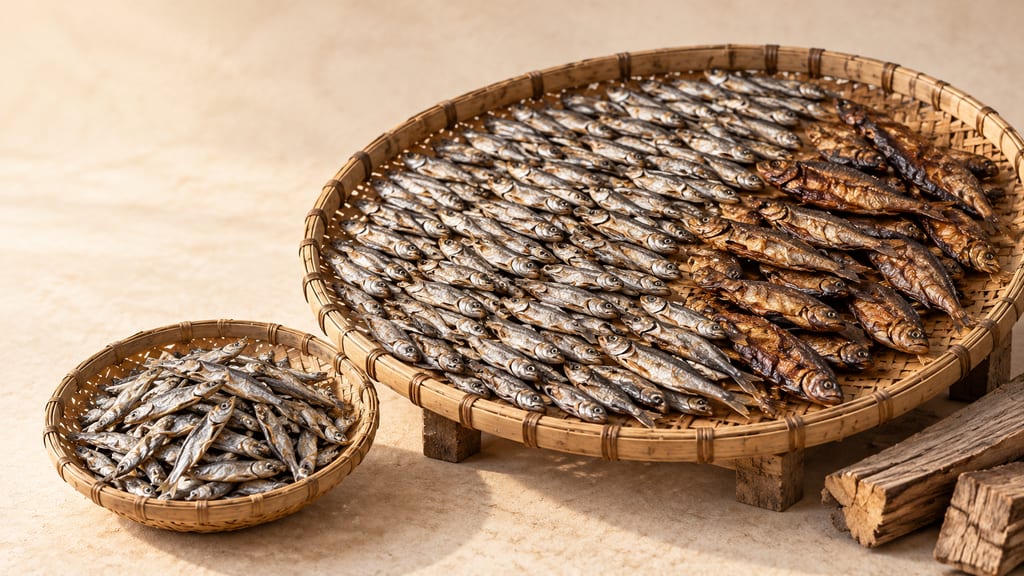
Dried and smoked small fish on a woven drying rack: the kind of catch Lake Malawi's usipa and utaka become.
Seven thousand fish in one kiln
A usipa weighs about five grams. When researchers loaded the largest of three smoking kilns at the Nkhotakota beach station on Lake Malawi in 2019, one batch took 35 kilograms of usipa. That is about 7,000 fish spread over seven racks of trays. Utaka, the other small fish in the trial, average 15 grams, so a full load of them, 31.5 kilograms, comes to about 2,100 fish.
Fish like these now dominate the lake's catch. Researchers from Bunda College, part of the Lilongwe University of Agriculture and Natural Resources, wrote in 2019 that Lake Malawi's fishery is hampered by overfishing and climate change, that the make-up of the catch has shifted, and that production of the small species usipa (Engraulicypris sardella), kambuzi and utaka (Copadichromis species) had recently doubled.
A lot rides on them. A 2025 paper on school meals puts fish at 14.2 per cent of the animal-source protein eaten in Malawi, a figure it takes from an FAO source, and in its summary it counts 217,000 people employed. Eaten whole, small fish are also rich in calcium, vitamin A, iron and zinc. A recipe book from WorldFish and Malawi's Department of Fisheries notes that dried small fish are within reach of low-income households and that dried usipa, kapenta and utaka are often divided more evenly than larger fish.
When the sun cannot dry the catch
The trouble is timing. The biggest catches come in the rainy season, when humidity and cloud slow sun-drying. Small fish are rarely eaten fresh, so they must be preserved whatever the weather. Makawa, Kaunda and Kapute, who ran the trial, cite an earlier estimate that post-harvest losses in Malawi reach 40 per cent in the rainy season. A 2025 news report on a kiln project quotes higher figures: 43 per cent lost at the beach, 54 per cent in processing and 69 per cent in marketing. It does not say what those percentages are measured against, so they cannot be set beside the 40 per cent estimate.
Sun-drying is the older route. Slow Food's Ark of Taste calls sun-dried usipa mululi, and calls partial boiling followed by drying wakufwafwaska or wofutsa.
Smoking is now by far the most common way of processing fresh fish in Malawi. Makawa and colleagues argue that it is probably the best answer to bumper catches, because smoked fish keep longer, taste better and sell for more. It also burns a great deal of wood, and they count it among the major drivers of deforestation. Around the lake, some processors have lately started frying fresh fish before sale, and fried fish are described as more popular with buyers than smoked fish.
Three kilns and a frying pan
The trial set three smoking installations and a frying line side by side on the Nkhotakota beach to find out which used the least wood and which gave fish that people liked. Makawa, Kaunda and Kapute ran it in August and September.
The traditional kiln is burnt mud brick and mud, 90.5 by 90.5 centimetres in plan, with a fire hole of 29 by 26 centimetres. A plywood cover with an iron sheet closes over the fish, and the trays have wire-mesh bases.
The second, FRISMO, is the Food Research Institute improved smoking oven, adapted from West Africa. It has a brick exterior around an angle-iron frame, a base 2.2 metres across and a height of 1.68 metres. Seven racks hold trays of 0.9 by 0.9 metres, and firewood goes in through two holes in the sides. At Lake Chilwa, FRISMO had already been introduced, and wood use for catfish and matemba was reported to fall by 30 per cent. But it was big and fixed in place, and moving its trays took more than one person. That made it a poor fit for the mobile processors who dominate Lake Malawi's beaches and have to move when floods come.
So the researchers built a third kiln. The modified kiln swaps brick for metal: a corrugated iron body 1.5 millimetres thick, mild-steel trays 1.2 millimetres thick on five tiers, four legs, a metal door and a chimney. One person can run it, and it is light enough to carry indoors or into shade when it rains or the beach floods.
Fish, fire and a stopwatch
The trials ran three times, each time with different fish. The fish were iced, then semi-dried for about five minutes at 25 °C. Every kiln burned muwanga (Pericopsis angolensis), a dense wood that burns slowly with high heat and gives the fish a rich brown-golden colour.
The loads show the difference in scale. FRISMO took 35 kilograms of usipa or 31.5 kilograms of utaka. The modified kiln took 20 or 17.5, and the traditional kiln 8 or 13. Smoking temperatures were held at 52–73 °C in all three. A batch was done when the fish looked golden brown and glossy, had the desired texture and a smoky aroma, and had lost a weight set in advance. That endpoint describes quality; it is not a safety test.
Frying ran at 190 °C in a pan, one kilogram of fish at a time, starting with five litres of oil. Forty trained assessors, half men and half women, scored the results on a nine-point scale.
What the wood bill showed
Frying was the biggest consumer of wood. For usipa it took about 5.8 kilograms of wood per kilogram of fish, against 1.81 in the traditional kiln, 1.01 in FRISMO and 0.98 in the modified kiln. Compared with the traditional kiln, FRISMO saved 44 per cent of the wood on usipa and the modified kiln 46 per cent. The authors explain frying's appetite by the oil. It is boiled for a long time before and during frying, and left about ten minutes between batches to come back to heat.
Utaka gave a tighter spread, from roughly 0.96 kilograms of wood per kilogram of fish in the modified kiln to 1.84 for frying. The modified and FRISMO figures appear as 0.96 and 1.23 in the detailed results and as 0.98 and 1.24 in the summary. Traditional smoking sat at about 1.42. Across all four methods the difference narrowly missed statistical significance (P = 0.056), and only the gap between the modified kiln and frying was significant. Against the traditional kiln, FRISMO saved 13 per cent of the wood on utaka and the modified kiln 32 per cent.
One result went against expectation. An insulated brick oven should hold heat better than a metal box, yet the uninsulated modified kiln matched or beat FRISMO. The authors suggest that kilns without insulation may suit small fish. They point out that in Nigeria, processors favour the thick earthen walls of kilns like FRISMO, but mostly for smoking catfish, which are larger.
Speed, money and taste
Speed told a different story. For usipa, the traditional kiln processed 0.04 kilograms of fish a minute, the modified kiln 0.09, frying 0.17 and FRISMO 0.20. For utaka the figures were 0.06, 0.14, 0.54 and 0.23, so frying was the fastest of all. A smoking batch took 61–75 minutes for usipa and 90–126 minutes for utaka. A frying batch took about four.
Smoking won on money. For usipa the cost-benefit ratio was 2.3 for FRISMO and the modified kiln, 2.2 for the traditional kiln and 0.8 for frying, which was found not to be profitable. The traditional kiln paid for itself in the first year, the other two in the second.
Taste favoured the pan. Assessors scored fried usipa 7.9 and fried utaka 8.3 out of nine. Smoked utaka scored 7.8–7.9 from the modified kiln, 7.3–7.4 from FRISMO and 6.1 from the traditional kiln, and fried and smoked utaka did not differ significantly. For smoked usipa two sets of scores exist, and they disagree. One gives 7.0 for the modified kiln, 7.3 for FRISMO and 6.1 for the traditional kiln. The other gives 7.8, 6.2 and 7.0. Only the second puts the modified kiln first on both species, so the ranking of kilns for usipa is not settled.
The authors recommend the modified and FRISMO kilns for small fish because they use less wood, are well liked and pay back. They want future designs to be mobile, insulated and to need little handling of the fish. They are warier of frying. They say it promotes polycyclic aromatic hydrocarbons, which are carcinogenic, that the oil is heavily recycled and often dirty, and, from personal observation, that fried fish in Malawi is of lower quality. Part of the oil and hydrocarbon case rests on a popular cookery book, and the trial measured wood, time, money and taste, not oil or hydrocarbons.
Kilns after the trial
Other projects have worked on the same problem. A 2019 feature from Pact, which ran the USAID FISH project with the local partner CISER, describes one processor who replaced his 20 traditional kilns with improved smoking kilns and took up mobile kilns and parboiling stoves. He later modified the designs himself, and FISH and CISER adopted his changes. A parboiling stove cut one batch from seven hours to five on a static stove and four on a mobile one, with no load stated. The feature gives no wood, loss or income figures, and his modified kiln is not the one from the Nkhotakota trial.
A 2025 news report on a kiln project quotes its lead, James Banda of Malawi's Ministry of Agriculture, saying such kilns can process 100 kilograms of fish in two hours. That is 0.83 kilograms a minute, several times the best rate measured at Nkhotakota, which was 0.23 for FRISMO on utaka. No measurement backs it, and it does not say which kiln or fish.
From kiln to porridge
Not every small fish meets smoke. The 2022 recipe book makes fish powder two ways. One is to roast dried fish lightly for two to three minutes and dry it in the sun. The other is to parboil usipa, then dry it further in the sun and pound it without roasting. The book says the powder keeps in a closed container in a cool, dry place for up to a month. That line concerns these unsmoked powders and says nothing about smoked fish.
A 2025 study describes the parboiling step: partly sun-dried fish is dipped in boiling water at 100 °C for about two to three minutes and then dried in the sun again. The recipe book puts the powder into porridge. Three tablespoons of parboiled usipa powder go into 1½ cups of whole maize flour with a teaspoon of pounded vegetables and five cups of water, simmered for 10–15 minutes, at 1 cup (250 g) per serving. The book lists a 100 g portion of this porridge at 260.28 kilocalories, 9.93 grams of protein, 4.67 grams of fat, 9.6 milligrams of iron and 28.27 milligrams of calcium.
The 2025 study asked whether such powders could go into school meals. Learners aged 6–13 in Mangochi and Dowa tasted the porridges, and 223 of them assessed them. The headline figure is approximately 90 per cent of learners eating more than 75 per cent of porridges containing pan-roasted fish powder; the detailed results give over 80 per cent for most recipes. Pan-roasted usipa was rated highest for smell, taste and appearance in most categories. Pan-roasted usipa powder cost 7,670 Malawi kwacha per kilogram (USD 4.56) and smoked usipa powder 6,550 (USD 3.90), and pan-roasting added processing time and cost because it needs firewood.
Smoking and sun-drying leave different fish. A 2018 study of ndunduma, a different lake fish of the genus Diplotaxodon, compared smoked fish with fish sun-dried for three days in the open on reed mats. Smoked fish came out at 12.22 per cent moisture, 55.30 protein, 25.31 fat and 12.96 ash; sun-dried fish at 24.28 moisture, 52.80 protein, 22.36 fat and 13.81 ash. Both treatments lowered protein, though the fall in smoked fish was not statistically significant. The authors read the lower moisture of smoked fish as a sign of better storage, but warn about its fat. These are not usipa or utaka, and the text read gives no smoking temperature or time.
What the trial cannot tell us
The kiln numbers come from one beach, one season and three runs with different fish each time. They show a pattern: a light metal kiln can do as well on small fish as a heavy brick one, and frying used far more wood than smoking for usipa. They do not show how many processors use which kiln today. They do not date the start of smoking on Lake Malawi, and they offer no household procedure, safe endpoint or storage period for smoked usipa or utaka.
What they do show is that the fish, the fire and the forest cannot be weighed separately. The small fish that feed Malawi's schools and tables are the ones whose preservation costs the most wood per kilogram when it is fried, and the least when they are smoked in a kiln like FRISMO or the modified one.
Community
No community contributions have been published for this entry yet.
Share what you made
Sign in to contribute. Published comments and photos are free to read.
Sources
Makawa Z, Kaunda E and Kapute F; African Journal of Food, Agriculture, Nutrition and Development 19(2), 2019, 14432–14457
Wood utilization efficiency and acceptability of fried and smoked fish from Lake MalawiCited in: Seven thousand fish in one kiln; When the sun cannot dry the catch; Three kilns and a frying pan; Fish, fire and a stopwatch; What the wood bill showed; Speed, money and taste; Kilns after the trial; What the trial cannot tell us
WorldFish and Malawi Department of Fisheries (2022)
Fish Based Recipe BookCited in: Seven thousand fish in one kiln; From kiln to porridge
Fondazione Slow Food per la Biodiversità, Ark of Taste
UsipaCited in: When the sun cannot dry the catch
Ahern M et al.; Frontiers in Nutrition 12 (2025), article 1605540
Exploring the integration of fish powder in school meal programs in Malawi through a food environment lens: acceptability, affordability, and convenienceCited in: Seven thousand fish in one kiln; From kiln to porridge
Msuku L and Kapute F; African Journal of Food, Agriculture, Nutrition and Development 18(1), 2018, 13009–13018
Effect of smoking and sun drying on proximate composition of Diplotaxodon fish species (ndunduma) from Lake Malawi, MalawiCited in: From kiln to porridge
Pact, 18 March 2019
A fish processor in Malawi protects the environment, one stove at a timeCited in: Kilns after the trial
SciDev.Net, 28 April 2025
Eco-friendly kilns help Malawi's fish curers cut lossesCited in: When the sun cannot dry the catch; Kilns after the trial
Gaps
- The kiln numbers come from one beach, one season and three runs; there is no count of kilns in use around the lake today and no date for when smoking began there.
- No source gives a household smoking procedure, safe endpoint or storage period for smoked usipa or utaka.
- The Slow Food entry's claims about usipa habitat and behaviour were not confirmed in the text read.
Updated 2026-10-29