
Smokehouses
How much mangrove does a smoked fish cost? A trial on Manoka Island
On Manoka Island, women smoke fish over mangrove wood. In a project-reported trial, a brick smoker used a third less wood than the rack house and a metal one almost nine-tenths less. The trial reports no measure of the smoke.
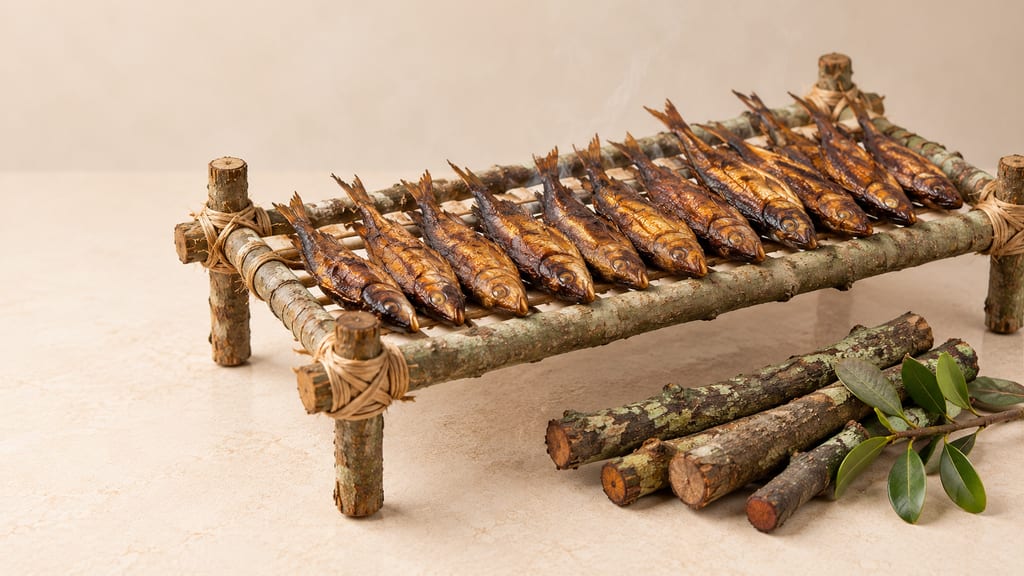
Smoked fish on a pole rack beside a stack of mangrove wood, the fuel at the centre of the Manoka trial.
Three days of smoke, 1.33 cubic metres of wood
To smoke 200 kg of fresh fish in a traditional rack house on Manoka Island, a project trial recorded three days and 1.33 cubic metres of mangrove poles. The same weight of fish went through a brick smoker in two days on 0.88 cubic metres of wood. In a metal smoker insulated with glass wool it took one day and 0.16 cubic metres. All three figures are project-reported.
Those numbers come from a participatory project on Manoka, an island in the Wouri estuary at Douala, Cameroon. They matter because the fuel is mangrove, and the island's smokers burn a lot of it. They are also thin: one trial, no stated temperatures, no fish species. This article sets out what the project reports, where its sources disagree and what they leave unsaid.
An island of fishers and smokers
On Manoka the men fish and the women collect wood and smoke the catch. How many people live there depends on the source. A 2021 Forests News article gives about 4,000 residents, mainly fishers. A 2020 article from the same publication gives about 2,000 and calls Manoka the largest island in the country. The two figures stand side by side here because nothing in either explains the gap.
The women have an association, the Association des femmes fumeuses de Manoka, or AFUMA, which translates as the smoking women of Manoka. Its president is Thérèse Iniyon. The work described below is a project with this association, not a survey of Cameroonian fish smoking.
The wood is palétuvier, the French word for mangrove. The 2021 article describes Cameroon's mangroves as among the most productive in the Gulf of Guinea and puts them at about 200,000 hectares, a figure it attributes to FAO. A 2025 report from Mongabay gives 220,000 hectares for the country and says about 3,000 hectares are lost each year. The 2020 article cites a loss of around 6.2 percent a year in the Douala-Bonabéri area. These are national and city-area figures, and none of them is a Manoka measurement.
The rack house and its appetite for wood
The traditional smoker is a rack of poles inside an airy house. The smoke drifts through the building and is not held in a closed chamber. A 2020 article describes the same arrangement as a banda built from many mangrove branches. The two names describe one idea, a rack under a shelter, and not a sealed oven.
It burns a lot of wood. A study by Cameroon Ecology found that the women of Manoka need more than 750 cubic metres of wood a year to supply the market. That figure turned a question about fish into a question about the forest.
A survey from another part of Cameroon shows how large the difference between smoker designs can be. Dongmo Keumo Jiazet interviewed 243 smokers in Ndian and Fako, in the south-west, and found that 99.6 percent used traditional bandas. A traditional session there handled 528 kg of fish in 53 hours and burned 1,205 kg of wood, about 2.3 kg of wood per kilogram of fish. The one cinderblock smoker in the sample handled 160 kg in 5 hours on 122 kg of wood, about 0.8 kg per kilogram. That second figure rests on a single user, and it comes from a different region, so it only shows the direction of the problem. It is not a prediction for Manoka.
Two new smokers built with the women who use them
The partners were CIFOR, the University of Douala, Cameroon Ecology, the PNDP and AFUMA, with European Union funding named in the 2020 article. The sources disagree on the start. The 2020 article says CIFOR has worked on Manoka since 2018. The 2021 article and the 2023 project summary date the participatory prototype work to 2019. The gap may be the project's start against the start of the prototypes, but the articles do not say so.
The brick smoker was developed with the University of Douala. The 2021 article says it was made from local materials. A 2023 project summary is reported to say that Manoka's sandy soil lacked clay, so bricks were brought from the mainland. The sources do not settle which is right.
The metal smoker came later. It is insulated with glass wool, takes up less space and dries fish in a day. The sources do not name who built it. For neither prototype do they give dimensions, the number of racks, the layout of the firebox or the cost.
What the trial counted
The comparison is one trial on 200 kg of fresh fish. The traditional rack house used 1.33 cubic metres of mangrove poles over three days. The brick smoker used 0.88 cubic metres over two days, a wood reduction of about 33 percent. The metal smoker used 0.16 cubic metres over one day, a reduction of about 88 percent.
The 2021 article calls those percentages energy gains, and the 2023 summary calls them reductions in wood. The volumes support the second reading, so wood is the word used here. The sums are easy to check. The brick smoker took two-thirds of the time and used about two-thirds of the wood. The metal smoker took a third of the time and about an eighth of the wood. The sources do not say why.
They also do not say how any batch was judged finished. No moisture content, temperature or finish test is given. Until that is known, one day in the metal smoker and three days on the rack describe different amounts of work, and perhaps different fish. The trial is a measure of fuel and time, not of what came out.
From a trial to a village plan
The AFUMA president told the project that she was pleased with the new smokers and that wood use had dropped considerably. Abdon Awono, a CIFOR researcher, said pressure on the mangroves would fall markedly and that the time saved could go to other activities.
AFUMA has internal savings that members can use to buy them. The PNDP and CamEco are working to write the improved smokers into Manoka's commune development plan. The 2023 summary adds three other pieces of the project: zoning of the Manoka Community Forest, a Plan Vivo Project Idea Note and a code of conduct for the mangroves. It says lasting results depend on the local council taking the work up and on the capacity to replicate it.
What the smoke leaves behind
Smoking fish over wood is combustion, and combustion makes polycyclic aromatic hydrocarbons, or PAHs, a group of contaminants produced when carbon-based materials burn. No source found for this article measured PAHs or any health outcome on Manoka. None gives a safety endpoint or a storage period for the fish.
The nearest evidence is from Ghana, where Bomfeh and colleagues measured benzo(a)pyrene, a PAH used as a marker, in smoked Sardinella. They expressed risk as a margin of exposure, where a value below 10,000 is a serious public health concern. Fish from traditional ovens scored as low as 1,060, and fish from informal markets 752. Fish from the FAO-Thiaroye improved oven scored about 161,000. That is a different fish, a different country and a different oven, so it says nothing direct about Manoka. It does show that a better smoker can change the exposure a great deal, and that a smoker built to save wood has to be checked for smoke separately.
Smell, colour and a good smoky look do not show that smoked fish is safe. Nor does a short smoking time.
What Manoka shows, and what it does not
The sure part is modest. A women's association on a mangrove island helped test two smokers against its own rack houses, and the project reports that both used far less wood. A wood saving of the size reported for the metal smoker would, if it holds, change how much mangrove a smoking household needs.
The fish end up in many kitchens. A Camerdish recipe for ekok'a makwamba, a Duala cassava dish, lists four smoked fish, bifaga or bilolo. The recipe does not mention Manoka, AFUMA or the racks, so it shows only how smoked fish is used in the region.
The open questions are the ones a cook or a forester would ask first. Which fish were smoked, and with what salt or cure. How hot the fish got, and how the end of the process was judged. Whether the savings hold in repeat trials and in daily use. What the prototypes cost. And what the smoke from each one puts on the fish.
Community
No community contributions have been published for this entry yet.
Share what you made
Sign in to contribute. Published comments and photos are free to read.
Sources
Forests News, CIFOR (Arnauld Ulrich Chyngwa, 26 July 2021)
Cameroun : Deux nouveaux prototypes de fumoirs à poisson permettent de faire des économies sur le bois énergieCited in: Three days of smoke, 1.33 cubic metres of wood; An island of fishers and smokers; The rack house and its appetite for wood; Two new smokers built with the women who use them; What the trial counted; From a trial to a village plan; What Manoka shows, and what it does not
Forests News, CIFOR (Awono and Essamba à Rim, 24 July 2020)
Securing the future of mangroves through sustainable wood fuel managementCited in: An island of fishers and smokers; The rack house and its appetite for wood; Two new smokers built with the women who use them
CIFOR-ICRAF (A. Awono et al., 2023)
Improved practices for forest management and fish smoking in Cameroon's mangrovesCited in: Three days of smoke, 1.33 cubic metres of wood; Two new smokers built with the women who use them; What the trial counted; From a trial to a village plan; What Manoka shows, and what it does not
Mongabay (Chimtom, 11 December 2025)
As fish catches fall and seas rise, Douala's residents join efforts to restore mangrovesCited in: An island of fishers and smokers
Tropical Conservation Science 12(1) (Dongmo Keumo Jiazet, 2020)
Potential Impact of Fish Smoking on Mangrove Resources in Southwest CameroonCited in: The rack house and its appetite for wood
Risk Analysis 42(5): 1007-1022 (Bomfeh et al., 2022)
Risk assessment of PAHs in smoked Sardinella sp. in Ghana: impact of an improved oven on public health protectionCited in: What the smoke leaves behind
Gaps
- No source gives the fish species, cure, smoking temperature, rack or house dimensions, or cost, and the brick origin, population and start year are reported inconsistently.
- No PAH measurements or health data exist in the sources for Manoka itself; the Ghana figures are context from another fish, oven and country.
Updated 2026-10-29