
Smokehouses
Dried, steamed and stored: where smoke fits in Māori fish preservation
Most written accounts of Māori fish preservation describe drying and steaming. Smoke appears with eels, in a whānau learning story and in a Hauraki recipe. Here is what each record shows, and what it leaves out.
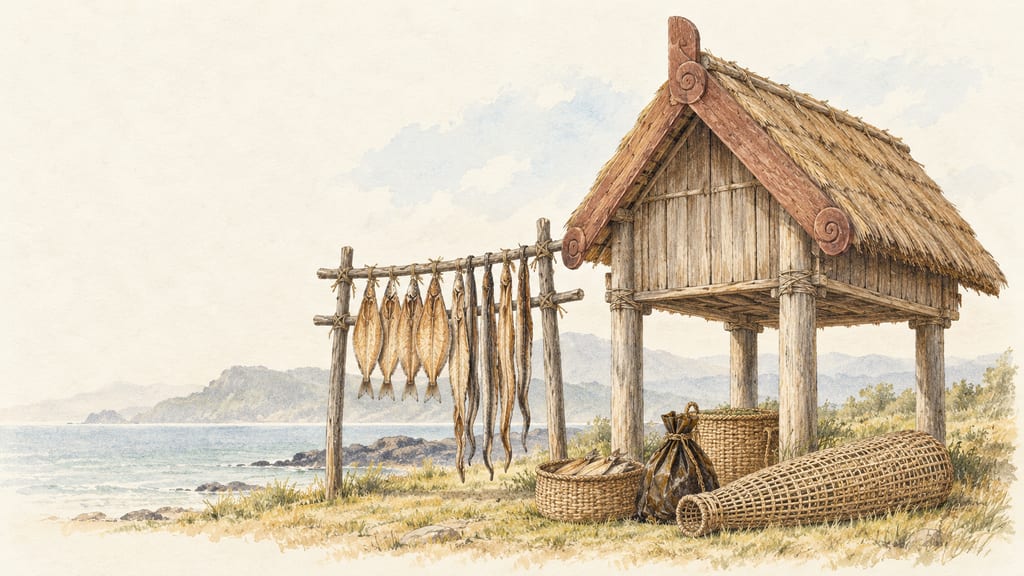
A historical interpretation of a raised storehouse beside a drying frame hung with fish and eels, with woven baskets and bags below.
A storehouse on four posts
In 1840 the artist Charles Heaphy drew a raised, carved building standing on four posts on the north shore of Cook's Strait, at a place he spelled Otumatua. He called it a wata, a provision house. Baskets of food stand on the ground beside it. The drawing was printed in London in 1845. It is a picture of the building, not of the food inside, but it marks where the work of preserving a catch ended: in a store lifted clear of the ground.
Te Ara gives fish the same ending. A catch was steamed, or hung on scaffolds to dry, and then put away in a pātaka, the raised storehouse that kept preserved fish, birds and kao, seed, safe from kiore, the Pacific rat, over the winter. Drying and steaming are the verbs that run through the written record. Smoke turns up less often: in the material on eels, and in two modern sources, one about a smoker built with children and one about a meal that starts from a smoked fish.
This article keeps those three things apart: fish that was dried, fish that was smoked, and fish that was cooked and eaten. The sources do not always do the same, and the difference matters.
Dried or steamed, not smoked
Te Ara gives dated examples of exchange and feasting: Te Rarawa in 1855, Te Waharoa of Ngāti Hauā in 1837 and Pōtatau Te Wherowhero in 1844. The fish and eels in those examples were sun-dried or steamed. None is described as smoked, and the word "preserved" should not be read as "smoked" when it appears beside them.
Te Ara also prints a fishing calendar that runs from March to October, attributed to Tāmati Poata of Ngāti Porou. It is a calendar of fishing, not a smoking season. At a customary event at Kāwhia in the early 2000s, dried flounder and shark-liver sausage were among the foods on offer. Neither is described as smoked.
Racks of sharks 400 metres long
Te Ara describes shark-drying racks as long as 400 metres. The scale of the catch behind them is hard to picture. An observer, R. H. Matthews, recorded in 1855 that about 1,000 people in 50 canoes caught about 7,000 sharks. Te Ara presents that as a single observed event, not a typical year's total.
Some European explorers wrote that a village could be smelt from 13 km away. The sources do not say whether smoke played any part.
Eels: weirs, hīnaki and the question of smoke
A display label in the Rotorua Museum, Te Whare Taonga o Te Arawa, explains the hīnaki, the woven eel trap. Its neck is narrow, so eels can get in but not out. During the eels' seaward migration in autumn, pā tuna, or eel weirs, were built with hīnaki set in the gaps, and the flow of the water drove the eels into them. The label also lists hands, lines, spears and nets as ways of catching eels. All of this is about catching. Preserving comes next.
Eels were often preserved, and for eels the record names smoke. NIWA's account of customary tuna fisheries says they were preserved by smoking or dried in the sun. Te Ara describes partial cooking on a grating of green rods over a fire, and carries a photograph titled "Eels in a smoking chamber".
Two Māori terms appear for the preserved product. Tuna pāwhara is given for dried or smoked eel, and tuna maroke also appears as a name for it. The exact range of each term is worth confirming with Te Ara's full entry, or with the people who use the words.
A 1968 film cited in Te Ara's eel entry describes a different order of work. Eels were cleaned, salted and dried on a whata, a raised structure, and covered with sacking when a storm was coming. In the film's account, smoking was the more modern method.
Keeping eels: baskets, bags and oil
Not every eel was preserved at once. NIWA records that tuna could be kept alive in specially woven containers until they were needed. Preserved eels could be kept for months in bags made from kelp or bark, and sometimes whale oil was poured over the contents to exclude the air.
NIWA also cites a historian who described a feast with 20,000 dried tuna on hand, and gives no method for how they were prepared. These passages name no iwi and no dates, so they describe a range of practice, not a recipe from any one place.
A smoker built with children
The Ministry of Education's Te Whāriki Online has a learning story, "Tamariki learning tikanga", in which Tarquinn takes tamariki fishing. The children help make a smoker and smoke the ika. The story presents this as whānau food preparation, collective learning and tikanga. A companion version lists the steps of the day: gathering kaimoana, building a smoker, karakia to Tangaroa, catching fish and smoking the ika.
The story names no iwi, hapū or place, and says nothing about species, materials, fuel, duration or storage. It is one story, not a national practice and not a plan for a smoker.
Smoked fish at a Hauraki table
Kia Kaha Te Kai, published in 2010 by the health provider Te Korowai Hauora o Hauraki, collects recipes its foreword calls loved by whānau. On page 99 is Smoked Fish in White Sauce. It starts with one whole smoked fish, and the book suggests kahawai.
The cook strips the flesh from the bones and breaks it into bite-sized pieces. Eight cups of low-fat milk and a tablespoon of margarine are heated until near boiling, and the fish goes in to reheat. An extra cup of milk is shaken with half a cup of flour, stirred in, and simmered for one to two minutes. Preparation takes 10 minutes, cooking another 10, and the dish serves 10, depending on the size of the fish.
The fish arrives already smoked. The recipe gives no fish weight, no size standard and no smoking method, and one provider's cookbook cannot stand for Māori cooking everywhere.
What the record supports
Put together, the record is mostly about drying and steaming, with a few notes on eels over a fire and in a smoking chamber, one modern lesson and one modern meal. Nothing here is a method to copy. No source gives a smoking time, a fire temperature, a storage limit or a basis for judging safety.
The practices also belong to particular iwi, hapū and whānau, and most of these records do not say which. A single account from one place should not be read as a description of all Māori. Fuller accounts of how fish and eels were dried, smoked and stored belong to the people who hold that knowledge, to be shared on their terms.
Community
No community contributions have been published for this entry yet.
Share what you made
Sign in to contribute. Published comments and photos are free to read.
Sources
Paul Meredith; Te Ara – The Encyclopedia of New Zealand (22 September 2012)
Te hī ika – Māori fishingCited in: A storehouse on four posts; Dried or steamed, not smoked; What the record supports
New Zealand Ministry of Education; date not stated on page
Tamariki learning tikangaCited in: A smoker built with children; What the record supports
Te Korowai Hauora o Hauraki (2010); front matter credits Gwendoline Welburn
Kia Kaha Te KaiCited in: Smoked fish at a Hauraki table; What the record supports
Te Ara – The Encyclopedia of New Zealand
Traditional cooking and preservingCited in: A storehouse on four posts; Dried or steamed, not smoked
Te Ara – The Encyclopedia of New Zealand
Eels in a smoking chamberCited in: Eels: weirs, hīnaki and the question of smoke
NIWA, Tuna information resource
Customary tuna fisheriesCited in: Eels: weirs, hīnaki and the question of smoke; Keeping eels: baskets, bags and oil; What the record supports
Wikimedia Commons
Eel trap in the Rotorua Museum (display label, Te Whare Taonga o Te Arawa)Cited in: Eels: weirs, hīnaki and the question of smoke
Charles Heaphy, drawn 1840, published London: Smith, Elder, 1845; Wikimedia Commons
Wata or Provision house, at Otumatua on the North shore of Cook's StraitCited in: A storehouse on four posts
Te Ara – The Encyclopedia of New Zealand (Te hopu tuna – eeling)
Cooking, preserving and storing eelsCited in: Eels: weirs, hīnaki and the question of smoke
Gaps
- No source describes how a smoking chamber for fish or eels was built, how long fish was smoked or how long it kept.
- The full wording of Te Ara's eel entry could not be read, and a Smoked Fish entry on Puketeraki Rūnaka's Kaumātua Recipes page was not readable.
- No account authorised by an iwi or hapū was found.
Updated 2026-10-29