
Smokehouses
Thirty-four smokehouses and one dam
Monnickendam had 34 smokehouses in the 1930s. The dam that turned the Zuiderzee fresh took the herring away, and the eel stayed. What the records say about the trade, and where they disagree.
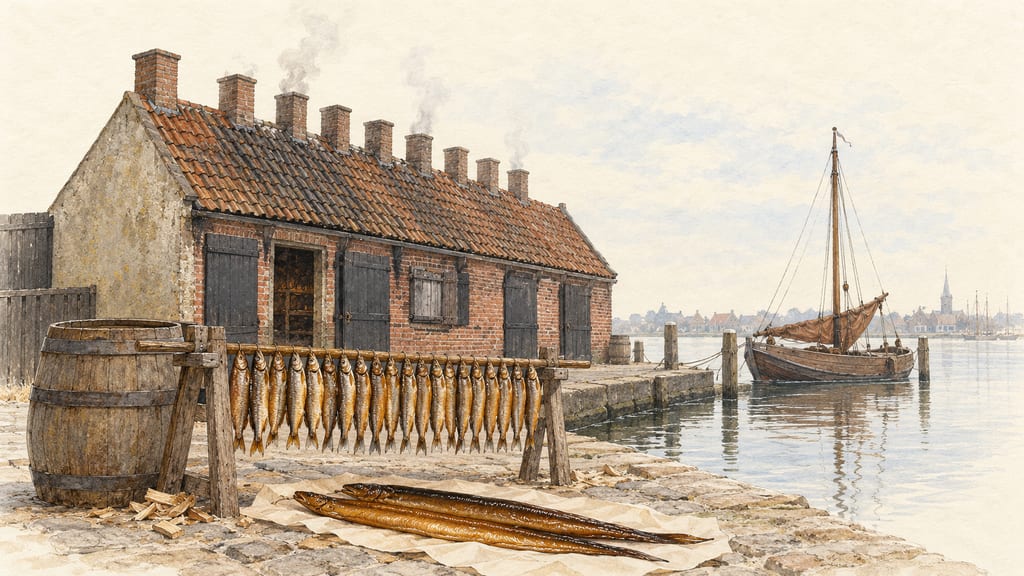
A watercolour illustration of a low brick Zuiderzee smokehouse with a row of chimneys on its roof ridge, drawn after the museum smokehouse from Monnickendam; the scene is an interpretation, not a record of one day.
A smokehouse taken apart in four pieces
In 1974 a herring smokehouse on the harbour quay in Monnickendam had to make way for cold-storage cells. It did not go to the scrapyard. The Zuiderzeemuseum took it apart in four parts and rebuilt it in Enkhuizen, and its catalogue record says what the museum was careful to keep: the heavy layers of soot and the smell.
The record, object MO-3, dates the complex to about 1910 and gives it to the firm Groot, which smoked herring there. Herring is the only fish it names. The smokehouses stood by the harbour, and the record calls them hangs. There were two buildings with nine chimneys between them, and the complex measures 955 cm across and 385 cm deep.
The record also keeps the working method. The herring were cleaned, brined and rinsed, then threaded on spits, twenty herring to a spit and 500 spits to a hang. A fire was lit underneath. Near the end it was smothered with sawdust, which made a thick smoke. The record says that smoke gave the herring its flavour and made it keep longer. It gives no smoking time, no temperature and no storage period, and neither does any other source about Monnickendam.
The herring that became bokking
The Zuiderzee was a salt inlet of the North Sea in North Holland, and its fishers landed smelt, shrimp, anchovy, flounder, eel and herring. Herring caught there was smoked into bokking, and bokking and smoked eel became the two typical Monnickendam delicacies.
The town had a claim on that herring long before smokehouses lined the quay. In 1440, a 1930 history of the Zuiderzee fishery says, Duke Philips gave Monnickendam a privilege: all herring caught in the Zuiderzee by Holland fishers had to be brought there. How far anyone kept to it is hard to trace, and Monnickendam, for centuries the most important landing place, was not the only one. In 1519 Charles V banned the export of pickled Zuiderzee herring. The same history has early herring going mainly to market as bokking, with bokking later shipped to Kleef and Cologne.
How many herring made a hang?
By the 1930s the town had 34 smokehouses. One of them, Oosterbaan, had more than fifty hangers, the people who hung the fish in the smoke. Waterlands Nieuws, a local news site, puts one hang at about 1,500 herring, so three hangs would handle about 4,500 a day. Landings in Monnickendam ran to millions of herring a year.
The museum record does not fit those numbers. Twenty herring on a spit and 500 spits in a hang make 10,000 herring in one hang, nearly seven times the news report's figure. Neither source says why they differ or which smokehouse each describes. Both are given here as they stand.
The same news report introduces Martin Visser, who tells the herring story at the Stegh, the former fish auction, during the town's fish days. The headline attached to the story credits him with 67 years in the smokehouses. The text says only that he worked there for a number of years. The two do not agree and the sources do not settle it.
Inside the Haringburgwal smokehouse
A photograph probably taken in 1945 or 1946, kept by the organisers of the fish days, shows the inside of one working smokehouse on the Haringburgwal. Dirk Oosterbaan, known as Dirk Stut, holds up a spit of salted sprat. He rented the smokehouse from his uncle Johan Oosterbaan. Sprat, locally sardien, was hung on laths, and two spits side by side made a double hang, called a 2 sas.
Steurharing, a herring product, was smoked with the doors open and with little heat. The fires were topped with houtmot, wood pulp, and zwartgoed, old ash and pulp, was laid over them to damp them down. Water and an old clog stood nearby. In the photograph the doors are wooden. By about 1950 almost all of them were iron. Johan Oosterbaan's telephone number was 3. The mayor's was 1.
No record links this smokehouse to the Groot complex in the museum.
What a Vlaardingen smokehouse did with a herring
The sources on Monnickendam give no times or temperatures. A history of the smokehouses of Vlaardingen, a different town, gives some for Vlaardingen, and it quotes an older description of undated origin for part of them. They show what a Dutch smokehouse had to manage, and they are not Monnickendam figures.
Vlaardingen smokers bought herring at the auction and carried it to the smokehouse in barrels by handcart. They soaked it for a few hours to lower the salt, because otherwise the herring would turn white after smoking. Then it was threaded on a spit and hung in the smoke hall. The quoted older description has smoking lasting up to 48 hours at 24 °C. In the history's own account the fire was fed for an hour or so, then the air supply was cut and the temperature held at no more than 85 °C. Hotter, and the bokking "verbroeide", burned.
Smoking time set the product. About three hours gave laffe bokking, which kept poorly. A little longer kept for weeks, and hard bokking, called English bokking, for a few months. These are the trade's own quality descriptions for Vlaardingen, not safety limits for anything made at home. Bokking there was known as the salmon of the poor, because it was cheap and kept when meat was dear.
The smoke downwind
Complaints about the smoke go back to the late seventeenth century. The answer was a rule: smoking was allowed only in the north of Monnickendam, because the wind there is mostly south-westerly and carries the smoke away from the town.
The dam, and the eel that outlasted the herring
The Afsluitdijk was completed in 1932. Within a few years the salt sea behind it had become a freshwater lake. The sea fish disappeared, the Zuiderzee herring with them, and the eel remained. A 1943 Utrecht dissertation on the glass eel run into the IJsselmeer opens by calling the closure the end of a flourishing fishery.
Eel survived because of how it lives. The European freshwater eel, Anguilla anguilla, spawns in the Sargasso Sea. Its larvae are carried to Europe, and the transparent glass eels reach European coasts from October and the Dutch coast in March. They swim back into fresh water and stay for between 5 and 15 years before leaving to spawn.
The dam first stood in their way. The sluices hindered the young eels at the start, and from 1938 the Zuiderzee works service moved them through. In the four years from 1936 to 1939 the runs started between late February and early April and ended between mid-May and early June.
Eel fishing in the IJsselmeer now faces a total ban from September to November, and each year it is reviewed whether the ban is needed.
Eel on the market, and in the Queen's hands
The eel came especially from fishers on Marken, and the smoked fish went to the markets of Purmerend and Amsterdam. A caption from Oneindig Noord-Holland describes a 1974 photograph in which Queen Juliana is offered eel from Monnickendam at a parade for older people at Soestdijk Palace.
Almost all the smokehouses left the town after the dam, apart from two. The sources do not date that count. Gebr. De Boer on the Havenstraat still smokes eel, and a bronze statue, De Palingroker by Rob Cerneus, stands by the harbour bridge. During the fish days there is fish smoking in barrels, net-mending and basket-weaving.
Rokerij De Groot began in Monnickendam in 1929 as a smokehouse, bakery and herring trade, and moved to Volendam in 1989. It shares a name with the firm in the museum record, but the sources do not connect the two. A recent Dutch recipe turns bought smoked eel into a cold roll with cucumber, chives, lemon and basil. It describes serving eel, not smoking it.
What the records leave out
The story of the trade is better documented than its practice. No source gives Monnickendam smoking times, temperatures, salt levels or storage lives for herring or eel, and nothing here is a method to copy. Smell and colour say nothing about whether smoked fish is safe to eat. What the records do establish is who smoked, what they smoked, how many hung in a hang and what the dam did to the catch.
Community
No community contributions have been published for this entry yet.
Share what you made
Sign in to contribute. Published comments and photos are free to read.
Sources
Oneindig Noord-Holland
Haven van Monnickendam: De PalingrokerCited in: The herring that became bokking; The smoke downwind; The dam, and the eel that outlasted the herring; Eel on the market, and in the Queen's hands
Zuiderzeemuseum Enkhuizen (Zuiderzeecollectie)
Visrokerijen, object MO-3Cited in: A smokehouse taken apart in four pieces; How many herring made a hang?; What the records leave out
Waterlands Nieuws (rodi.nl)
Visser was 67 jaar werkzaam in de visrokerij van MonnickendamCited in: How many herring made a hang?; What the records leave out
P. E. van Renesse, De Gids, jaargang 94 (1930), via DBNL
De Zuiderzeevisscherij en haar geschiedenisCited in: The herring that became bokking
G. P. H. van Heusden, dissertation, Rijksuniversiteit Utrecht, 1943
De trek van den glasaal naar het IJsselmeerCited in: The dam, and the eel that outlasted the herring
Jan van Hees, Historisch Jaarboek Vlaardingen 2010, Historische Vereniging Vlaardingen
Zalm der armen. Visrokers in Vlaardingen (1750-1950)Cited in: What a Vlaardingen smokehouse did with a herring
Gaps
- No source gives smoking times, temperatures, salt levels or storage lives for Monnickendam herring or eel.
- The museum record and the local news report disagree on how many herring a hang held, and the sources do not link the museum complex to the Oosterbaan, Haringburgwal or De Groot firms.
- Martin Visser's years in the trade, and the date of the state with only two smokehouses left, are not settled.
Updated 2026-10-29