
Smokehouses
Seven hours instead of fourteen: a Senegalese smoker rebuilt for rohu in Kale
In Myanmar's Kale Township, smoking a batch of rohu took 12–14 hours. A brick kiln from Senegal cut that to 7 and used a third of the fuel. Whether the fish are safer is still unmeasured.
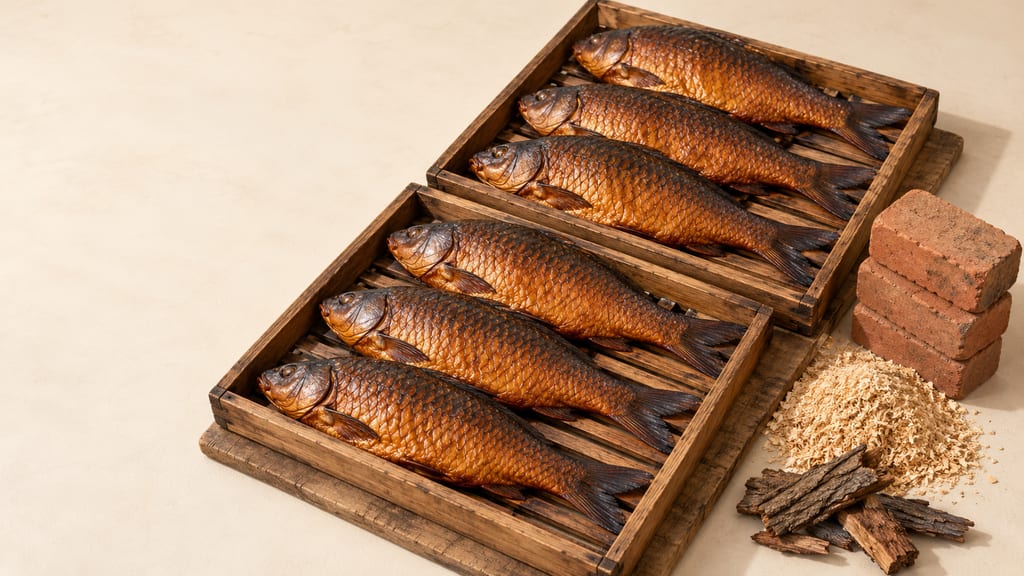
Smoked rohu on wooden trays, with the clay bricks and sawdust that a smoker of this kind is built from and fed with.
A fish trade that burned wood and sawdust
A batch of rohu in a traditional Kale smoker took 12 to 14 hours. In 2021 two processors in this township in Myanmar's Sagaing Region tried a brick kiln designed on another continent, and their batches finished in 7.
Between March and June 2020, a Chinbridge Institute study counted seven rohu smokers in Kale. Together they turned about 1,605 viss (2,616 kg) of fresh rohu a day into 401 viss (654 kg) of smoked fish. A viss is a Burmese unit of weight, 1.63 kg. About 90 percent of the smoked fish went to Mizoram in India, and the trade was worth about MMK 1.75 billion a year.
The same study found the local smokers inefficient in their use of fuel, which was wood and sawdust, and poorly designed for the health and safety of the people working them. It also raised concerns about consistent quality, shelf life and basic food safety and hygiene. The Myanmar Sustainable Aquaculture Programme, MYSAP, then worked with WorldFish to test an alternative.
Two processors, one design from West Africa
The pilot ran with two processors. Daw Vuli, in Pyin Khone Lay village, processed 46,000 viss of fresh rohu, sold 11,500 viss of it smoked and earned MMK 33,682,000 (US$21,556) a year by sending it to Mizoram. U Lala, in Nat Gyi Kone village, sold 8,250 viss smoked and earned MMK 11,920,000 (US$7,629) through a middle trader.
Their new smokers were built to the FAO-Thiaroye Processing Technique, FTT. The consultant, Bandara Rotawewa of Sri Lanka, mentored the builders from a phone over Viber while MYSAP's inland coordinator, Yu Maung, was on site.
FAO began the work behind FTT in 2008 with Senegal's National Training Centre for Fisheries and Aquaculture Technicians, aiming to improve the Chorkor and Banda kilns that West African processors already used. FAO's construction manual says the technique was tested and validated first in Senegal, then used in Togo, Côte d'Ivoire, Tanzania and, recently, Ghana. The manual's cover lists Côte d'Ivoire as the country of first practice, which contradicts its own text and FAO's gender feature, both of which say Senegal.
How an FTT smoker is meant to work
FAO describes FTT as a dual-function oven: a smoker and a mechanical drier that also serves as storage. It has four parts. An ember furnace holds the fire. A fat-collection tray sits above it. An indirect smoke generator makes the smoke away from the fish. A hot-air distributor spreads the heat.
The fat tray is the part that carries into Kale. Holes in it, topped with cone-shaped caps, let heat from the fire reach the fish. Fat dripping from the fish lands on a slightly tilted tray and runs out through pipes at its edge into a container outside. FAO says the fat can be made into soap or used for cooking or frying, and that traditional methods leave more tar particles in the product.
The smoke generator is a metal barrel welded to a tube about 1.5 m long and 30 cm across, with a filter casing. The manual warns that diesel, rubber (tyres included) and waste oil must never go into it, because they can raise polycyclic aromatic hydrocarbon (PAH) levels significantly. PAHs are combustion by-products that regulators limit in smoked fish.
FAO's case for the oven rests on four claims: products that meet food-safety requirements better, smoking and drying in any weather, better control of losses that it says can exceed 50 percent in the rainy season or on cloudy days, and less exposure to smoke and heat for the people who work it. FAO's gender feature lists sun-drying losses of 10–50 percent and puts the equipment cost at US$500 to 800. It also states that after Côte d'Ivoire adopted the ovens, its smoked products met EU PAH rules, following a 2006–2011 EU import ban that it values at about US$1.7 million a year. That is FAO's own account and has not been checked against EU records.
Brick, tin and sawdust: what Kale changed
The Kale smoker is two identical brick compartments, built without the indirect smoke generator. The racks and fat trays keep the original design, and no separate hot-air distributor is described. The walls are two rows of local clay bricks, 9 by 3 by 4.5 inches, on a reinforced concrete floor 3 inches thick. A roof is ideal, so that work can go on in the rain.
The local fuel forced one change. Kale smokers burn a mix of firewood and sawdust, mostly from Dipterocarpus turbinatus. Sawdust would fall through the furnace's wire mesh, so the builders laid a tin sheet on the mesh to hold the embers longer and keep sawdust off the furnace bed.
Two other changes were practical. The metric drawings were converted to imperial units, which people in Myanmar knew better, and extra wooden trays were added for more capacity. A batch holds 49.0–61.3 viss (80–100 kg) of fish.
The furnace box is 16-gauge tin on four caster wheels, with a waist-high 1-inch handle. The text of the guide gives its dimensions as 2 feet 11 inches by 2 feet 2 inches by 10.5 inches, but its drawing appears to give 3 feet 2 inches for the second dimension, and the two do not agree. The fat tray is 14-gauge (2.3 mm) tin with six cone-capped holes on three risers, set just above the furnace. Thinner tin would be damaged by the flames over time.
Materials for the brick kiln cost MMK 228,600 (US$173), with a skilled mason and a helper working four days each. A lid cost MMK 25,000 (US$20), a steel rack MMK 37,300 (US$28), a fat tray MMK 50,150 (US$38) and a furnace MMK 89,650 (US$67). The whole model comes to MMK 941,400 (US$700) in materials, with labour roughly estimated at a third of that (MMK 313,800; US$233). The materials figure sits inside the range FAO quotes for the equipment. The guide's cost table is untidy, though: it lists the fat tray at MMK 37,300 and labels the kiln total as a smoking lid.
What the Kale pilot measured
Smoking time fell from 12–14 hours to 7. WorldFish's blog post gives the traditional figure as an average of 13. The new smoker used one third as much fuelwood and sawdust per weight of smoked fish produced. MYSAP's success story says greenhouse-gas emissions were "less", with no number, while the WorldFish blog calls them "significantly lower", also with no number. Operators were less exposed to smoke, which may reduce the likelihood of respiratory infections.
Finished fish were small, medium or large, and their moisture ran 5.5–14 percent, 15–21 percent and 21–24 percent respectively. Those readings came after oven drying at 100 °C for 7 hours, a laboratory step, not the smoking cycle. Gutting removed 5.5–8.5 percent of the weight, smoking and drying took off a further 66–71 percent, and the yield was 23–29 percent of the fresh fish.
A blind taste test in late April 2021 gave 20 people the traditional and FTT fish and seven attributes to score from 1 to 5. Taste and flavour averaged 3.25 for traditional rohu and 4.45 for FTT rohu. Overall acceptability averaged 3.7 against 4.8. Summed over six attributes, saltiness excluded, the average tester scored 20.6 for the traditional fish and 25.5 for the FTT fish.
The money is less settled. FTT rohu has not yet fetched a higher price. Payback on materials is put at 3 years for Daw Vuli and 4 years for U Lala. The success story prints the materials cost as MMK 1,093,750 and US$7,034, but at its own rate of MMK 1,315 to the dollar the kyat figure is about US$832, so the dollar figure looks like a misprint. Daw Vuli now smokes pork at weekends and sells it profitably, though no figure is given.
The pilot "did not allow a full scale scientific direct comparison". Shelf life, food safety (including PAH levels), nutrition, capacity, profit and marketing are all listed as needing further study. No smoking temperatures were found for the Kale smoker.
Is the fish safer? The Kale data cannot say yet
The WorldFish post is headed "safe, nutritious food", but the Kale pilot reports no PAH, no microbial counts and no shelf-life results. Its evidence is about fuel, time and taste.
The PAH evidence below comes from Ghana and is context only. A 2019 study of an improved FTT kiln, read here as an abstract, found mean benzo[a]pyrene up to 1.8 µg/kg and the PAH4 group up to 7.6 µg/kg. Traditional kilns gave up to 70 and up to 395 µg/kg, and their products exceeded EU limits by up to 33 times. Wood produced more PAH than lit charcoal.
A separate 2021 Ghana study did not test FTT at all. It measured 16 PAHs in mackerel and barracuda, 10 kg of each species per batch, smoked for about 4 hours (2 cooking, 2 drying) in Chorkor, Cabin and Abuesi kilns. In the Chorkor kiln, the type FTT was meant to improve, benzo[a]pyrene reached 15.51 µg/kg and PAH4 121.60. The Cabin kiln reached 3.59 and 67.99. The Abuesi gas smoker reached 0.66 and 2.52. The EU limits are 2 µg/kg for benzo[a]pyrene and 12 for PAH4, so Chorkor fish ran 3 to 8 times above the benzo[a]pyrene limit, depending on the firewood.
Those findings show how far a kiln can move PAH levels. They do not transfer to Kale. The Kale smoker omits the smoke generator, burns sawdust and has no PAH test of its own.
What it means, and what is still unknown
For a rohu smoker, 7 hours of smoking, a third of the fuel and a better-liked product are the measured gains. The evidence is two smokers, one trial and a 20-person taste test. How many smokers of this kind now work in Myanmar, who owns the local design, whether the design lowers PAH and how long its fish keep are all open.
Smell, colour and taste never prove smoked fish is safe.
Community
No community contributions have been published for this entry yet.
Share what you made
Sign in to contribute. Published comments and photos are free to read.
Sources
MYSAP / WorldFish (2021)
Guide for the construction of improved FTT smoker in MyanmarCited in: Two processors, one design from West Africa; Brick, tin and sawdust: what Kale changed
MYSAP (2021)
Success story: Improved fish smoker delivers a superior productCited in: A fish trade that burned wood and sawdust; Two processors, one design from West Africa; What the Kale pilot measured; What it means, and what is still unknown
WorldFish (29 July 2021)
Improved fish smoker delivers safe, nutritious food in MyanmarCited in: What the Kale pilot measured; Is the fish safer? The Kale data cannot say yet; What it means, and what is still unknown
FAO (2015)
The FAO-Thiaroye processing technique: How to construct it and assemble its componentsCited in: Two processors, one design from West Africa; How an FTT smoker is meant to work
FAO Gender Insights
FTT-Thiaroye Ovens: Clearing the air for women fish processors in Côte d'Ivoire, and beyondCited in: Two processors, one design from West Africa; How an FTT smoker is meant to work; Brick, tin and sawdust: what Kale changed
Journal of the Science of Food and Agriculture 99(12), 2019
Reducing polycyclic aromatic hydrocarbon contamination in smoked fish in the Global South: a case study of an improved kiln in GhanaCited in: Is the fish safer? The Kale data cannot say yet
Food Control 121:107576, 2021
Polycyclic aromatic hydrocarbons (PAHs) in fish smoked using traditional and improved kilns: Levels and human health risk implications through dietary exposure in GhanaCited in: Is the fish safer? The Kale data cannot say yet
Gaps
- No PAH, microbial or shelf-life data exist for Kale products, and no smoking temperatures were found. Current adoption in Kale and ownership of the local design are not established.
- The companion operating and testing guide named in the pilot report was not located. The 2019 Ghana kiln figures come from an abstract-level summary without sample sizes.
Updated 2026-10-29