
Smokehouses
Two metres of ground: a Negidal smoking shelter on the Amur
In August 1992 an expedition found Negidal smokehouses still in use on the Lower Amur. One recorded shelter, a shallow fire pit under a bark-covered pole frame, opens onto a salmon people's food and a river short of fish.
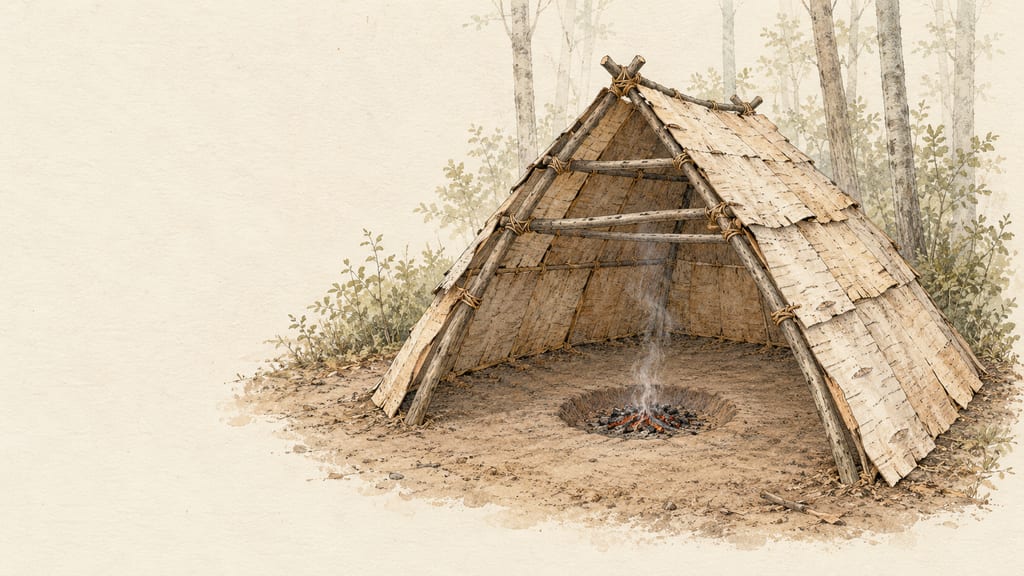
A historical interpretation of the Negidal smoking shelter, built only from the recorded figures: a cleared site of 2 by 2 m, a round pit 70–80 cm across and 15–20 cm deep, and a pitched pole frame up to 1.5 m high with bark on the sides and an open entry.
A clearing, a pit and a pole frame
In August 1992 an expedition on the Lower Amur found smokehouses in use among the Negidal. They called them khenakta (хенакта). People used them to smoke food and to heat-treat clothing against the wet. When D. V. Yanchev, who worked with the expedition, published a study of Negidal buildings in 2010, he wrote that such structures could still be found among the upper and lower Negidal.
Yanchev recorded one shelter in numbers. It stood on a cleared site of 2 by 2 m. It had a round pit 70–80 cm across and 15–20 cm deep, which held the fire and gave the heat and the smoke. Over it rose a pitched frame of poles up to 1.5 m high, with bark covering the sides everywhere except the entry. Several horizontal poles under the roof held the food above the fire.
That is a small building. A pit 15–20 cm deep can hold only a modest fire or a bed of embers, and a frame no taller than 1.5 m keeps the smoke close to whatever hangs in it. The principle is the one behind every smokehouse: a closed space over a fire holds smoke and warmth around the food.
The record stops there. It describes a single shelter, not a standard Negidal plan. It does not say which fish hung in it, whether they were salted first, what wood burned, how hot it ran or how long a load stayed. Whether the measured shelter and the khenakta seen in 1992 are the same type of building is not established either.
A people named for the shore
The Negidal live in the Lower Amur basin of Khabarovsk Krai, along the Amur and its tributary the Amgun. Their name is a Russified form of the Evenki ngeida, which is linked to nge, "low slope, shore, edge", and gida, "side". They call themselves elkan boyonin, "own, local person, native", or amngun beyenin, "Amgun person". Their ethnic formation took place in the Amgun basin between the 17th and 19th centuries.
Clans organised the people. Between 1844 and 1846 the naturalist A. F. Middendorf recorded nine clans in the Amgun, Nimelen and Tugur basins. Ethnographers of the late 1920s counted thirteen. In 1926 the Nyasikhagil had 110 people, the Ayumkan 88, the Chukchagil 48 and the Chomokhogil 29.
The 2020 census counted 483 Negidal, 224 men and 259 women, down from 513 in 2010 and 567 in 2002. They live mainly in the Polina Osipenko, Ulchsky and Nikolayevsky districts. Vladimirovka, with about 200 people in early 2022, is the only compact settlement. Hunting, fishing and gathering are the traditional occupations, and reindeer herding was practised earlier. Fishing leads to the food that a smoking shelter would serve.
Salmon split and hung to dry
Each Negidal family made large reserves of salmon for the winter. The base product was yukola. A salmon was split into two halves with cuts along the back and dried on pole racks, and the work was done in summer. Yukola was not eaten as it came off the rack. It could be soaked and sliced, and the sliced form was called olana.
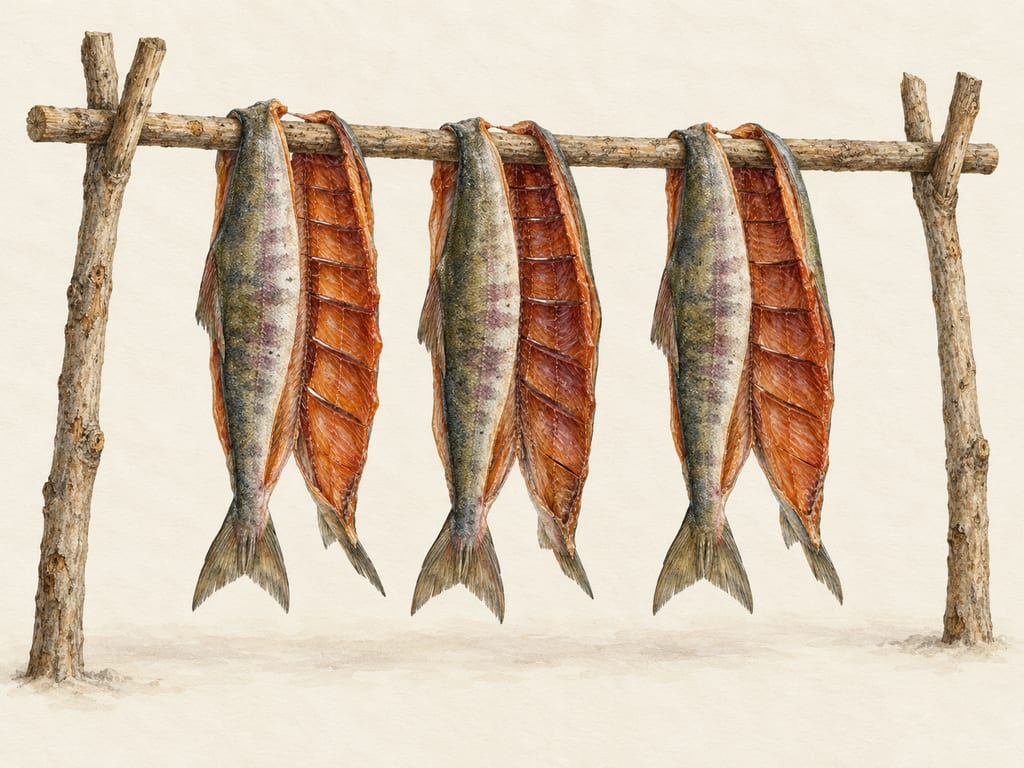
Other products came from the same fish. Yaku was air-cured fish in small pieces, and delna was dried fish heads. Fat was rendered from heads and intestines. Bones left after making yukola were dried, crushed and fed to dogs.
Smoking is named among the Negidal ways of keeping fish, but yukola is described only as rack-dried. No source ties yukola, or any other named food, to the shelter Yanchev measured. Whether Negidal yukola was ever finished in smoke is not recorded.
Fat, berries and a jelly from skin
The rest of the fish table shows how little was wasted. Septulu, or septula, was a fatty mass made by heating fish slowly, without water, for several hours. It is said to have kept for a very long time, though no vessel, temperature or yield is given. Solan was fish mixed with crushed berries. Mosin was a jelly made from fish skin. Stroganina was raw frozen fish. Fish fat and seal fat went into almost every dish.
Meat had its own dishes. Silavun was meat on a skewer, talakha raw meat, and khulte meat dried in small pieces. Hunters ate flour fried in moose fat and mixed with boiling water before they went into the taiga. Kapa, a flatbread, was served with tea.
What the neighbours add
No calendar of the Negidal salmon runs turned up. The nearest figure belongs to a neighbour. For the Nivkh, the main season for catching salmon that run up the rivers was July to early October, and in summer they prepared yukola and hung it on special racks. That is the Nivkh calendar, not the Negidal one.
Fish skin shows up in the neighbours' clothing. Nivkh footwear was made from seal skin or from the skin of fish: autumn chum salmon, lenok, pike and others. The Uilta likely sewed clothing from fish skin, as the Amur peoples did. Museums hold Nivkh-Nanai fish-skin boots and a Hezhe (Nanai) fish-skin jacket from 1875 to 1900. The sources for the Negidal do not show whether they worked skins in the same way.
A river short of fish
The Amur is 4,440 km long, and its salmon spend two to four years at sea before they come back. In 2020 The Moscow Times reported that fish had all but vanished from the river since 2017. Odzyal said that in 2017 barely any fish made it up the river. The ichthyologist Mikhail Skopets put recovery at about a decade. Pozdnyakov said that 90% of the local catch is exported.
The report speaks mostly for the Nanai, whose livelihoods depended on salmon for centuries. Nadezhda Donkan, a 57-year-old Nanai pensioner, said that something must be done or her great-grandchildren would not see salmon at all. No catch or stock numbers came with the report, and none were found for the Negidal.
River fishing among Amur peoples has also been reshaped by commerce. A 2024 paper by S. V. Berezhnitsky of the Kunstkamera examines the zaezdok, a fishing device, and the way fishing companies changed Indigenous river fishing between the 19th and 21st centuries.
What a 2 m shelter can and cannot say
A pit 15–20 cm deep and a frame at most 1.5 m high show how little building it took to hold smoke over a catch. They do not show how much fish there was, which fish went in, or whether a family smoked, dried or salted the winter supply. The food record and the shelter record sit side by side without being joined.
None of this is a method for building a smokehouse or for keeping fish. Smoked and dried fish need tested salt levels, times and temperatures, and smell or colour will not show whether a piece is safe.
Community
No community contributions have been published for this entry yet.
Share what you made
Sign in to contribute. Published comments and photos are free to read.
Sources
D. V. Yanchev, Ойкумена, 2010, no. 3 (14), pp. 92–99
Жилые, промысловые, хозяйственные и ритуальные постройки негидальцев (середина XIX – XX вв.)Cited in: A clearing, a pit and a pole frame; What a 2 m shelter can and cannot say
Arctic Megapedia (30 November 2020)
Традиционная пища негидальцевCited in: Salmon split and hung to dry; Fat, berries and a jelly from skin; What a 2 m shelter can and cannot say
V. N. Davydov, Institute of Ethnology and Anthropology, Atlas of the Indigenous Peoples of the Lower Amur (atlaskmns.ru)
Негидальцы. Общие сведенияCited in: A people named for the shore
Russian Museum of Ethnography, online album (2026)
Нивхи и уйльта: единство людей и природыCited in: What the neighbours add
Evan Gershkovich, The Moscow Times, 8 August 2020
Salmon Is Disappearing From Russia's Amur River. It's Taking Local Tradition With It.Cited in: A river short of fish
S. V. Berezhnitsky, Гуманитарные исследования в Восточной Сибири и на Дальнем Востоке, 2024, no. 2, pp. 64–71
Ихтиофаги Амура и рыбопромышленники: от этнокультурной диффузии до гуманитарной катастрофыCited in: A river short of fish
Rhode Island School of Design Museum of Art, via Wikimedia Commons (CC0)
1875-1900 Hezhe (Nanai) fishskin jacketCited in: What the neighbours add
Musée du quai Branly, via Wikimedia Commons (CC BY 4.0)
Nivkh-Nanai fish skin boots, 71.1966.10.1-2Cited in: What the neighbours add
Gaps
- Only one shelter is measured, and its fish, fuel, salting, smoking time and storage are not recorded.
- No source ties yukola or any other Negidal food to the shelter, and no Negidal salmon-run calendar or Ulch or Nanai smoking method was found.
Updated 2026-10-29