
Smokehouses
Half the firewood: a Senegalese smoker comes to the Sepik
A fish smoker designed in Senegal has come to women's groups in Papua New Guinea's Sepik through the UN's food agency. The public record holds one measured result, a 50 percent cut in fuel, and a good deal of context from Africa and Asia.
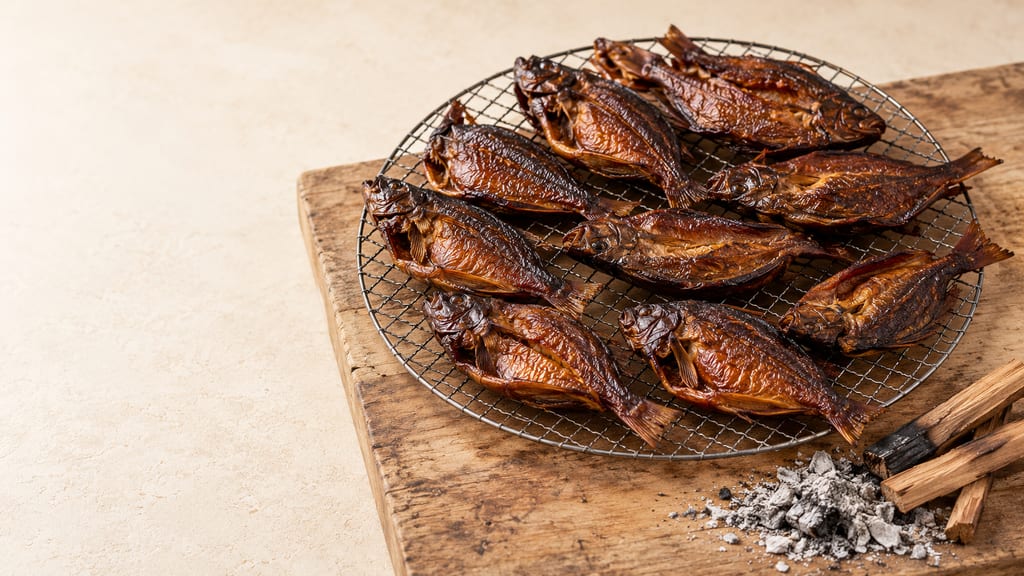
Smoked fish on a round wire smoking rack.
A pilot at Karawap
On 13 April 2023, a pilot of a new fish smoker ran at Karawap, in East Sepik Province, with the Karawambo Women's Business Group. Staff of the EU-funded STREIT PNG programme attended, along with officers from the Provincial Fisheries Office in Wewak and leaders from Angoram, Kararau, Chambri Lake, Rok Island and Wewak. The National, a Papua New Guinea newspaper, put one number on the day: the new smoker used 50 percent less fuelwood than the traditional method.
That figure is close to everything the public record measures about smoking fish in the Sepik. The accounts name no species, smoking time, temperature, capacity or income. What FAO does say is why it wanted a different smoker. Open-fire smoking, in its words, wastes energy, takes a great deal of labour and harms health, and fish is a food people cannot easily do without: around 40 percent of the animal-source food eaten in the low-altitude communities of the Sepik. FAO also cites an electrification rate of 13 percent. That is a national figure, not a count for fishing villages, but it hints at why refrigeration is not the obvious way to keep fish there.
The kiln that started in Senegal
The Karawap smoker belongs to a family of ovens built in West Africa. In 2008 FAO began working with Senegal's National Training Centre for Fisheries and Aquaculture Technicians, known by its initials CNFTPA, to improve two smokers already in use there, the Chorkor and the Banda. The result is called the FAO-Thiaroye Technology, or FTT, and sometimes just Thiaroye.
Two things about it matter in the Sepik. Local metal workers can build it, at an equipment cost FAO gives as US$500–800. And it is aimed at women, who do much of the smoking: FAO says at least 80 percent of the people trained to build, use and maintain FTT are women.
The case for the design rests on smoke. Yvette Diei-Ouadi of FAO has written that traditional smoking releases contaminants called polycyclic aromatic hydrocarbons, or PAHs. They have a price outside the kitchen. From 2006 to 2011 the European Union banned imports of processed fish from Côte d'Ivoire over their levels, a ban FAO values at around US$1.7 million a year.
Testing the smoke in Ghana
Whether the improved oven cuts the contamination is a measurable question, and a team in Ghana measured it. Their 2022 study in Risk Analysis, by Bomfeh and colleagues, took samples of smoked sardinella from traditional ovens, from FTT ovens and from informal markets. It used benzo(a)pyrene, one of the PAHs, as a marker, and calculated a margin of exposure for each group of consumers. A margin below 10,000 marks serious concern.
At the low end of the range, the margin was 1,060 for fish from traditional ovens and 752 for fish from informal markets, both far under that line. For FTT fish the lowest value was about 161,000. The authors call FTT technically viable.
The limits are plain. This is one country and one kind of fish, and it says nothing about the Sepik. But it is the nearest thing to a test of the technology that the record contains.
Seven hours instead of thirteen
A second set of numbers comes from Myanmar, where WorldFish worked with FAO and CNFTPA on an FTT pilot funded by the EU and BMZ. In Kale Township, the processor Daw Vuli smoked rohu, an Indian major carp. Average smoking time fell from 13 hours to 7. The kiln burned one-third of the fuelwood and sawdust of a traditional kiln. In sensory tests the smoked fish scored 4.45 out of 5, against 3.25 for the traditional product.
The builders added a tin sheet to suit the local mix of wood and sawdust, and estimated that fuel savings would repay the cost of construction in three years. WorldFish also claims less worker exposure to smoke and lower greenhouse-gas emissions, without figures. Smoking temperature and the number of fish sampled are not given.
These are Myanmar's results, from a different fish, a different fuel and a different kiln. They show what an FTT can do under one set of conditions. They do not predict the Sepik, where the only measured claim is the 50 percent fuel cut.
From a pilot to a portable drum
The pilot sits inside EU-STREIT PNG, a United Nations joint programme led by FAO with the International Labour Organization, the International Telecommunication Union, the UN Capital Development Fund and the UN Development Programme. FAO calls it the largest grant-funded EU programme in Papua New Guinea and the Pacific. It works in East and West Sepik. On 1 June 2023, FAO announced the Karawap pilot from Wewak. The group was trained in product quality and safety, stock management, record keeping, finance and marketing, and a second FTT site was under construction at Angoram.
FAO's case is that the smoker shortens processing, lightens the work and lowers smoke exposure, and that fish handled this way can travel farther with a longer shelf life and fewer losses after harvest. Those are claims, not measurements. In December 2024 the programme's work reached Mushu Island, in East Sepik, where residents were given fish-processing technology to smoke fish efficiently and sell it.
In August 2026 FAO described a change of design. Monitoring after the first distribution led to a smaller, modified FTT, the Portable Drum Fish Dryer. It keeps the core components and operating principles but changes the shape, structure and scale. In the enclosed drum, FAO says, fish dry faster and more evenly on less firewood, smoke follows a set path, and the enclosure keeps black carbon, the soot of an open fire, off the fish. The drum is light, inexpensive, and built and repaired locally. Thirty fisher groups were chosen with local authorities to receive one, and each got a two-page standard operating procedure and a printed user guide. Vanimo, in West Sepik Province, is among the places named.
What the record does not settle
The story so far is a technology adjusted as it travels: from Senegal to Ghana and Myanmar, to a pilot in Karawap and then to a drum for small catches. What the Sepik has not published is the evidence that would show how well it works. FAO gives no income or sales figures, no batch records, no dimensions for the smoker and no independent test of its performance, food safety or engineering. The 50 percent fuel figure is the only measured Sepik result, and no measurement record is attached to it.
Nothing says the Karawap smoker, the Mushu Island equipment and the 2026 drums are the same device, and the drum is a smaller one. The state of the Karawap and Angoram sites after 2023 is unknown. For anyone thinking of building a smoker, the smell and colour of smoked fish do not show it is safe, and the operating procedure should come from the programme, not from a summary.
Community
No community contributions have been published for this entry yet.
Share what you made
Sign in to contribute. Published comments and photos are free to read.
Sources
FAO, EU-STREIT PNG programme (June 2023)
Women's groups in Papua New Guinea embrace new technology in fish processing introduced by FAOCited in: A pilot at Karawap; From a pilot to a portable drum; What the record does not settle
FAO, EU-STREIT PNG programme (December 2024)
Innovative Fish Processing by the EU-STREIT PNG ProgrammeCited in: From a pilot to a portable drum
FAO, EU-STREIT PNG programme (August 2026)
FAO introduces innovative, safer fish drying drums to support women fish processors in Papua New GuineaCited in: From a pilot to a portable drum; What the record does not settle
FAO, EU-STREIT PNG programme
Fisheries Value ChainCited in: A pilot at Karawap; From a pilot to a portable drum
FAO Gender Insights (December 2016)
FTT-Thiaroye Ovens: Clearing the air for women fish processors in Cote d'Ivoire, and beyondCited in: The kiln that started in Senegal
WorldFish (July 2021)
Improved fish smoker delivers safe, nutritious food in MyanmarCited in: Seven hours instead of thirteen
Risk Analysis 42(5): 1007-1022 (2022)
Risk Assessment of Polycyclic Aromatic Hydrocarbons (PAHs) in Smoked Sardinella sp. in Ghana: Impact of an Improved Oven on Public Health ProtectionCited in: Testing the smoke in Ghana
The National, Papua New Guinea (20 April 2023)
Women business group embraces new technologyCited in: A pilot at Karawap; From a pilot to a portable drum; What the record does not settle
Gaps
- No Sepik account names the fish species, smoking temperature or time, or the smoker's dimensions and capacity.
- The state of the Karawap, Angoram and Mushu Island sites after the first reports, and any independent assessment, are unknown.
- The Ghana study was read as an abstract only, and the Ghana and Myanmar figures do not measure the Sepik.
Updated 2026-10-29