
Smokehouses
A fish called manzi, ten women and a coast that smokes sardinella
Women at Matombi smoke and sell manzi, a fish no source identifies. Pointe-Noire’s drum ovens were described in 1989; the carcinogens in smoke were measured only in Ghana.
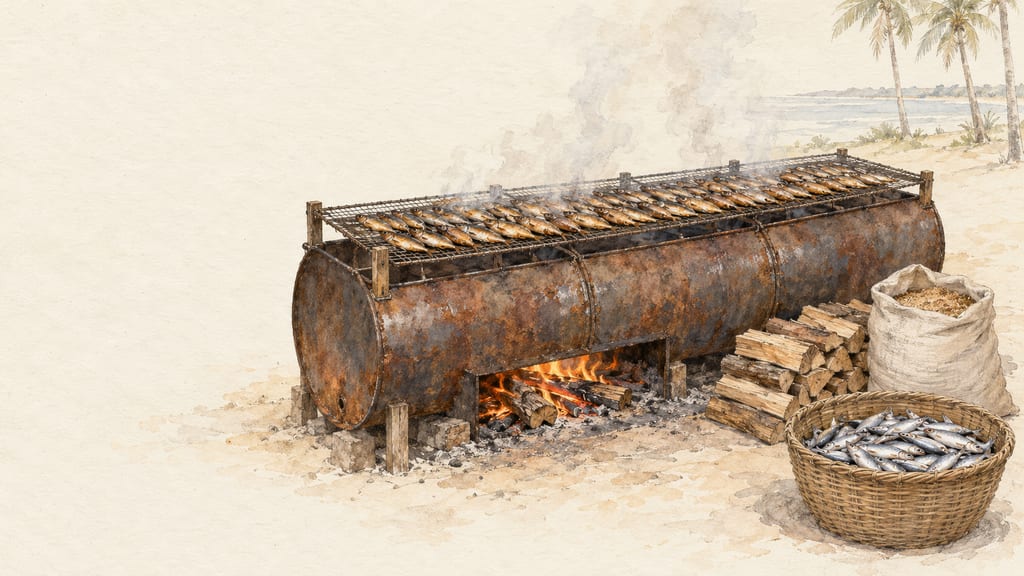
An illustration of a rectangular drum oven of the Pointe-Noire type, with sardinella on a wire-mesh bed above a wood fire.
Ten young mothers and a start-up envelope
On 18 December 2015, about ten young mothers in Matombi, a fishing village in the Kouilou department of the Republic of the Congo, formed a group to smoke fish and sell it. Their leader was Sylvie Makaya.
They had tried before. Attempts in 2003 and 2011 had failed. This time they had two backers: Bongo Makosso, president of the village’s council of elders, and Marie Jeanne Mpassy Steimbault, the departmental director for women’s integration in Kouilou, who gave the group an envelope of start-up money.
The business is easy to state. The women buy manzi, smoke it and resell it in Pointe-Noire and locally. The local press called manzi a Matombi specialty, close to the aron fish but slightly larger.
That is nearly everything written down about it. No account of the group says which species manzi is, what kind of oven the women use, what they burn, how long the fish stays over the fire or how long it keeps. What follows is a story about the coast around Matombi, where smoking has been measured, counted and argued over, and about how little of that can safely be borrowed for one village.
A fish with a local name
A 1989 thesis on smoked fish in Congo, from the EISMV school in Dakar, never uses the word manzi. It does place ethmalose, also called bonga, on the stretch of coast between Loango Bay and the Kouilou River. A smokehouse research compilation equates the local “manzis” with ethmalose, but it leans on a 1981 ORSTOM study that has not been retrieved. Ethmalose is a candidate for manzi, not an identification.
The thesis does describe the village the fish comes through. In its count, 79 percent of Matombi’s people were fishermen. By landed volume, Matombi took 6 percent of the catch and Pointe-Noire took 84 percent. In coastal villages such as Matombi, Focko and Fouta, the processors were often fishermen’s wives or close relatives, and the fish came from the husband’s catch.
The 2015 group is described differently: its members buy manzi rather than smoke a husband’s landings. Who sells it to them is not recorded.
Beninese women and the smoking beaches of Pointe-Noire
Pointe-Noire’s smoking trade has a documented origin. From the 1950s a Beninese artisanal fishery grew up there, and Beninese women processed and smoked the fish that Beninese crews landed. Adrien’s 1981 ORSTOM study, as Gobert cites it, put their capacity at about 90 tonnes of sardinella a day and counted nearly 2,000 smoking units. On 9 February 1984, 22.5 tonnes of sardinella landed on one beach went only to Beninese women. That was about 40 percent of the day’s production.
Jul-Larsen’s 1994 portrait of the Popo community, the Beninese migrants, is closer to a street view. It had fewer than 500 fishermen and nearly as many adult women, living in two villages on the northern beach of Pointe-Noire. The great majority of the women smoked and sold fish. Each had her own ovens and young Congolese workers. She sold in the town’s markets or sent fish by rail on the CFCO line, as far as Brazzaville.
Adrien put a woman’s normal retail limit at about 100 kg of fresh fish a day. Under the wholesale system of the 1980s, a woman with hired labour could smoke 1 to 1.5 tonnes a day.
The two counts do not agree. Gobert’s nearly 2,000 smoking units and Jul-Larsen’s 243 women both come from Adrien’s 1981 study. They may count different things, and nothing available settles it. They are shown here side by side, not merged.
These sources describe mainly Popo women in Pointe-Noire. They do not show that the women of Matombi used the same ovens or methods.
Oil drums, iron rods and a smoking bed
Everything in this section and the next describes Pointe-Noire, as the 1989 thesis summarises Adrien’s 1981 study. It is not a description of Matombi.
The ovens were built from 200-litre drums about 0.90 m high. The upper third of the drum wall was pierced to hold iron rods, and the rods set how far the fish sat from the fire. There were three forms. The rectangular oven used three drums and measured 1.70 m long and 0.90 m wide and high, with base openings 0.50 by 0.25 m. The cylindrical oven used two drums, measured 1.10 m across and had two base openings. The large cylindrical oven used three drums and measured 1.50 m across; only Beninese women used it, to store smoked fish. A drum oven lasted one to three years.
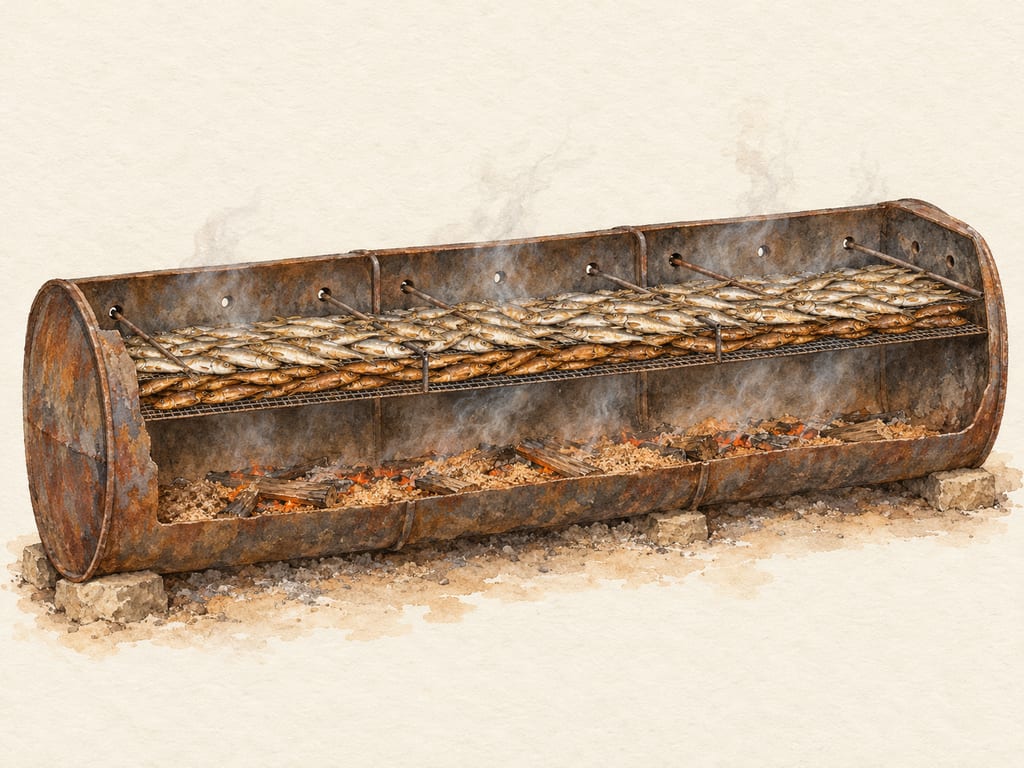
The fish lay on a smoking bed 3 m long and 1 m wide, set on four to six wooden legs. Coastal villages used wire mesh for the bed and the Cuvette region used bamboo. The bed could stand in a separate smoking hut (a case-fumoir) or in the open.
Fuel was wood and sawdust. In Pointe-Noire women bought both; in coastal villages and the Cuvette they gathered wood. On the first day a processor used 20 kg of wood and 5 kg of sawdust per oven, or about 100 kg of wood and 20 kg of sawdust for four ovens. The second day took 10 kg of wood.
A five-hour fire
For sea fish, the cycle began with a low fire kept going for 30 to 60 minutes while the fish was turned. Then the fire was raised. At its peak the lower layer of fish sat in 150 °C heat, sometimes 200 °C, and the upper layer in 80–90 °C. Heat at that level cooks the fish as well as dries it.
Fish oil slowed the fire, and temperatures fell to 110 °C on the lower layer and 70 °C on the upper. The processor added wood, or damp sawdust if the smoke was thin. The main phase lasted two hours and the whole cycle about five. The fish was sold after three to four days.
Most of the smoke went unused. Diers, cited in the thesis, found that only 3 to 10 percent of the smoke produced was used.
The thesis judged that smoking did not directly destroy forest. A 2022 news feature argues the opposite for Congo-Brazzaville, reporting rising firewood demand and mangrove loss driven by smoked-fish demand. It gives no volumes of smoking wood and, in the text read, does not mention Pointe-Noire or Kouilou. The two were written 33 years apart and speak at different scales.
Two beds for one village
The only dimensions attached to Matombi do not match the Pointe-Noire summary. A research compilation drawing on the 1981 study describes Matombi’s case-fumoirs as separate, bamboo-walled and metal-roofed, with smoking beds about 4 m long and 1 m wide, 70 cm off the ground, holding about 150 kg of fresh fish. The thesis gives a bed 3 m by 1 m, with wire mesh in coastal villages and bamboo only in the Cuvette.
Both trace back to the same 1981 study, and neither could be checked against it. Neither comes with a field measurement a reader can inspect. No source gives a Matombi smoking schedule, a fuel record or a storage period, and none says whether manzi are smoked in drum ovens at all.
Metal barrels, gas trials and sore backs
The Japanese agency JICA ran a pilot project called PECHVAL on the artisanal fisheries of Pointe-Noire from September 2012 to March 2016. By then the metal-barrel kiln, introduced by the Beninese community more than 40 years earlier, was the standard way to smoke sardinella. Fish sat on six levels between a metal grid and wooden sticks, were smoked three to four hours over logs, then cooled and smoked again in a second kiln.
The processors told the project what the work cost them: headaches, eye and breathing problems from smoke, burns from the iron bars and back strain.
The project tested four fuels and kilns for four hours each: gas (butane), a Tebiyama (Seiro) kiln, the conventional kiln and charcoal. The return rate of finished product showed no significant difference. Each had a drawback. Gas needs a cylinder bought up front, firewood is heavy and has to be transported, and charcoal needs a support grid.
One sardinella session shows how the money runs. Fresh fish cost FCFA 76,138 and sales brought in FCFA 107,711. Operating profit was FCFA 18,702, and the logs cost FCFA 3,827.
It contains no measurement of smoke compounds in the fish.
What the smoke leaves in the fish
Wood smoke deposits polycyclic aromatic hydrocarbons (PAH) on the food it touches. One of them, benzo(a)pyrene, which the 1989 thesis calls 3,4-benzopyrene, is a carcinogen. The thesis cites Diers for the comparison that a kilogram of French smoked trout holds the 3,4-benzopyrene of 250 cigarettes. It estimates 0.5 to 60 ppb (µg/kg) of benzo(a)pyrene in smoked fish and states a maximum of 1 ppb, without saying where the limit comes from. It also cites Irish fishermen who ate a lot of smoked fish and are said to have had three to four times the gastrointestinal cancer rate of people living inland.
The thesis did not measure PAH. It tested aflatoxins and microbes, and it recommended measuring PAH. No PAH measurement for Congolese smoked fish was found in the sources read. Soaking the fish for 30 to 60 minutes and removing the skin “might help”, the thesis suggests; this was never tested.
The measured evidence comes from Ghana. In a 2021 study of mackerel and barracuda smoked in Chorkor, Cabin and Abuesi gas kilns, benzo(a)pyrene peaked at 3.59 µg/kg in the Cabin kiln and 15.51 µg/kg in the Chorkor. The sum of four PAH compounds, PAH4, peaked at 67.99 and 121.60 µg/kg. The EU limits are 2 µg/kg for benzo(a)pyrene and 12 µg/kg for PAH4, and the study put Chorkor benzo(a)pyrene at 3 to 8 times the maximum.
A 2022 risk assessment sampled Sardinella, which Pointe-Noire’s processors also smoke, from Chorkor ovens, metal-drum ovens and an improved FTT oven, along with fish from informal markets. It reports a margin of exposure for benzo(a)pyrene as low as 1,060 for the traditional ovens and 752 for market fish, against about 161,000 for the FTT. A margin below 10,000 counts as a serious concern. The authors call the FTT technically viable.
FAO also states, on its own authority, that the European Union banned processed fish from Côte d’Ivoire from 2006 to 2011 over PAH, at a cost of about US$1.7 million a year. It adds that at least 80 percent of the people trained on the FTT oven are women.
None of this was measured on Congolese fish, ovens or fuel. Ghana’s kilns, species and fuel differ from Pointe-Noire’s drums. The figures show what the same kind of smoking can do; they do not state what is in fish from Pointe-Noire or Matombi.
What remains unwritten
Women in a fishing village organised, received an envelope of start-up money and began selling smoked fish in a city whose smoking trade was shaped by Beninese migrants and has been counted, measured and studied since the 1950s. For Matombi, the species, the oven, the fuel, the schedule and the storage time are not in the record. The drums and temperatures belong to Pointe-Noire in the 1980s, as summarised in a 1989 thesis from a study that could not be retrieved.
Anyone who wants to smoke fish should use a process validated for that fish, not infer one from these accounts. Smell and colour do not show that smoked fish is safe, and the 3 to 4 days before sale in the thesis is not a storage limit.
Community
No community contributions have been published for this entry yet.
Share what you made
Sign in to contribute. Published comments and photos are free to read.
Sources
ADIAC / Les Dépêches de Brazzaville, 19 December 2015
Kouilou : les femmes vendeuses de poissons manzi à Matombi regroupées en associationCited in: Ten young mothers and a start-up envelope; A fish with a local name; What remains unwritten
Bertrand Gobert, Revue des Travaux de l’Institut des Pêches maritimes 47(3–4): 251–260, 1983
Quelques aspects socio-économiques de la pêcherie artisanale béninoise de Pointe-Noire (Congo)Cited in: Beninese women and the smoking beaches of Pointe-Noire
Eyolf Jul-Larsen, FAO/IDAF Technical Report 56, Cotonou, June 1994
Migrant Fishermen in Pointe-Noire (Congo): Continuity and Continuous ChangeCited in: Beninese women and the smoking beaches of Pointe-Noire
Opoye-Itoua, thesis no. 18, EISMV Dakar, defended 7 July 1989
Production et consommation du poisson fumé (Mokalu) au Congo : aspects techniques, hygiéniques et socio-économiquesCited in: A fish with a local name; Oil drums, iron rods and a smoking bed; A five-hour fire; Two beds for one village; What the smoke leaves in the fish; What remains unwritten
JICA
PECHVAL pilot project, Pointe-Noire artisanal fisheries (September 2012 to March 2016)Cited in: Metal barrels, gas trials and sore backs; What remains unwritten
Asamoah, Nunoo, Addo, Nyarko and Hyldig, Food Control 121, 107576, 2021
Polycyclic aromatic hydrocarbons (PAHs) in fish smoked using traditional and improved kilnsCited in: What the smoke leaves in the fish
Bomfeh and colleagues, Risk Analysis 42(5): 1007–1022, 2022
Risk assessment of PAHs in smoked Sardinella sp. in Ghana: impact of an improved oven on public health protectionCited in: What the smoke leaves in the fish
FAO Gender Insights, 2016
FTT-Thiaroye Ovens: Clearing the air for women fish processors in Côte d’Ivoire, and beyondCited in: What the smoke leaves in the fish
Matteo Cavallito, Resoil Foundation, 20 May 2022
Smoked fish is driving deforestation up in Congo-BrazzavilleCited in: A five-hour fire
Gaps
- The species and preparation of manzi, and any Matombi smoking schedule, fuel record or storage period, need a local-language or fisheries source; the 1981 ORSTOM study by Adrien behind the oven figures was not retrieved.
- No PAH measurement for Congolese smoked fish was found; the figures come from Ghana.
- The JICA report’s publication date is not established, and a 2019 survey of smoked-fish vendors in Brazzaville markets was not read.
Updated 2026-10-29