
Starter cultures
Ogiri: one name, many seeds, and no single starter
Nigerian cooks turn melon, pumpkin and other hard seeds into a pungent seasoning paste. Lab studies show that each seed ferments differently, and none of them hands a home cook a recipe.
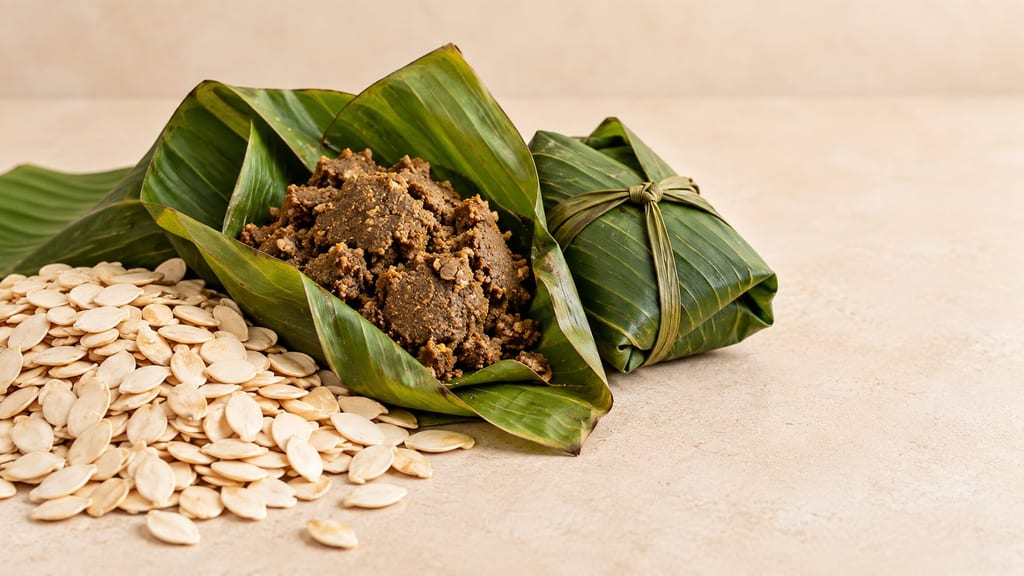
Shelled melon seeds beside a parcel of finished ogiri, a pale-to-brown paste wrapped in leaves; the same name covers products made from many different seeds.
A hard seed becomes a pungent paste
Ogiri starts as a hard, oily seed and ends as a pungent paste that seasons soups and other dishes. In the best-documented batch, the seeds were boiled until they softened, wrapped in leaves and left to ferment for four days. Photographs of Igbo ogiri show the finished product in the leaves it was packaged with.
What happens inside the wrapping is not souring in the way a yoghurt or a sauerkraut sours. Enzymes and microbes cut the seed's proteins into free amino acids, which is where the savoury intensity comes from. In the one melon-seed batch where the acidity was tracked, the pH rose from 5.5 at the start to 6.4 in the finished ogiri. Such products are grouped as alkaline seed fermentations.
The name covers a family, not a single recipe. Studies of products called ogiri describe melon (egusi), castor, fluted-pumpkin and watermelon seeds, and a related product, ogiri-okpei, is made from the seeds of Prosopis africana. These are chemically different materials. Moving a method from one to another is a guess, and for one of them it is a dangerous guess, as a later section explains.
Ninety-six hours in plantain leaves
The most detailed account of what the seeds do comes from a laboratory batch of Prosopis africana. Researchers bought about 800 g of seeds at a market in Awka, in Anambra State, and boiled them for 8 hours to soften the seed coat. They recovered about 350 g of cotyledons, the seed's inner halves, and heated those for another 15 minutes. They then packed the cotyledons into a plastic basket lined and covered with wilted plantain leaves and left it for 96 hours at room temperature, with about an hour of sun each day. No numeric temperature or humidity was recorded.
Samples were taken at 0, 24, 48, 72 and 96 hours. Soluble sugars and free amino acids climbed, peaked at 72 hours and then declined. The enzymes that make them, amylase (starch to sugar) and protease (protein to amino acids), rose in step. Lipase, which splits the seed's oil, was strong and kept increasing throughout.
The amino acid figures show the pattern. Lysine started at 6.60 g per 16 g of nitrogen, reached 13.43 at 72 hours and fell back to 9.60 at 96 hours. Cystine went from 13.60 to a peak of 20.23 at 72 hours and then to 10.29. Glutamine peaked earlier, at 23.78 after 24 hours, from a start of 19.25, and ended at 13.18. In this batch a longer ferment was not a richer one.
Those numbers belong to one substrate, one basket and one 96-hour run in a laboratory. They show what changes in a Prosopis africana ferment. They do not give a time for melon seed, or for any other seed under any other roof.
Who is doing the work
A 2018 study at the Federal University of Agriculture, Abeokuta, sampled bacteria through the processing of iru and ogiri and sorted 227 isolates into 12 operational taxonomic units, groups of bacteria whose 16S rRNA gene sequences match at 97% or better. The isolates spanned three phyla and nine genera, including Bacillus, Enterococcus, Lysinibacillus and Staphylococcus. Bacillus-related groups dominated the processing stages of both condiments.
The two condiments behaved differently. No single group persisted through every stage of iru, the locust-bean relative of ogiri. In ogiri, one group, mostly related to Bacillus safensis, dominated the stages, and the authors suggest it may have starter potential. The Enterococcus and Lysinibacillus isolates looked like candidate starters for iru. The same samples also held bacteria that are presumptive food-borne pathogens at some stages, possibly from poor hygiene.
That is the contrast with natto, where one defined strain of Bacillus does the job. Ogiri is a community that changes with the seed and the stage, and finding a bacterium in it does not make that bacterium a starter or its presence a sign of safety.
An older study of melon and groundnut seed, in different ratios over 96 hours, found Bacillus and Acinetobacter bacteria alongside yeasts and the moulds Rhizopus and Mucor. Only the total carbohydrate fell substantially. In samples with 50–100% melon the pH fell as fermentation went on, the opposite of the rise in the melon batch above, and when up to 75% of the seed was groundnut the bacteria did most of the work. Dried products fortified with salt, ascorbic acid and flour rated acceptable in sensory tests.
The seed decides
A 2021 comparison from Michael Okpara University of Agriculture, Umudike, made ogiri from melon, castor oil, pumpkin and watermelon seeds by solid-state fermentation and measured what each contained. Melon ogiri had the most crude fat and watermelon ogiri the most crude protein. The published figures, 44.86 for fat and 38.32 for protein, appear without units.
A thesis from the same university fermented castor seed for 96 hours, sampling every 24 hours. Its inoculum was a portion of locally made ogiri, with no species named. That is a retained piece of earlier product, a community passed forward, and not a defined isolate. It does not show that cooks keep such portions as a general practice, and it is not advice on how to store or reuse one.
The differences are not cosmetic. Seeds differ in fat, protein and carbohydrate, and the microbes and the chemistry change with them. That is why a method for one seed does not transfer to another.
The castor seed problem
Raw castor seed is toxic. Castor ogiri appears in the research, and it was made and tested in the studies above, but nothing in the work behind this story gives cooking conditions for whole castor seed, or shows that boiling or fermenting makes it safe to eat. The thesis summary does not discuss the toxicity at all.
This story therefore gives no castor method and makes no claim that cooking makes the seed safe. Castor ogiri is documented here so that the name is recognised, not as something to try at home.
What the market product can carry
A doctoral thesis from Nnamdi Azikiwe University by Dimejesi, with Odibo, collected ogiri made from creeping melon, climbing melon, castor oil and fluted-pumpkin seeds in several Nigerian states and examined the microbiology and chemistry at each production stage. It identified six critical control points: sorting, washing, fermentation, mixing, boiling and packaging.
The samples held 17 bacterial and 5 fungal genera. Pathogens named in the work include Staphylococcus aureus, Enterobacter cloacae, Klebsiella pneumoniae and Aspergillus fumigatus. Aflatoxin, a mould toxin, was higher in locally produced samples than in laboratory ones. Heavy metals were higher in raw seed than in fermented samples. Raw and processed castor seed carried between 9.5 × 10⁴ and 5.2 × 10⁸ colony-forming units per gram.
The thesis advises boiling ogiri before it goes into cold ready-to-eat dishes such as abacha. That is a hazard-control recommendation from one study of market samples, not a validated household process.
What a reader can take from this
Ogiri is a family of related seed ferments, each tied to its seed, in which Bacillus is common and the exact community changes with the substrate. The figures in the studies describe their own batches: the 96-hour plantain-leaf batch of Prosopis africana, the melon-and-groundnut ratios, the castor-seed thesis, and each one stops there.
A strong smell is part of the product, so it says nothing about whether a batch is safe, and a long fermentation is not a safer one.
Still unknown: a validated household starter, a process endpoint, a storage time, and a qualified safety assessment. Local names and seed choices across communities have not been mapped in the sources reviewed, and fluted-pumpkin ogiri has no method source here.
Community
No community contributions have been published for this entry yet.
Share what you made
Sign in to contribute. Published comments and photos are free to read.
Sources
Letters in Applied Microbiology; PubMed
Phylogenetic analyses of bacteria associated with the processing of iru and ogiri condimentsCited in: Who is doing the work; What a reader can take from this
Journal of Industrial Microbiology and Biotechnology; Oxford Academic
Biochemical changes during the fermentation of Prosopis africana seeds for ogiri-okpei productionCited in: A hard seed becomes a pungent paste; Ninety-six hours in plantain leaves; What a reader can take from this
Nigerian Journal of Microbiology
Production and Proximate Composition of Ogiri Condiments from Different SubstratesCited in: A hard seed becomes a pungent paste; Who is doing the work; The seed decides; The castor seed problem; What a reader can take from this
Plant Foods for Human Nutrition; PubMed
Improvement of the traditional method of ogiri production and identification of the micro-organisms associated with the fermentation processCited in: Who is doing the work; What a reader can take from this
Michael Okpara University of Agriculture thesis repository
Effect Of Fermentation On The Quality Parameters And Nutrient Changes Of Condiment (Ogiri) Made From Castor Oil Seeds (Ricinus Communis)Cited in: The seed decides; The castor seed problem; What a reader can take from this
Nnamdi Azikiwe University dissertation repository
Aspects of Microbiology, Physicochemical and Hazard Analysis Critical Control Points of 'Ogiri' Production from Different SubstratesCited in: What the market product can carry; What a reader can take from this
Gaps
- No validated household starter, process endpoint, storage time or qualified safety assessment appears in the studies reviewed.
- Whole castor seed has no documented cooking conditions, so no castor method is given.
- Local names and seed choices across communities, and a method for fluted-pumpkin ogiri, are not covered.
Updated 2026-10-29