
Starter cultures
A pinch of yeast, a night of waiting: how biga and the sponge work
Biga and the bread sponge both ferment flour with baker's yeast before the dough is mixed, but yeast dose, water and time vary widely and the names fix none of them. What a long preferment changes, and what is unknown.
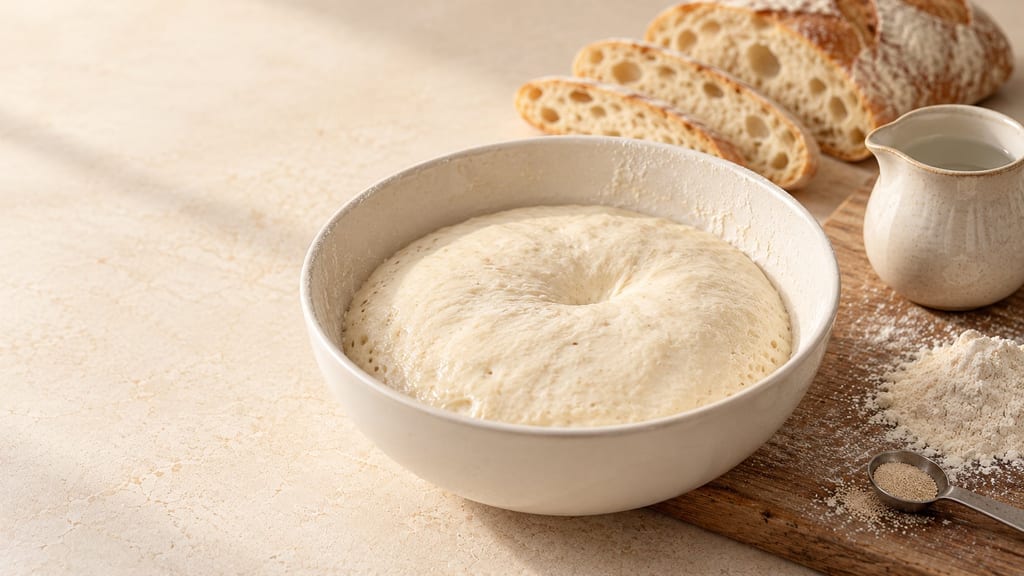
A bowl of biga after a night on the counter, with the surface domed and just beginning to settle in the middle.
Twelve hours in a bowl
The yeast for a ciabatta loaf goes in twice, and the first dose is tiny. King Arthur Baking's sandwich ciabatta starts the evening before, with 300 g of bread flour, 227 g of cool water and an eighth of a teaspoon of instant yeast. The baker stirs them together, covers the bowl and leaves it at room temperature for 12 to 16 hours. There is no salt in the bowl and no kneading.
That bowl is a biga. If an eighth of a teaspoon weighs roughly 0.4 g, the yeast is about 0.13 percent of the flour's weight, close to the 0.1 percent that King Arthur's professional reference gives as the least a biga can contain. The recipe gives it 12 to 16 hours to work, and what that wait does to the dough is the subject of this story.
The loaf itself is young and has a date. Ciabatta was created in 1982 by a baker in Adria, in the Veneto, who was worried about the popularity of sandwiches made on baguettes imported from France, and by 1999 it had been licensed to bakers in 11 countries. The method behind it cannot be dated the same way. Where and when bakers first fermented flour, water and a little yeast ahead of the dough is not established by anything found for this story.
The second day
The next day the biga goes into a stand mixer with another 227 g of lukewarm water, 320 g of flour, a full teaspoon of instant yeast and 12 g of table salt. It mixes for about 2 minutes on low and 3 to 4 minutes on medium. The recipe warns that kneading this dough by hand is difficult, because it is so wet and sticky.
The dough rises for an hour, is deflated and rises for another hour. It is then pressed into a rectangle about 7 by 14 inches, cut into two strips and proofed for 1½ to 2 hours. The oven is heated to 260 °C with a rack in the middle and lowered to 218 °C. They bake for 15 minutes covered and 10 to 15 minutes uncovered, then cool in the switched-off oven with the door open about 2 inches.
The overnight biga is wetter than the usual description of a biga. Its 227 g of water against 300 g of flour works out to about 76 percent hydration, which is where the confusion about the name begins.
A word that covers a range
Biga is an Italian word that, in professional baking, can mean preferment in general: any mix of flour, water and yeast fermented before the final dough is made. Used that way, a biga can be quite stiff or loose enough to sit at 100 percent hydration, and it holds no salt. The American Society of Baking's glossary defines it the same way, as a preferment of flour, water and yeast only, and calls it stiff, with 50 to 60 percent water. A baker's article on preferments in True Loaf magazine puts a stiff biga at perhaps 50 to 60 percent hydration too.
So the ciabatta biga, at 76 percent, sits outside the 50 to 60 percent range both of those give. The word does not fix a formula. A biga is also not automatically a starter in the sourdough sense, one that is kept and fed from bake to bake. Its yeast is commercial and added on purpose, and the flour and water are what the yeast works on.
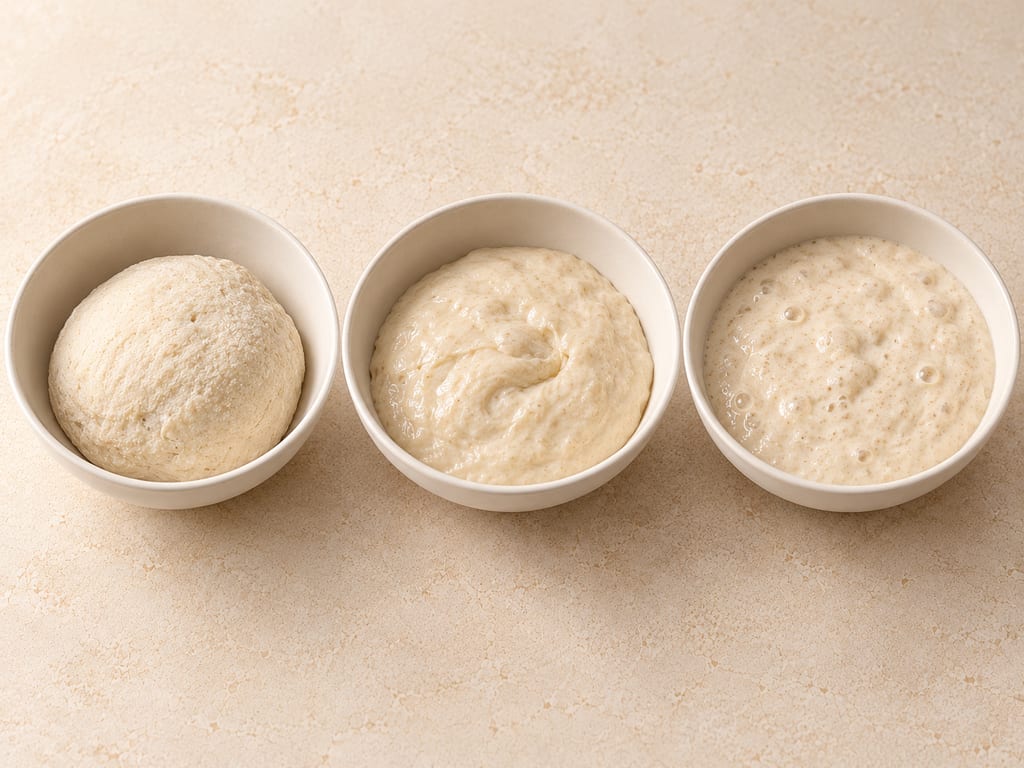
The glossary's timetable is 8 to 16 hours at 15–20 °C, which brackets the ciabatta recipe's 12 to 16 hours at room temperature. The biga is mixed only until it is even, because full gluten development is not the goal. It is ready when the surface is domed and has just begun to sink in the middle.
What the wait changes
Bakers argue that a night of fermentation changes three things: flavour, acidity and the way the gluten behaves. Flavour is the easiest to claim and the hardest to measure. King Arthur's bakers say a biga gives the finished loaf floral, aromatic qualities, where a loose poolish tastes nutty and makes the dough more extensible. The American Society of Baking says only that the long fermentation gives bread a complex flavour.
Acidity and gluten are better documented. As a preferment ferments, its pH falls. Chris Young, writing in True Loaf in 2015, says the rising acid strengthens the gluten in a stiff preferment. A literature review in Balestra's 2009 doctoral thesis at the University of Bologna says something different about a soft sponge: it loses much of its elasticity as it ferments, while the low pH leaves the gluten network more extensible. The two statements describe different preferments, one stiff and one soft, and neither study measured them against each other.
Balestra also measured what a long preferment does to dough. The thesis sponge held 50 percent water and 1 percent yeast and fermented for 24 hours at 18 °C before it went into the dough. On a Kieffer rig, which records how hard a strip of dough pulls back when stretched, dough made with it resisted extension with 29.37 g straight after mixing and 31.78 g an hour later. Dough made without a preferment resisted with 18.26 g and 24.38 g. A poolish built on sourdough and fermented for 4 hours at 24 °C fell between, at 25.49 g and 29.34 g. A 2015 paper by Balestra, Pinnavaia and Romani compared a 60 percent biga-type preferment with a sourdough-based poolish-type and found the biga-type dough the stiffest of the three. Its poolish was made with sourdough, not commercial yeast.
Stiffness is a trade. The American Society of Baking warns that a biga can hurt extensibility when the flour is already strong, and suggests more water or an autolyse, a rest of flour and water before mixing, to restore the balance.
The sponge, built for speed
King Arthur sorts the sponge with the liquid yeasted preferments and the biga with the stiff ones, and its own article admits that the four categories are a simplification of the many terms bakers use. The sponge is better understood as a stage in a two-step method: part of the flour ferments with the yeast first, and the rest of the flour and the other ingredients join it later.
The Canadian Grain Commission publishes a sponge-and-dough method that shows how far a sponge can sit from a biga. In it, 70 percent of the flour is mixed with yeast for 2.5 minutes and fermented for 4.5 hours in a fermentation cabinet. The yeast is 2.2 percent of the total flour weight, which is about 3.1 percent of the flour in the sponge. The ciabatta biga carries about 0.13 percent. That is more than 20 times as much yeast in a sponge that ferments for roughly a third of the time.
The remaining 30 percent of the flour goes into the dough stage, with salt at 1.9 percent of the total flour, sugar at 5.0, shortening at 3.0, dry milk at 2.0 and small amounts of malt and other improvers. The dough rests 15 minutes at 30 °C, is punched, rested again, sheeted, moulded and proofed at 38 °C and 85 percent humidity until it reaches a target height of 120 mm, in about 70 minutes. The loaf bakes in a rotary oven at 216 °C for 30 minutes and has its volume measured an hour later. The commission describes the formula as typical of plant bakeries in Japan, and its apparatus belongs to a laboratory. None of it carries over to a kitchen by simple scaling.
The word sponge stretches as far as biga does. In Balestra's thesis a sponge is a 24-hour preferment at 50 percent hydration, fermented at 18 °C with 1 percent yeast, closer in time to a biga than to the commission's four-and-a-half-hour version.
Read the numbers, not the name
Two bowls labelled biga can hold a stiff 50 percent mix and a sticky 76 percent mix. Two labelled sponge can ferment for 4.5 or 24 hours. A recipe that names its preferment tells the baker less than one that gives its flour, water, yeast, temperature and time, and those are the figures to compare when one recipe's biga is swapped for another's.
Safety needs the same discipline. A biga or a sponge is raw dough. The Centers for Disease Control and Prevention warn that tasting or eating raw dough or batter can cause food poisoning, because germs in flour die only when the flour is baked or cooked. They advise washing hands with soap and water after handling flour, and washing bowls, utensils and counters with hot, soapy water. The 12 to 16 hours in the ciabatta recipe is a quality window for the loaf, not a safety deadline, and a biga that is domed, bubbly and pleasant to smell has not been shown to be safe by any of those signs. No safe holding time, failure rule or acidity limit for a biga or a sponge was found.
Community
No community contributions have been published for this entry yet.
Share what you made
Sign in to contribute. Published comments and photos are free to read.
Sources
King Arthur Baking, professional reference
PrefermentCited in: Twelve hours in a bowl; A word that covers a range; Read the numbers, not the name
King Arthur Baking
Baking with prefermentsCited in: A word that covers a range; What the wait changes; The sponge, built for speed
King Arthur Baking
Sandwich CiabattaCited in: Twelve hours in a bowl; The second day; A word that covers a range
Canadian Grain Commission
Method for Sponge and Dough Bread BakingCited in: The sponge, built for speed; Read the numbers, not the name
Centers for Disease Control and Prevention
Raw Flour and DoughCited in: Read the numbers, not the name
Journal of Texture Studies 46(4): 262-271
Evaluation of the Effects of Different Fermentation Methods on Dough Characteristics (Balestra, Pinnavaia and Romani, 2015)Cited in: What the wait changes
Doctoral thesis, Università di Bologna
Empirical and fundamental mechanical tests in the evaluation of dough and bread rheological properties (Balestra, 2009)Cited in: What the wait changes; The sponge, built for speed
American Society of Baking, ASB BAKERpedia
BigaCited in: A word that covers a range; What the wait changes
Sustain, Real Bread Campaign
Afore ye dough (Chris Young, True Loaf, issue 22, January 2015)Cited in: A word that covers a range; What the wait changes
Gaps
- No dated history of the word biga or of the sponge method was found.
- No measured enzyme activity in a biga or sponge is established.
- No source gives a safe holding time, failure rule or acidity limit, and no home sponge formula with verified figures was found.
Updated 2026-10-29