
Starter cultures
Barm: the bread leaven that was never one thing
British cooks called their leaven barm, but it was bitter brewery froth in one kitchen, a malt-and-flour ferment in a Scottish bakery and a washed paste in a Victorian larder. A history of one word and three leavens.
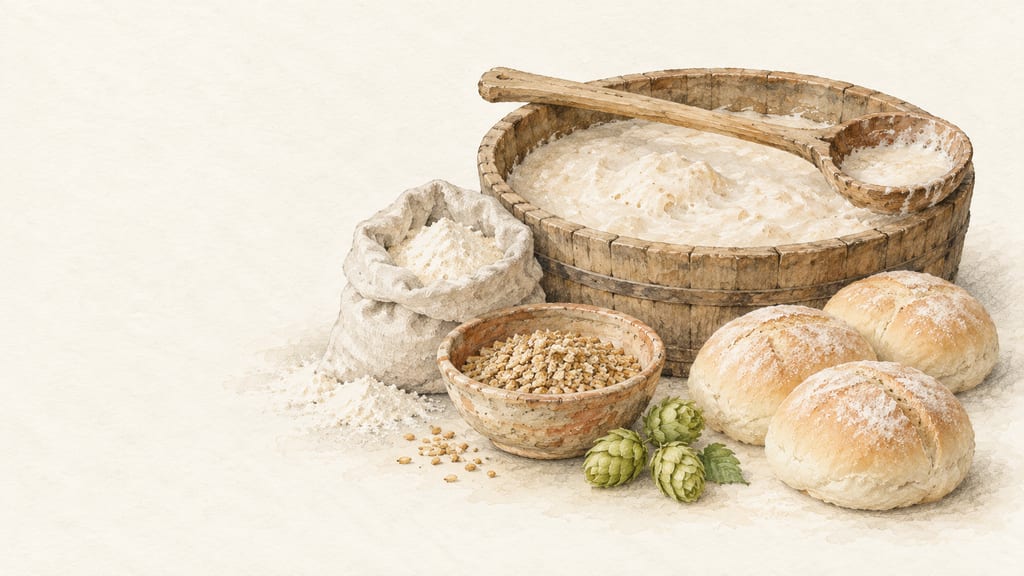
An illustration of the materials of a baker's barm: a tub of foaming malt-and-flour ferment, flour, crushed malt, hops and the soft rolls it was meant to raise.
A bitter pint from the brewery
A Victorian cook who bought yeast from a public brewery could not use it as it came. Miss Acton warned that it was “often so extremely bitter that it can only be rendered fit for use by frequent washings,” and she meant frequent: daily in winter, and “both night and morning in very hot weather.” Porter yeast, she added, was “dark-coloured and bitter.”
Washing was only the first step. Her household bread took a pint of yeast as it came from the brewery, or half that quantity once it had been washed and made solid, stirred into four quarts or more of lukewarm milk. Mrs Beeton printed the recipe in 1861 as “Miss Acton’s Recipe” and gave the yeast in two forms: 1 large tablespoonful of solid brewer’s yeast, or nearly 1 oz of fresh German yeast. To make brewer’s yeast solid, she mixed it with plenty of cold water and let it stand and settle for a day and night.
The froth that cooks were washing is what English and Scots speakers called barm. But the word covered more than the brewery’s leftovers, and the longer the records are read, the less it looks like the name of a single culture.
A word older than the recipes
The 1900 bulletin from the United States Department of Agriculture, written by Helen W. Atwater, defines barm as “literally the foamy scum which rises to the top when beer, etc., is made.” It adds that this “may be used to ferment other materials” and that “a variety of yeast is also called barm.” The Yorkshire Historical Dictionary, which follows the word through regional records, defines it as a regional word for yeast, “the froth of fermenting malt liquors which can be used as a leavening agent.” Even Pasteur’s description of alcoholic fermentation, as a 1911 bread-making textbook quotes it, uses both names for one thing: “the ferment which bears the name of yeast or barm.”
The word is old. The dictionary’s earliest dated form, barmeclathes, carries the date 1299 as a headword, with no quotation attached. The earliest quotation is from 1304, in the accounts of Bolton Priory: “in grossa tela pro barmeclathes et pro caseo,” coarse cloth for barmeclathes and for cheese. The dictionary glosses a barm-cloth, after the lexicographer Halliwell, as an apron. So the entry shows the word in a priory’s ledger by 1304 and says nothing about bread.
For the seventeenth century there is more. A 2022 University of Stirling MPhil thesis on brewing and baking in Scotland describes ale barm, “skimming it off the top of actively fermenting ale,” as “the prescribed method for housewives in the 17th century.” The thesis cites Markham’s English Housewife, published in 1615, for the amount: three pints of barm to a bushel of meal.
Malt, flour and a tub in Scotland
Scotland’s bakers did not skim anything. The leaven the 1900 bulletin calls Scotch barm was grown from malt and flour, and the bulletin credits the method to William Jago’s 1895 book on breadmaking. Atwater describes the household version in a few steps. Crush malt in warm water. Pour hops and boiling water over it and add flour. Let it stand while the diastase, the malt enzyme that turns starch into sugar, does its work. Drain the sweet liquid and mix it with more flour and water.
What turns this sweet paste into a leaven is yeast, and the bulletin names two ways it arrives. It can be “acquired spontaneously by exposure to the air,” which gives virgin barm. Or it can be added “in the form of a little old barm or ordinary yeast,” which gives Parisian barm. The mixture then ferments for “several days” before it goes into a sponge, the first, wet stage of a dough. “A strong flour is needed.” The bulletin gives no quantities.
The trade version survives in more detail. The 1911 edition of Jago and Jago’s Technology of Bread-Making prints the working formulae of Thoms of Alyth. His virgin barm used 10 lb of malt, 3 oz of hops, about 40 lb of flour, 2–3 oz of salt, 8–12 oz of sugar and about 18 gallons of boiling water. After about 21 hours the tub was cooled to 29 °C, and salt, sugar and a handful of flour went in. It was kept at 27–29 °C for about 24 hours more.
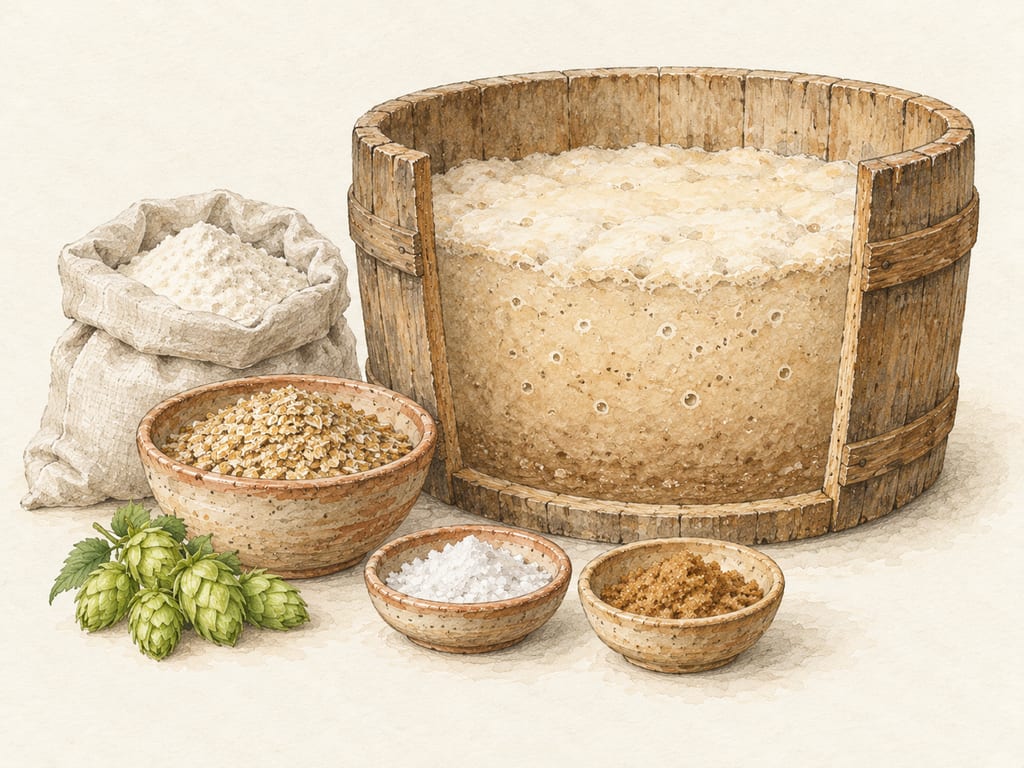
Parisian barm skipped the wait for wild yeast. It took, in winter, about 1½ gallons of old barm or virgin barm, and in summer about 1 gallon. The formula gives 29–30 °C for winter and 24–26 °C for summer, and the finished barm is then kept between 16–21 °C. Thoms also dates the method’s arrival: Parisian barm “was introduced from Paris to Scotland, by a baker near Edinburgh, about the year 1865.”
A second set of Scottish formulae came in October 1910 from J. Meikle, a baker and teacher of bread-making classes in Belfast, who had collected data from a number of bakers in Scotland. In that addendum, Parisian barm is “the barm of Scotland to-day.” These are trade formulae for tubs of many gallons, not a kitchen recipe, and the sources give no safety limits for them.
Sour, or just Scottish
The two Scottish accounts that survive disagree about the taste. Atwater doubted that the method’s economy was real. Leaving the mixture open to the air, she wrote, lets in “a great many bacteria which start lactic and other fermentations and give a decidedly sour taste to the bread.”
Thoms, writing from inside the trade, called the same thing normal. Scotch flour barms, he said, “always show a certain proportion of lactic ferments as a normal constituent.” Lactic ferments are the bacteria that make lactic acid, the sourness of yoghurt. He thought the acidity was beneficial: Scotch bread has “a slight acid flavour,” closer to the flavour of buttermilk, and it was “not quoted as a fault.”
Another contributor to the same book, J. Montgomerie of Glasgow, shows how a baker could steer the result with temperature. His Parisian barm was made from a scald, a mixture of flour and hot water, cooled to 27–32 °C in winter and 16–21 °C in summer, with 1 pint of barm kept for every 4 pints of scald. Elsewhere the book warns that bakers’ barms and patent yeasts left to ferment on their own “are then found to contain a large proportion of foreign organisms, principally the lactic ferment,” and “often produce sour bread.” Whether sourness was a defect or a house style depended on who was talking and which loaf they sold.
Why bakers left the brewery
Brewer’s yeast had its own troubles in hot weather. “Particularly in summer time brewer’s yeast is found to be very unreliable and uncertain in its actions,” Jago and Jago write, and bakers “find themselves compelled to resort to compressed yeast during the hot summer months.” They also note that a potato ferment was “almost invariably” used together with brewers’ yeast. A Liverpool firm’s report on the trade found “a few small bakers who still use brewers’ barm,” and set them against “practically all distillers’ yeast.”
Modern genetics offers a way to think about why a baker’s needs differ from a brewer’s. In a 2020 review in Frontiers in Genetics, Lahue and colleagues at North Carolina State University find that the family trees of beer and bread strains of Saccharomyces cerevisiae “are largely separated.” There are exceptions: African maize-dough strains group with African beer strains, and a subset of beer strains falls among mixed-origin bakery strains. But no sequenced bakery strains cluster with ale strains. Baking strains tend to carry more chromosome sets (higher ploidy), make “significantly more CO2, both in rate and in total,” and start fermenting after a shorter lag than non-bakery strains.
None of this shows that Victorian brewery yeast was a poor leaven, and it cannot say what a given tub of barm held. It does mean that a shared species name does not make brewer’s and baker’s yeast the same.
What the old barm can and cannot teach a kitchen
Modern brewers keep yeast on the principle bakers once used for barm: collect it from a finished batch and pitch it into the next. Brewing suppliers write careful guides to it. White Labs suggests cold storage at 2–4 °C for 1–3 days, and advises checking viability before repitching yeast stored for 7–14 days or more. Lallemand advises storing it in the fridge for up to a week, limiting repitches to fewer than 5 and thoroughly cleaning and sanitizing the harvesting spoon and receiving container. That is commercial brewing advice, written for beer. It is not a bread method, and no source read links it to the barm of the old bakeries.
The old texts do not fill the gap. The 1900 bulletin outlines a sponge but gives no quantities, controlled temperatures, readiness test or storage limit. Jago and Jago’s tub formulae are for trade batches. Nothing in them says how long a barm can be kept, how acidic it may become or how many yeast cells it holds.
Raw dough has its own hazards. The Centers for Disease Control and Prevention says not to eat raw dough or batter, notes that “germs are killed only when flour is baked or cooked,” and advises following recipe or package directions for cooking or baking and washing hands and surfaces after handling flour or raw eggs. That applies to any dough, whatever leavens it, and it is not a validation of any barm-specific handling. Appearance, smell and bubbles do not show that a barm is safe.
So barm is best read as a historical word for several leavens: froth skimmed from ale, a malt-and-flour ferment grown in a Scottish tub, and the washed, solid paste in Miss Acton’s larder. What remains unknown is what organisms any of them held, and whether anyone now uses brewery foam as a bread leaven with a documented method.
Community
No community contributions have been published for this entry yet.
Share what you made
Sign in to contribute. Published comments and photos are free to read.
Sources
U.S. Department of Agriculture
Bread and the Principles of Bread Making (Farmers' Bulletin No. 112), by Helen W. AtwaterCited in: A word older than the recipes; Malt, flour and a tub in Scotland; Sour, or just Scottish; What the old barm can and cannot teach a kitchen
Internet Archive
The Technology of Bread-Making (1911 edition), by William Jago and William C. JagoCited in: A word older than the recipes; Malt, flour and a tub in Scotland; Sour, or just Scottish; Why bakers left the brewery
Project Gutenberg
Modern Cookery for Private Families, by Eliza ActonCited in: A bitter pint from the brewery
Project Gutenberg
The Book of Household Management, by Isabella BeetonCited in: A bitter pint from the brewery
University of Stirling
Brewing and Baking in Scotland, 1406–1513Cited in: A word older than the recipes
Frontiers in Genetics
History and Domestication of Saccharomyces cerevisiae in Bread BakingCited in: Why bakers left the brewery
Lallemand Brewing
5 Tips For Repitching Yeast at HomeCited in: What the old barm can and cannot teach a kitchen
White Labs
Yeast Harvesting & Repitching GuideCited in: What the old barm can and cannot teach a kitchen
Centers for Disease Control and Prevention
Raw Flour and DoughCited in: What the old barm can and cannot teach a kitchen
Gaps
- No source read gives a safe storage period, acidity limit or cell count for any barm, and none gives a home-scale method.
- Markham’s 1615 book and Jago’s 1895 original were not read; the Markham figure is as the Stirling thesis cites it, and the Acton quotations come from an 1882 edition.
- The date at which Scottish writers first sorted barm into virgin, compound and Parisian types is unsettled: the Stirling thesis gives a different date from the 1865 given for Parisian barm in the 1911 text.
Updated 2026-10-29