
Starter cultures
A cup of raisins, a jar of bubbles: what fruit yeast water does for bread
Raisins soaked in water bubble within days, and an 1898 cookbook already called the result a yeast. Lab tests show what the jar adds to bread, what it does not, and what nobody has validated.
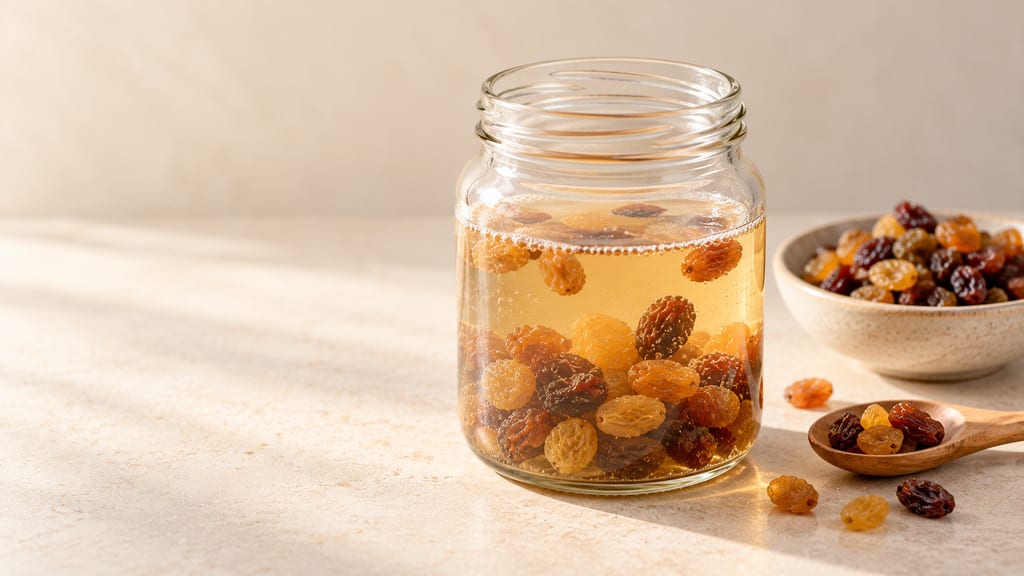
Raisins soaking in water: the bubbles and floating fruit that home recipes treat as a sign the liquid is working.
Bubbles on top of the water
A cookbook printed in Battle Creek, Michigan, in 1898 has a recipe it calls Fruit Yeast. Wash a cup of raisins, put them in warm water, and keep them somewhere warm for two or three days, until the bubbles on top of the water show that fermentation has started.
That is only the first stage. Four good-sized potatoes are mashed with a teaspoon of salt and a tablespoon of sugar, and enough raisin water is stirred in to bring the mixture to the right consistency, about two cupfuls. The potato mixture is left to rise until light, packed into clean glass cans and kept in a cool place. The book says the yeast is better a few days old. It gives no storage limit and no other test of readiness than the bubbles in the raisin water and the rise of the mash.
The raisins in this recipe are not the leaven. They produce a bubbling liquid, and the liquid starts a potato yeast. The recipe ends with the jars and does not describe feeding the mixture again the way a sourdough is fed.
One name, several recipes
The same jar of raisins now travels under names such as yeast water, raisin water starter and fruit yeast, and the names cover procedures that have little in common beyond the fruit. Lambert's potato yeast is one. A strained raisin liquid that starts a flour-and-water culture is another: a food blog uses it that way, and so does a 2025 laboratory study of sourdough. A raisin syrup, sweetened and kept for several days before it goes into dough, is a third. A fourth puts fruit straight into the dough: a 2016 study of durum wheat sourdough added macerated pears and the water they had soaked in.
Each of these sets fruit and flour in a different relationship. In some the fruit liquid is a stepping stone that is discarded once flour takes over. In others the fruit or its liquid stays in the dough from the first mix. No account describes one fixed culture, one list of organisms or one way of keeping the culture going. The name alone does not say what will rise, and it does not promise that the liquid keeps.
Two modern recipes, in numbers
The recipe most home bakers meet first is a blog post published in 2020. It uses 100 g of raisins, 250 g of filtered water and 4 g of white sugar in a clear jar with an airtight lid, kept in a warm place out of direct sunlight. The jar is shaken for 3 seconds morning and evening for 3 to 8 days, or until the raisins float. The blogger writes that it usually takes 3 to 4 days. The yield is 414 g of liquid, which the blogger says keeps in the fridge for up to two months. All of these numbers describe one cook's kitchen. No test has validated them as limits.
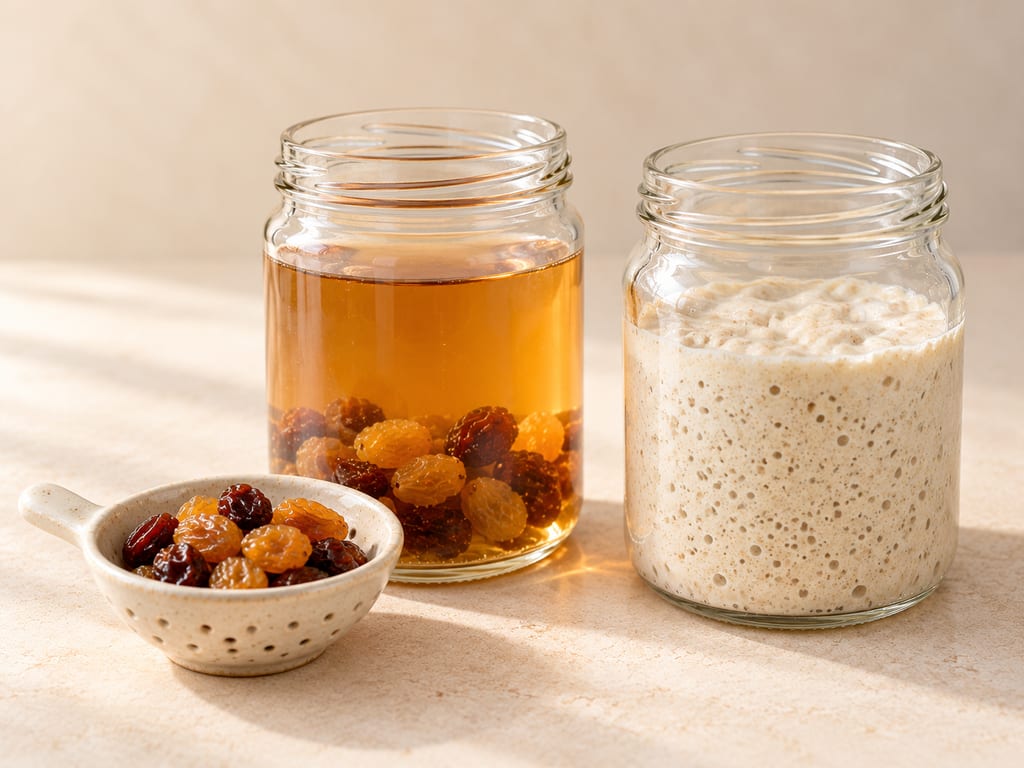
A Japanese team published a more elaborate version in 2026. Its raisin syrup starter is 100% water, 50% raisins, 25% caster sugar and 2% malt syrup, stirred daily at 27 °C for 4–5 days and judged complete when all the raisins float and bubbles show. In the dough, 240 g of starter went into 3000 g of flour with 63% water. The bulk fermentation took 8 hours at 27 °C, the final proof 70 minutes at 32 °C, and the loaves baked for 27 minutes starting at 250 °C. A control bread used 0.5% commercial yeast.
Two things stand out. Both recipes add sugar on top of the fruit, and both use floating raisins as the signal that the liquid is ready. That cue comes from the home recipes. The team did not test it as a safety marker. The study followed the bread's aroma compounds and how the loaves aged. It did not identify or count the microbes in the starter, so it does not say which organisms leavened the dough.
Fast bubbles are not fast bread
Myhrvold and Migoya tested fruit in starters for Modernist Bread, and their results cut against the story the jar tells. Infused water worked only if the fruit had first soaked in water for 3 days. Levains made with raisin water bubbled sooner and higher than the others, but they were never ready in less than 5 days. Fast bubbling, they write, does not make a fast levain, and all their test levains reached maturity at about the same time. When they made the raisin water with raisins that had been sterilised under pressure, they concluded that it is not the microbes that make the levain rise.
A 2025 laboratory test in Italy points the same way. The team soaked 50 g of dried Corinthian raisins in 250 mL of tap water for 48 hours at room temperature and discarded the fruit. The soaking water went into a first dough with 150 g of bread wheat flour, while a control dough used 150 mL of tap water. Both were left for 24 hours at 25 °C and then refreshed daily at 25 °C for at least nine days: 50 g of dough with 50 g of flour and 50 mL of water each time.
The doughs acidified at about the same pace, 0.22 pH units a day with raisin water and 0.24 in the control. By day 10 the control had about one log cycle more yeast, roughly ten times as many cells. The raisin water gave the dough no extra yeast; it ended with fewer cells than the control. This was a single raisin variety, one flour and one laboratory, and it ran as a side experiment inside a study of something else. It is one result, not a rule.
What lives on a raisin
A raisin is not a fresh grape. A review of the microbes on wine grapes found that Saccharomyces cerevisiae, the baker's and brewer's yeast, is rarely found on unblemished berries and is favoured by damage, which releases sugars. A shrivelled, dried berry may carry a different yeast community from the one on the vine, so findings about fresh grapes do not carry over to raisins.
Researchers at Kyoto University in Uji followed raisin water as it fermented by itself, as part of a study of raisin wine. On day 0 they isolated Lachancea, Schizosaccharomyces and Saccharomyces. On days 3 and 4 only S. cerevisiae could be isolated. By day 5 Schizosaccharomyces pombe, S. octosporus and Zygosaccharomyces rouxii had appeared, and by day 14 Zygosaccharomyces dominated. Ethanol reached about 90 g per litre by day 8. Across ten commercial raisins, fermentation varied with the supplier rather than with the region or the grape variety.
That study concerns wine, with no flour in the jar, and its organisms and alcohol figures do not transfer to bread. What it does show is that a jar of raisin water is a community in motion. The yeast that leads on day 3 is not the one that leads on day 14, and the packet you bought matters.
Bread studies show the same variability. In the durum wheat sourdough study, doughs made with pears reached a pH of about 4.0 after two refreshments, the control after seven. Lactobacillus plantarum and S. cerevisiae dominated every dough, but the strains differed from one dough to the next. A 2014 study of spontaneous sourdoughs made from sugarcane, apple and grape chose the grape dough for its high fermentation volume and the preference of tasters. Its counts were about 7.5 log of lactic acid bacteria and 7.6 log of yeast per gram, around 40 million yeast cells in every gram. After one year the lactic acid bacteria had risen by 1.3 log and the yeasts had fallen by 0.6 log.
What to take from the jar
Raisin water gives a baker a visible, fast, sugary start. The evidence so far says it does not shorten the time to a mature levain and may not raise the yeast count, so what it offers is a lively-looking start of uncertain benefit. That may be reason enough to make it. It is not a reason to treat a bubbling jar as a validated culture.
None of the sources gives a tested endpoint, storage time or jar design for home fruit yeast water. Bubbles, floating fruit, a sharp smell and a float test appear in the home recipes, and none has been shown to establish that a liquid or a dough is safe or ready. A storage time such as two months is one blogger's experience, not a safety deadline.
Dough made with fruit water is still dough made with raw flour. The CDC warns that tasting or eating raw dough or batter can put people at risk of food poisoning, and advises washing hands with soap and water after handling flour, raw eggs or any surface they have touched.
The open question is how much the fruit contributes at all: how much comes from the raisin, how much from the flour and how much from the kitchen.
Community
No community contributions have been published for this entry yet.
Share what you made
Sign in to contribute. Published comments and photos are free to read.
Sources
Lambert & Co., Battle Creek, Michigan; digitised by Southern Adventist University
Guide for Nut Cookery (1898 digitised edition)Cited in: Bubbles on top of the water; One name, several recipes
Drive Me Hungry
How to Make Yeast Water with FruitCited in: One name, several recipes; Two modern recipes, in numbers; What to take from the jar
Food Microbiology 60:112-123
Added ingredients affect the microbiota and biochemical characteristics of durum wheat type-I sourdough (Minervini, Celano, Lattanzi, De Angelis, Gobbetti, 2016)Cited in: One name, several recipes; What lives on a raisin
Scientific Reports 15, 39194
Spontaneous fermentation of raisin water to form wine (Hio, Murata, Takase, Ogura, Hashimoto, 2025)Cited in: What lives on a raisin
Foods 14(18):3263
Development of Organic Sourdough Bread with Paste from Germinated Seeds (Akiki, Refaie, Minervini, Cavoski, 2025)Cited in: One name, several recipes; Fast bubbles are not fast bread; What to take from the jar
Acta Scientiarum. Technology 36(4):713-719
Evaluation of sourdoughs for the production of bread using spontaneous fermentation technique (Aplevicz et al., 2014)Cited in: What lives on a raisin
Real Bread Campaign
Weird stuff in starters (Myhrvold and Migoya, excerpt of Modernist Bread)Cited in: Fast bubbles are not fast bread; What to take from the jar
Foods 15(4):717
Multi-Omics and Chemometric Analysis of Aroma and Shelf Life Dynamics in Raisin Syrup Sourdough and Commercial Yeast Breads (Zhang et al., 2026)Cited in: One name, several recipes; Two modern recipes, in numbers
International Journal of Food Microbiology 153(3):243-259
The microbial ecology of wine grape berries (Barata, Malfeito-Ferreira, Loureiro, 2012)Cited in: What lives on a raisin
Gaps
- Sealing, gas release and storage advice in modern raisin-water recipes is not validated, and floating raisins or bubbles are not a validated endpoint.
Updated 2026-10-29