
Starter cultures
The starter nobody sells: how injera inherits its microbes
Every batch of teff injera begins with a little of the last. Ersho is old, unstandardised and thinly studied, and no source says how long it keeps or when to throw it out.
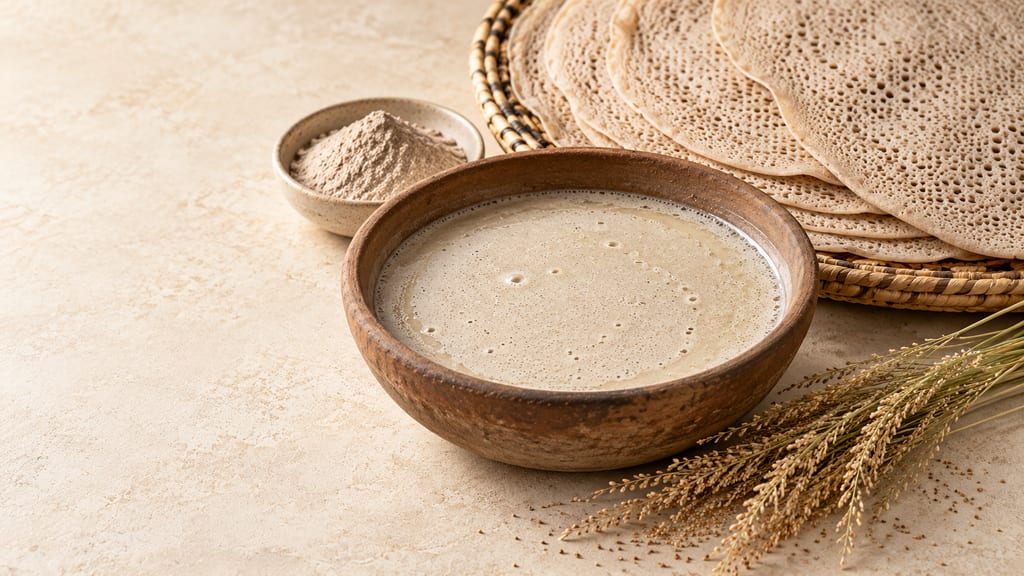
Teff batter fermenting in an earthenware bowl beside a dish of teff flour and a stack of injera: an illustration of the ingredients and the bread, not a real household's batch.
A jar left for a day and a night
In a book published in 1853, Mansfield Parkyns described how the ordinary bread of Abyssinia was made. He called it taita or tabita. Flour from several kinds of grain, and in the country sometimes peas and vetches, was mixed with water until it was about as thin as weak gruel, poured into an earthen jar and left to stand for a day and a night to leaven. The passage says nothing about a spoonful of the previous batch going in.
That silence matters, because the teff injera eaten today depends on exactly such a spoonful. Cooks in Ethiopia call it ersho, also written irsho, and pass it from one batch to the next. Nobody sells it. A 2025 food-safety paper by Cornell AgriTech researchers says plainly that there is no commercially available ersho, and that neither the amount used nor the ratio of flour to water is standardised. What ersho is, what lives in it and how long it keeps are all less settled than the bread it makes.
An old bread with a short paper trail
Injera feels ancient, but the dated evidence is recent. A comparative review of fermented flatbreads in the Horn of Africa and southern Arabia, built on interviews with 17 experts, only one of them from Ethiopia, puts the earliest evidence of teff injera as a staple food in northern Ethiopia in the early 1750s. It adds that the bread did not reach other local ethnic groups until the nineteenth century. A view that injera goes back to a clay baking tray from about the sixth century CE is, in the review's words, not confirmed.
The way injera is cooked has its own short history. Hiroki Ishikawa's 2024 study of the Shoa region places the arrival of the circular pour of batter onto the griddle between 1879 and 1898, and possibly between 1882 and 1886. Ishikawa does not mention ersho. Parkyns describes a jar that leavened by standing. The 1750s evidence concerns the bread, not the starter. So the history of the saved starter itself is blank: it could be older than any of these records or younger, and the evidence does not say.
The geography is wider than the laboratory work. Injera is a staple throughout Ethiopia and Eritrea, and the Cornell paper adds some parts of Somalia. The measurements of ersho, though, come from Ethiopia: four households in the 1990s, nine localities in a 2024 thesis. No Eritrean household record of the starter's name or form turned up. Whether Eritrean cooks keep an ersho of the same kind is an open question.
What cooks mean by ersho
The word covers more than one thing. In Ashenafi's 1994 laboratory study, ersho is a clear yellow liquid that collects on the surface of fermenting teff batter and is taken off to seed the next fermentation. A review of Ethiopian fermented foods describes it as a liquid taken from previously fermented dough. A comparative review of the region's flatbreads describes a starter saved from a fermentation two to seven days earlier. The Cornell paper offers a shortcut for cooks without any: prepare a fresh ersho 36 to 48 hours before making injera.
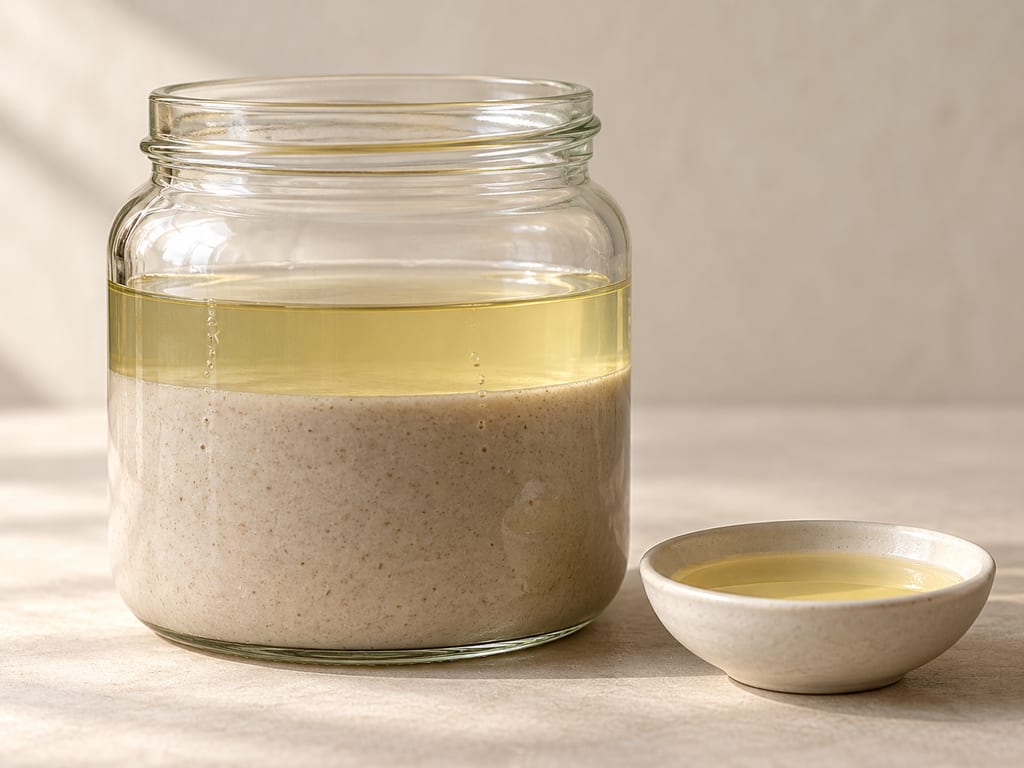
The liquid itself is sour and mostly water. Ashenafi measured a pH of about 3.5 and a titratable acidity of 3.1% and 5.7% in the samples, and a review of injera cites a moisture content of 96.4%. The amount added to a batter varies. One summary of traditional practice gives one part flour to two parts water with about 16% ersho by the weight of the flour, while the ratios of flour to water in the literature run from 1:1 to 2:3.
Two fermentations and a cooked spoonful
Injera is fermented in two rounds. The first, in a batter of flour, water and ersho, runs 24 to 72 hours at room temperature in the Cornell account, 30 to 72 hours in the injera review by Neela and Fanta, and 1 to 3 days depending on the surrounding temperature in the review of Ethiopian ferments. Across the literature the two rounds together last anywhere from 1 to 7 days.
Between the rounds, the cook boils part of the batter with water to make absit and stirs it back into the rest. Neela and Fanta say it develops gas formation. The Cornell paper says it supplies sugars for the microbes in the batter. The second fermentation takes 2 to 24 hours, with 2 hours given in one review. The batter is then poured onto the griddle, the mitad, and cooks for 2 to 3 minutes at 90–95 °C, giving a round injera 50–60 cm across.
What lives in the liquid
Ashenafi sampled ersho from four households. Aerobic mesophilic bacteria, the ones that grow in air at moderate temperatures, ranged from 6.9 million to 130 million per millilitre, and the isolates were Bacillus species. Yeasts ranged from 520,000 to 1.8 million per millilitre, and Candida milleri was the most dominant isolate in every sample.
A 2024 thesis by Hailemariam at Addis Ababa University collected 91 ersho samples from nine localities, among them Fiche, Holeta, Adama and Bishoftu. It isolated lactic acid bacteria, aerobic bacteria, yeasts and moulds. Sequencing named Bacillus subtilis, Lacticaseibacillus paracasei, the yeast Pichia fermentans and the mould Aspergillus niger. The best of the combinations tested, a six-part mix of isolates, fermented injera in 28 hours. The thesis adds that the selected starter still needs study of its profile, performance and shelf life.
Earlier work followed the batter rather than the liquid. Desiye and Abegaz, in a 2013 study reported in two later reviews, sampled 34 batters at 6-hour intervals over 96 hours and recorded 107 strains of lactic acid bacteria and 68 of yeast. Pediococcus pentosaceus and Lactobacillus fermentum were the most common lactic acid bacteria.
These are measurements of particular samples. They show a mixed community of acid-makers, yeasts and Bacillus whose make-up varies from house to house. They do not define a formula for ersho, and none of the counts is a pass mark for a safe batch.
The flour comes with its own microbes
A starter made of raw flour and water carries whatever was on the flour. Teff flour is mostly contaminated with Gram-positive bacteria, chiefly Bacillus. Ashenafi also counted Enterobacteriaceae, a family that includes many gut bacteria, at about 10,000 per gram in around 80% of his samples. Cornell researchers place the growth of that family in a teff batter at typically around 12 hours. Flour in general has a record of carrying E. coli, Salmonella enterica, Listeria monocytogenes and Bacillus cereus.
The same Cornell paper found no documented foodborne outbreak specifically associated with injera. It treats fermentation as a critical control point where pathogen growth can be held down by monitoring pH and temperature. What it cannot supply is a pH or temperature limit for ersho itself, and none has been published.
Cooking is what kills the germs. The US Centers for Disease Control and Prevention advise against tasting raw dough or batter, point out that germs in flour are killed only when it is baked or cooked, and recommend washing hands, bowls, utensils and counters after handling flour. A starter is never cooked before it goes into the next batter, so the advice applies to it as much as to the batter.
A home version, and what it leaves out
Lola Osinkolu's injera recipe, published in 2021 and updated on 1 June 2022, shows one way to start from nothing. The starter is 1 cup of teff flour and 2 cups of water left for 3 to 4 days in a warm place. The batter then ferments for three days, has its water changed and ferments three days more. The absit is made from 3 cups of boiling water and 1½ cups of batter, cooked for about 5 minutes and cooled with 1 cup of cool water.
Two details show how loose the method is. Osinkolu suggests a teaspoon of baking soda for ten minutes as a shortcut and calls it not traditional. And the finished batter may be refrigerated for later use, with no time limit. The recipe gives no temperature, no pH and no point at which the starter should be thrown away.
What nobody has measured
No source gathered here gives a validated storage life for an ersho, a rule for when to discard one, or a way to bring back a starter that has gone wrong. The nearest figures describe injera, not the starter. The review of Ethiopian ferments says injera may be stored for 3 days at room temperature and that mouldy injera is usually thrown out. The Cornell paper allows up to three days in a traditional straw basket called a messob, or refrigeration until there are visible signs of spoilage. Its 36 to 48 hour fresh-ersho option is guidance, not a validated limit.
Bubbles, a separated layer, a sour smell and a change of colour are the cues cooks go by, and none of the sources treats them as a safety test. A duration that gives good injera is a statement about quality, not a deadline for safety.
The practice is documented in outline: a saved liquid or batter, a few days of standing, a cooked portion, a hot griddle. The measurements that would turn it into a method are missing, among them counts and pH over time, storage trials and a comparison across households. The 2024 thesis begins to define a starter from isolates. A home ersho is best treated as a traditional practice with unmeasured limits, with raw flour and raw batter treated as foods to cook before tasting.
Community
No community contributions have been published for this entry yet.
Share what you made
Sign in to contribute. Published comments and photos are free to read.
Sources
World Journal of Microbiology and Biotechnology (Ashenafi, 1994; PubMed abstract)
Microbial flora and some chemical properties of ersho, a starter for teff (Eragrostis tef) fermentationCited in: What cooks mean by ersho; What lives in the liquid; The flour comes with its own microbes
Journal of Ethnic Foods (Neela and Fanta, 2020)
Injera (An Ethnic, Traditional Staple Food of Ethiopia): A review on Traditional Practice to Scientific DevelopmentsCited in: What cooks mean by ersho; Two fermentations and a cooked spoonful; The flour comes with its own microbes
Addis Ababa University (Hailemariam, 2024; repository page)
Evaluation of Microbes from Teff (Eragrostis Tef (Zucc.) Trotter) Ersho for Injera Starter Culture DevelopmentCited in: What lives in the liquid; What nobody has measured
J-STAGE (Ishikawa, 2024)
A Historical Study on the Establishment of Injera Cooking in the Shoa Region, EthiopiaCited in: An old bread with a short paper trail
Mansfield Parkyns, via Internet Archive
Life in Abyssinia (1853), Chapter XXVIICited in: A jar left for a day and a night; An old bread with a short paper trail
Chef Lola's Kitchen (Lola Osinkolu, 2021, updated 2022)
INJERA-100% Gluten Free Teff Injera RecipeCited in: A home version, and what it leaves out
Foods (MDPI; Wolgamuth et al., 2026)
Comparative Analysis of Fermented Flatbreads in the Horn of Africa and the Southern Arabian Peninsula: A Picture of Biocultural DiversityCited in: An old bread with a short paper trail; What cooks mean by ersho; Two fermentations and a cooked spoonful
Food Science & Nutrition (Wiley; Worku et al., 2026)
Fermented Foods and Beverages of Ethiopia: Substrates, Traditional Preparation Techniques, and Nutritional QualityCited in: An old bread with a short paper trail; What cooks mean by ersho; Two fermentations and a cooked spoonful; What lives in the liquid; What nobody has measured
Centers for Disease Control and Prevention
Raw Flour and DoughCited in: The flour comes with its own microbes
Food Protection Trends 45(6):389-395 (Charles-Vegdahl, Worobo et al., 2025; Cornell AgriTech)
Food Safety Recommendation for Traditional Fermented Food by Small-Scale Producers: Injera as a Case StudyCited in: A jar left for a day and a night; An old bread with a short paper trail; What cooks mean by ersho; Two fermentations and a cooked spoonful; The flour comes with its own microbes; What nobody has measured
Gaps
- No validated storage life, discard rule or recovery method for ersho has been found.
- Eritrean household evidence on the starter's names and form is missing.
Updated 2026-10-29