
Starter cultures
The batter that floats: who raises idli and dosa?
Nobody adds a culture to idli and dosa batter, yet it rises overnight. A 1965 paper named the bacterium responsible; a 2019 study says that bacterium was probably a different genus.
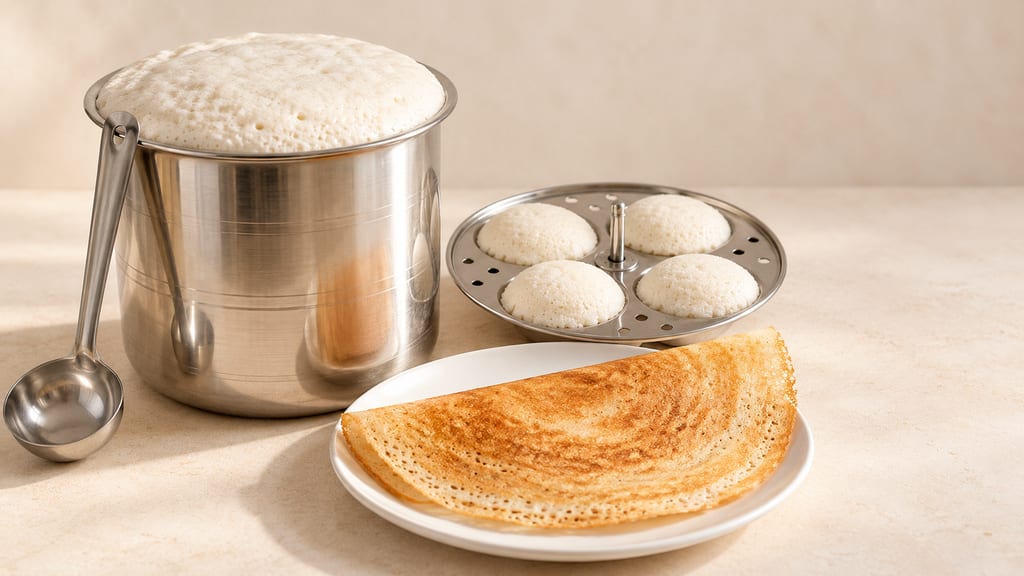
Fermented idli and dosa batter risen to the rim of a steel pot, the point at which it is ready to be steamed or spread on a griddle.
The float test
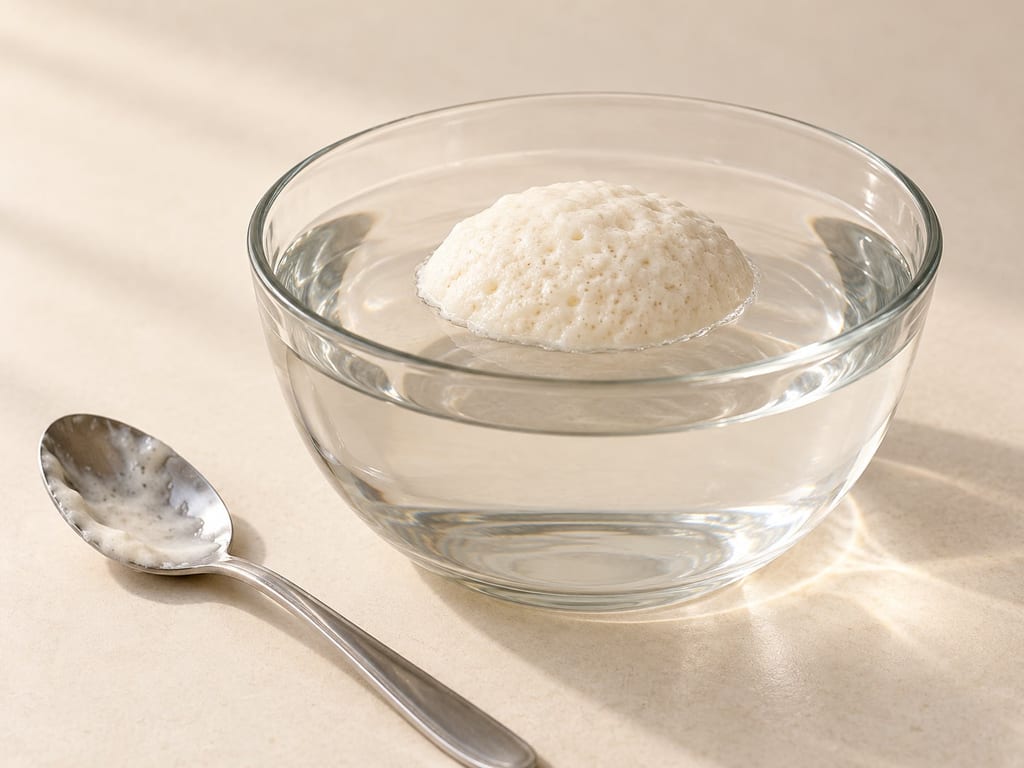
The kitchen test for idli and dosa batter is a bowl of water. A batter that has fermented properly has roughly doubled in volume, and a spoonful dropped into the water should float. It floats because the batter has trapped enough gas to be lighter than the water around it.
The batter itself is plain. Rice and dehusked black gram, called urad (Vigna mungo), are soaked separately, drained and ground with water. They are mixed with salt at 2% and left to ferment overnight, typically at least 12 hours, at around 30 °C. The BC Centre for Disease Control gives 4 parts rice to 1 of black gram for idli and 3 to 1 for dosa. After 12 hours one study measured the batter at pH 4.3–4.6, mildly acidic, which is where the sour edge comes from.
Then the two foods part. Idli batter goes into moulds and is steamed, for 5 to 8 minutes in the special pans the BC guideline describes or 10 to 25 minutes in the perforated trays The Idli Project describes. The result is a soft, moist, spongy cake, eaten as a breakfast and a staple. Dosa batter is spread on a hot griddle and cooked into a thin, crisp pancake, also a staple.
Nothing is added to the pot
No culture goes into the batter. The microbes arrive on the grains. When researchers at the National Centre for Microbial Resource in Pune sterilised the surface of the rice and lentils with isopropanol for 30 minutes, the batter sat for 15 hours and stayed unfermented, its pH slipping only from 6.3 to 5.8. Stirring in 10% fermented batter brought the fermentation back. In an untreated batter the pH fell from 6.3 to 4.5 over the same 15 hours and the volume rose by 100%.
The same team pulled the two ingredients apart. The pulse on its own leavened; rice on its own did not. In this batter, the pulse was the part that leavened.
These are results from one set of laboratory batches, soaked for 4 hours, ground coarse and held at ambient temperature, about 30 °C. They do not show that every household batter fills with the same organisms, and nothing in them describes a household keeping back batter to start the next one.
Who makes the bubbles
In 1965 a team at the New York State Agricultural Experiment Station in Geneva, part of Cornell University, gave a definite answer. Leuconostoc mesenteroides, a lactic acid bacterium, was the main organism behind both the souring and the gas in idli batter. Streptococcus faecalis grew later, and Pediococcus cerevisiae after it. The team added that, as far as they knew, this was the first record of a leavening action produced entirely by a lactic acid bacterium and not by yeast.
The names then moved. In 1993 a group at the Institute of Food Research in Reading, in the United Kingdom, was working on Leuconostoc-like bacteria from fermented sausages. Comparing their 16S rRNA sequences, they proposed moving Leuconostoc paramesenteroides and its relatives into a new genus, Weissella. A bacterium filed under Leuconostoc in 1965 could be filed somewhere else by 2019.
The Pune team went back to the question with sequencing. Lactic acid bacteria made up 86% of the bacterial population in their batter, and Weissella was more than 70% of the sequence reads in the important part of the fermentation, rising from 9% to 71% between the 6th and 9th hour. Weissella isolates alone fermented sterile batter. A test with radiolabelled glucose traced the gas to the heterofermentative pathway, the route that releases carbon dioxide. They argue that the organism named in 1965 was probably a Weissella.
Yeasts are the third candidate. The BC guideline calls yeasts the primary fermentation agents, responsible for leavening and flavour, with lactic acid bacteria acidifying the batter. A 2016 review of microbes in the world's fermented foods lists for idli the Leuconostoc of 1965, several lactobacilli, Pediococcus cerevisiae, Enterococcus faecalis and Bacillus amyloliquefaciens, alongside several Candida species, Debaryomyces hansenii and Saccharomyces cerevisiae. Its entry for dosa is shorter but also mixes bacteria and yeasts.
So three answers sit side by side: a lactic acid bacterium alone, Weissella, and bacteria and yeasts together. The teams worked in different decades, with different tools, on different batters. Part of the disagreement may be about batches, not biology, and the sources do not settle it.
Three batters, three sets of numbers
Ask for a recipe and you get a ratio, a soak and a temperature, and the sources give different ones. The Pune batter used 2 parts rice to 1 of black gram. The BC guideline gives 4 to 1 for idli. Ghosh and Chattopadhyay, working at Jadavpur University and the Guru Nanak Institute of Technology in Kolkata, tested 2:1, 3:1 and 4:1 by weight in a 2011 paper in the Journal of Food Science and Technology.
That paper is a reminder to keep each batch with its own conditions. It gives two soaking times, 5 hours in its methods and 4 hours at 30 ± 1 °C in its abstract. It gives two temperatures too: in the methods the batter ferments in stainless steel with no temperature control and varies between 20 and 26 °C, while the captions of its rheology figures say 37 °C. The BC guideline prefers soaking at or below 4 °C and allows at most 4 hours at room temperature. It notes that the literature describes room-temperature soaks of 4 to 6 hours. Vendor batters in Pune and Bangalore were held at 26–30 °C for 12 hours.
Inside the Kolkata pot the batter changed steadily. Samples were taken at 0, 4, 7, 10, 13, 16, 19 and 22 hours. Volume rose from 1.62 to 3.2 times the original. By hour 22 the density was 0.592, 0.682 and 0.831 g/cm³ for the 2:1, 3:1 and 4:1 batters, so the more black gram, the lighter the batter. The pH ran from 5.9 down to 4.21 and total acidity from 0.44% to 0.91%. Riboflavin and thiamine peaked at 0.76 and 0.73 mg per 100 g in the 3:1 batter, and folic acid peaked at 0.75 mg per 100 g after 10 hours.
Averaging these into one formula would reproduce none of the batches.
An old name for a different food
The BC guideline says idli is mentioned in literature as far back as 700 BC. It cites a 2017 paper on non-thermal food preservation for the date and names no text, so the claim is the guideline's and the basis for it has not been traced.
The Idli Project's history gives earlier written evidence of a different kind. The earliest texts it identifies are iddalige in the Kannada Vaddaradhane, around 920 CE, and iddarika in the Sanskrit Manasollasa, in 1130 CE. Both describe a cake made only from black gram batter, with no rice, no fermentation and no steaming. The Tamil word itali appears by the 17th century.
Where the idea came from is disputed. K. T. Achaya proposed that Indonesian cooks, whose word for the food was kedli, brought it to India between 800 and 1200 CE. Colleen Taylor Sen argues that fermentation arose independently in India. No source dates dosa.
If the first idli was a black gram cake, a mention of idli, whatever its date, is not necessarily a mention of the fermented rice and black gram batter eaten now.
What the safety guidance covers
The BC guideline is written for food businesses. It asks for potable water, thorough cooking or reheating to an internal 74 °C for at least 15 seconds, and, for commercial batter, a pH of 4.6 or below before packaging. For ordinary batter it allows about 1 day at room temperature at most, up to 7 days refrigerated at 4 °C, and says batter that will not be cooked within 24 hours should be refrigerated and used within 5 to 7 days. One study it cites reached up to 30 days with 0.1% mustard essential oil and another up to 20 days with sonication.
It also describes shortening the fermentation from 12 to 14 hours to around 3 hours by adding dried fermented idli, and does not recommend it. Batter that is not actively fermenting can support mould growth.
The outbreak record is short. The Public Health Agency of Canada found no idli-associated outbreaks in Canada or elsewhere from 1985 to 2021. The guideline lists five outbreaks in all, and one, a 2018 dosa outbreak in New York, involved 9 suspected cases of enterotoxigenic E. coli (ETEC).
A batter that has risen, smells sour and is full of bubbles has done what a batter does, and none of those signs shows that it is safe to eat. The storage figures are handling limits for ordinary batter. No source tested how long a household batter can be kept after it has been used to seed another, or how to rescue one that failed to rise.
What a cook can and cannot take from this
A batter of rice and black gram becomes an ecosystem within a day, with no help except warmth, time and salt. The measurements here are for one batch each, with each team's own temperature, grain ratio and soak, and they are not interchangeable.
The float test and the doubling in volume tell a cook that the batter has trapped gas. They do not tell anyone which organism made it or whether the batter is safe to eat.
Still unknown are which organisms do the work in ordinary home batters, how households in different regions and in the diaspora vary their ratios and temperatures, and how old the fermented batter really is. No source gives a safe keeping time for batter kept to start a later one.
Community
No community contributions have been published for this entry yet.
Share what you made
Sign in to contribute. Published comments and photos are free to read.
Sources
BC Centre for Disease Control
Fermented Foods Guideline 3.4: Dosa and IdliCited in: The float test; Who makes the bubbles; Three batters, three sets of numbers; An old name for a different food; What the safety guidance covers; What a cook can and cannot take from this
Applied and Environmental Microbiology (PMC)
Diversity and Succession of Microbiota during Fermentation of the Traditional Indian Food IdliCited in: Nothing is added to the pot; Who makes the bubbles; Three batters, three sets of numbers; What a cook can and cannot take from this
Journal of Food Science and Technology (PMC)
Preparation of idli batter, its properties and nutritional improvement during fermentationCited in: Three batters, three sets of numbers; What a cook can and cannot take from this
Applied Microbiology (PMC)
Role of Leuconostoc mesenteroides in leavening the batter of idli, a fermented food of IndiaCited in: Who makes the bubbles
Journal of Applied Bacteriology
Taxonomic studies on some leuconostoc-like organisms from fermented sausages: description of a new genus Weissella for the Leuconostoc paramesenteroides group of speciesCited in: Who makes the bubbles
Frontiers in Microbiology (PMC)
Review: Diversity of Microorganisms in Global Fermented Foods and BeveragesCited in: The float test; Who makes the bubbles
Gaps
- Which organisms leaven household idli and dosa batter is unsettled: the studies sample single sets of batches and name bacteria, Weissella or yeasts.
- The basis of the 700 BC date for idli is not traced, and no source read here dates dosa.
- No validated household storage limit, starter-keeping practice or recovery method for a failed batter was found.
Updated 2026-10-29