
Starter cultures
A bucket of meat, a warm room and ten weeks: the new garum
Restaurant and research kitchens now make garum from beef, chicken skin and peas, often with koji and weeks in a warm room. Their figures disagree, so does the science, and no home version has been shown to be safe.
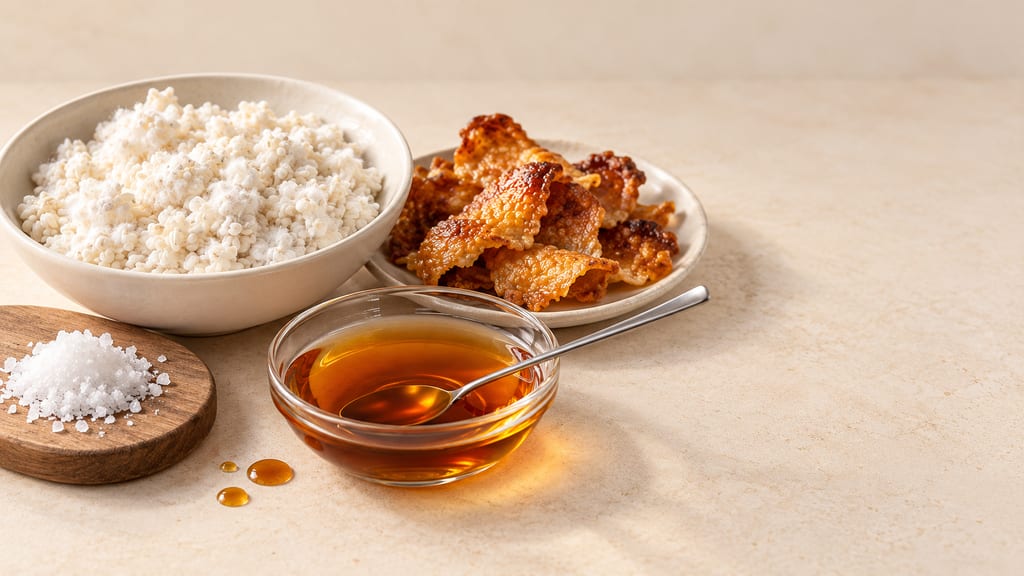
Koji-grown rice, roasted chicken skin, coarse salt and a dish of strained garum.
The warm room at Noma
Noma keeps a room at 60 °C for its garum. A bucket of meat goes in, salted to about 12% of its weight, and 10 to 12 weeks later it comes out as finished garum, a powerful savoury liquid seasoning. The restaurant's fermentation book calls garums the most precise and safest ferments the kitchen makes. In the same passage it says the temperature precludes microbial activity.
Put those two statements side by side and the question of modern garum appears. If the heat holds microbes off, something else is breaking the meat down, and it is fair to ask whether the result is a fermentation at all. Noma Projects says as much itself: without koji, many of its garums are technically autolysis, meaning the raw material digests itself with its own enzymes, rather than fermentation.
This article follows that question through the kitchens that now make garum from meat, chicken skin, insects and peas: Noma Projects, the Modernist Food fermentation pages, the Nordic Food Lab and a restaurant in Rotterdam. It starts with a short look at the older method they are measured against.
The older method, in brief
Noma describes ancient garum as small gutted fish such as sardines and mackerel, brine and time, and puts the wait at almost a year. That is the restaurant's own summary, not a measurement. Its fermentation book adds that garums were traditionally fermented under the hot Mediterranean sun, offered as an explanation with no temperature attached.
Archaeology gives a thinner and more local picture. In a 1996 preliminary report, Lernau, Cotton and Goren described fish remains and inscribed amphorae at Masada, imported from southern Spain, and called the sauce, allec, high quality and kosher. Those finds show what was stored and traded at one site. The salt, temperature and time figures that modern recipes depend on do not come out of them.
Weeks instead of a year: koji and the formulas
Noma's own account of the process is short. The raw ingredient is pressed, mixed with salt and water, fermented for 6 to 10 weeks depending on the ingredient, and strained. The result is a liquid used for salt and umami: a few drops of beef garum go on raw beef. Noma describes its garums as less tangy and less salty, without saying what it compares them with. It also reports a no-water variant that resembles Thai shrimp paste, and says plant-protein garums should not stay in the heat as long as animal protein, without giving a duration.
Koji changes the timetable. Koji is cooked grain, usually rice, grown with the mould Aspergillus oryzae, which makes enzymes that cut proteins into smaller pieces. Noma says adding it can shorten garum making by more than half, and does not say half of what.
The Modernist Food fermentation pages give the most complete numbers. A 1 kg jar takes 400 g of protein, 250 g of rice koji, 250 g of water and 100 g of salt. A 2 kg crock doubles the quantities: 800, 500, 500 and 200 g. The mash is held at a steady 55–60 °C for 2 to 6 weeks, which the page contrasts with a year. Salt runs from 8 to 12% of the mash, with 10% as the default and 11–12% for raw meat or fish. Koji is 20–30% of the mash, and the target pH of the finished sauce is 5.0–5.8. A jar yields 700–800 ml of strained garum and a crock about 1.5 litres, which is then refrigerated at 2–4 °C or frozen.
A second Modernist page, on amino pastes, describes the same warm method for garum but gives 4–8% salt, with 5% as the default, and 1 to 4 weeks of warm ageing. It also offers a slower, more aromatic alternative at 28–30 °C. The two pages from one publisher therefore disagree on the salt floor and on the length of the hold.
A restaurant version comes from Michael van der Kroft at Tres in Rotterdam: roasted chicken skin garum, made from 500 g of roasted chicken skin, 180 g of salt, 225 g of koji made from pearl barley and 800 g of water, for a yield of 600 ml. Against the 1,705 g of ingredients listed, that is about 11% salt and 13% koji. The published entry gives no temperature, time or steps, so it records a ratio and a yield, not a method.
Set next to one another, the figures spread widely. Noma's 10–12 weeks at 60 °C and 12% salt comes without any mention of koji. Modernist's 2–6 weeks comes with koji at 20–30% of the mash, which would be consistent with Noma's remark that koji can cut the time by more than half. No page reconciles the numbers, and the substrates differ.
Fermentation, or enzymes in a warm bath?
One view treats the warm hold as chemistry. Noma Projects calls many of its koji-free garums autolysis, and its book says the heat precludes microbial activity. The Modernist amino-paste page goes further for koji: at 55–60 °C, it says, the mould is dead but its enzymes remain active. It gives no citation for that claim. On this view koji is a bag of ready-made enzymes, and the hold is a controlled digestion.
The other view treats it as microbiology. In October 2011 Ben Reade of the Nordic Food Lab wrote about sauces of herring and mackerel made in incubator tanks, with the aim of speeding the process up by inoculating with microorganisms that break down protein. The post names no inoculant and gives no salt, temperature or time. A secondary account of the lab describes a batch wrapped in an electric blanket set at 40 °C and says a batch begun on 12 June 2011 was on its way to Harvard University for chemical analysis. No result of that analysis has been reported.
A 2017 study by Mouritsen, Duelund, Calleja and Bom Frøst compared 21 sauces. Some were mackerel sauces made by procedures from ancient Roman cuisine; others used insects (moths and grasshoppers), pheasant or peas. In some cases a fungal inoculation based on a Japanese koji mother is said to have facilitated the fermentation, though which cases is not stated. All 21 sauces turned out high in glutamate and aspartate.
The sources do not settle whether live koji is present in any given batch. A 40 °C blanket and a 60 °C room are different environments, so the two views may simply describe different batches.
What the warm hold does not prove
Nothing in this material shows these methods to be safe at home. The Modernist pages say outright that the warm hold is not a validated botulism control, and they treat the garum as a refrigerator or freezer product: strain it, cool it to 2–4 °C or freeze it, and do not can it.
The same pages are candid about what protects the sauce. Animal-protein garums rely on salt and the warm hold, they say, not on acidity, because the pH stays above 4.6, and not on refrigeration during the ferment. They list an ammonia or putrid smell, a gas-bloated bag and pink or black surface growth as reasons to discard a batch. Those signs can condemn a batch, but their absence proves nothing. Smell, taste and bubbles do not establish safety.
Noma's description of its warm room as precise and safe is the producer's own, and no limits or validation are given behind it. None of the recipes described here is backed by a validation of a warm hold for animal protein against botulism or raw-meat hazards.
The US Food and Drug Administration publishes hazard and control guidance for fish and fishery products. It is written to help processors build HACCP plans, a structured food-safety method for commercial producers, and it says it does not address safe handling by consumers. It does not validate a household garum process. Because the figures above differ between sources and between substrates, none of them is offered here as a home schedule. A time, temperature and salt figure from a professional kitchen describes that kitchen's practice.
What is still open
For a reader, the useful lesson is about categories. Garum now names a family of ideas: a protein, salt, heat, and either the food's own enzymes or a mould's, strained into a seasoning. Within that family the published salt levels run from 4% to about 12%, and the holds from one week to twelve, on different substrates and with koji or without it.
Several things would settle more than any further recipe. Noma's three time figures need reconciling, and the claimed halving needs a baseline. The statement that koji mould is dead but its enzymes are active at 55–60 °C needs a citation. The Harvard analysis of the Nordic Food Lab batches needs a published result, and the Tres ingredient list needs a method. Until those appear, modern garum is a well-described idea with figures that nobody has validated for the kitchen at home.
Community
No community contributions have been published for this entry yet.
Share what you made
Sign in to contribute. Published comments and photos are free to read.
Sources
Lernau, O., Cotton, H., Goren, Y. (1996). Archaeofauna 5, 35–41. University of Haifa Research Portal
Salted fish and fish sauces from Masada. A preliminary reportCited in: The older method, in brief
Mouritsen, O. G., Duelund, L., Calleja, G., Bom Frøst, M. (2017). International Journal of Gastronomy and Food Science 9, 16–28, doi 10.1016/j.ijgfs.2017.05.002. University of Southern Denmark
Flavour of fermented fish, insect, game, and pea sauces: garum revisitedCited in: Fermentation, or enzymes in a warm bath?
Noma Projects
The Lab Dispatch: GarumCited in: The warm room at Noma; Weeks instead of a year: koji and the formulas; Fermentation, or enzymes in a warm bath?; What is still open
Noma Projects
About GarumsCited in: The older method, in brief; Weeks instead of a year: koji and the formulas
U.S. Food and Drug Administration
Fish and Fishery Products Hazards and Controls GuidanceCited in: What the warm hold does not prove
Noma Projects
Garum: Got to Have the Funk (excerpt from The Noma Guide to Fermentation by René Redzepi and David Zilber)Cited in: The warm room at Noma; The older method, in brief; Weeks instead of a year: koji and the formulas; Fermentation, or enzymes in a warm bath?; What the warm hold does not prove; What is still open
Modernist Food | Fermented
Quick Garum (Koji-Driven)Cited in: Weeks instead of a year: koji and the formulas; What the warm hold does not prove; What is still open
Modernist Food | Fermented
Amino Pastes (Quick Miso, Peaso & Garum)Cited in: Weeks instead of a year: koji and the formulas; Fermentation, or enzymes in a warm bath?; What the warm hold does not prove; What is still open
Nordic Food Lab, blog post by Ben Reade, 2 October 2011
Fish SauceCited in: Fermentation, or enzymes in a warm bath?; What is still open
Katie Parla, 16 November 2011
The Nordic Food Lab, Where Science Creates TraditionCited in: Fermentation, or enzymes in a warm bath?
Gastronomixs
Roasted chicken skin garum (Michael van der Kroft, restaurant Tres, Rotterdam)Cited in: Weeks instead of a year: koji and the formulas; What is still open
Gaps
- No source reconciles Noma's three time figures or says what the claimed halving of time is measured against.
- The Tres entry gives ingredients and yield but no temperature, time or steps.
- Whether live koji is present in any batch, and what the Harvard analysis of the Nordic Food Lab batches found, are not reported.
Updated 2026-10-29