
Starter cultures
A boiled root in a well-used bag: how attiéké gets its start
Before attiéké is pressed and steamed, a boiled cassava root has to ferment in a used bag. The bacteria that grow there differ by community and by batch, and nobody has turned them into a validated recipe.
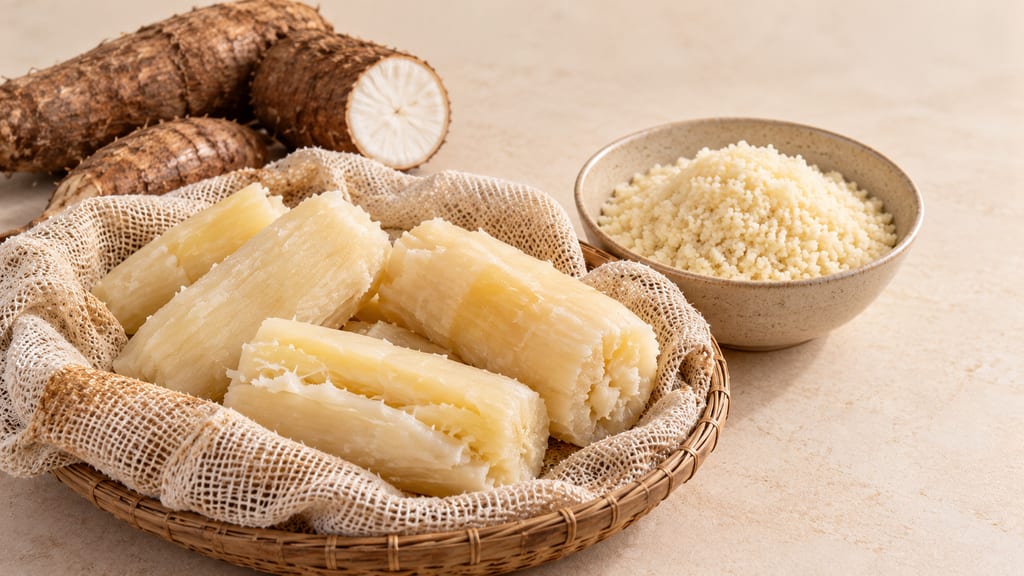
Peeled, boiled cassava roots in a woven basket beside a bowl of finished attiéké grains: an illustration of the material the inoculum is made from and the food it helps start.
The root that goes in first
Attiéké begins a few days before anyone grates a cassava root for it. In the practice that researchers recorded among 170 producers around Abidjan, Dabou and Jacqueville in 1999, the first task is a small side batch that will seed the rest. Two to three kilograms of fresh roots are peeled, washed, boiled for 5 to 10 minutes and left to cool at 28–35 °C.
The cooked roots then go into a bag or a set of nets that has already held earlier fermentations, and the bag sits in a basket or a cardboard box at the same 28–35 °C for one to three days. No pure culture is added, only time, warmth and a used bag. When the batch is ready, the cassava is very soft, yellowish and covered in visible growth. This is the inoculum. It is used at 5–10% of the weight of the fresh cassava that is about to be fermented.
That is a record of what producers did, not a recipe. Other producers leave the roots whole and unpeeled and cook them on embers. The 1999 survey found peeled and boiled roots becoming the usual choice and the braised form fading, and the same word, inoculum, covers both. Which form a producer uses is a choice made before the fermentation starts, and the studies do not tell us how much it changes what grows.
Lidjrou, Magnan, Bédé Fon
The inoculum has names. Adjoukrou producers call it Lidjrou, Ebrié producers Magnan and Alladjan producers Bédé Fon. A 2026 laboratory study spells the Ebrié name Mangnan. The names mark which communities researchers sampled. They do not mark one culture, and they do not say where the practice began.
Attiéké was originally confined to the lagoon complex of southern Côte d'Ivoire, home to the Adjoukrou, Ebrié, Alladjan, Avikam, Aizi and Neo. FAO puts its origins in the south of the country. It is now eaten across Côte d'Ivoire and beyond its borders, and the Adjoukrou, Ebrié and Alladjan remain the largest producers and consumers. A 1992 thesis, cited in the 2019 survey paper, points to a shift from household cooking toward production for sale. No source gives a date or a birthplace for attiéké or for its inoculum.
From pulp to grain
Once the inoculum is ready, it goes into freshly grated cassava pulp together with a little red palm oil and some water. The recorded amounts differ by community: 0.1% palm oil in Adjoukrou and Alladjan kitchens, 0.1–0.15% in Ebrié ones, and 10–20% water in the Ebrié practice against 7–10% in the Adjoukrou and Alladjan. The dough ferments for 12–15 hours, and producers judge when it is ready by touch.
Fermentation is then over, and what follows is physical work. The dough is pressed for one to three hours in a nylon bag in a mechanical screw press, sieved through 4–5 mm and then 1.5–2 mm meshes, and rolled into grains by hand in a plastic bowl (Ebrié) or a wooden one (Adjoukrou and Alladjan). The grains dry for at least an hour in the sun on plastic sheets or raffia trays and steam for 20–30 minutes in a couscous cooker. FAO describes steaming for about 30 minutes over boiling water, with the joint between pots sealed with wet clay. In the dried product, about 20% of the grains are under 1 mm, 70% are 1–2 mm and 10% are 2–3 mm.
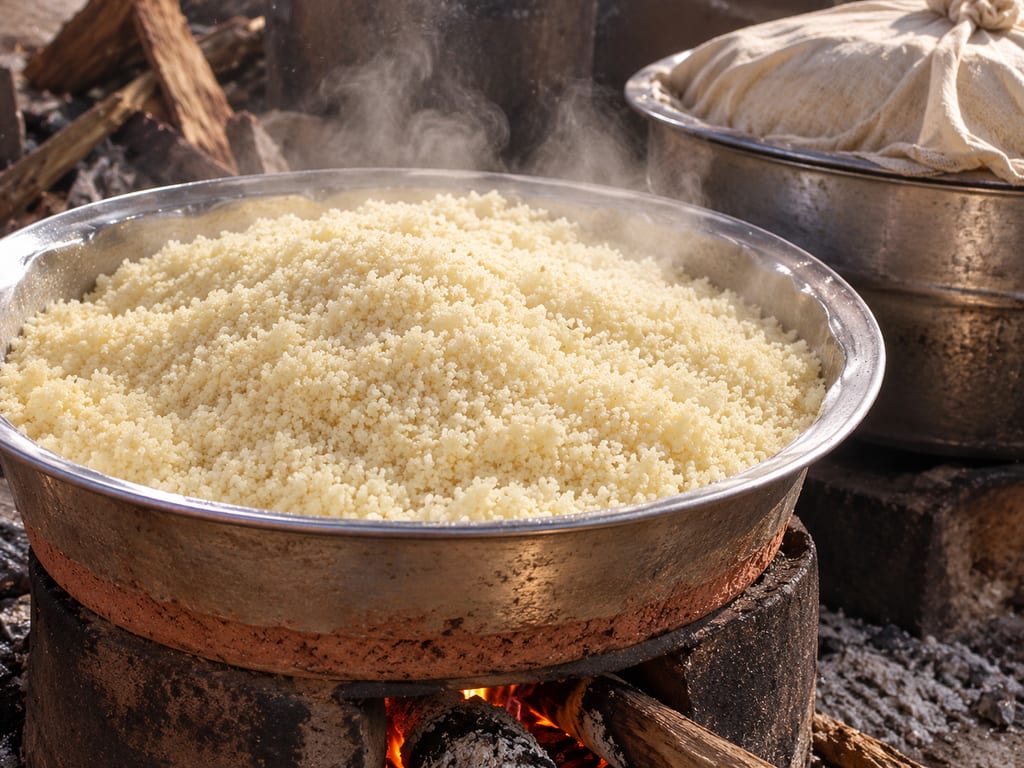
Only the inoculum and the dough stage are fermentation. Pressing, sieving, granulating, drying and steaming are physical and thermal steps that shape and finish the food, and keeping the two groups apart matters when the question turns to safety.
A crowd of bacteria, not a single culture
The best account of the dough stage comes from a team at ETH Zurich that followed batches at 15 small-scale production sites. Inoculum was added at 10% to grated pulp. The inocula arrived carrying about 82 million colony-forming units of aerobic mesophiles per gram and had a mean pH of 5.0. Over the 15-hour fermentation, lactic acid bacteria (LAB) took over and reached about 1.2 billion colony-forming units per gram.
The species changed as they grew. At the start Leuconostoc mesenteroides made up 20% of the LAB. At the end four other species led: Lactobacillus salivarius (20%), L. delbrueckii (16%), L. fermentum (12%) and L. confusus (10%). Organisms that cannot tolerate acid, among them Bacillus, Enterobacter and Klebsiella species that had come in with the inocula, fell below 100 per gram. The yeast Candida tropicalis stayed near 100,000 per gram. The finished food had a pH of 4.4, 0.6% lactic acid and 0.1% acetic acid.
The inocula themselves vary by community. A comparison of 54 traditional inocula from three production zones found five LAB species in four clusters: Leuconostoc mesenteroides, Pediococcus acidilactici, Lactobacillus plantarum, L. fermentum and Weissella cibaria. Adjoukrou inocula were mainly L. mesenteroides and P. acidilactici, Alladjan inocula mainly L. fermentum and Ebrié inocula mainly L. plantarum, and W. cibaria turned up only in Ebrié samples. The authors suggest that dominant strains could serve as starter cultures, which is a proposal and not a tested result. Another 2006 study, in Dabou, took the starter itself as its subject, and a 2017 study asked whether the quality of the inoculum changes attiéké made from four cassava varieties.
A 2026 paper from Abidjan went one step further. From 100 isolates taken from Mangnan collected in the Cocody-Blockhauss area, the authors kept six: four Lactiplantibacillus plantarum and two Enterococcus faecalis. They tested them at 25, 40, 42, 45 and 50 °C. One of the E. faecalis strains inhibited every pathogen tested at every temperature. That is a laboratory finding about what these isolates might do, and the authors call E. faecalis safety-associated only for these strains. It is not a method for a kitchen, and finding an organism in an inoculum, even a dominant one, does not show that it is safe to keep and pass on.
What steaming removes, and what it does not
Cassava roots contain cyanogenic glycosides, which can release hydrogen cyanide, and food authorities say they can be harmful. Cooking reduces them by 10 to 75% in the preparations the Australian and New Zealand standards body describes, and those are not attiéké figures. For attiéké, one hazard study in Côte d'Ivoire measured 116 ± 9.42 mg per kg of hydrocyanic acid in the roots and 3.4 ± 0.14 mg per kg in the finished food, under the 10 mg per kg Codex figure the authors cite. It is a single study, not a validated endpoint for anyone's batch.
The variant called Garba shows how much the process matters. It is made with a fermentation of about 6 hours, no drying and less cooking. In samples of commercial attiéké, Garba contained 12 mg of cyanide per 100 g of dry matter against 4.41 mg for other attiéké, and the authors name a risk for people who eat it regularly. Garba differs in three ways at once, so those figures cannot say which difference matters. They also come from a different study than the 3.4 mg per kg above, on a different basis, and should not be set against it.
The microbial picture has the same shape. In the hazard study, coliform bacteria disappeared during fermentation and pressing, and Bacillus cereus, Staphylococcus aureus and moulds were reduced. Cooking removed everything except B. cereus spores, at about 110 per gram, and organisms reappeared after packaging. The authors name roots, crushing, fermentation and drying, cooking and packaging as the critical control points. None of this makes sourness, smell, colour, texture or one pH reading a test for safe attiéké.
A recognised skill, a protected name
In 2024 UNESCO inscribed the skills related to attiéké production in Côte d'Ivoire on its Representative List of the Intangible Cultural Heritage of Humanity. The inscription describes lagoon peoples and a division of labour: men grow, harvest, transport and grind the cassava, while women prepare, cook, preserve and sell the attiéké, mostly for household consumption. The knowledge passes orally and by observation within families, and mastering production is described as giving women and girls financial independence and a place in their communities.
What nobody has settled
A working home method for attiéké would need one named tradition and one source batch, a cassava variety and its condition, a way of handling the inoculum, each processing stage, monitoring, measurable endpoints, cyanogen controls, cooking and storage. No source supplies these together, and steps borrowed from different communities or studies do not add up to a method.
The gaps are specific. The bag is reused from batch to batch, but no study tests how long an inoculum can be held between uses. FAO gives a shelf life of two to four days for the finished food, which is a quality figure for attiéké and not a holding period for an inoculum or a safety deadline. Whether the candidate starter strains work outside a laboratory is untested, and so is what the decline of the braised inoculum does to the microbes that start the dough.
For now the inoculum is best understood as knowledge that producers hold and researchers have recorded in fragments. A boiled root, a used bag and a few warm days start a fermentation that ends, after pressing and steaming, in a food eaten across a country. How exactly that works, community by community and batch by batch, is still being written down.
Community
No community contributions have been published for this entry yet.
Share what you made
Sign in to contribute. Published comments and photos are free to read.
Sources
Food Control (Djeni et al. 2015)
Biochemical and microbial characterization of cassava inocula from the three main attieke production zones in Côte d'IvoireCited in: A crowd of bacteria, not a single culture; What nobody has settled
International Journal of Food Microbiology (Coulin et al. 2006)
Characterisation of the microflora of attiéké, a fermented cassava product, during traditional small-scale preparationCited in: A crowd of bacteria, not a single culture
Food Control 17:37-41 (Assanvo et al. 2006)
Microflora of traditional starter made from cassava for "attiéké" production in Dabou (Côte d'Ivoire)Cited in: A crowd of bacteria, not a single culture
Food Control 78:286-296 (Assanvo et al. 2017)
Influence of microbiological and chemical quality of traditional starter made from cassava on attiéké produced from four cassava varietiesCited in: A crowd of bacteria, not a single culture
Journal of Food Research (Assanvo et al. 2019)
Production Methods and Physicochemical Characteristics of Cassava Inoculum and Attiéké from Southern Côte d'IvoireCited in: The root that goes in first; Lidjrou, Magnan, Bédé Fon; From pulp to grain; What steaming removes, and what it does not; What nobody has settled
UNESCO Intangible Cultural Heritage
Skills related to attiéké production in Côte d'IvoireCited in: A recognised skill, a protected name
Food Standards Australia New Zealand
Cassava and bamboo shootsCited in: What steaming removes, and what it does not
FAO
Processing of Roots and TubersCited in: Lidjrou, Magnan, Bédé Fon; From pulp to grain; What nobody has settled
Letters in Applied Microbiology (Kouamé et al. 2020)
Identification of hazards and critical control points during attiéké (a fermented cassava product) process in Côte d'IvoireCited in: What steaming removes, and what it does not
Frontiers in Microbiology (Coulibaly et al. 2026)
Lactic acid bacterial strains isolated from Attiéké (semolina cassava): bio-tools for combating emergent pathogens in the context of climate changeCited in: Lidjrou, Magnan, Bédé Fon; A crowd of bacteria, not a single culture; What nobody has settled
Gaps
- No source gives an origin date for attiéké or its inoculum, or tests how long an inoculum can be held between batches.
- No household cyanide endpoint is validated for attiéké, and the one hazard study measured a single set of samples.
- The specification behind the Attiéké des Lagunes indication was not found, so what it requires of the inoculum is unknown.
Updated 2026-10-29