
Starter cultures
A starter for a ferment that starts itself
Cabbage, kimchi and olives ferment on bacteria they already carry. Korean kimchi makers have added a chosen strain since 2004; in some 16,000-litre olive vessels the bacteria did not last.
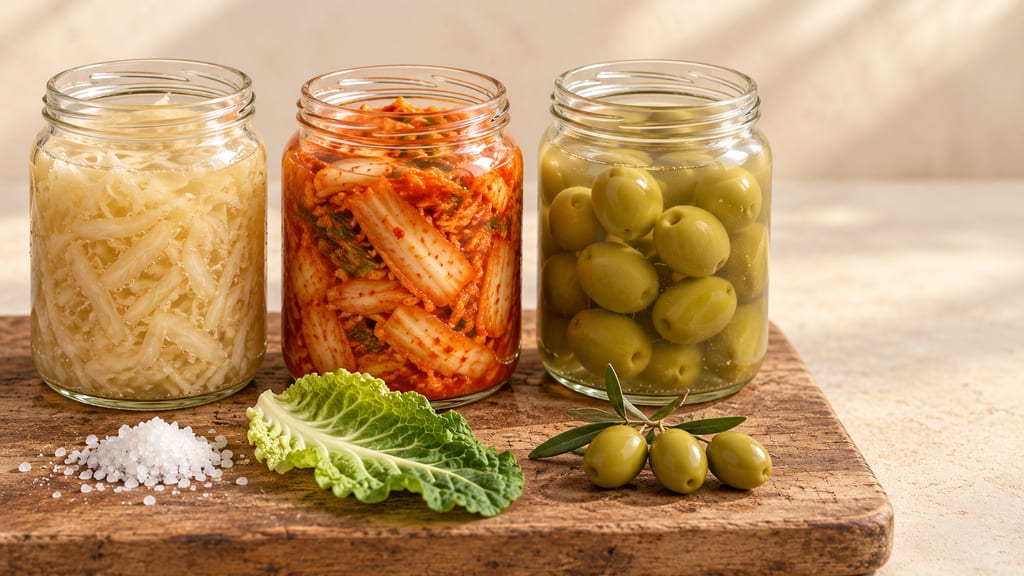
Cabbage, kimchi and olives, three vegetables that ferment on bacteria they already carry.
A ferment that starts itself
Pack shredded cabbage into a crock with salt, press it under its own brine and leave it. Nobody adds a culture or a spoonful from the last batch. The lactic acid bacteria that sour the cabbage arrive with the cabbage and its surroundings, and salt, temperature and the exclusion of surface air decide which of them win. The community is built anew from the raw vegetable each time. Kimchi vegetables ferment the same way, and so do olives in brine, where Lactobacillus does most of the work and Leuconostoc and Pediococcus play smaller parts.
Home instructions reflect this. The sauerkraut guide from the National Center for Home Food Preservation at the University of Georgia measures salt by the pound of cabbage and sets a room temperature for the ferment: at 21–24 °C the cabbage takes about three to four weeks, and at 16–18 °C about five to six. Below 16 °C it may not ferment, and above 24 °C it may go soft. The guide has no step for adding a starter.
So why would anyone add bacteria to a ferment that works without them? The answer changes with the vegetable, which is why "vegetable starter culture" names a question more than a product. The trials that exist cover kimchi and olives, and they are the subject of this article. The sauerkraut and cucumber communities are covered in their own articles.
What a starter is supposed to fix
Researchers at the World Institute of Kimchi describe starters as an alternative for the industrial production of standardised kimchi. Their reasoning is practical. Natural fermentation of unsterilised ingredients lets many kinds of lactic acid bacteria grow, and that makes the process hard to control and the quality hard to hold steady at industrial scale. They add that demand for starter cultures is rising.
A defined starter is a named strain, or a known blend of strains, added on purpose, so that the maker decides in advance who is in the tank. Its promise is a predictable result. Its price is proof. A species name does not say how a particular strain will behave in a particular vegetable process, so each strain has to be shown to work in each food.
Kimchi: backing the species already in front
Kimchi has a recognisable order of events. Leuconostoc mesenteroides is the main organism during the optimal ripening period at low temperatures, usually below 10 °C. Lactobacillus plantarum becomes the predominant species in the later stages, and above 10 °C it causes acidic deterioration. A kimchi starter therefore tends to strengthen a species that already leads the early ripening instead of introducing a stranger.
A 2012 Korean trial tested exactly that. Researchers made two kimchis, baechu from Chinese cabbage and chonggak from radish, each with and without Leuconostoc mesenteroides strain B1, and followed pH, cell numbers, bacterial community and metabolites for 40 days. In both kimchis the starter raised the share of Leuconostoc and lowered the share of Lactobacillus, and it kept Weissella at higher levels until the end. The inoculated kimchi used up its free sugars sooner, made slightly more lactic acid, acetic acid and mannitol, and finished fermenting earlier. These are directions of change reported for one strain in two kimchis, not a guarantee for other strains or recipes.
A 2020 study took the idea a step further and paired Leuconostoc mesenteroides with Lactobacillus sakei in model kimchi, held at 15 °C for 72 hours. With a high share of Leuconostoc mesenteroides, the model kimchi finished at pH 3.9 and contained 1393.11 mg of mannitol per 100 g.
The industry did not wait for the papers. Since 2004, a Leuconostoc mesenteroides strain called DRC, which the same review also names DRC0211, has served as a starter in the Korean kimchi industry. Even so, a defined starter changes speed and flavour without making all kimchi products interchangeable.
Olives: lye, brine and a long list of requirements
Olives are a harder case, because the fruit goes through chemistry before the bacteria arrive. In the Spanish style for green olives, the fruit is treated with sodium hydroxide, 1.8–2.5% (weight per volume) in one review's description, washed, and then put into brine at 8–10% salt. Then the fermentation takes over, and in treated and natural olives alike Lactobacillus leads it.
The same review sets out what a starter could offer: better texture and flavour, help against harmful organisms, and a more controlled process. It also explains why control matters. Botulism from olives is uncommon, but several cases of food-borne botulism have been linked to conserved olives, and the fungal toxin citrinin has occasionally been observed. A candidate strain has to survive freeze-drying, and the review stresses that this survival depends on the strain and must be tested. Enterococci are out: European Food Safety Authority advice in 2007 did not recommend them as starters. The review's advice is to validate a strain in the laboratory first and in the factory second.
From pilot plant to 16,000-litre vessel
A pilot-plant study of Manzanilla olives shows the first half of that advice working. Two Lactobacillus pentosus strains, TOMC LAB2 and TOMC LAB4, selected as potential probiotics, were added to the brine. The inoculated brines acidified and used up sugar, and the lactic acid bacteria peaked sooner than in the spontaneous control. At the end both strains were recovered at high frequencies, confirmed by RAPD-PCR, a DNA fingerprinting method. On the olive skin, yeasts reached about 6 log10 CFU per square centimetre and lactic acid bacteria about 7 log10, while Enterobacteriaceae, about 9 log10 at the start, fell below detection.
The factory is where things get complicated. A team from the Instituto de la Grasa (CSIC) and the olive company JOLCA in Seville tested TOMC-LAB2 over two seasons, 2011/12 and 2012/13, in about 150 tonnes of Manzanilla olives. Each 16,000-litre vessel held 9,856 kg of olives and 6,374 litres of brine. The olives were treated with 2.6% sodium hydroxide, a little above the 1.8–2.5% range given for the style, and the initial brine of 11% salt settled near 6% as the fruit and brine equilibrated. The team confirmed the strain by rep-PCR, a related fingerprinting method.
In vessels processed in September, the lactic acid bacteria in the brine fell sharply and had disappeared by about day 40. In olives processed in October the bacteria survived for more than 250 days. The strain's share of the isolates differed between vessels, and the published figures disagree: the abstract and the main table do not give the same numbers, so none is quoted here. Open vessels, the outdoor setting and wild microbiota are the suspected causes. The loss during storage in September vessels was unexpected, and the researchers were still investigating it.
What a kitchen can take from this
Set the three vegetables side by side and the pattern is plain. In kimchi, a starter reinforces a species already in the lead, and one strain has been reported in commercial use since 2004. In olives, strains selected in the laboratory worked in a pilot plant, and then behaved differently from vessel to vessel and season to season in a factory. In cabbage, the home process has no starter at all. The strain, the food, the salt level and the season each shape the result, and nothing read here supports one starter that suits every vegetable.
Cucumber pickles are the obvious next question, and the evidence gathered here does not answer it, because it holds no study of a defined cucumber starter. What it does hold is a warning. Old pickle juice can be sour without being a suitable fresh inoculum, and juice from vinegar pickles or heat-processed jars may hold no useful living bacteria at all. The same limit applies to the rest of the vegetable shelf. The defined-starter evidence gathered here covers kimchi cabbage and radish and green olives, and no other vegetable.
Nor is there a household recipe. No source gives a household dose, an activation routine, a storage schedule or a response to contamination for a defined vegetable starter, so none is given here. Nothing tested whether a spoonful from one batch can carry a defined blend into the next. Anyone who wants to use a commercial starter needs a named culture, a process defined for that food, and the maker's own instructions.
Safety is the least settled part. No validated home endpoint or control was found for these starters. Smell, taste and bubbles do not show that a ferment is safe, and a single home measurement does not either. The question the research leaves open is narrower than the one it started with: not whether starters help vegetables, but whether this strain helps this vegetable, at this salt level, in this season.
Community
No community contributions have been published for this entry yet.
Share what you made
Sign in to contribute. Published comments and photos are free to read.
Sources
International Journal of Food Microbiology / PubMed
Effects of Leuconostoc mesenteroides starter cultures on microbial communities and metabolites during kimchi fermentationCited in: Kimchi: backing the species already in front
Food Microbiology / PubMed
Production of potential probiotic Spanish-style green table olives at pilot plant scale using multifunctional startersCited in: From pilot plant to 16,000-litre vessel
Frontiers in Microbiology
Microbiota of table olive fermentations and criteria of selection for their use as startersCited in: A ferment that starts itself; Olives: lye, brine and a long list of requirements; What a kitchen can take from this
Journal of Microbiology and Biotechnology
Starter Cultures for Kimchi FermentationCited in: What a starter is supposed to fix; Kimchi: backing the species already in front; What a kitchen can take from this
Frontiers in Microbiology
Assessing the challenges in the application of potential probiotic lactic acid bacteria in the large-scale fermentation of Spanish-style table olivesCited in: From pilot plant to 16,000-litre vessel; What a kitchen can take from this
National Center for Home Food Preservation, University of Georgia
SauerkrautCited in: A ferment that starts itself
Food Research International / AGRIS
Effects of combining two lactic acid bacteria as a starter culture on model kimchi fermentationCited in: Kimchi: backing the species already in front
Gaps
- Defined-starter trials in sauerkraut and cucumbers were not available to read, and the kimchi results come from abstracts without full figures.
- How much of the olive brine the starter held in each factory vessel is unresolved, because the abstract and the main table of the factory paper disagree.
- No source gives a household dose, activation routine, storage schedule or safety endpoint for a defined vegetable starter.
Updated 2026-10-29