
Starter cultures
Cabbage, salt and a crowd that assembles itself
Studies of sauerkraut, from a commercial batch near Providence to household jars in Dalian, find lactic acid bacteria assembling in the brine. They do not agree on who leads, or in what order.
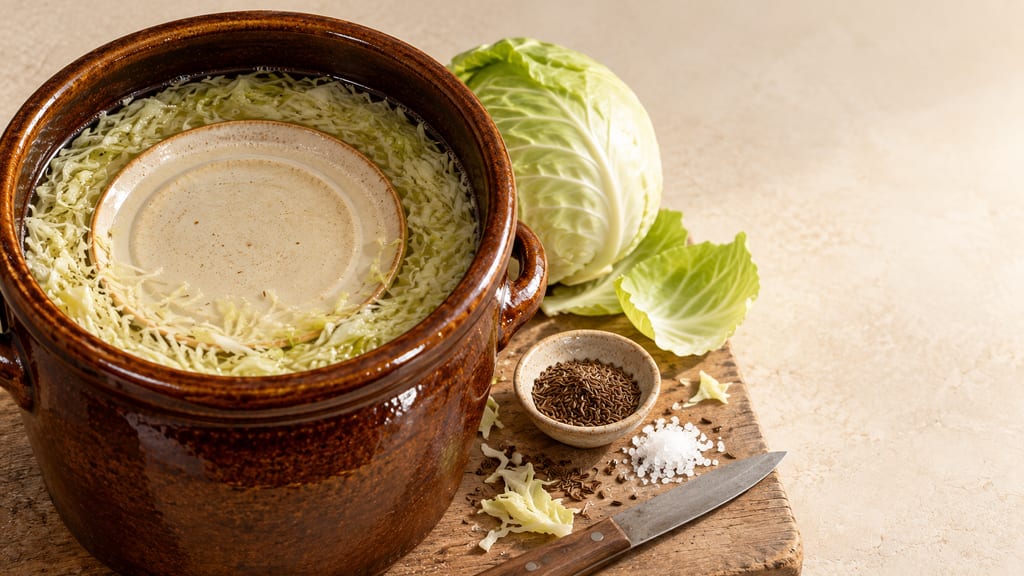
A glazed crock of salted shredded cabbage, with a whole cabbage, coarse salt and caraway beside it.
Fourteen days in a plastic drum
In June 2017, at a facility near Providence, Rhode Island, a 50 lb batch of shredded cabbage was mixed with 2.25% salt and caraway at under 1% by weight, then packed into airtight plastic drums. The ferment ran at about 21 °C. Researchers at Brown University took samples on days 0, 2, 7, 10 and 14, sequenced the bacterial DNA in each, and compared them with samples of the raw ingredients. They counted the batch a success if its pH ended below 3.6.
The answer came early. By day 2 the most abundant bacteria belonged to the Lactobacillales, the order that holds the lactic acid bacteria. Across the two weeks, two genera dominated: Leuconostoc and Lactobacillus. The sample taken on day 0 already looked far more like the finished day-14 kraut than like the raw ingredients. The community that would sour the cabbage was in the drum almost from the start, and it held.
The limits are plain. All the triplicate samples came from the same batch, so they repeat the measurement of one drum; they are not independent batches. Taste, texture and nutrition were not measured. The result describes one factory run with real precision, and says little beyond it.
The textbook relay
Food microbiologists have a standard account of what happens in a kraut ferment, and it runs like a relay. Packed cabbage starts in a brine at pH 5.9–6.5, with aerobic bacteria from the leaves in the majority. Those decline after packing. Leuconostoc, mainly Leuconostoc mesenteroides and Leuconostoc fallax, runs the first leg: its numbers can climb to 100 million cells per millilitre of brine within 12 to 14 hours.
Leuconostoc is heterofermentative, which means it makes carbon dioxide and other products along with lactic acid. The pH starts to fall after two to three days, and lactic acid is usually still below 1% at the end of the first week. In the second week homofermentative lactobacilli, which make mostly lactic acid, take over, above all Lactobacillus plantarum.
Acid keeps building. At 1.5–2% lactic acid the brine sits at pH 3.8–4.1. After four weeks or more it can reach 2.5% acid and a pH as low as 3.4. The Providence drums fit the outline: Leuconostoc and Lactobacillus led.
What salt and cold decide
Two settings steer the relay. The first is salt. The workable range runs from 0.7% to 3% by weight, and 2.25% is the optimum. Start above 3.5% and Leuconostoc is held back at the beginning. Too much salt gives a pink kraut; too little gives a soft one. The Providence batch sat exactly on the optimum.
The 2.0–2.25% range comes with a short list of other conditions: uniform salting, tight packing, air excluded and a ferment at 18 °C. Later researchers trace that list to a 1969 bulletin by Pederson and Albury at the New York State Agricultural Experiment Station in Geneva. Salt does a second job too. It draws water out of the cabbage, and more than a quarter of the cabbage’s weight ends up as the brine in which the whole relay runs.
The second setting is temperature, which sets the pace. A BC Centre for Disease Control document says to avoid anything above 25 °C or below 10 °C, because both favour spoilage organisms. The home schedule from the National Center for Home Food Preservation is more specific: about three to four weeks at 21–24 °C and five to six weeks at 16–18 °C. Below 16 °C the kraut may not ferment; above 24 °C it may turn soft. Its recipe salts each 5 lb of cabbage with 3 tablespoons of canning or pickling salt.
Why most producers skip the starter
If the relay needs particular bacteria, why not add them? Pederson and Albury asked that question decades ago and concluded that inoculating a batch made under those conditions would give no substantial benefit. In the United States, commercial kraut is typically fermented by the cabbage’s own lactic acid bacteria, without an added starter culture. The Providence paper does not say whether that factory added one, so the absence of a starter there is an inference, not a finding.
A starter can also meet an enemy. Researchers sampling two commercial fermentations of 90 tons each isolated nine bacteriophages, the viruses that infect bacteria. They attacked chosen strains of Leuconostoc mesenteroides and Lactobacillus plantarum, including a starter culture. A defined strain that phage can attack is one practical argument against relying on it.
There is one case where a starter earns its place. In a 2007 trial, cabbage was fermented at 0.5, 1.0 and 2.0% salt, with or without Leuconostoc mesenteroides added at a million cells per gram, and stored for ten months at 18 °C. With the starter, the kraut stayed firm and had fewer off-flavours at every salt level. Without it, softening and off-flavours grew as the salt fell. The starter made a 50% cut in salt possible.
The BC Centre for Disease Control document contradicts itself on the subject. One passage says that in commercial operations both starters and backslopping, the habit of adding a portion of an earlier batch, may be used. A box a few pages on says commercial starter cultures are not typically used in sauerkraut production. The two statements cannot both stand as a flat rule, and neither comes with a survey of producers.
When the relay breaks
The textbook order is a summary of many batches, and recent studies show how far single batches can stray. In Val di Gresta, in Trentino, Italy, researchers followed spontaneously fermented organic sauerkraut from two artisanal producers, in five 500 kg tanks each. Salt was about 3%. Temperature was logged but not controlled. After 35 days, Lactiplantibacillus, the genus where Lactobacillus plantarum now sits, averaged 56% of the bacteria at one producer and 48% at the other, with margins of 15 and 13 points. Leuconostoc averaged 29% at the first producer and 8% at the second. The pH fell from 5.7 on day 1 to 3.8 and 4.0 on day 7, then to 3.5 and 3.6 on day 35. Two craft producers, one method, and a gap of more than threefold in Leuconostoc.
In Dalian, in north-eastern China, researchers took 72 samples over 30 days from sauerkraut that three households made spontaneously. Leuconostoc did not lead the early days; Weissella did, and it stayed dominant until the ferment was done. It peaked at 63% on day 3 in one jar, 75% on day 3 in another and 75% on day 7 in the third. By day 30 Lactobacillus held 17%, 4% and 31% of the community, and Leuconostoc 1%, 5% and 5%. The salt and temperature of these jars were not reported, and the researchers point to the uncontrolled environmental conditions of homemade kraut.
These results do not stack into one story. A factory drum at 21 °C, an Italian cellar at the season’s temperature and three kitchens with unreported salt and temperature are different experiments. The Weissella-led jars contradict the Leuconostoc-then-Lactobacillus relay as a rule for every jar; they do not prove it never happens. Nothing in these sources compares how the jars tasted or kept.
An old food with a thin paper trail
Where sauerkraut began is less settled than how it ferments. The BC Centre for Disease Control traces it to the first century AD and says it gained prominence in 1775, when Captain James Cook acclaimed it as protection against scurvy. The Providence paper opens by linking it with Central and Eastern European cultures and with Western European cooking, and says it goes back to the Roman Empire, with no citation for that last claim. It credits winter use to earlier reviews, and it describes United States use as a cooking ingredient, a side dish or a condiment.
All of this is background in review texts. No early record of the first batch was inspected, and no verified source documents the Central European tradition or the route the food took. Treat the first-century date and the Cook story as the way the food is told, not as dates a document establishes.
What the home jar is doing
The home method from the National Center for Home Food Preservation does not try to keep or pass on a culture. It uses 25 lb of cabbage and three-quarters of a cup of canning or pickling salt, and makes about 9 quarts. The cabbage is salted and packed until its own juice covers it. The method calls for 1 gallon of container for each 5 lb of vegetables. Plastic and glass both work as substitutes for a stone crock. A plate slightly smaller than the opening, weighted, keeps the cabbage 1 to 2 inches under the brine. A sealed bag filled with 3 quarts of water and 4½ tablespoons of salt can serve as the weight; garbage bags and trash liners are ruled out. Mason jars are accepted, though they may lead to more spoilage.
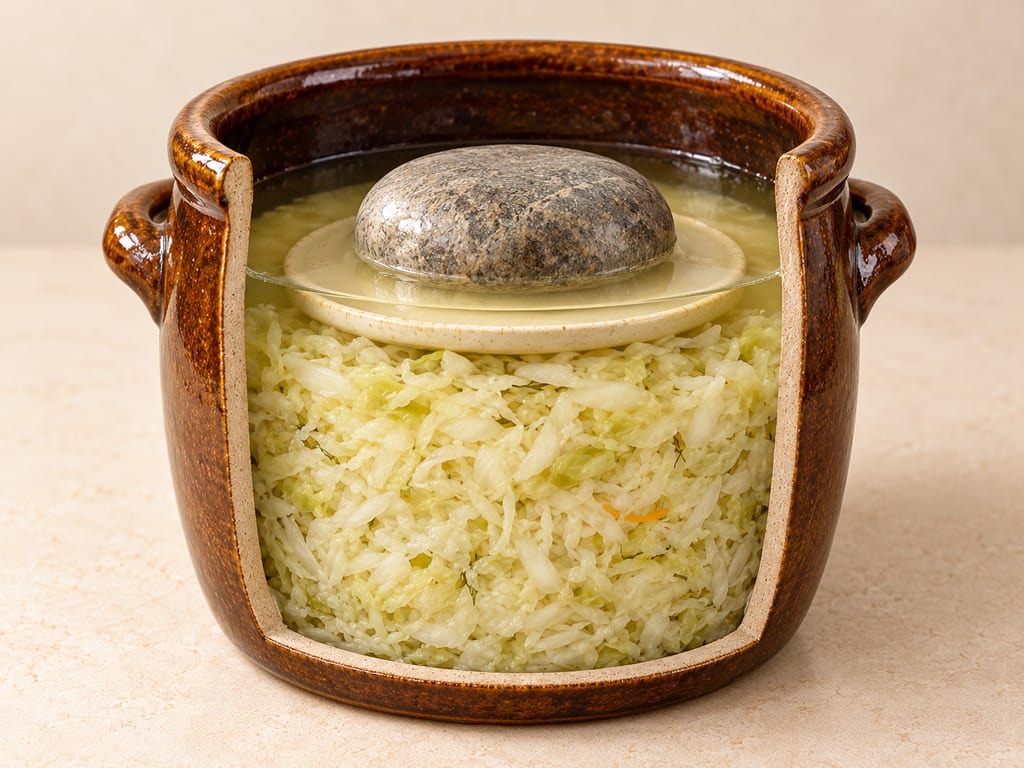
The method asks the cook to check a jar and weight two or three times a week and skim off any scum. A crock weighted with a brine bag is left alone until normal fermentation is complete, which the method defines as the point where bubbling stops. That is the method’s own endpoint for the ferment. It does not show that a batch is safe, and the time ranges above describe how long the method takes, not a safety deadline. Finished kraut keeps tightly covered in the refrigerator for several months.
The BC Centre for Disease Control document looks at risk from the other side. Its search of outbreak databases, run on 7 February 2022, found no foodborne illness or outbreak linked to sauerkraut, and a United States review it cites calls sauerkraut rarely reported as a food vehicle, with no pathogens identified to date. Recalls have mostly been for physical hazards: glass in 2001 and 2011, and metal in a pouched product in Luxembourg in 2021. No reports of illness from biogenic amines turned up. A clean search is still not a guarantee for a particular jar, and the document is written for professionals, not as a home recipe.
A community, not a culture
A jar of sauerkraut is not a strain you can keep, label and hand on. It is a population that assembles itself in a brine shaped by salt and temperature. Two craft producers following one method end up with different proportions. Three kitchens in one Chinese city end up led by a genus missing from the textbook relay. A starter can rescue a reduced-salt batch, but it adds a strain that phage may attack, and Pederson and Albury found it of no substantial benefit at normal salt.
What a cook controls is short: the salt, the temperature, and keeping the cabbage under the brine. What remains open is longer. No one has shown why household jars lean towards Weissella in one kitchen and Leuconostoc in another, whether it changes the taste, or what pH a home batch should reach before it counts as finished. The earliest history of the food is just as open.
Community
No community contributions have been published for this entry yet.
Share what you made
Sign in to contribute. Published comments and photos are free to read.
Sources
Foods (MDPI), via PubMed Central
Microbial Community Analysis of Sauerkraut Fermentation Reveals a Stable and Rapidly Established CommunityCited in: Fourteen days in a plastic drum; The textbook relay; Why most producers skip the starter; An old food with a thin paper trail; A community, not a culture
National Center for Home Food Preservation
SauerkrautCited in: What salt and cold decide; What the home jar is doing
National Center for Home Food Preservation
Suitable containers, covers and weights for fermenting foodCited in: What the home jar is doing
BC Centre for Disease Control
Safety of Fermented Foods, Section 3.2 Sauerkraut (December 2024)Cited in: The textbook relay; What salt and cold decide; Why most producers skip the starter; An old food with a thin paper trail; What the home jar is doing
Journal of Food Science
Effects of Leuconostoc mesenteroides Starter Culture on Fermentation of Cabbage with Reduced Salt ConcentrationsCited in: The textbook relay; What salt and cold decide; Why most producers skip the starter; A community, not a culture
Applied and Environmental Microbiology
Isolation and Characterization of Bacteriophages from Fermenting SauerkrautCited in: Why most producers skip the starter
Frontiers in Microbiology
Microbial and metabolic characterization of organic artisanal sauerkraut fermentation and study of gut health-promoting properties of sauerkraut brineCited in: When the relay breaks; A community, not a culture
Frontiers in Microbiology
Microbial Community Dynamics and Metabolome Changes During Spontaneous Fermentation of Northeast Sauerkraut From Different HouseholdsCited in: When the relay breaks; A community, not a culture
Gaps
- No primary or museum source for sauerkraut's early history in Central Europe is established; the first-century and 1775 dates rest on a review.
- The salt and temperature of the Dalian jars were not reported, and no study here compares how Weissella-led and Leuconostoc-led jars taste or keep.
- No pH or acidity target for a home batch is established.
Updated 2026-10-29