
Starter cultures
No starter in the tank: what turns a cucumber into a pickle
Commercial pickle tanks are open to the sky and have no culture poured in. Research on them, and on home and Polish village methods, shows a changing crowd of bacteria, vinegar in the brine and a gas problem called bloating.
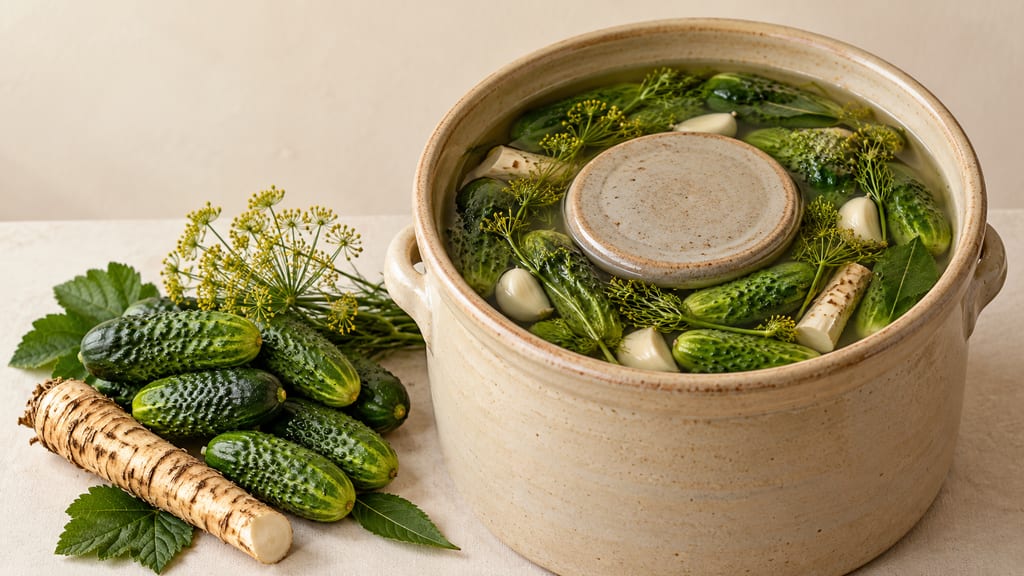
An illustration of small cucumbers packed in brine with dill, garlic, horseradish and fruit-tree leaves, the aromatics named in a Polish regional method.
A tank with no lid
A commercial cucumber fermentation, as the USDA researchers who study them describe it, happens in a white fibreglass tank that holds 28,000 to 40,000 L. The tank is open at the top and stands outdoors. Cucumbers fill roughly half of it or a little more, and a salt brine of about 6% (1.04 M) covers them. Nothing seals the tank off from its surroundings.
The open top is deliberate. Sunlight's ultraviolet light reduces or prevents yeast growth on the surface, which is why the tanks are kept uncovered and outdoors. Pumping air through the brine, which some operators do, has a cost of its own: it can encourage oxidative yeasts, and these consume lactic acid, the acid the whole process exists to make.
That raises the question this article follows. What lives in a pickle tank or a pickle jar, where did it come from, and does anything get handed on from one batch to the next? The answer from the research is a shifting crowd of lactic acid bacteria whose makeup depends on the brine, the vinegar and the air, and no single starter culture that every cucumber pickle shares.
Fermented, or only sour?
The word pickle covers two different foods. In a fermented pickle, cucumbers sit in salt brine and bacteria make the acid. Regular dills and sauerkraut are fermented and cured for about three weeks; refrigerator dills take about a week. A fresh-pack pickle skips that: fresh cucumbers are acidified in a bath of 0.5 to 1.1% acetic acid, the acid in vinegar, and nothing needs to ferment.
Vinegar does not sort one from the other, because fermented pickles use it too. The fermented dill recipe from the National Center for Home Food Preservation puts 1/4 cup of 5% vinegar into each gallon batch, along with 1/2 cup of salt and 8 cups of water. Commercial tanks do the same on a larger scale: modern cover brine contains acetic acid, added as concentrated vinegar.
How much acetic acid depends on which paper you read. The USDA team's tank study gives 25 mM (millimoles per litre) for the equilibrated cover brine in its introduction. Its methods describe adding 15 mM to the second tank, and the fresh brine of that tank measured 22.2 ± 1.7 mM. A 2020 paper by Zhai and Pérez-Díaz puts the figure at about 14 mM. Each figure belongs to its own paper and its own tank, and none is a general rule.
What separates a fermented pickle from a vinegar pickle is where most of the acid comes from. In a fermented pickle the bacteria make it from the cucumbers' own carbohydrates.
Who does the souring
Microbiologists have been looking into cucumber tanks for a long time. Studies began in 1899, and by the 1940s Lactobacillus plantarum had become the first lactic acid bacterium linked to cucumber fermentation. Wooden vessels of that era gave way to fibreglass tanks. In 2017 a USDA team reassessed which bacteria take over as the fermentation proceeds, and what lets the winners dominate.
The team followed two tanks of 28,400 to 37,854 L, with air pumped through the brine for 21 days, 20 hours on and 4 hours off. Samples were plated, their DNA sequenced, and the brine analysed for organic acids and sugars. Six more tanks were sampled at the peak of fermentation for molecular identification. The Lactobacillales prevailed, in this order of prevalence: Lactobacillus pentosus, Lactobacillus plantarum, Lactobacillus brevis, Weissella species, Pediococcus ethanolidurans, Leuconostoc species and Lactococcus species.
The two tanks started differently. One was filled with recycled brine and began at pH 4.39 ± 0.01. The other was made with vinegar and began at a more acidic pH 3.70 ± 0.02. The recycled-brine tank went on to produce 61.9 ± 9.3 mM lactic acid from the cucumbers' carbohydrates, the vinegar tank 48.5 ± 2.9 mM. Leuconostoc turned up in the vinegar tank. P. ethanolidurans was the main pediococcus in both tanks, at a lower density than the lactobacilli.
A separate tank in the same study was given a Pediococcus pentosaceus starter. All of these are commercial systems with large volumes, purged air and, in one case, added vinegar, and they say little about a crock in a kitchen.
Gas inside the cucumber
One defect the industry works to prevent is the bloater: a cucumber with gas pockets inside it, lesions that look like honeycomb, lenses or balloons. The gas is carbon dioxide. It can come from heterofermentative lactic acid bacteria, from fermentative yeasts, and from homofermentative bacteria such as Lactobacillus plantarum that break down the malic acid in the cucumber and release carbon dioxide.
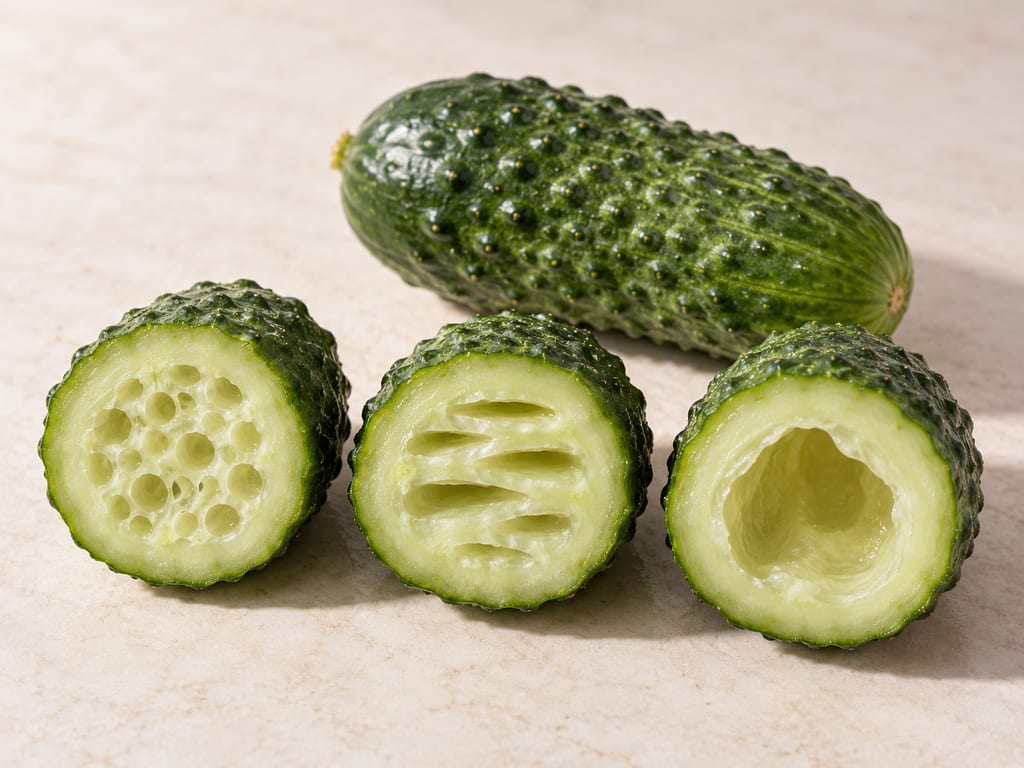
This is where the choice of bacteria stops being academic. A lactic-only fermentation reduces carbon dioxide production, and the USDA tank paper argues that this is why the pediococci it found are useful against bloating. Operators also prevent bloaters by pumping air or nitrogen through the brine, and the tank study describes air purging being used together with vinegar. Purging has its own risk: it may soften the fruit through mould growth.
Leuconostocaceae, the bacterial family that includes Leuconostoc, make a lot of gas. In cucumber juice at 30 °C they produced over 40% carbon dioxide. Whether they cause bloaters in practice is more subtle. In a 2020 jar experiment with brine containing 25 mM calcium chloride and 6 mM sorbate, adding Leuconostocaceae made no significant difference to the bloater defect. In a second set of jars with the pH set to 5.9 ± 0.4 and a Leuconostoc lactis starter, carbon dioxide reached 13.6 ± 3.5% and the bloater index 21.3 ± 6.4, against 8.6 ± 0.8% and 5.2 ± 5.9 in the controls. The bloater index scores how many internal injuries a cucumber has and how severe they are.
The conclusion is a careful one. Leuconostocaceae can produce enough carbon dioxide to contribute to the defect if the leading lactic acid bacteria do not outcompete them. Whether they do depends on how quickly the leading bacteria get ahead.
Soft, scummy and spoiled
Gas is one fault. Softening is another. The enzymes responsible are polygalacturonases, which break down the pectin that holds cucumber tissue together; mould brought in on cucumber flowers can supply them. Salt helps prevent the tissue from softening and helps rupture the fruit membranes, and calcium chloride can slow the enzymatic softening. Because commercial brines are usually recycled, they are assayed for polygalacturonase before reuse and, if necessary, treated with a protein-adsorbing clay.
Surface growth is the third. A heavy scum of yeast or mould usually follows neglect of brined material in extended storage.
Looking and smelling cannot settle whether a pickle is safe. For home pickles the guidance from the National Center for Home Food Preservation is blunt: discard pickles that are soft, slimy or smell unpleasant. A pickle that looks and smells normal has not been shown to be safe by that fact alone.
Salt, temperature and the home crock
Home and village methods differ from the tank in nearly every number. The FAO's survey of fermented vegetables places cucumber pickles in Africa, Asia and Latin America and names khalpi as a summer cucumber pickle of Nepal. For the traditional method it gives 1 kg of salt to 20 kg of small cucumbers or 15 kg of large ones. The salt draws water out of the cucumbers, so a brine forms within 24 hours by osmosis, and the fermentation lasts one to four weeks depending on the ambient temperature.
Salt levels cover a wide range. Traditional processes used up to 17% sodium chloride, the modern commercial tank uses about 6%, and a survey of United States commercial brine stocks found 6 to 10%. Work from 1950 found that Leuconostoc prevail at 7 to 10 °C with 2.5 to 3.75% salt, which shows that temperature and salt together shape which bacteria start the fermentation.
The dill pickle recipe from the National Center for Home Food Preservation is the household counterpart of the commercial tank. It makes a one-gallon batch from 4 lb of small pickling cucumbers, dill, salt, vinegar and water. A weight keeps the cucumbers under the brine. The recipe gives two schedules: about 3 to 4 weeks at 21–24 °C, or 5 to 6 weeks at 13–18 °C, and it says to avoid temperatures above 27 °C. Those figures belong to that recipe. They are not a general schedule for all cucumber ferments.
The container matters more than it seems. Stone crocks and food-grade plastic or glass vessels are suitable. A container that is not food-grade has to be lined with a food-grade bag, and a trash bag is never acceptable.
Refrigerated half-sours are a different case. These brined cucumbers are held in barrels for a few days or longer at room temperature and then refrigerated at 2 to 5 °C, and their low salt makes them prone to softening. A brine pH of 4.6 cannot be ensured in retail jars of this kind of pickle.
A Polish cucumber on the national list
Poland's agriculture ministry lists Skalbmierskie ogórki kiszone, a soured-cucumber product, on its national list of traditional products. It was entered on 14 January 2014 under vegetables and fruit for the Świętokrzyskie region. The cucumbers are elongated and boat-shaped, 5 to 10 cm long, firm and sour, with a smell of dill and garlic.
The method, recorded in an ethnographic interview, is a jar method. Jars are scalded. A dill umbel, horseradish root and currant and cherry leaves go in the bottom, the cucumbers are packed in tightly with three or four cloves of garlic, and cold salted water goes over them. The pickling recipe is dated to 1922. Earlier, the cucumbers went into oak barrels sealed with tar and sunk in a river or in water-filled ditches for the winter. Today they are kept in jars or plastic barrels in cool cellars.
The entry gives no amount of salt, no number of days and no temperature. The method cannot be compared with the NCHFP recipe or the FAO salt ratio figure for figure.
What is handed on
So is there a cucumber-pickle starter? Not in the sense that kefir grains or a sourdough culture is one. The tanks and jars described here are steered by salt, acid, temperature and air, and nothing in the research presents a culture carried from one batch to the next as part of the method. Commercial brines are usually recycled, but the research examined here treats that as a matter of controlling enzymes and does not show recycled brine working as a culture. Sour juice from a finished household jar has not been shown to carry a useful living culture either.
For a reader making pickles at home, the practical lessons are modest. Keep the cucumbers under the brine. Follow a published recipe's salt, vinegar and temperature as a set. Discard anything soft, slimy or unpleasant in smell. What no source settles is how the community of a village crock, a Polish cellar jar or a Nepalese khalpi compares with the tanks that scientists have counted.
Community
No community contributions have been published for this entry yet.
Share what you made
Sign in to contribute. Published comments and photos are free to read.
Sources
Food and Agriculture Organization of the United Nations
Fermented Fruits and Vegetables: A Global PerspectiveCited in: Salt, temperature and the home crock
Food Microbiology 63: 217–227 (2017), Pérez-Díaz et al.; USDA Agricultural Research Service
Reassessment of the succession of lactic acid bacteria in commercial cucumber fermentations and physiological and genomic features associated with their dominanceCited in: A tank with no lid; Fermented, or only sour?; Who does the souring; Gas inside the cucumber; Salt, temperature and the home crock; What is handed on
National Center for Home Food Preservation
General information on picklingCited in: Fermented, or only sour?
National Center for Home Food Preservation
Dill picklesCited in: Fermented, or only sour?; Soft, scummy and spoiled; Salt, temperature and the home crock; What is handed on
National Center for Home Food Preservation
Suitable containers, covers and weights for fermenting foodCited in: Salt, temperature and the home crock
APHA Press, 2013; USDA Agricultural Research Service copy
Fermented and Acidified Vegetables (Chapter 51, Compendium of Methods for the Microbiological Examination of Foods)Cited in: A tank with no lid; Fermented, or only sour?; Gas inside the cucumber; Soft, scummy and spoiled; Salt, temperature and the home crock; What is handed on
Food Microbiology 91: 103536 (2020), Zhai and Pérez-Díaz
Contribution of Leuconostocaceae to CO2-mediated bloater defect in cucumber fermentationCited in: A tank with no lid; Fermented, or only sour?; Gas inside the cucumber
Ministerstwo Rolnictwa i Rozwoju Wsi (gov.pl)
Skalbmierskie ogórki kiszoneCited in: A Polish cucumber on the national list
Gaps
- The Polish entry gives no salt, time or temperature, and regional methods such as khalpi are not established as complete processes.
- No evidence shows that sour brine from a finished household jar works as a starter for the next batch.
Updated 2026-10-29